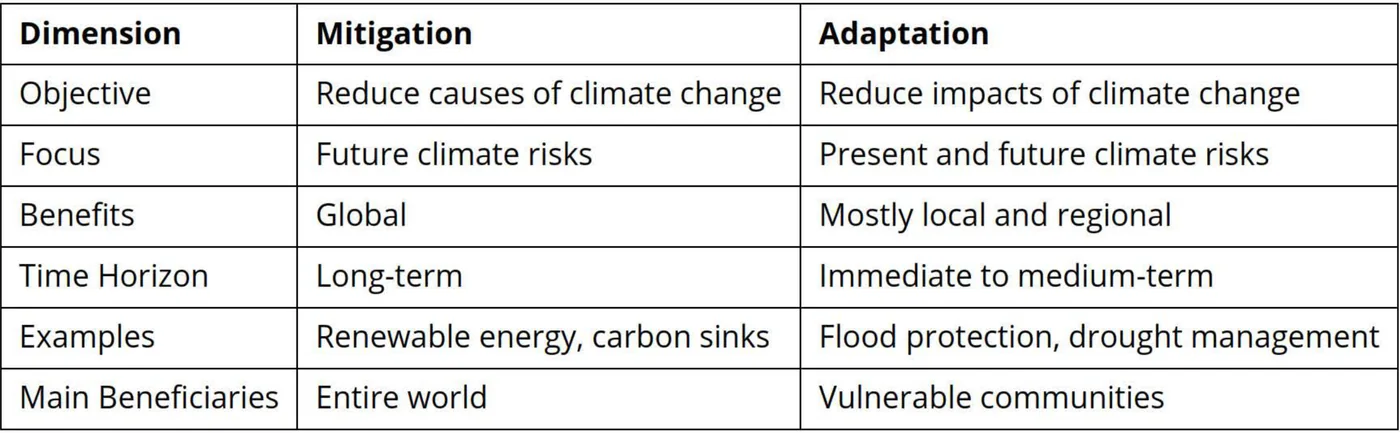
The Loss and Damage Fund (LDF) — agreed at COP27 Sharm el-Sheikh (2022) and operationalised at COP28 Dubai (2023) — is the third pillar of climate action, alongside mitigation and adaptation. For decades, vulnerable developing nations demanded compensation for irreversible climate harms already occurring. The LDF is the first dedicated multilateral fund to address those harms. For UPSC, it is a flagship current-affairs topic that recurs across GS-III climate questions.
What is "Loss and Damage"?
| Year | Development | Significance |
|---|---|---|
| 1991 | Vanuatu (AOSIS) proposed an international insurance mechanism | First formal demand for compensation |
| 2013 | Warsaw International Mechanism (WIM) | Recognition of Loss & Damage as a separate issue |
| 2015 | Paris Agreement (Article 8) | Formal recognition without creating liability or compensation obligations |
| COP27 (2022) | Decision to establish a Loss & Damage Fund | Historic political breakthrough |
| COP28 (2023) | Fund operationalised with initial pledges | Shift from recognition to implementation |
| COP29 onwards | Focus shifted to governance, funding sources and accessibility | Implementation remains the key challenge |
Definition
Loss and damage refers to the negative consequences of climate change that are beyond adaptation — the costs that communities bear from:
- Sea level rise eroding land (Tuvalu, Marshall Islands, Sundarbans).
- Hurricanes and cyclones intensified by warming.
- Prolonged heat waves and droughts.
- Desertification.
- Ocean acidification.
- Extreme events — bushfires, floods.
- Species extinction.
- Cultural and territorial loss.
Two categories
- Economic — infrastructure, property, agriculture, commerce.
- Non-economic — cultural heritage, biodiversity, human mobility, identity.
The concept sits on the premise that adaptation has limits — certain climate impacts cannot be adapted to and will generate permanent costs.
Scale of loss and damage
- A 55 vulnerable-country report estimated combined climate-linked losses over the last two decades at USD 525 billion, or 20% of their collective GDP.
- By 2030, annual loss and damage could reach USD 580 billion/year.
- By 2050, some estimates place annual loss and damage at USD 1-1.8 trillion.
Historical trajectory
Before COP27
- Warsaw International Mechanism (WIM, COP19, 2013) — first formal mechanism to address loss and damage.
- Paris Agreement Article 8 — acknowledges loss and damage but explicitly decoupled from liability and compensation (insisted by developed countries).
- Santiago Network (COP25, 2019) — for technical assistance to vulnerable developing countries.
- Glasgow Dialogue (COP26, 2021) — discussion on loss and damage finance.
COP27 Sharm el-Sheikh (2022) — breakthrough
- After decades of resistance, developed countries agreed in principle to establish a dedicated fund.
- Transitional Committee set up to design it.
COP28 Dubai (2023) — operationalisation
- On Day 1, Parties agreed to operationalise the LDF.
- World Bank as interim host for 4 years (developing countries preferred UN-led body but compromised).
- Board composition — majority from developing countries.
- Initial pledges: ~USD 700-800 million.
Pledges
| Contributor | Pledge (approx) |
|---|---|
| UAE | USD 100 million |
| Germany | USD 100 million |
| Italy | USD 109 million |
| France | USD 108 million |
| UK | USD 75 million |
| US | USD 17.5 million |
| Japan | USD 10 million |
| Others | ~USD 300 million |
Total USD 800 million is vastly below estimated needs (USD 400+ billion/year by 2030).
Merits of the LDF
Shift of focus
- Climate funding to date focused on mitigation (~60%) and adaptation (~30%); only ~10% or less for loss and damage.
- LDF institutionalises the "third pillar".
Climate justice
- Recognises that climate disasters cause damage beyond adaptation.
- Places vulnerability-based need alongside responsibility-based finance.
Urgency
- LDC and SIDS have long argued for this fund; operationalisation signals multilateral responsiveness.
Institutional innovation
- Fast-track World Bank hosting balances speed with multilateral access.
- Developing-country majority on board ensures vulnerable nations have voice.
Issues and criticisms
1. Scope ambiguity
- No consensus on what counts as "loss and damage caused by climate change" — attribution science still developing.
- Slow-onset events (sea level rise, ocean acidification) harder to quantify than single extreme events.
2. Who pays?
- Vulnerable nations and activists argue historical emitters (US, EU, Japan, UK, Australia) must pay given cumulative responsibility.
- US and EU initially resisted liability framing.
- EU argues China (world's 2nd largest economy) should also contribute — but China classified as developing under UN.
- Risk of responsibility shifting and deadlock.
3. Inadequate capitalisation
- Initial USD 800 million is <0.1% of annual loss and damage needs.
- No clear replenishment mechanism.
4. Governance — World Bank concerns
- Developing countries worry about borrower-style conditionalities.
- Prefer independent UN governance.
5. Access barriers
- Least-developed and small-island states face capacity constraints in accessing fund.
6. Overlap with existing funds
- Green Climate Fund, Adaptation Fund, Global Environment Facility already address partial loss and damage.
- Risk of fragmentation.
7. Private finance role unclear
- Most pledges are public; private and philanthropic roles underdefined.
India's position
- Supports the LDF firmly.
- Has not pledged money to it (not considered liable).
- Advocates that:
- L&D finance must be new and additional, not repurposed ODA.
- Historical emitters should bear primary responsibility.
- Finance should be grant-based, not loans.
- Attribution science should not be weaponised against developing countries.
- India's own losses — Kerala floods, Sikkim GLOF, Wayanad landslides — justify L&D access.
Related concepts
Forest Landscape Restoration (FLR)
A related approach stressed in climate recovery discussions. FLR is landscape-scale, forward-looking, and focuses on resilience:
- Landscape focus — not individual sites.
- Maintain/enhance natural ecosystems.
- Stakeholder engagement and participatory governance.
- Locally tailored approaches.
Santiago Network
- Provides technical assistance to vulnerable developing countries for loss and damage.
- Operationalised at COP27.
Latest developments (2024-26)
Updated context: verify with UNFCCC, World Bank, and MoEFCC releases.
- L&D Fund board — operational; Philippines elected host.
- Total pledges — crossed USD 1 billion in 2024.
- India positions — argues for scale-up through NCQG architecture.
- COP29 Baku — incremental progress; no new L&D pledges of significance.
- COP30 Belém (2025) — focus on L&D finance delivery and Tropical Forests Forever Facility linkage.
- Attribution science — rapid advances connecting specific extreme events to climate change.
- India's losses — Wayanad 2024 estimated at USD 1+ billion; strengthens case for access.
UPSC relevance
GS-III mapping
- Climate change, environment.
GS-II overlap
Prelims bullets
- LDF agreed at COP27 (2022), operationalised at COP28 (2023).
- World Bank — interim host for 4 years.
- Philippines — elected host of L&D Fund Board.
- Warsaw International Mechanism — COP19 (2013).
- Santiago Network — COP25 (2019), operationalised COP27.
- Paris Agreement Article 8 — loss and damage.
- Decoupled from liability/compensation under Paris.
Mains angles
- "Discuss the significance of the Loss and Damage Fund for vulnerable developing countries and India's position."
- "Loss and damage goes beyond adaptation. Explain with reference to UNFCCC negotiations."
- "Evaluate the scale gap between estimated loss and damage needs and current pledges."
Essay hooks
- Climate justice as the moral backbone of climate finance.
- The unfinished Paris Agreement — loss and damage.
- From responsibility to delivery in climate governance.
Quick revision
| Milestone | Year | Detail |
|---|---|---|
| Warsaw International Mechanism | 2013 | First formal L&D recognition |
| Paris Article 8 | 2015 | No liability/compensation |
| Santiago Network | 2019 | Technical assistance |
| L&D Fund agreed | COP27 (2022) | Breakthrough |
| L&D Fund operational | COP28 (2023) | WB host |
| Pledges | ~USD 800 m | 2023 start |
| L&D board host | Philippines | 2024 |
Bottom line for UPSC: the Loss and Damage Fund represents a moral victory for vulnerable developing countries — the first global multilateral acknowledgement that climate harm deserves compensation. Its scale remains grossly inadequate, and its governance contested. For India, it is a diplomatic lever and, increasingly, a practical need.
Tell Google you want more of this.
Add Anantam IAS as a preferred sourceOne tap, and this site shows up more often in your own Top Stories, AI Overviews and AI Mode. Remove it any time.