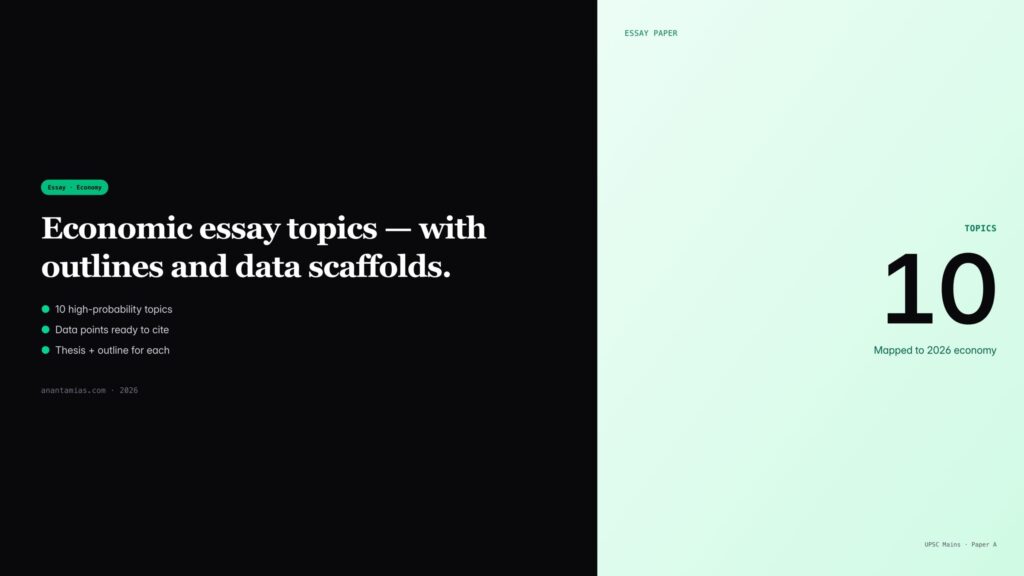
Economic essay topics reward data discipline. An essay on ‘Growth and equity’ that cites Gini coefficients, Oxfam’s latest report, and NFHS data beats one that recycles adjectives. This guide lists 10 likely topics, their one-line thesis, and the data points that make each essay bullet-proof.
1. Why Economic Topics Need a Data Scaffold
Economics is a moral discipline dressed in numbers. Without numbers, your argument is an opinion. With numbers, it is analysis. Carry 30 data points into the exam hall — inflation, growth, poverty, employment, trade, debt, demography.
2. Essential Data Points for 2026
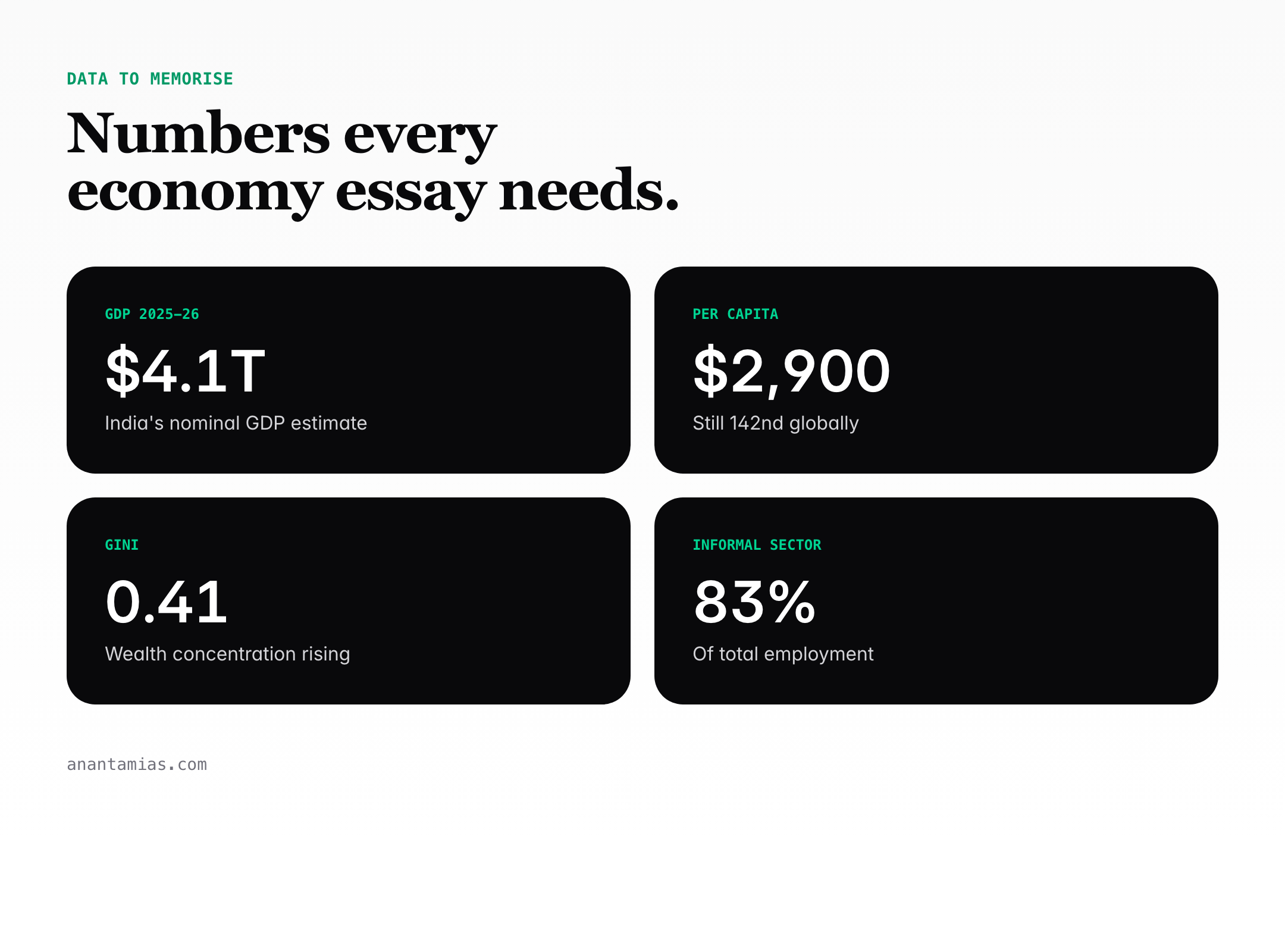
| Indicator | Value | Source |
|---|---|---|
| Real GDP growth (FY25) | 6.5% | NSO provisional |
| Inflation (CPI, Mar 25) | ~4.6% | MoSPI |
| Unemployment (PLFS, urban) | 6.6% | PLFS |
| Poverty (MPI 2024) | 14.96% (2019–21) | NITI Aayog |
| Gini (consumption, 2022–23) | ~0.28 | HCES |
| Tax-to-GDP | ~11.7% | Budget |
| Fiscal deficit (FY25 BE) | 4.9% of GDP | Union Budget |
| FDI inflows (FY24) | $70.9 bn | DPIIT |
3. Ten Economic Topics with Thesis Lines
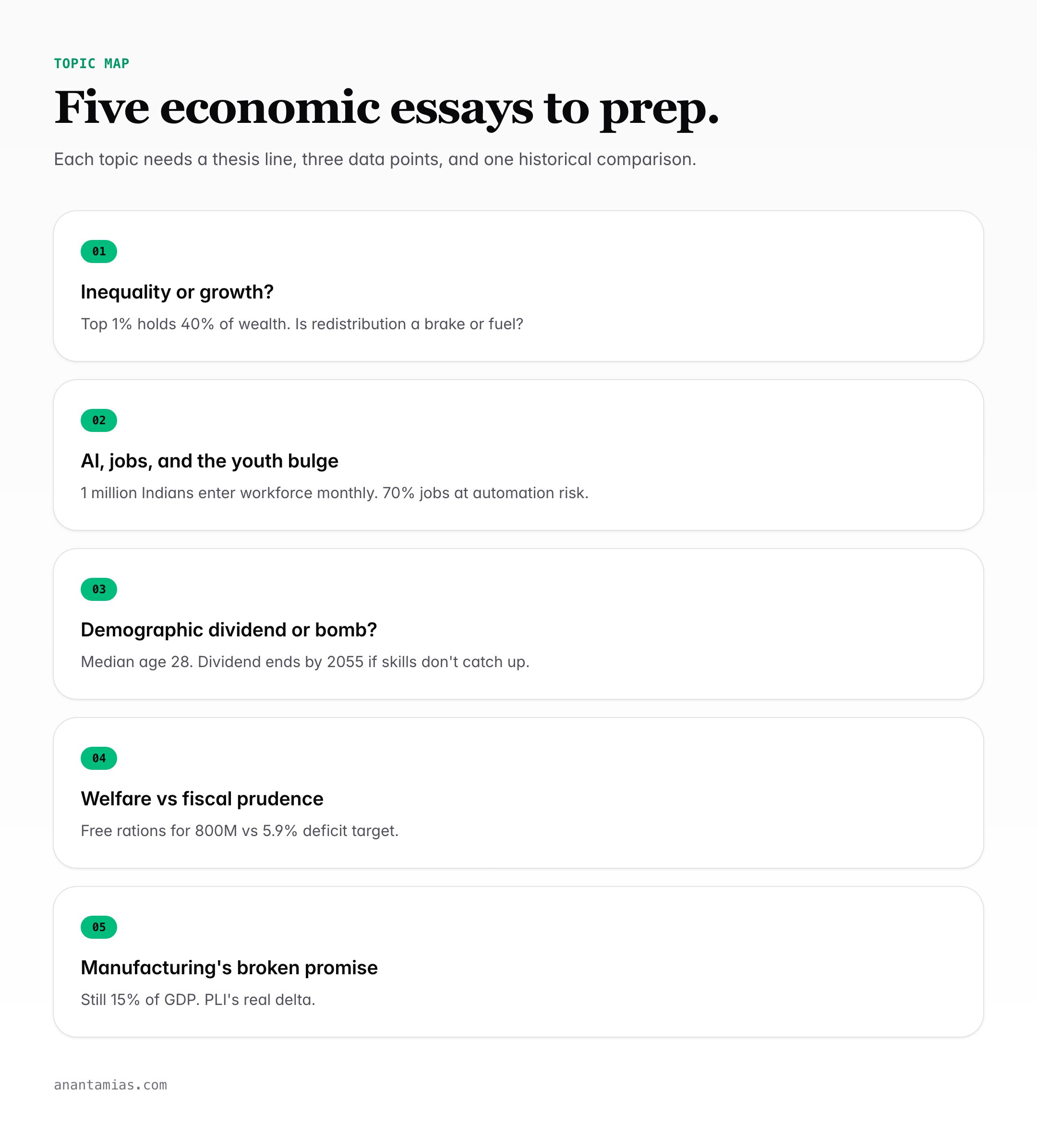
1. Growth without equity is statistically impressive, socially dangerous
Thesis: India’s aggregate growth masks a K-shaped recovery. Use Oxfam 2024, HCES 2023, Piketty’s ‘Income and Wealth Inequality in India 1922–2023’ (top 1% owns 40.1% of wealth).
2. Demographic dividend is a policy choice, not a gift
Thesis: Dividend is conditional on education, health, and jobs. Use ILO India Employment Report 2024 (83% of unemployed are youth), NEP 2020, Apprentices Act data.
3. Farm to firm: the unfinished migration
Thesis: 45% of workforce in agriculture contributes 18% of GDP. Use Situation Assessment Survey, PLFS sectoral share, Arvind Panagariya‘s ‘reforms 2.0’ argument.
4. Green growth: oxymoron or imperative?
Thesis: India needs $10 trillion by 2070 for net-zero (CEEW). PM-KUSUM, Green Credit Programme, PLI for solar.
5. Middle-income trap
Thesis: Growth slows at $10,000 per capita. India is at $2,700. Korea, Malaysia, Brazil lessons. Total factor productivity, R&D (0.65% of GDP) the bottleneck.
6. MSMEs — the forgotten engine
Thesis: 30% of GDP, 45% of exports, but starved of formal credit. Use Udyam registrations (5 cr+), TReDS flows, credit gap ₹25 lakh crore.
7. Cryptocurrencies and monetary sovereignty
Thesis: Regulate, don’t ban. Use RBI e-rupee pilot, BIS 2024 report, El Salvador’s experiment.
8. Informal work, formal aspirations
Thesis: 90% informal workforce is a development failure. Use e-Shram (30 cr registered), Code on Social Security 2020.
9. Women’s workforce participation
Thesis: India’s FLFPR rose to 37% (PLFS 2023–24) but remains below Bangladesh. Use time-use surveys, NFHS-5.
10. Cooperative federalism and fiscal space
Thesis: GST compensation end, 16th Finance Commission, horizontal devolution debates.
4. Standard Outline Template
- Hook: a paradox or a number
- Context: historical trajectory in 2 paragraphs
- Dimensions: growth, equity, employment, sustainability, governance
- Case studies: Indian + one global comparison
- Criticism: what the dominant narrative misses
- Way forward: 4 actionable ideas
- Conclusion: a Gandhian or Tagorean quote tying economics to humanism
5. Quotes to Anchor Economic Essays
Poverty is the worst form of violence.
— Mahatma Gandhi
Development is freedom.
— Amartya Sen
Growth is not the end of economic policy; well-being is.
— Joseph Stiglitz
6. Books to Read
- India’s Long Road — Vijay Joshi
- Poor Economics — Banerjee & Duflo
- Backstage — Montek Ahluwalia
- The White Tiger (fiction, for texture) — Aravind Adiga
- Economic Survey (latest)
7. Final Tip
Do not turn an essay into a GS-3 answer. Economics here is a lens on life, not a lecture.
Frequently Asked Questions
How much data is too much?
8–10 numbers per essay. More turns it into a GS answer and loses the literary register.
Should I memorise Economic Survey chapters?
Memorise 15 themes, not chapters. Treat the Survey as a quote bank.
Can I cite foreign economists?
Yes — Sen, Stiglitz, Banerjee, Piketty, Rajan are all fair game.
How do I avoid the GS trap?
Keep the tone humanistic. Each data point should point to a life, not a policy.
Tell Google you want more of this.
Add Anantam IAS as a preferred sourceOne tap, and this site shows up more often in your own Top Stories, AI Overviews and AI Mode. Remove it any time.