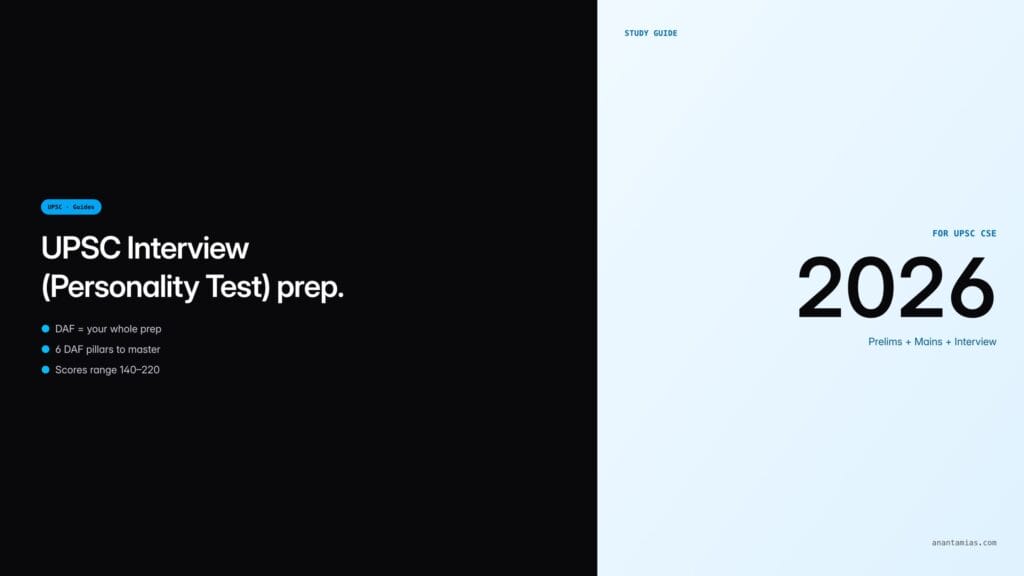
The UPSC Interview — officially the Personality Test — is 275 marks of conversation. Unlike Prelims and Mains, there is no syllabus, no textbook, no right answer. The Board is evaluating whether you have the temperament, judgment, and clarity expected of a civil servant. Here is how to prepare for it — without losing yourself in the process.
What the Interview Actually Tests
From the UPSC’s own notification, the Personality Test assesses: mental alertness, critical powers of assimilation, clear and logical exposition, balance of judgment, variety and depth of interest, ability for social cohesion and leadership, intellectual and moral integrity. Translated: can you think clearly, speak honestly, handle pressure, and disagree without being unpleasant.
The DAF: Your Most Important Document
The Detailed Application Form (DAF) is 70% of your interview. Every question can emerge from it — hometown, hobbies, education, work experience, optional subject, service preferences, cadre preferences. Before anything else:
- Print your DAF. Highlight every single word — place names, subjects, hobbies, achievements
- For each highlighted item, prepare 10–15 lines of depth
- Google each item — what news has been there about it recently?
- Identify vulnerable points (a hobby you don’t really practise, an achievement you exaggerated) and either strengthen them or be honest
The Six DAF Pillars
1. Hometown / District / State
Expect questions on history, geography, local politics, economic activity, tourism, recent news, famous personalities. Prepare a 1-page district profile.
2. Education Background
If you’re an engineer: basic technical questions from your branch are fair game. If you’re a commerce graduate: accounting basics, commerce subjects. Revisit 3–4 fundamental concepts from your degree.
3. Work Experience
Be prepared to explain your role, why you chose that company, why you’re leaving for civil services. Honesty wins here — every interviewer has heard ‘I want to serve society’ 500 times.
4. Hobbies
The most common trap. If you wrote ‘reading books’, be ready to name 3 books, 3 authors, compare two of them, and explain your takeaway. Adding 15 hobbies is a red flag. Two real hobbies are enough.
5. Optional Subject
You spent 500 hours on it. Know the foundational theorists, recent developments, and why you chose it. Members often test how well you can explain a core concept to a non-specialist.
6. Service and Cadre Preferences
Know your first 3 services deeply — roles, responsibilities, current challenges. For cadres, know geography, culture, current affairs of your top 3 states.
Current Affairs for Interview
Different from Mains. Interview current affairs focus on:
- Last 6 months’ major policy announcements
- Supreme Court landmark judgments
- India’s bilateral relations (especially neighbours and G20 partners)
- State of the economy: GDP, inflation, jobs, fiscal deficit — latest figures
- International conflicts and India’s position
- Budget and Economic Survey highlights
Mock Interviews: Absolutely Essential
Attend a minimum of 5 mock interviews across different institutes. Each mock panel spots different flaws. Common institutes: Vajiram, KSG, Samkalp, Chanakya, Byjus, RauIAS, Forum IAS. Free government-led mocks are also available via state academies in some states (like UPSC’s own ‘Samkalp’ for reserved category candidates).
Mock interviews are not about ‘performing well’. They’re about getting feedback on:
- Body language — sitting posture, hand movements, eye contact
- Filler words — ‘actually’, ‘basically’, ‘you know’
- Answer length — short, specific answers are rewarded
- Opinion-holding — the ability to disagree politely
The Seven Rules of Speaking
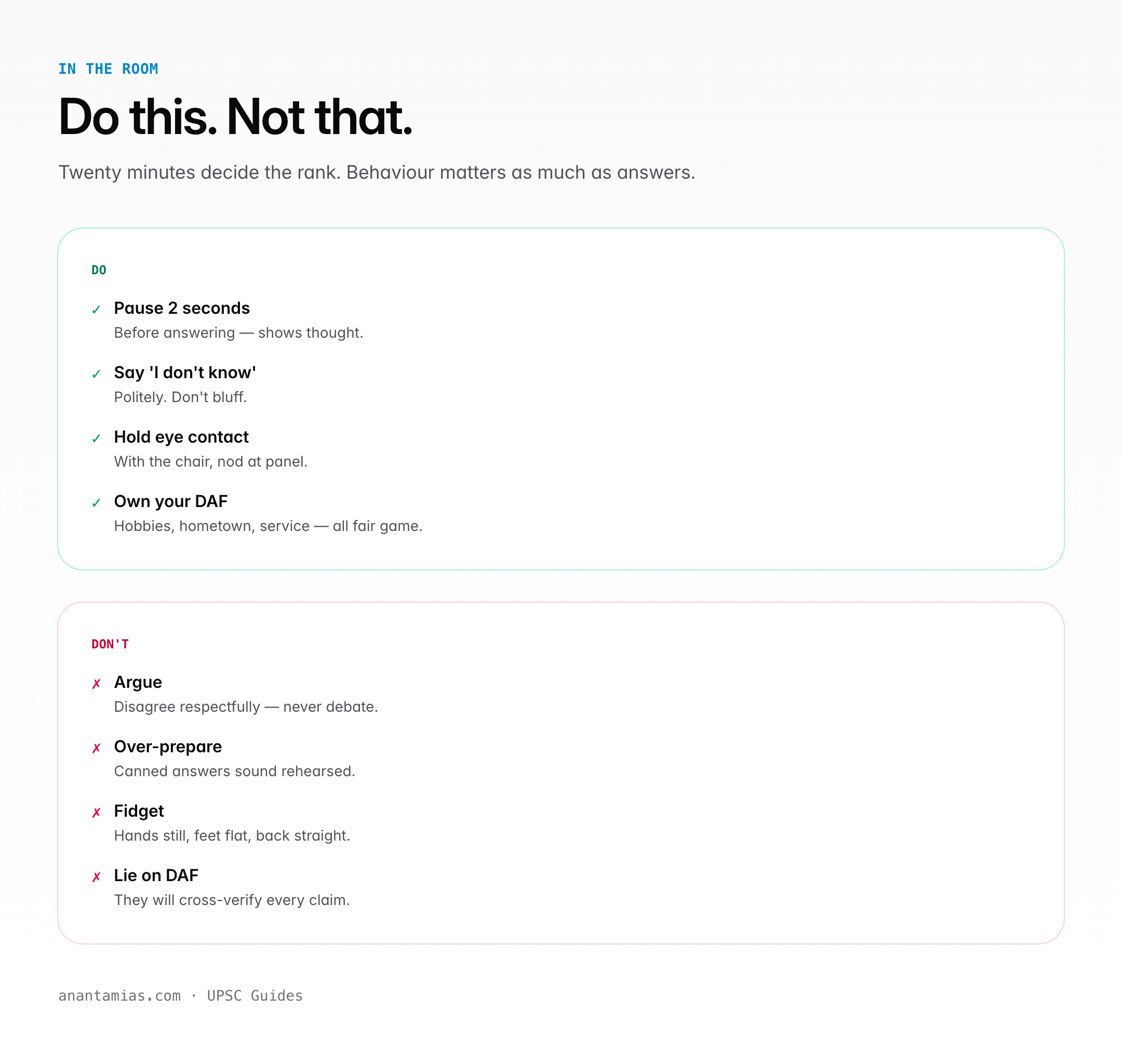
- Listen fully before answering. Pause for 2 seconds — it is not a penalty.
- Don’t bluff. ‘I am not sure, Sir, but I believe…’ is infinitely better than a made-up confident answer.
- Hold your opinion politely. ‘I see the point, Sir, but I would respectfully differ because…’ is a mark-gaining response.
- Be specific, not abstract. ‘Unemployment in India was 6.7% in 2024’ beats ‘Unemployment is very high’.
- Connect the answer to something personal when possible — DAF item, hometown, work experience.
- Keep answers to 30–60 seconds. The Board will ask follow-ups if they want depth.
- Smile. Genuinely. A frozen face reads as fear.
The Ethics Questions
Every board asks at least 2–3 ethics-rooted questions. Examples:
- ‘You are a District Magistrate. An MLA pressures you to transfer an honest officer. What do you do?’
- ‘Your best friend offers you inside information about a tender. You win the tender. Is it corrupt?’
- ‘Should a civil servant publicly oppose a government policy they disagree with?’
Don’t go textbook. Share your reasoning: what you would consider, which values you would prioritise, what institutional mechanism you’d use. Honesty about dilemmas beats fake perfection.
The Day Before the Interview
| Time | Activity |
|---|---|
| Morning | Revise DAF once, not 10 times |
| Afternoon | One mock interview + feedback (if possible) |
| Evening | Iron your formals, pack documents, recheck call letter |
| Night | Light reading, early sleep. No new content. |
Dress Code
For men: dark formal trousers, light formal shirt, tie, black formal shoes, minimal accessories. For women: saree / formal suit / business formals. Comfort over fashion — you’ll sit for 30–45 minutes.
Inside the Room: First 20 Seconds
Knock, wait for permission, enter confidently, greet the Chairperson first, then Members. Wait to be asked to sit. Thank them when seated. These small cues set the tone.
What Not to Do
- Don’t memorise answers. Every memorised answer sounds memorised.
- Don’t criticise the government or any community gratuitously.
- Don’t namedrop religious/political figures unless the question demands.
- Don’t argue. Disagree politely, once, then move on.
- Don’t carry fake confidence. Boards spot it immediately.
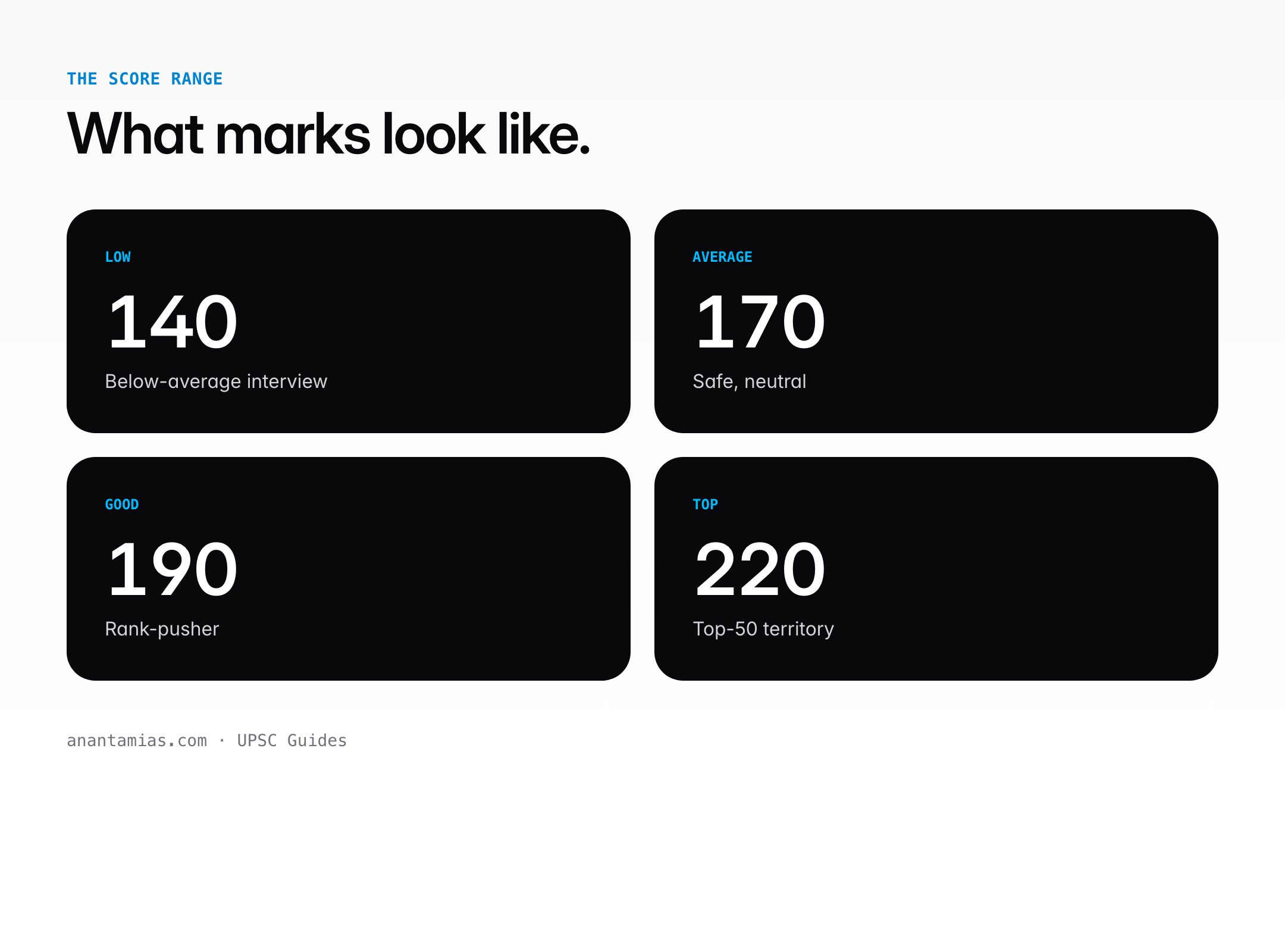
The Range: 140 to 220
Most candidates score between 140 and 200 out of 275. A 200+ score comes from a consistent personality, not from lucky questions. Candidates who clear with AIR below 100 typically score 170–210 in the interview. Focus on being the truest, clearest version of yourself — not a rehearsed one.
Frequently Asked Questions
How long is the UPSC Interview?
Typically 25–40 minutes. Shorter interviews are not necessarily bad — the Board may have formed its impression quickly, positively or negatively.
What should I say if I don’t know the answer?
Honestly say so. ‘I am not sure, Sir, but I can try to reason through it’ or ‘I do not know this, Sir’ is respected. Bluffing is penalised heavily.
How many mock interviews are enough?
Five to seven mock interviews across different institutes is ideal. Each panel catches different flaws — you need varied feedback, not repeated validation.
Do marks in the Interview matter as much as Mains?
Yes and no. Interview carries 275 of 2025 total marks (about 13.6%) — enough to change your rank by 100+ positions. A bad interview can pull down a strong Mains performance.
What should I wear to the UPSC Interview?
Formal, conservative, well-fitted clothes. Men: dark trousers, light shirt, tie, black shoes. Women: saree or formal business wear. Avoid flashy accessories and strong perfumes.
Can the Board ask questions outside my DAF?
Yes — current affairs, situational ethics questions, and general awareness are fair game. But 60–70% of questions will be DAF-rooted. Master your DAF.
Watch on YouTube
Related video from the Anantam IAS YouTube channel.
UPSC Interview Secrets

Tell Google you want more of this.
Add Anantam IAS as a preferred sourceOne tap, and this site shows up more often in your own Top Stories, AI Overviews and AI Mode. Remove it any time.