Mock tests are not tests. They are the training ground where you build the exam-day machine. An aspirant who reads 15 books and solves 30 mocks outperforms one who reads 30 books and solves 10 mocks — every year, without exception. Yet most aspirants treat mocks as an optional add-on. Here is the complete strategy: when to start, how many to take, and the analysis ritual that turns test-day loss into next-week gain.
Why Mocks Matter More Than Reading
- They simulate exam pressure, which no amount of reading does
- They expose the gap between passive reading and active recall
- They teach time management — every Prelims question is under 1 minute
- They force educated guessing skills for marginal questions
- They build mental stamina for 2-hour (Prelims) and 3-hour (Mains) sessions
When to Start Taking Mocks
Different for Prelims and Mains.
Prelims Mocks
- Sectional tests: from month 3 onwards (after first reading of 3–4 subjects)
- Full-length mocks: from 4 months before Prelims
- Revision mocks (previous year mocks from Vision / Forum): from 2 months before Prelims
Mains Mocks
- Individual answer writing: from month 4 onwards
- Sectional tests (one GS paper, 5 questions): from month 6
- Full-length 3-hour tests: from 2 months before Mains (post-Prelims)
How Many Mocks? The Numbers That Work
| Stage | Recommended Count | Purpose |
|---|---|---|
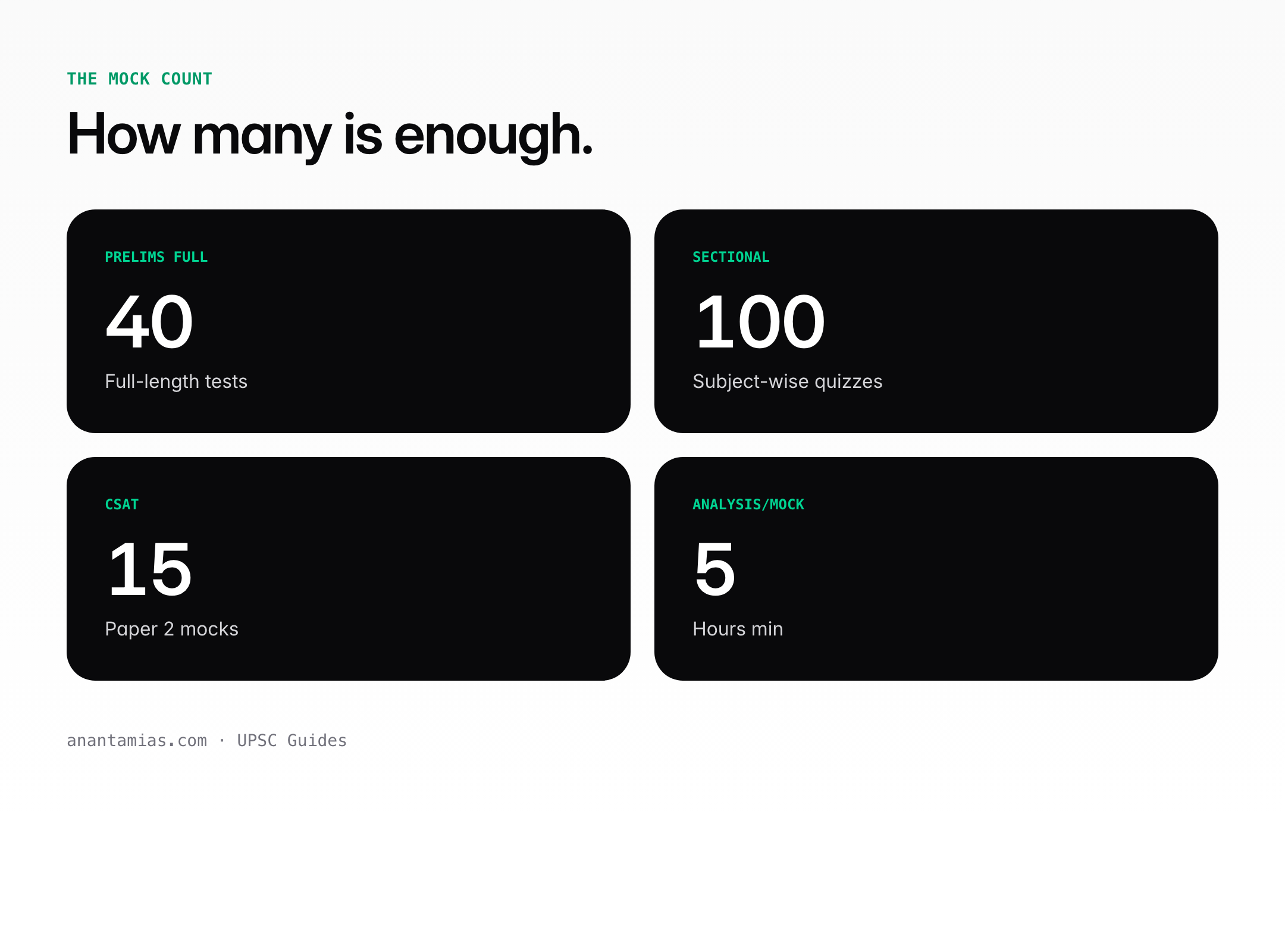
| Prelims sectional tests | 15–20 | Subject-level diagnosis |
| Prelims full-length tests | 20–25 | Exam simulation, time management |
| Prelims PYQ practice | Last 10 years, solved twice | UPSC pattern familiarity |
| Mains GS sectional | 4 per GS paper = 16 | Paper-specific weaknesses |
| Mains full-length GS | 4–6 | Endurance and integration |
| Mains Essay tests | 4 | Structural practice |
| Mock interviews | 5–7 | Body language, speech patterns |
The Best Test Series in 2026
- Vision IAS — most reliable for Prelims. Difficulty level closest to UPSC.
- ForumIAS — strong Mains test series with detailed evaluation.
- InsightsIAS — good free daily answer writing; paid tests well-evaluated.
- RauIAS — quality Prelims tests, relatively expensive.
- GS Score — well-regarded Mains series, especially for GS-I and GS-IV.
- Chanakya IAS — decent for Prelims, less consistent for Mains.
- Byju’s Exam Prep — good online coverage, variable quality across subjects.
How to Take a Mock Test
- Sit at a desk — not on your bed
- Use a timer — not your phone (turn it off and keep it in another room)
- Use the exact time window of the real exam (9:30 AM – 11:30 AM for Prelims)
- Use ink pens and OMR sheets (for Prelims) or the real Mains booklet format
- No tea, no toilet breaks, no glancing at notes
- Take it as seriously as the actual exam
The Analysis Ritual (Most Important Part)
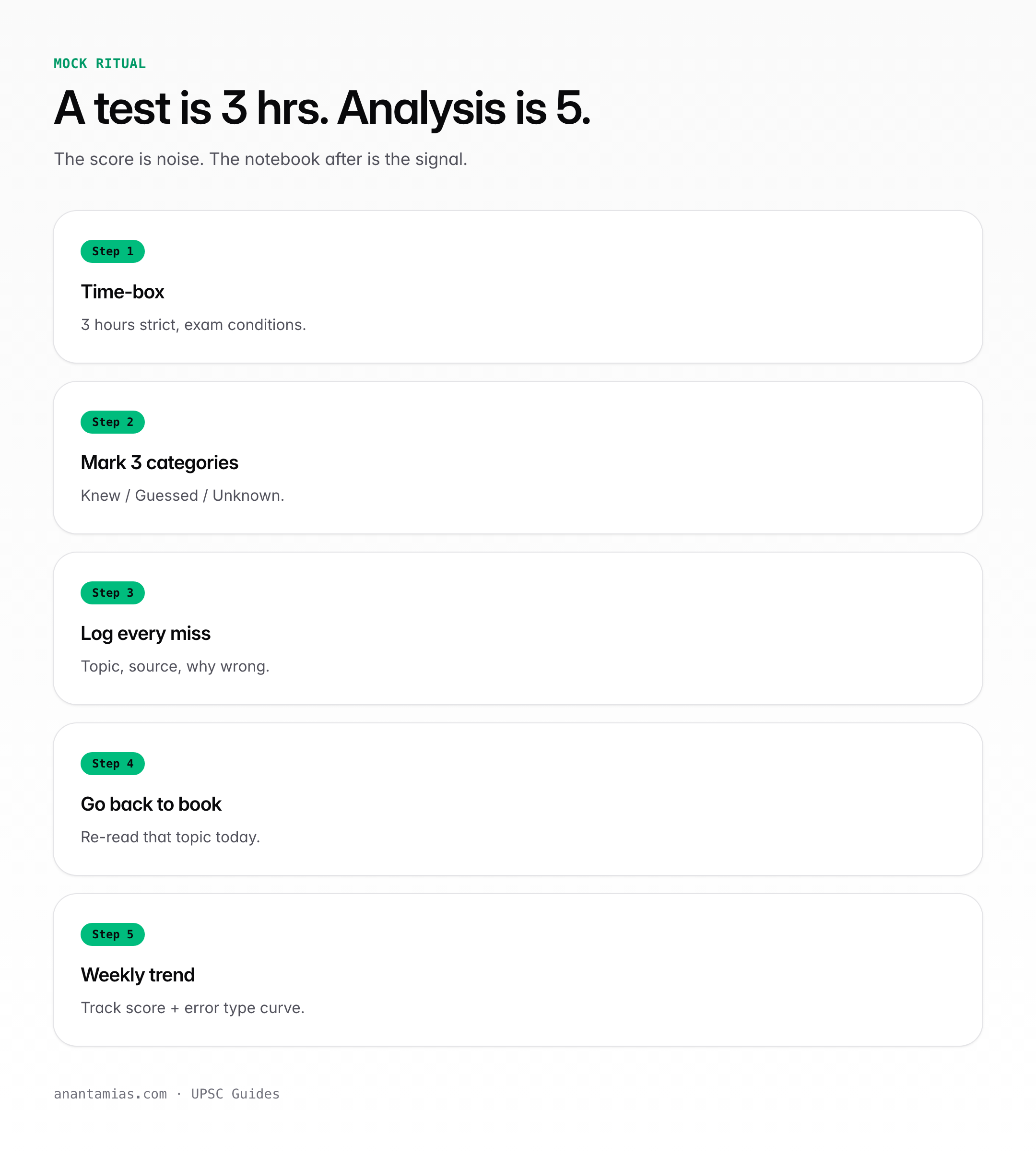
A mock without analysis is a waste. Spend at least 2 hours analysing every 2-hour Prelims mock, and 3 hours analysing every Mains sectional. Here’s the framework:
Prelims Analysis in 6 Steps
- Step 1: Score yourself using UPSC negative marking (+2 / –0.66).
- Step 2: Tag every wrong answer into 3 categories — silly mistake, conceptual gap, not studied.
- Step 3: For every conceptual gap, open the source book and re-read that section.
- Step 4: For every silly mistake, write one line in your Mistake Notebook about what caused it.
- Step 5: Review every question you left blank — could you have attempted with educated guessing?
- Step 6: Summarise the top 5 takeaways from this mock in a weekly tracker.
Mains Analysis in 5 Steps
- Read the model answer / topper’s answer for the same question
- Circle 3 structural improvements — introduction, subheading use, conclusion
- Highlight missing data points / committee names / scheme names
- Note the directive verb treatment — did you address ‘critically examine’ as ‘examine’?
- Rewrite one answer from that mock within 48 hours using the feedback
The Mistake Notebook
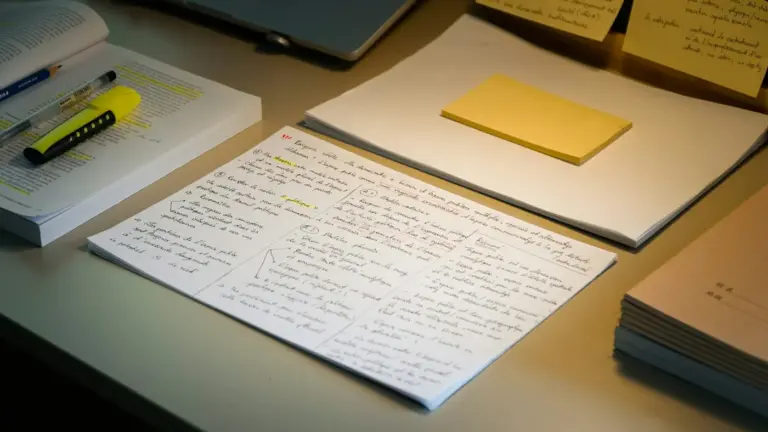
This is your single most powerful revision tool. One notebook. Every wrong mock answer. Every conceptual confusion. Every fact you kept forgetting. Before each mock, spend 20 minutes reading this notebook. Before Prelims and Mains, this notebook is what you revise. Aspirants who religiously maintain this score 10–15% higher in the real exam compared to those who don’t.
Score Trends: What’s Normal?
Expect this progression:
| Mock Number | Expected Prelims Score | Status |
|---|---|---|
| 1–3 | 60–90 | Baseline — don’t panic |
| 4–8 | 90–110 | Active learning phase |
| 9–15 | 105–125 | Consolidation phase |
| 16–20 | 115–135 | Exam-ready calibration |
| Last 5 mocks | 120–145 | Fine-tuning |
Don’t obsess over scores week to week. Obsess over the trend over 5-mock windows. A plateau for 5 mocks signals you need to shift strategy — more revision, new PYQs, different test series.
Common Mock Test Mistakes
- Skipping analysis to save time — this defeats the whole purpose
- Taking too many mocks from too many institutes — 15 Vision tests revised deeply beats 60 mixed tests reviewed shallowly
- Giving up after a bad mock — every topper has a 75/200 mock on record
- Taking mocks in a casual setup (bed, phone nearby) — you’re training yourself wrong
- Obsessing over national ranking — it’s comparative to a specific test series, not to the real exam
CSAT Mocks
Since CSAT became unexpectedly difficult in 2023 and 2024, CSAT mocks are essential. Take 10 full-length CSAT mocks in the 3 months before Prelims, plus all previous year CSAT papers. Aim for 45% consistently before you can relax about the 33% cut-off.
The Final 30 Days
In the last 30 days before Prelims:
- 3–4 mocks per week maximum
- Spend more time on analysis than writing
- Revise Mistake Notebook + one-page summaries
- No new books. No new YouTube channels. No new Telegram groups.
- Full rest day 2 days before the exam — don’t take a mock on the final day
Mocks are where you bleed so you don’t die. Bleed ruthlessly for 6 months, then walk into the exam hall with nothing left to lose.
Frequently Asked Questions
When should I start taking mock tests?
Start sectional tests after 3 months of preparation and full-length Prelims mocks 4 months before the exam. For Mains, begin individual answer writing from month 4 onwards.
How many Prelims mocks are enough?
Around 20–25 full-length mocks plus 15–20 sectional tests and 10 years of PYQs solved twice. Quality of analysis matters more than raw count.
Which test series is best for Prelims?
Vision IAS is generally considered closest to UPSC’s actual difficulty. ForumIAS and RauIAS are strong alternatives. Pick one primary series and stay with it.
Should I worry about my mock test scores?
Not week-to-week. Track the trend over every 5 mocks. Scores typically rise from 60 to 130+ over 6 months for serious aspirants.
How important is mock test analysis?
More important than the test itself. Spend at least 2 hours analysing every 2-hour mock. Without analysis, mocks are entertainment, not preparation.
Can I take mocks from multiple test series?
Yes, but cautiously. Too many sources dilute analysis time. A common approach: one primary series (Vision / Forum) + previous year mocks from other institutes in the last 60 days.
Tell Google you want more of this.
Add Anantam IAS as a preferred sourceOne tap, and this site shows up more often in your own Top Stories, AI Overviews and AI Mode. Remove it any time.