Most aspirants treat Previous Year Questions as a test they take near the end — a box-ticking exercise in the last two months before Prelims. That’s the single most expensive mistake in the whole preparation. PYQs aren’t a mock test you save for later. They’re the closest thing UPSC ever gives you to a published answer key on what the syllabus actually means.
The official syllabus is a one-page list of vague headings — “salient features of Indian society”, “effects of globalisation on Indian economy”. It tells you the territory but not the terrain. Ten years of question papers tell you the terrain: which corners UPSC keeps returning to, how deep it digs, whether it wants a fact or a judgement, and how it phrases the demand. This guide walks through how to read PYQs as a map rather than a quiz — how to tag them, weight them, and use them at every stage of the journey.
Why PYQs Are Your Real Syllabus
The syllabus defines the outer boundary of what can be asked. PYQs tell you where inside that boundary the examiner actually lives. And those are very different things. The polity syllabus, for instance, runs from the Preamble to panchayati raj, but a decade of papers shows the Commission circling the same high-value zones again and again — the basic structure doctrine, Centre-State financial relations, the powers of constitutional bodies, and the evolving reading of fundamental rights. You can read the whole syllabus and still misjudge weightage by a mile. You can’t misjudge it once you’ve seen the questions.
PYQs reveal four things no syllabus can. First, real weightage — how many questions a sub-topic has drawn over ten years, which is a far better guide to effort than the syllabus’s flat list of equal-looking headings. Second, depth — whether UPSC wants you to know that the Finance Commission exists, or to argue about whether its terms of reference have been politicised. Third, recurring themes — the federalism debate, the ethics of development versus environment, the state’s role in welfare, which surface year after year in new costumes. Fourth, framing — UPSC’s distinctive habit of asking you to “critically examine”, “comment”, or weigh two ideas against each other rather than recite. Once you internalise the framing, even an unseen question feels familiar.
There’s a deeper reason this works. UPSC is a remarkably consistent examiner. It rarely chases the newest headline for its own sake; it filters current events through a stable set of static themes it already cares about. So a question on a 2025 data-protection rule is really a question on privacy, the state, and rights — themes the papers have tested for years. Learn the themes from the PYQs, and you stop preparing for individual questions and start preparing for the examiner’s mind.
How to Analyse Ten Years of Papers
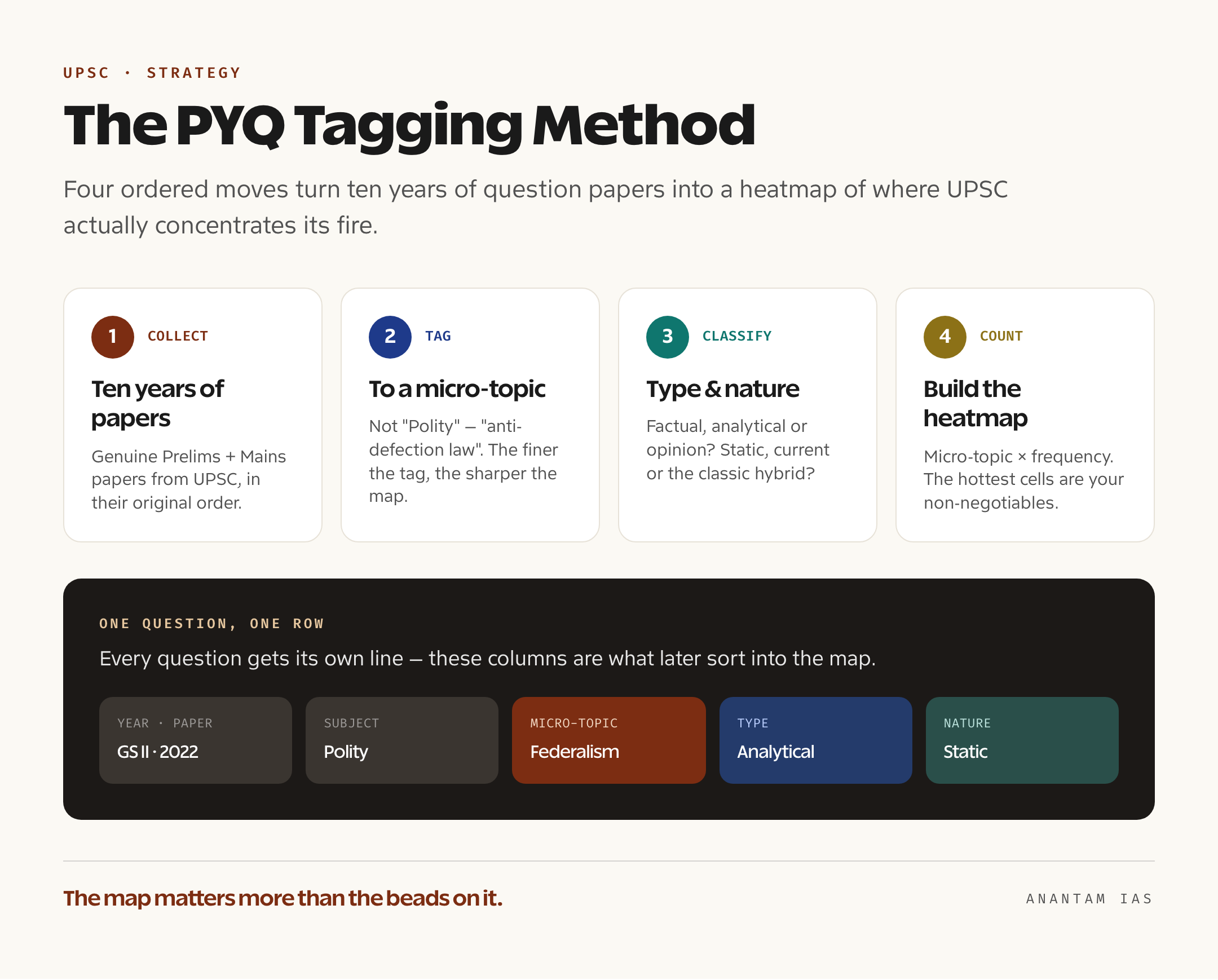
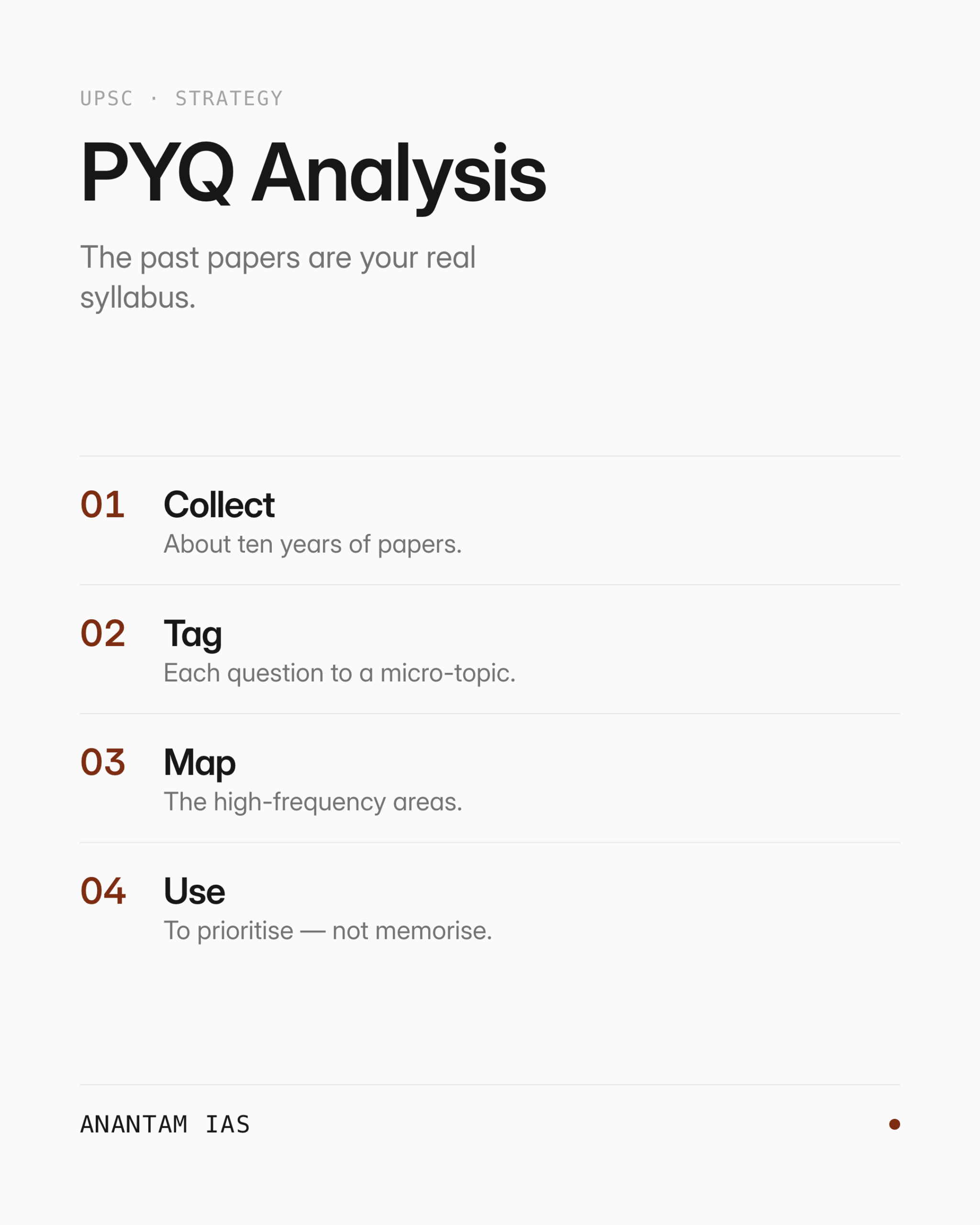
Start by collecting the raw material properly. Download the genuine question papers straight from the UPSC website — both Prelims (GS Paper I and the CSAT) and all the Mains GS papers, plus the Essay and your optional — for at least the last ten years. Ten is the floor, not the ceiling; the deeper themes only show up across a decade. Keep the papers in their original form first, before any coaching “compilation” has reshuffled them, because the order and phrasing of the original is itself information.
Then tag every single question to a syllabus micro-topic. This is the heart of the method and there’s no shortcut for it. Open a spreadsheet and give each question its own row, with columns for year, paper, the broad subject (Polity, Economy, Geography, History, Environment, Society, IR, Science and Tech, Ethics), and — the column that does the real work — a precise micro-topic. Not “Polity” but “anti-defection law”; not “Economy” but “monetary policy transmission”. The finer your tags, the sharper the map that emerges. Doing this by hand, paper by paper, is slow and a little tedious, and that slowness is the point: you are reading the examiner’s choices one question at a time.
Add two more columns that change how you’ll use the data. One for question type — is it factual (a date, a provision, a definition), analytical (explain a mechanism or a cause), or opinion-based (take a position and defend it)? The other for the static-versus-current axis — is this a timeless concept, a current-affairs hook, or the classic UPSC hybrid that anchors a current event to a static idea? When you sort by these columns, patterns jump out. You’ll see that Geography in Prelims leans factual and map-based, while GS Paper IV is almost entirely analytical and applied. That tells you exactly how to study each area, not just what to study.
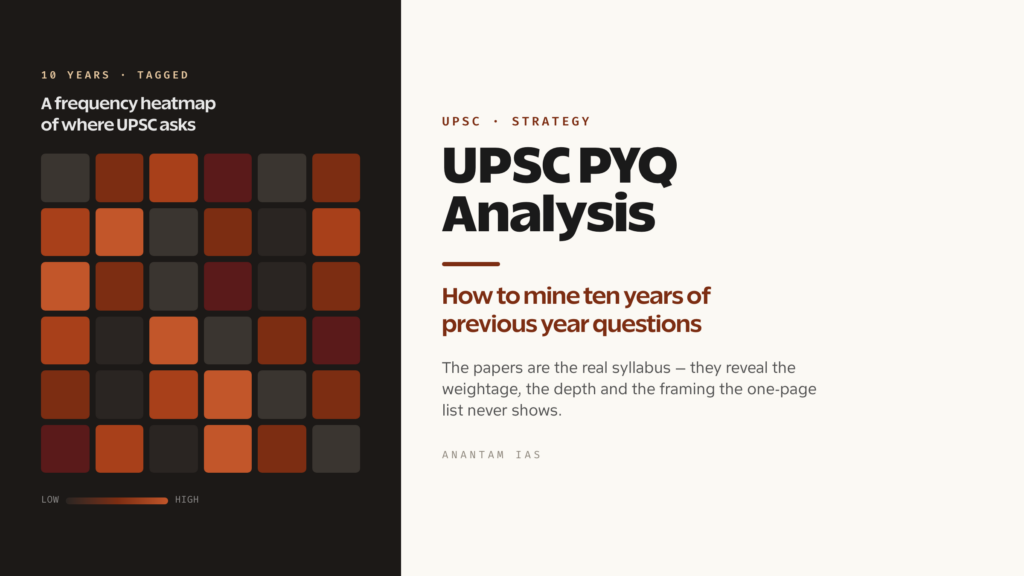
Once tagged, count. A simple frequency table — micro-topic against number of questions over ten years — becomes a heatmap of where UPSC concentrates its fire. The hottest cells are your non-negotiables. The cold cells aren’t worthless, but they tell you where to stop over-investing. This frequency map is the deliverable that justifies all the tagging; everything downstream flows from it.
Using PYQs for Prelims vs Mains
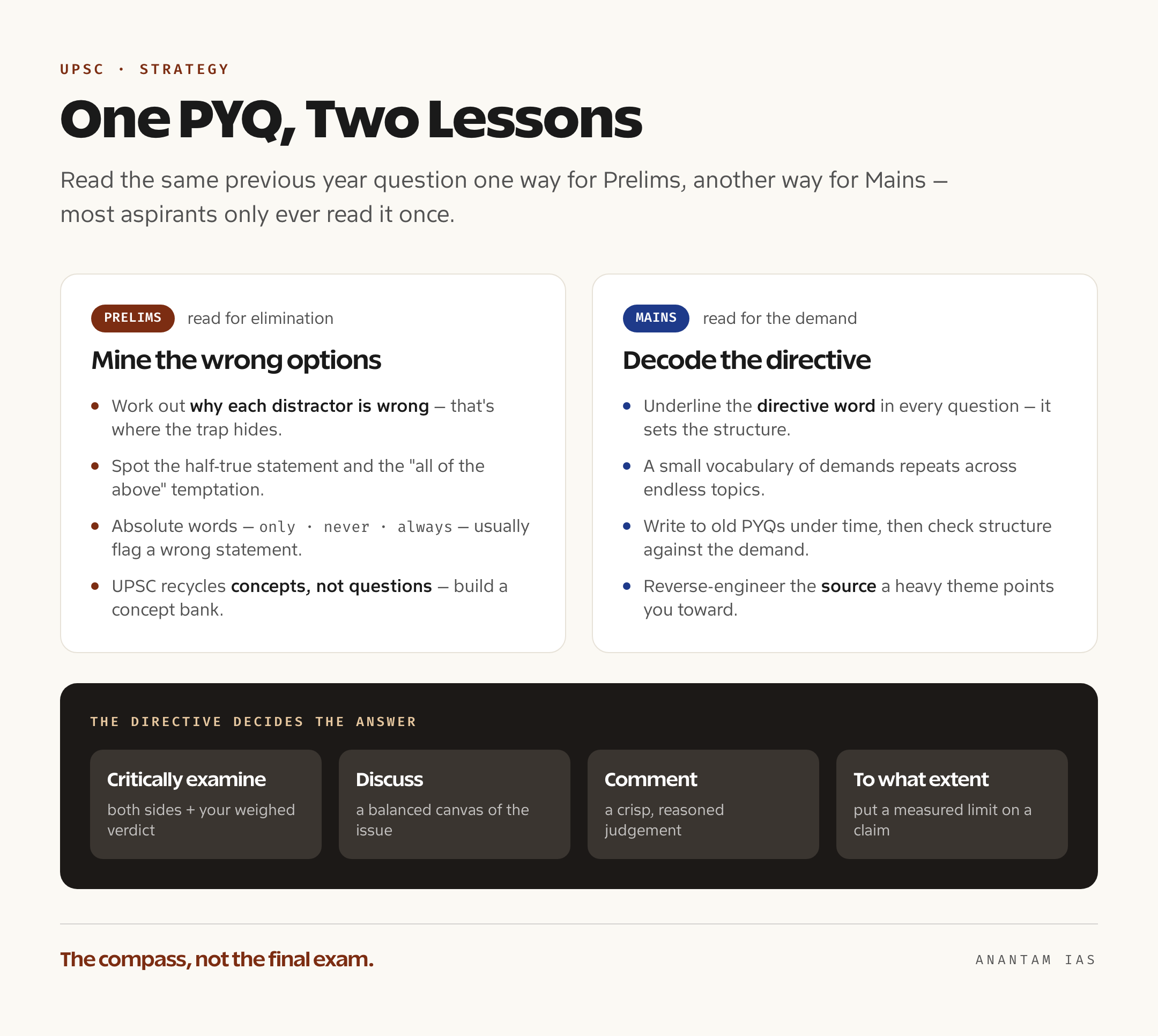
A PYQ is read completely differently depending on which stage you’re preparing for, and most aspirants only ever read it one way. For Prelims, the question is a closed object with one correct option and three wrong ones — and the wrong ones are where the learning hides. Don’t just confirm the right answer; work out why each distractor is wrong. That reverse-engineering teaches you UPSC’s favourite traps: the half-true statement, the “all of the above” temptation, the pairing question where one match is off. Over a decade you’ll notice the Commission recycling concepts rather than exact questions — the same idea about, say, the powers of the Governor, dressed in a new statement set. You’re learning a concept bank, not a question bank.
PYQs also teach Prelims elimination as a skill in itself. Study how the option patterns work — when “two statements correct” tends to be the answer, how absolute words like “only”, “never” and “always” usually flag a wrong statement, how the most extreme-sounding option is often a plant. You can practise pure elimination on old papers even for topics you haven’t finished reading, because the skill of ruling out the impossible is partly independent of content. For the full screening-stage approach, the deeper tactics sit in our UPSC prelims strategy guide.
For Mains, the same paper teaches a different lesson: the demand of the question. Mains questions are built around directive words, and reading PYQs trains your eye to spot what each one is really asking. “Critically examine” wants both sides plus your weighed verdict; “discuss” wants a balanced canvas; “comment” wants a crisp judgement; “to what extent” wants you to put a measured limit on a claim. Take a ten-year run of GS Paper II questions and underline the directive in each — you’ll start seeing that UPSC repeats a small vocabulary of demands across endless topics. Practise writing to those PYQs under time, then compare your structure against what the directive actually asked for. That loop, more than any model answer, builds the instinct our UPSC mains answer writing guide is built around.
Building a Weightage Map
The weightage map is where PYQ analysis stops being an exercise and starts steering your daily plan. Take your frequency table and convert it into a priority tier for each subject. Tier one is the cluster of micro-topics that has drawn the most questions over ten years — for many aspirants in Polity that’s the basic structure, the federal scheme, fundamental rights jurisprudence and the constitutional bodies. Tier two is the steady middle. Tier three is the long tail of one-off questions you should recognise but never let swallow your week. The map turns the flat syllabus into a graded one, and graded effort is the whole game when time is short.
Read the map against the UPSC syllabus 2026 so every hot zone is anchored to its official heading — that keeps you honest about coverage and stops the heatmap from quietly dropping a syllabus line UPSC simply hasn’t touched recently but still lists. The map should also drive your source selection in reverse. When you see that a micro-topic is heavy and analytical, you can reverse-engineer the source: questions on poverty and inequality point you toward the Economic Survey’s chapters and government data, questions on social-justice schemes point toward the relevant ministry’s flagship programmes. PYQs effectively tell you which pages of which books are load-bearing, so you read the standard texts with a filter instead of cover to cover.
Keep the map alive. After each new exam cycle, tag that year’s paper and fold it into the table. A weightage map built once and forgotten goes stale; one refreshed every year stays a true mirror of where the Commission is heading, including the slow drifts — the rising share of environment and technology in recent Prelims, for instance, or the growing analytical load in GS Paper III.
Mistakes That Defeat the Purpose
The most common failure is treating PYQs as a question bank to be memorised. Rote-learning old answers is close to useless, because UPSC almost never repeats a question verbatim — it repeats concepts and themes. If you memorise that a particular statement was true in a 2019 question, you’ve learned one fact. If you understand why the examiner cared about that concept, you can handle every future question built on it. The map matters more than the beads on it.
The second mistake is ignoring older papers. Aspirants binge the last two or three years and skip the rest, but the deep recurring themes — the ones that define UPSC’s personality — only become visible across a full decade. The federalism debate, the development-versus-environment tension, the ethics of public service: these announce themselves as patterns only when you can see ten years at once. Drop the older papers and you lose exactly the signal that PYQ analysis exists to find.
The third mistake is not revisiting them. A single pass through PYQs at the start of preparation is far weaker than three lighter passes spread across the year — one to build the map, one mid-way to test how much of the hot zone you can now answer, and one near the exam as a confidence and gap check. And don’t quarantine PYQs into a separate “revision” silo; weave them into each subject as you study it, so every chapter you read is immediately stress-tested against the questions UPSC has actually asked on it. Used that way, PYQs stop being a final exam and become the compass you carry the whole journey.
Frequently Asked Questions
How many years of UPSC previous year questions should I analyse?
Aim for at least ten years of both Prelims and Mains papers. Three or four years is enough to spot surface trends but too shallow to reveal the deep recurring themes, which only emerge across a full decade. Going back fifteen years is useful for static subjects like Polity and History, where the core concepts barely change, though for current-affairs-linked areas the recent papers carry more weight.
Should I solve PYQs at the start or end of my preparation?
Both, in light passes rather than one heavy sitting. Start by analysing PYQs to build your weightage map before you read deeply, so you read with a sense of priority. Then return to them mid-preparation to test recall, and again near the exam to find gaps. Treating PYQs only as a final mock wastes their biggest value, which is direction.
Do PYQs repeat in the UPSC exam?
Exact questions almost never repeat, but concepts and themes repeat constantly. UPSC recycles ideas — the same point about the Governor’s powers or the basic structure doctrine reappears in a new statement set or a new directive. That’s why understanding why a question was asked matters far more than memorising the old answer; you’re learning a concept bank, not a question bank.
Can I just use a coaching PYQ compilation instead of doing the tagging myself?
A compilation is a fine reference, but the analysis only sticks if you do the tagging yourself at least once. The slow work of assigning each question a micro-topic, a question type and a static-versus-current label is where you actually absorb the examiner’s pattern. Read the compilation, but build your own weightage map from the original papers.
Tell Google you want more of this.
Add Anantam IAS as a preferred sourceOne tap, and this site shows up more often in your own Top Stories, AI Overviews and AI Mode. Remove it any time.