Most aspirants read a book three times. Few revise it correctly. There is a difference. The UPSC syllabus is a well — you can keep pouring water in (new books) or use what you already have (revision). Revision is how 14 months of reading becomes 110+ in Prelims and 450+ in Mains. Below are techniques backed by cognitive science plus what toppers actually do. Not philosophy — tools. Numbered, dated, ranked.

The Forgetting Curve Problem
Hermann Ebbinghaus's 1885 research shows retention drops to ~44% after one hour, ~33% after 24 hours, and below 25% after a week without review. In plain English: read Laxmikanth Chapter 13 (Parliament) on a Sunday, and by the next Sunday you have lost three-fourths of it. The remaining quarter is mostly the headline ideas — not the article numbers, exceptions, or Article 169-vs-312 comparisons that PYQs love.
This is the core trap of UPSC. The syllabus is too wide to read once and remember. It is also too wide to read four times serially — by the time you finish, the first subject has drained out. Spaced revision is the operating system on which every other strategy runs.
How Memory Actually Works for Long Syllabi
The forgetting curve is the symptom. The mechanism is more interesting and more useful.
Consolidation, retrieval strength vs storage strength
New reading lands in the hippocampus as a fragile trace. Sleep — specifically slow-wave sleep — moves that trace toward long-term cortical storage. This is why "studied till 3 a.m." loses to "slept by 11 p.m. and revised in the morning" on a recall test seven days later.
Robert and Elizabeth Bjork's "New Theory of Disuse" splits memory into storage strength (how well it's encoded) and retrieval strength (how easily you pull it back right now). UPSC aspirants confuse the two constantly. After reading Spectrum twice in two weeks, retrieval strength feels high — every page seems familiar. Storage strength is still low because no time has passed for consolidation. Wait three weeks, and the difference between Surat Split (1907), Lucknow Pact (1916), and Lahore Session (1929) blurs. The Bjorks' insight: desirable difficulties — spaced revision, interleaving, retrieval practice — lower retrieval strength in the moment but raise long-term storage strength. Revision feeling hard is the signal it's working.
Cognitive load and the single-source rule
John Sweller's cognitive load theory describes three loads: intrinsic (topic complexity), extraneous (scattered notes, app-switching), and germane (schema-building). UPSC has very high intrinsic load. Most aspirants pile on extraneous load by reading five sources per topic and keeping notes scattered across Notion, Evernote, and 12 paper notebooks. Only germane load produces marks — and it happens during active recall, not reading.
The rule that follows: single-source per topic in revision phase. If you've read Laxmikanth, Vision handouts and DD National notes for Polity, pick one by January. Throw the rest. School-topper habits — cram the night before — fail here because the test is 8,000 pages of content 14 months after you started. Only the spaced, retrieval-tested, sleep-consolidated system survives the gap.
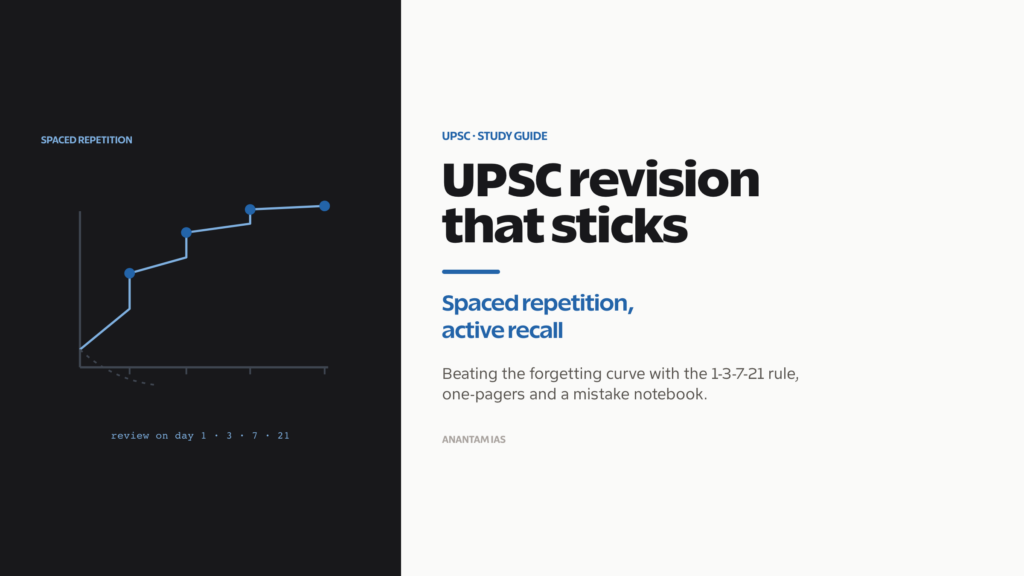
Technique 1: Spaced Repetition (The 1-3-7-21 Rule)
Spaced repetition is the single highest-leverage revision tactic on the table. Every other technique sits on top of this one.

What the 1-3-7-21 rule actually does
After learning new content, revise it at expanding intervals — Day 1, Day 3, Day 7, Day 21, then monthly:
| Revision | Day | Purpose | Time |
|---|---|---|---|
| R1 | Day 1 (same night) | Short review of day's notes | 15 min |
| R2 | Day 3 | Re-skim chapter, retrieve key points | 20 min |
| R3 | Day 7 | Active recall without book | 25 min |
| R4 | Day 21 | Full chapter revision from notes only | 30 min |
| R5 | Month 2 onward | Before each mock test | 15 min |
Each interval is timed to fall just before you would have forgotten the previous round. That's the entire trick. The first three revisions are the cheapest — 15 to 25 minutes — and they prevent you from re-reading the chapter from scratch in March, which costs four hours.
How to apply it to GS Paper 1
Take Polity. Day 1, read Laxmikanth Chapter 7 (Fundamental Rights). That night, write on a single page the six FR categories (Articles 12-35), exceptions (Article 33 armed forces, 34 martial law), and three landmark cases (Kesavananda 1973, Maneka 1978, Puttaswamy 2017). That's R1. Day 3, cover the page, write what you remember on a fresh sheet, compare. Day 7, do the same without the chapter at all. Day 21, retrieve the full chapter outline from blank paper. By Day 21, the chapter is in long-term memory at a fraction of the cost of re-reading.
Anki vs paper review
Anki implements SM-2 (now FSRS) scheduling automatically: you grade each card "Again / Hard / Good / Easy" and the algorithm picks the next interval. For high-density factual content — Polity articles, Economy terms, Environment Acts, dates — Anki is unbeatable. A 600-card deck takes 25 minutes a day.
Paper works equally well with a four-column tracker: Chapter, R1 date, R2 date, R3 date, R4 date. Tick as you go. Pick one system in month 1 and stay till Prelims — switching mid-prep loses two weeks.
The Revision Tools Stack
The ecosystem matters less than people pretend. Toppers have cleared with Anki + paper, and equally with two-rupee notebooks and a wall calendar. Pick a stack and stop tool-hopping by month 2.

Spaced-repetition algorithms — SM-2 vs FSRS
SM-2 (Wozniak, 1985) is the original SuperMemo algorithm — stable, conservative, shows cards more often than necessary. FSRS (Free Spaced Repetition Scheduler), Anki's modern default, is ~20–30% more efficient at the same retention target. For UPSC card volumes, that's 25 vs 35 minutes a day. Set FSRS retention to 0.90 (90% recall). Higher wastes time; lower loses facts on Prelims day.
Tools recommendation table
| Tool | Best for | Limitation | Verdict |
|---|---|---|---|
| Anki | Polity articles, Economy terms, Environment Acts, dates, schemes, taxonomy | Steep setup; screen fatigue | Yes — for ≥40% of factual recall |
| Notion | Topic-wise consolidated notes, current affairs compilation | Slow on patchy 4G; encourages over-formatting | Yes — for organized notes only |
| Paper notebook (4 colours) | One-page summaries, mistake notebook, timeline sheets | No search, no sync | Yes — for high-frequency revision |
| Obsidian / Logseq | Linked notes, atomic notes for IR, ethics case-bank | Engineering rabbit-hole; aspirants spend 40 hours setting it up instead of revising | Optional, only if already comfortable |
| Evernote / Google Keep | Quick captures from PIB, news clippings | Not a revision tool — capture only | Capture-only, do not revise from here |
| YouTube playlists | Quick concept refresh (Mrunal economy, StudyIQ geography) | Passive; minutes of marginal recall per hour | Use sparingly in cycle 1, almost never in cycle 3 |
Offline notebook hierarchy
Four notebooks most toppers converge on: (1) subject notes (one per subject, written in cycle 1), (2) one-page summaries (built in cycle 2, become 80% of cycle 3), (3) mistake notebook, (4) current affairs compilation (monthly topic-wise, not date-wise). Anything outside these four is clutter. Burn it in March.
Technique 2: Active Recall Over Passive Reading
Reading Laxmikanth five times is passive. Closing the book and writing down everything you remember about Emergency provisions (Articles 352, 356, 360) is active. Active recall is 2-3x more effective per hour than re-reading — Karpicke and Roediger's 2008 study showed retrieval-practice groups outperformed extended-study groups by 40-60% on delayed tests.

The 4-step active recall drill
After every chapter:
- Close the book.
- Write down 10 key points from memory on a blank A4 sheet.
- Open the book and check what you missed.
- Re-write the missed points in a Weak Points notebook (this becomes the seed of your mistake notebook).
This drill costs 15 minutes per chapter and replaces the temptation to "read it once more." Reading once more produces a feeling of knowing. Writing 10 points produces actual knowing.
Question-led recall and when passive reading is acceptable
Convert every chapter heading into a question. "Federal features of Indian Constitution" becomes "What are the 7 federal and 4 unitary features?" Answer before opening the chapter. The gap is where revision must concentrate. PYQ stems are pre-built versions of these questions.
Passive reading is acceptable in only two cases: the first encounter with a hard new topic, and context-rich skimming of NCERT Class 11 Fine Arts for Art and Culture. Beyond those, every reading hour without retrieval is donated to the forgetting curve.
Technique 3: Teach-to-Learn

The Feynman technique: explain a concept in simple language to an imagined beginner. If you stumble, you don't know it. Three UPSC implementations:
- Voice-record yourself for 5 minutes on a topic — GST, finality of Article 142, Indus Water Treaty mechanics. Listen back. The ums and pauses mark where revision is shallow.
- Whiteboard a friend in a 2–3 person study group. Take turns. The person asking dumb-but-precise questions ("why 245 days for a Money Bill?") finds cracks faster than any test.
- Write a Mains answer as a teaching paragraph. If you cannot teach monetary policy in 200 words, you cannot write 250 on stagflation.
This works especially well for Polity and Economy — abstract systems where memorization without understanding collapses on application questions. Static factual recall (dates, Acts) needs direct retrieval drills, not Feynman.
Technique 4: One-Page Summaries

After your second reading of a chapter, condense it to one A4 page. This is not note-taking. It is brutal compression.
Anatomy of a good one-pager
- Title bar — chapter, source, last revision date.
- Spine — central concept in 1-2 lines (e.g., "Article 368: 3 amendment categories — simple, special, special + state ratification").
- Branches — 4–6 sub-points with articles, exceptions, landmark cases.
- Margin notes — PYQ year tags ("2017 Pre", "2019 Mains GS-2") so the one-pager doubles as a PYQ filter.
- Colour code — black facts, blue definitions, red exceptions/traps, green current-affairs links.
Why one-pagers replace books in cycle 3
A typical aspirant ends up with 130–160 one-pagers covering the syllabus. At 90 seconds per page, that's a 3.5-hour full revision. Compare with re-reading books: 70–80 hours. In the last 30 days, books are lookups only — never primary revision.
The common failure: aspirants keep "supplementing" one-pagers till exam day, turning them into three-pagers, then five-pagers. Discipline: freeze one-pagers two months before Prelims. After that, only the mistake notebook gets new entries.
Technique 5: Previous Year Question (PYQ) Revision

PYQs are revision material, not just a test. Every 3 weeks, solve 50 PYQs from the subject you just finished revising. If you score below 60%, that subject needs another cycle.
The 10-year decade trend audit
Take Polity. Pull Prelims questions from 2014–2024. Tag each by chapter. The distribution is rarely even — Constitutional Bodies and Statutory Bodies together pull ~25% of Polity questions over a decade; Parliament and Judiciary ~22%; Centre-State ~14%; Local Government ~10%; FRs+DPSP+FDs combined ~12%. If you revise Constitutional Bodies monthly and DPSP quarterly, you've matched the test. The opposite optimizes for a syllabus that doesn't show up.
PYQ revision rhythm
- Weekly: 25 PYQs from the subject of the week (mixed years).
- Monthly: Full subject set (last 10 years) under timed conditions.
- Last 30 days: Only PYQs you got wrong before. The right answers are in your bones; the wrong ones are the leak.
For Mains, write outline answers in 7 minutes (intro, 3 body points, conclusion) rather than full essays. The test is whether you can produce structure under time.
Technique 6: Mock Test Analysis

A mock test without analysis is two hours wasted. The score is irrelevant — the diagnostic is everything.
The three-colour mistake taxonomy
For every wrong answer, mark it in one of three colours:
| Colour | Mistake type | Example | Fix |
|---|---|---|---|
| Red | Silly — careless reading, marking wrong option, time pressure | Marked B when meant to mark D | Slow-down protocol, double-tick before next question |
| Blue | Conceptual — you knew the topic but applied it wrong | Confused subordinate vs co-ordinate jurisdiction | Re-read concept; add to mistake notebook |
| Green | Not studied — never encountered this topic | Niche scheme name from PIB | Add to current affairs sheet; do not panic-study from new sources |
Update your mistake notebook with every blue and green marking. Revisit those topics within 48 hours — the only window where the mistake is still emotionally encoded enough to stick.
Pre-mock review and score plateaus
Before each mock, spend 20 minutes reviewing the previous mock's analysis sheet. Most aspirants skip this. It's the cheapest five-mark gain in the system.
Three plateaus most aspirants hit: 80–90 (conceptual gaps in 1–2 subjects), 95–105 (decision-making in 50/50 questions), 110–115 (CSAT dragging total, or shallow current affairs). Plateaus are subject-specific signals, not "I'm bad at this exam."
Revision Plan: The 3-Cycle Model

| Cycle | Duration | Focus | Sources |
|---|---|---|---|
| Cycle 1 | After foundation reading (months 1-8) | Full subject revision + short notes creation | Books + class notes |
| Cycle 2 | 2 months before Prelims | One-page summaries + PYQ + mocks | Short notes only; books for lookups |
| Cycle 3 | Last 15 days | One-pagers + mistake notebook + fact sheets | One-pagers + mistake notebook only |
Cycle 1 is broad and slow — you are building the schema. Cycle 2 is when one-pagers crystallize. Cycle 3 is brutal and narrow: nothing except revising what you already wrote. Don't treat these as three reads of the same material. Cycle 1 is detail-heavy, Cycle 2 recall-heavy, Cycle 3 recognition-heavy. Different muscles.
Day-by-Day Revision Calendar — 90 Days Before Prelims

The 90-day window is sacred. By T-90, the syllabus is read; revision is the entire game. Here is a defensible week-by-week structure assuming a June Prelims.
Days 90 to 60 — broad sweep
- Week 1 (T-90 to T-84): Polity full revision; 1 PYQ set (last 5 years); 1 sectional mock.
- Week 2: Modern History (Spectrum) + Post-Independence (Bipan Chandra). 1 PYQ set; 1 sectional.
- Week 3: Geography (NCERT 11-12 + GC Leong key chapters) + Maps. 1 PYQ set; 1 sectional.
- Week 4: Economy (Ramesh Singh + Mrunal shortlist) + Budget/Survey one-pagers. 1 PYQ set; 1 sectional.
- Week 5: Environment (Shankar IAS) + biodiversity Acts. 1 PYQ set; 1 sectional.
By T-60, one full revision cycle through GS-1.
Days 60 to 30 — narrow and test-heavy
- Week 6: Current Affairs compilation (last 12 months) + 2 full mocks.
- Week 7: Polity + Modern History second pass; 2 mocks.
- Week 8: Geography + Economy second pass; 2 mocks.
- Week 9: Environment + Sci-Tech + Schemes; 2 mocks; CSAT mock 1.
Revision is now driven by mock feedback, not chapter sequence. Two mocks a week is the floor.
Days 30 to 0 — one-pagers, then only what you've already written
- Week 10: One-pagers, all subjects, 12 hrs/day; 2 mocks; CSAT mock 2.
- Week 11: Mistake notebook + previously-wrong PYQs; 2 mocks; CSAT mock 3.
- Week 12 (T-15 to T-9): Mistake notebook + one-pagers; 1 mock; map sheet.
- Week 13 (T-8 to T-1): Final week (see next section).
Calendar assumes 10 hours/day in the last 60 days. Drop hours, drop one mock per week, but never drop mistake-notebook review.
Revision in the Final Week — Hour-by-Hour
The final week is not for new content. It is for keeping existing content liquid and the mind calm.
T-7 (one day, replicated structure)
- 6:00–9:00 — Polity one-pagers + Articles Master Sheet.
- 9:30–12:30 — Modern History timelines + Freedom Movement leaders.
- 14:00–17:00 — Economy terms + Budget/Survey 2-pager.
- 17:30–19:30 — Environment Acts + biodiversity hotspots map.
- 20:30–22:00 — Mistake notebook (full pass).
T-6 to T-4
Same structure, rotating subjects: Geography + maps (T-6), Current Affairs compilation (T-5), Schemes/Reports + Sci-Tech (T-4). Every day closes with the mistake notebook.
T-3 to exam day
- T-3: One full mock in real conditions (no phone). Evening only for analysis.
- T-2: Half-day mistake notebook, half-day off. Pack admit card, ID, pens. No new YouTube, no doom-scroll.
- T-1: Morning skim of one-pagers (recognition, no testing). Map sheet by 2 p.m., then close all books. In bed by 10 p.m.
- Exam morning: No revision after waking. Reach centre 90 minutes early. At most a one-page mistake summary if you must touch paper.
Aspirants who lose 10 marks on Prelims day from blanking are almost always the ones who tried to learn something new at T-2. Don't.
Revision for Mains vs Prelims — Different Engines
Prelims revision optimizes for fast, accurate recognition under time pressure. Mains revision optimizes for structured retrieval and synthesis under writing pressure. Same syllabus, different muscles.
Prelims-mode revision
- Recognition-driven: MCQ patterns, fact recall, elimination logic.
- One-pagers + Anki + mock-test analysis dominate.
- 80% of revision time on facts, 20% on concepts.
Mains-mode revision
- Retrieval-driven: 250-word answer structures, intro hooks, conclusion frames.
- Answer-bank: a notebook of 300+ Mains questions with 4-line skeletal answers (intro, 3 body points, conclusion).
- Topic compilation per GS paper — GS-1 (Society, Geography, History, Culture), GS-2 (Polity, Governance, IR), GS-3 (Economy, Environment, Sci-Tech, Internal Security), GS-4 (Ethics theory, thinkers, case-bank).
Current-affairs and ethics integration
Prelims: read PIB + Hindu daily, compile monthly into a topic-wise sheet, revise weekly. Don't revise daily news repeatedly.
Mains: link every static topic to a current-affairs anchor. "Federalism" should fire GST Council disputes, NEET-state friction, governor's discretionary powers controversies. One-line hook per static topic. Without this, Mains answers read like NCERT summaries — 5/10 territory.
For GS-4, build a 50-case ethics bank from past papers, news, and life. Each case: stakeholders, options, principles invoked, resolution. Revise twice in the last 30 days before Mains. Ethics scores in the 110–125 band almost always come from a pre-loaded case-bank.
Optional subject revision deserves its own 90-day micro-cycle: 2 full readings, 1 PYQ pass (15 years), 4–6 sectional tests, 1 model-answer notebook. Mains-equivalent depth, not a side project.
Subject-wise Revision Tips

Different subjects forget at different rates. Allocate revision frequency accordingly.
| Subject | Forgetting rate | Revision frequency in last 90 days | Primary tool |
|---|---|---|---|
| Polity (Laxmikanth) | Medium | Every 14 days | One-pagers + Articles sheet |
| Modern History (Spectrum) | High (dates) | Every 10 days | Timeline sheets + Anki |
| Economy (Ramesh Singh / Mrunal) | High (terms) | Every 10 days | Terms sheet + Anki |
| Geography (NCERT + Atlas) | Medium | Every 14 days | Maps + concept videos |
| Environment (Shankar IAS) | Medium | Every 14 days | Acts sheet + biodiversity map |
| Sci-Tech | High (topical) | Every 7 days | Current affairs compilation |
| Art & Culture | Low | Every 21 days | NCERT 11 Fine Arts one-pagers |
| Current Affairs | Highest | Every 5–7 days | Monthly compilation |
Polity
Revise Articles in blocks: FRs (12-35), DPSP (36-51), Amendment (368), Emergency (352, 356, 360), Centre-State (245-263), Constitutional Bodies (315 UPSC, 280 FC, 324 ECI). Build a 3-page Articles Master Sheet, revise weekly in the last 3 months, with 5 landmark cases on the back (Kesavananda, Maneka, Minerva, IR Coelho, Puttaswamy).
Geography & History
Map practice IS revision — 10 minutes daily with the Oxford Student Atlas. Mark current-affairs places on the map itself (Red Sea/Houthis, Nagorno-Karabakh) so they stick. For History, use timeline revision: one A3 sheet per period (1757-1857, 1857-1919, 1919-1947, 1947-now). Three sheets revise in 20 minutes. When you see "1916", three things must fire: Lucknow Pact, Home Rule League, Tilak's release.
Economy & Environment
Economy: maintain a Terms sheet (CRR, SLR, Repo, MSF, NPA, PSL, WPI, CPI, GDP deflator, GVA, GNI). Revise weekly; without term-clarity, Prelims Economy is a 50/50 guess. Keep a Budget one-pager and Economic Survey 2-pager updated through the year.
Environment: Act-wise — Environment Protection Act 1986, Wildlife Protection 1972, Biodiversity 2002, Forest Conservation 1980 (with 2023 amendment), Air 1981, Water 1974. Dates + 3 provisions each. International conventions on a separate 2-pager: CBD 1992, Kyoto 1997, Paris 2015, CITES 1973, Ramsar 1971, Bonn 1979. Hotspots, tiger reserves, biosphere reserves on a single India map.
Sci-Tech & Art and Culture
Sci-Tech is current-affairs driven: missions (Chandrayaan-3, Aditya-L1, Gaganyaan), defence (Agni-V, BrahMos, Pinaka), biotech (CRISPR, mRNA), digital (UPI, ONDC, DPI). Revise weekly. Static NCERT 8-10 science needs one revision in cycle 2.
Art and Culture has the lowest forgetting rate, highest reward per hour. Dance, painting schools (Mughal, Pahari, Tanjore, Madhubani), temple architecture (Nagara, Dravida, Vesara, Hoysala), classical music. NCERT Class 11 Fine Arts is the single best source. One revision every 3 weeks is enough.
Mistake Notebook: The Secret Weapon

Every wrong mock answer, every factual confusion, every concept you kept forgetting — one notebook. Title: My Mistakes. Before every mock test and in the final 10 days, this is the only thing you revise.
Mistake-type taxonomy
| Mistake category | What it looks like | Where to record |
|---|---|---|
| Factual confusion | Mixed up FATF and FSB | Mistake notebook page 1 (Definitions confused) |
| Article/section mix-up | Article 19 vs Article 21 ambit | Mistake notebook page 2 (Polity) |
| Year/date error | Confused 1885 INC vs 1906 ML founding | Mistake notebook page 3 (History) |
| Scheme detail | Wrong target year for PMAY-G | Mistake notebook page 4 (Schemes) |
| Convention mix-up | CITES vs CMS scope | Mistake notebook page 5 (Environment) |
| Conceptual gap | Real vs nominal GDP impact on debt-GDP ratio | Mistake notebook page 6 (Economy) |
Each entry is short — 2-4 lines. The fact, the trap, the correct distinction.
Why this notebook is worth more than any book
By T-30, your mistake notebook contains 200-400 entries. Every one is a leak patched. Reading it cover-to-cover takes 90 minutes. The same 90 minutes spent re-reading Laxmikanth gives you maybe 8 marks; the mistake notebook gives 15-25. Most toppers keep one; some keep a separate Mains version for missed dimensions, weak conclusions, and factual gaps.
Common Revision Failures (with Real Aspirant Stories)
Six anonymized vignettes that cover roughly 80% of revision failures observed across cohorts.
1. The note hoarder
A. came into Prelims with 14 notebooks, 6 source books, and 312 Notion pages. Revised everything once, nothing twice. Score: 92/200. Fix she found too late: pick one source per topic, dump the rest by January, revise the chosen source three times. Cleared next attempt with 124.
2. The perfectionist one-pager maker
B. started one-pagers in October. By March he had 60 — three pages each, seven colours, margins full of quotes from four teachers. Cycle 3 was supposed to be 130 one-pagers in 3 days. He had 60 three-pagers that took 9 days. He went into Prelims having revised only Polity and Modern History. A good-enough one-pager beats a perfect three-pager. Freeze format in week 1.
3. The late-stage syllabus expander
C. heard in April that Vision IAS released a new 200-page handout. She read all 200 pages. They displaced a full revision week. New content gave her 1 fresh mark; lost revision cost her 6. Zero new sources after T-60.
4. The mock-test denier
D. avoided full-length mocks because his sectional scores were low. First full-length test was T-21 — discovered he couldn't sustain attention past question 70. With three weeks left, unfixable. Score: 88. Mocks are calibration tools; refusing them is the failure mode mocks exist to prevent.
5. The current-affairs maximalist
E. tracked 6 daily news sources. Daily notes for 11 months — 1,400 pages. Revised twice. On Prelims, 8/15 current affairs questions right. The compilation she should have built — one consolidated 80-page topic-wise sheet — would have got 12. Compile monthly; revise the compilation, not the daily diary.
6. The optional procrastinator
F. left Sociology optional for "after Prelims." Post-Prelims he had 3.5 months for Mains. Optional needs 4–5 months of revision-grade work, not start-from-scratch. He scored 220/500 — 80 marks below interview cut-off. Optional must run parallel to GS, even just 1 hour a day in the last 90 days before Prelims.
What Not to Do
- Starting a new book in the last 30 days.
- Joining a new YouTube channel in the last 15 days.
- Re-reading textbooks as revision — always revise via notes or one-pagers.
- Ignoring a "low-scoring" subject — that's exactly where the next 10 marks live.
- Expecting to remember without active recall.
- Group-studying in the last 30 days (great for cycle 1; in cycle 3 it becomes mutual anxiety amplification).
- Revising on the phone in bed — sleep loses, retention loses.
- Cramming the night before. Past T-1 evening, sleep beats any chapter.
- Comparing your revision count to a Telegram topper's. Their cycle isn't yours.
The 80/20 of Revision
Twenty percent of topics produce 80% of marks. Identify them from the past 10 years of PYQs — these are your non-negotiable revision targets every month. Everything else is secondary.
For Prelims GS-1, the high-yield 20% is roughly: Polity (Constitutional and Statutory Bodies, Parliament, Judiciary); Economy (Banking, Inflation, Budget terms, Fiscal Policy); Modern History (1857–1947 spine + personalities); Environment (Acts, conventions, hotspots, tiger reserves); Geography (Indian physiography + climatology + current-affairs places); Sci-Tech (space missions + biotech + emerging tech in news); Current Affairs (schemes, reports, indices, summits).
Revise these every 14 days and everything else every 21–28 days, and you've matched the test. Don't confuse equal effort with equal returns. Revision is not the boring part of UPSC preparation. It is the part where preparation becomes performance.
Frequently Asked Questions
Should I revise current affairs daily or in batches?
Read daily, revise in batches. A monthly topic-wise compilation revised every 2 weeks produces marks. Aspirants who revise daily news daily end up revising the same Hindu editorial 30 times and never the consolidated theme.
Is Anki worth it for UPSC?
Yes, for ~40% of factual recall — Polity articles, Economy terms, Environment Acts, dates, schemes, taxonomy. Set FSRS as algorithm and 0.90 as retention target. Don't put conceptual material in Anki — it doesn't work for "explain federalism" content. Atomic facts only.
How many revisions before Prelims?
Floor: 3 full revisions of every standard book, 5–7 revisions of short notes in the last 60 days, daily mistake-notebook touches in the last 15. Toppers typically log 4–5 note revisions and 2–3 source-book revisions.
Should I make new notes or revise old ones?
Revise old ones. New notes in the last 90 days is a productive-feeling distraction. Exception: a one-page summary of a subject you never had short notes for — but only if you can finish all of them within 7 days.
Mock test or PYQ — which to prioritize in last 30 days?
PYQs first, mocks second. PYQs are the canonical distribution; mocks are test-prep interpretations of that distribution. In the last 30 days: 2 mocks per week, PYQ revision (especially previously-wrong ones) every other day.
How do I revise optional subject?
A parallel mini-cycle: 2 full readings, 1 PYQ pass (15 years), 4–6 sectional tests, 1 model-answer notebook with 60–80 framed answers. At least 1 hour daily pre-Prelims to keep warm. Full restart the day after Prelims — you have ~95 days to Mains.
What about CSAT revision?
If you clear cut-offs in mocks (≥80/200) consistently, drop to maintenance: 2 sectionals + 1 full mock per month. If you're at 60–70, daily 30-min comprehension or quant. Don't ignore CSAT till T-30 — that's how aspirants who clear GS get disqualified.
Is video lecture revision useful?
Useful in cycle 1 for concept-building; near-useless in cycle 3. A 90-minute Mrunal lecture revises maybe one chapter; the same 90 minutes on one-pagers revises 60. In the last 30 days, video drops to zero except 5-minute clarifications.
What if I haven't completed the syllabus?
By T-90, finish reading whatever's left within 30 days, even if shallow. Then start cycle 2 from T-60. Shallow first reading + 2 revisions beats deep first reading + 0 revisions. Always prioritize at least one revision.
How to revise current affairs for Mains?
Topic-wise compilation, then linkage. Maintain a sheet per GS paper where every static topic has 1–3 current-affairs hooks. Revise weekly. In the last 30 days before Mains, only revise this linkage sheet plus the year's flagship reports (Economic Survey, NITI reports, key indices).
Schemes — what to revise?
Major schemes only (PMAY, PMJAY, PM-KISAN, MGNREGA, ABDM, PLI). Skip the long tail. Maintain a 4-page sheet — name, year, ministry, target group, 3 key features, latest update. Revise every 2 weeks. For Mains, add 1–2 critique points per scheme.
How do I handle burnout in the last month?
Cap study at 10 hours, sleep 7, walk 30 minutes, no caffeine after 2 p.m., one full off-day per fortnight. Aspirants who burn out in the last 15 days lose 8–12 marks from sheer exhaustion. Intensity matters only if you arrive available to pull it.
When should I switch to mistake-notebook-only revision?
T-15 onwards: mistake notebook + one-pagers as primary. T-1: mistake notebook only. T-0 morning: nothing. Anything else past T-2 produces more anxiety than recall.
Mains Practice Questions
- Discuss the cognitive principles underlying spaced repetition and active recall, and evaluate their relevance to mastering a wide-ranging syllabus like the UPSC Civil Services examination. (250 words)
- "In high-stakes competitive examinations, the quality of revision matters more than the quantity of reading." Critically examine this proposition with reference to the structure of the UPSC examination. (250 words)
Tell Google you want more of this.
Add Anantam IAS as a preferred sourceOne tap, and this site shows up more often in your own Top Stories, AI Overviews and AI Mode. Remove it any time.