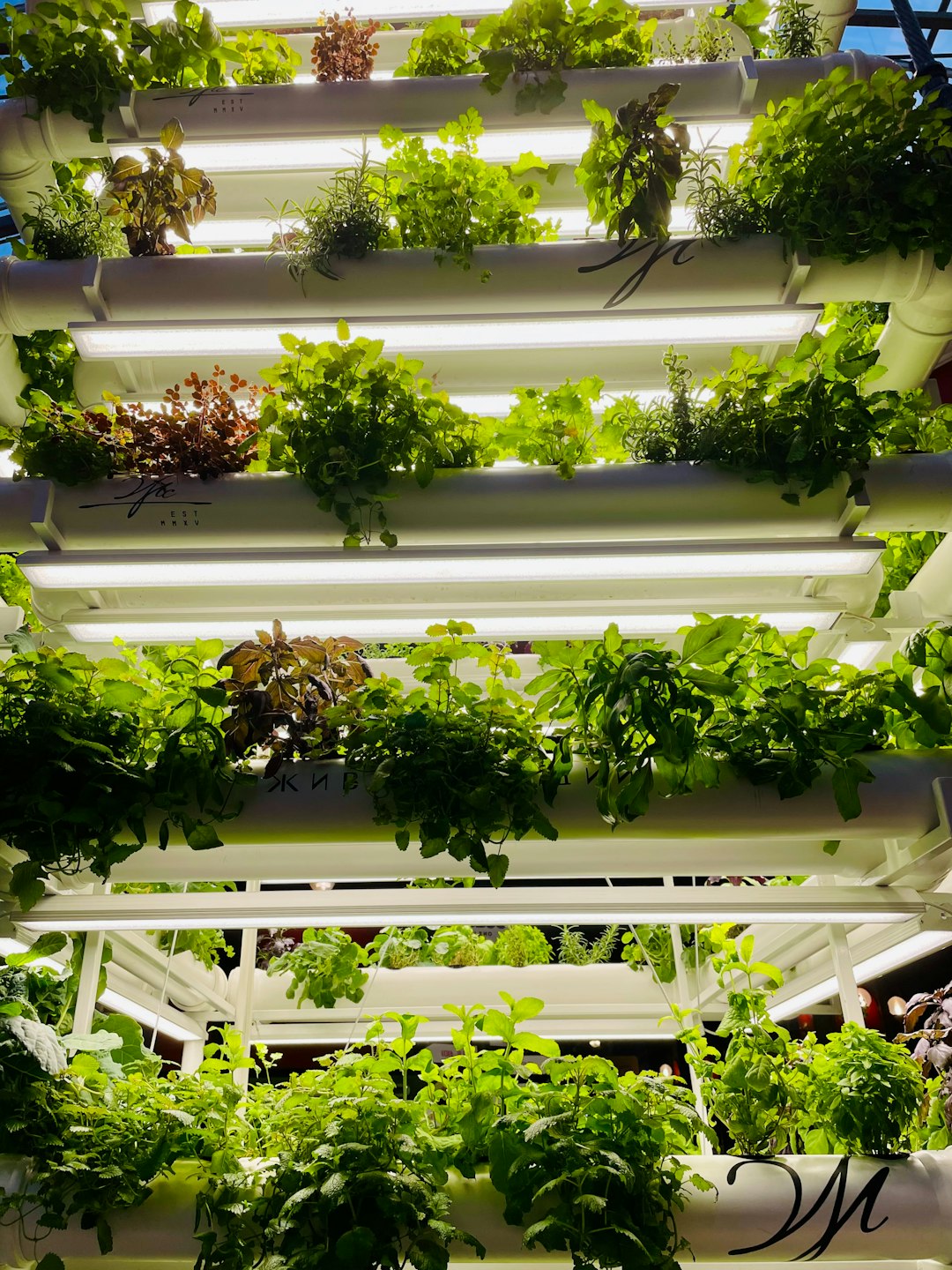
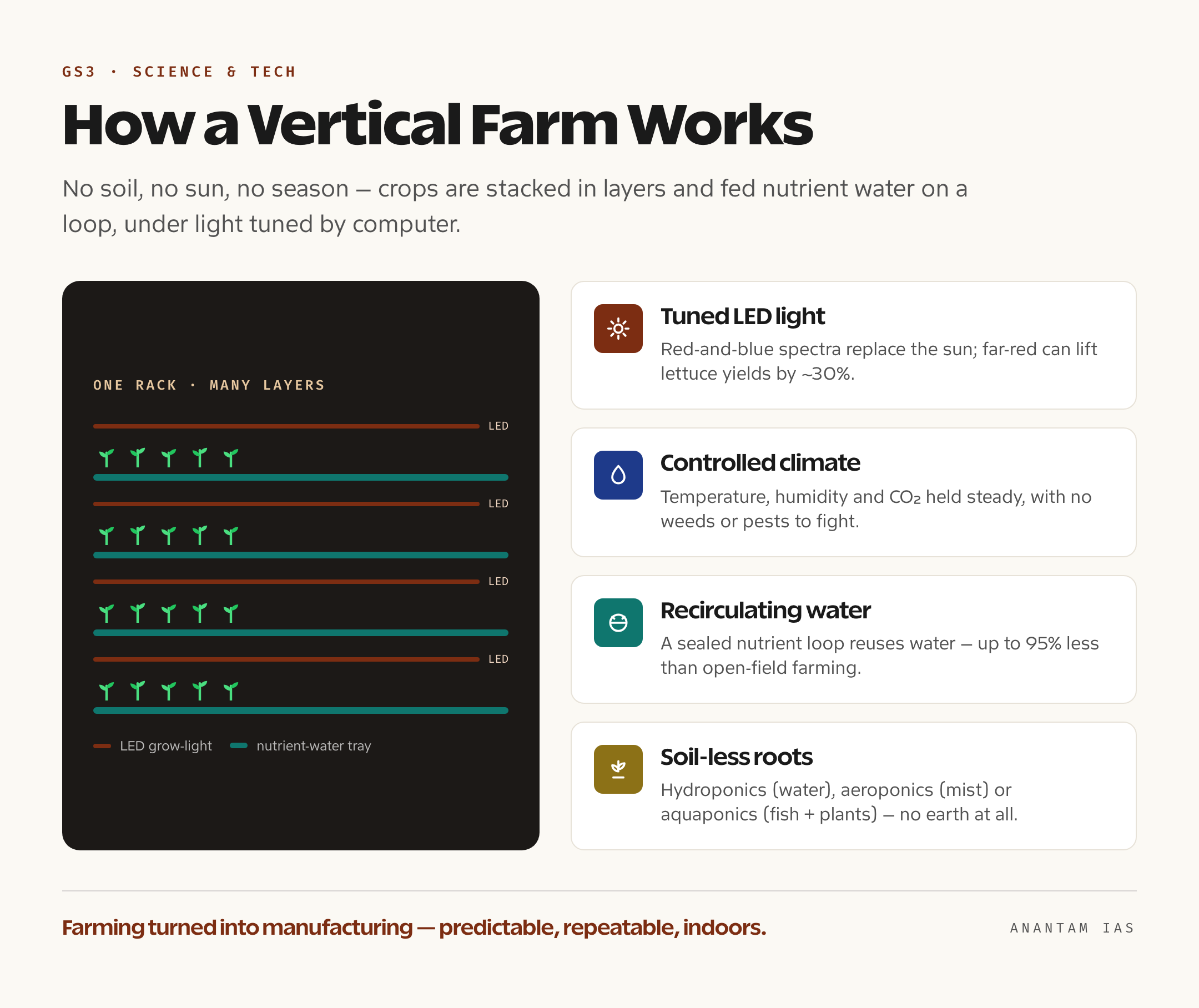
Picture a windowless warehouse on the edge of a city. Inside, there’s no soil, no tractor, no sky — just rack after rack of lettuce climbing twelve shelves high, bathed in pink-purple LED light, roots dangling in a thin film of nutrient water that never stops circulating. No rain falls here and no season passes; the temperature, the humidity, even the recipe of light each plant receives are set by a computer. This is vertical farming, and the basic promise is seductive: grow a salad’s worth of greens on a shelf, stack the shelves, and you can feed a neighbourhood from a footprint the size of a parking lot, using a fraction of the water and not a drop of pesticide.
The promise is real, but so is the catch — and over the past two years that catch has played out in public. Some of the world’s best-funded vertical-farming startups have collapsed even as the technology itself kept improving. For a UPSC aspirant, that tension is exactly what makes the subject worth knowing. Vertical farming sits at the meeting point of science and technology, agriculture, urbanisation, water stress and climate resilience, and it rewards a candidate who can do the harder thing — explain why something so clever is also, for now, so limited. The honest answer isn’t “miracle” or “hype.” It’s “a powerful niche tool,” and learning to say that precisely is the whole game.
What Vertical Farming and Controlled-Environment Agriculture Mean
Start with the words, because the exam loves the distinction. Vertical farming is the practice of growing crops in vertically stacked layers — shelves, racks or towers — rather than spread across a horizontal field. It is one branch of a larger family called Controlled-Environment Agriculture, or CEA: any system where you grow plants indoors and engineer the conditions around them instead of accepting whatever nature provides. A glass greenhouse is the oldest, gentlest form of CEA. A fully enclosed, artificially lit indoor “plant factory” is the most extreme. Vertical farming, in its purest sense, is that extreme end — a sealed building where every input is controlled and crops are stacked to multiply the growing area per square metre of ground.
The defining feature is that these farms are almost always soil-less. Instead of earth, the roots are fed directly with a water-based nutrient solution, and there are three main methods worth naming. Hydroponics, the most common, suspends the roots in or above flowing nutrient water. Aeroponics goes a step further and feeds the roots with a fine nutrient mist, using even less water. Aquaponics closes a loop by pairing fish with plants — the fish waste fertilises the crops, and the plants clean the water for the fish. Across the industry, hydroponics and aeroponics now account for the bulk of new installations, because they let growers deliver nutrients with surgical precision and recycle almost all the water.
The other half of “controlled environment” is the climate and the light. With no sun, the plants live entirely under LED grow-lights, and this is where the modern science gets interesting. Light-emitting diodes can be tuned to emit specific wavelengths — heavy on the red and blue that drive photosynthesis — so growers are no longer just lighting a room; they’re writing a light recipe for each crop. Researchers have found, for instance, that adding far-red light can lift lettuce yields by roughly 30 per cent, while more blue light can improve a crop’s shelf-life and nutritional quality. Around that core sit climate controls for temperature, humidity and carbon dioxide, plus a dense web of sensors feeding data to AI and automation software that constantly tweaks the watering, the lighting and the airflow. Robotic arms and conveyors increasingly handle the planting and harvesting too. The result is farming turned into something closer to manufacturing — predictable, repeatable and indoors.
Why It Appeals: Water, Land, Pesticides and the City
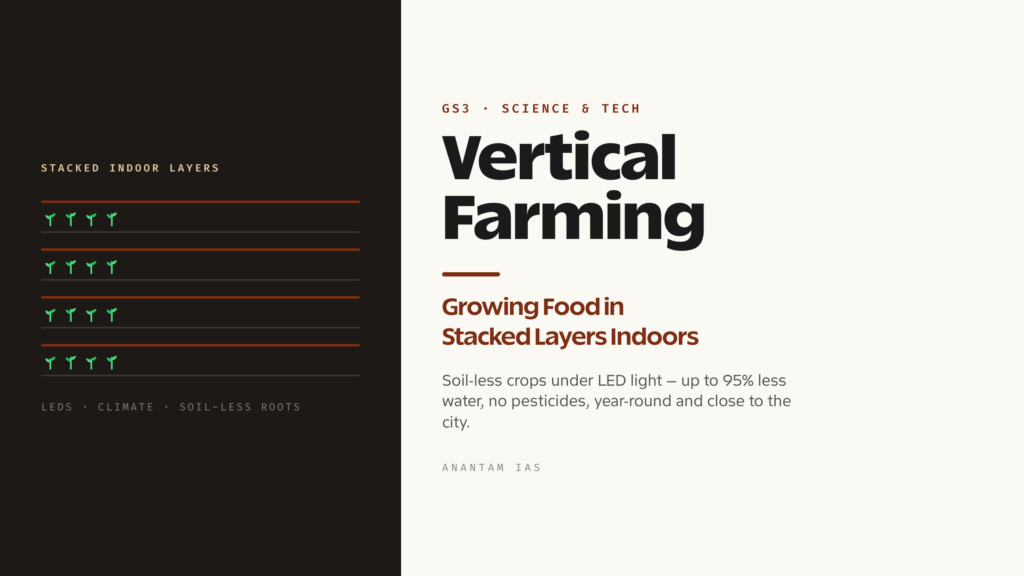
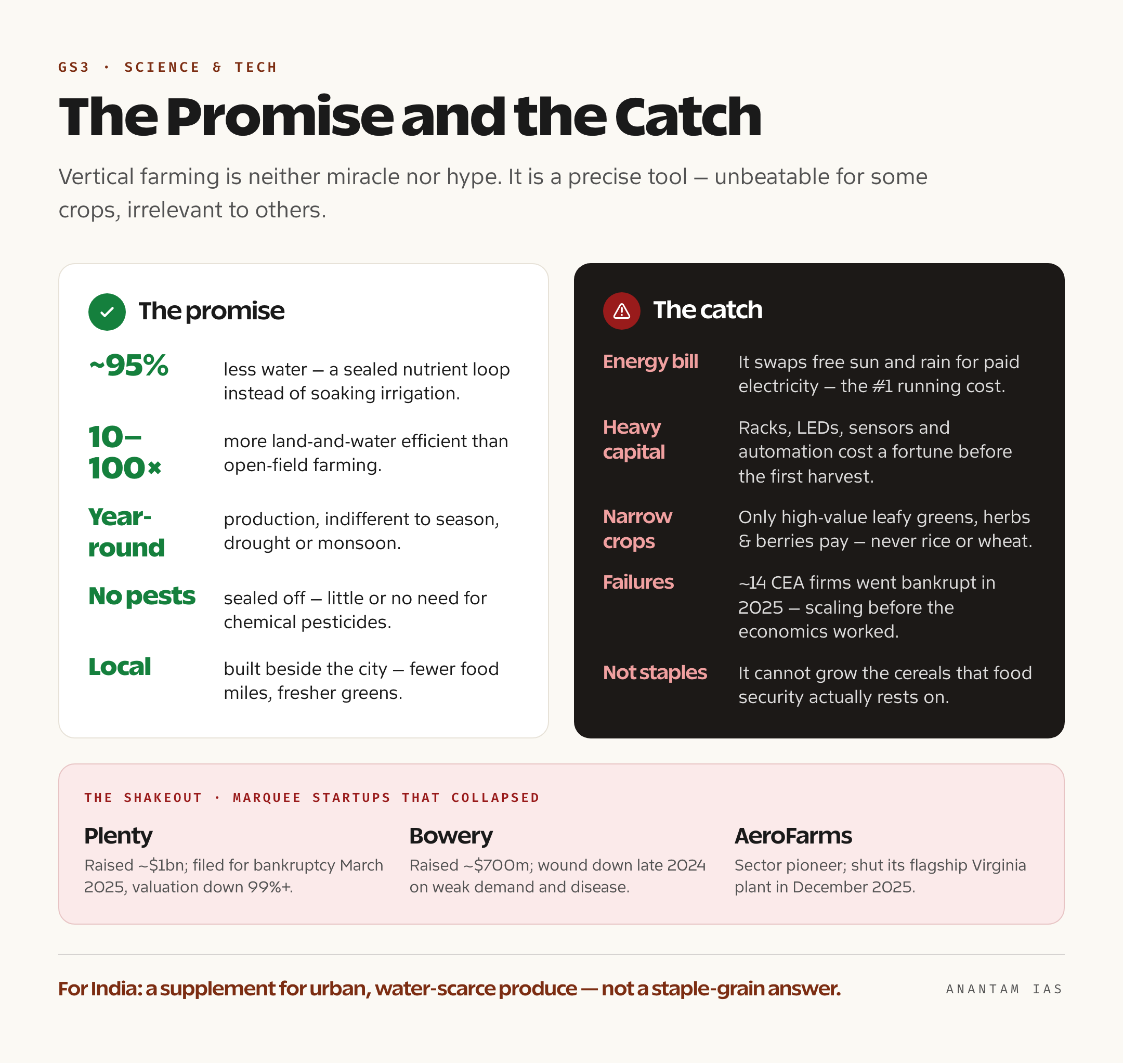
Now the case for the technology, which is genuinely strong on its own terms. The headline number is water. Because a vertical farm recirculates its nutrient solution in a sealed loop instead of letting irrigation soak into the ground and evaporate, it can use up to 90 to 95 per cent less water than open-field farming to grow the same crop. In a country where agriculture swallows the lion’s share of freshwater and where whole regions face groundwater stress, that figure alone is enough to make planners pay attention. Indian operators echo it directly — Hyderabad-based UrbanKisaan, for example, claims to grow many times more produce than a conventional field while using around 95 per cent less water.
Then there’s land, and the maths of stacking. A field gives you one growing layer; a vertical farm gives you ten or twelve in the same floor area, and it can run all twelve year-round regardless of the season outside. Put those together and analysts describe vertical systems as using land and water somewhere between ten and a hundred times more efficiently than field farming, with crop cycles that don’t pause for winter or wait for the monsoon. Because the whole thing is sealed off from the outside world, there are no weeds and almost no pests, which means little or no need for chemical pesticides — a real draw for the growing market of buyers who want clean, residue-free greens.
The last advantage is location, and it is the one that matters most for a crowded, urbanising India. A vertical farm doesn’t need fertile land or a particular climate, so it can be built right where the eaters are — inside or beside a city. That collapses the supply chain. Instead of leafy greens travelling hundreds of kilometres from farm to market, wilting and losing nutrients and racking up “food miles” along the way, they can be harvested the morning they’re sold, a few streets away. Shorter chains mean less spoilage, fresher produce and a degree of insulation from droughts, floods and the increasingly erratic weather of a warming planet. For places with little arable land — think Singapore, which grows only a sliver of its own food and is targeting 30 per cent of its nutritional needs locally, or the water-scarce Gulf — that climate-proof, build-it-anywhere quality is the entire appeal. This is also why vertical farming keeps coming up alongside the broader role of agritech in India’s farm modernisation story.
The Hard Limit: Energy, Capital and a String of Failures
So if it saves all that water and land, why isn’t the country covered in plant factories? Because vertical farming makes a brutal trade. It replaces two things nature provides for free — sunlight and rain — with two things you must pay for, electricity and engineered systems. Those LEDs running for fourteen-plus hours a day, plus the pumps, the air-conditioning and the dehumidifiers, turn energy into the single largest operating cost of almost every indoor farm. And the building itself, packed with racks, lights, sensors and automation, demands enormous upfront capital before a single leaf is sold. The economics only close if the crop fetches a high enough price to cover that energy-and-capital bill — and most crops simply don’t.
This is the limitation that has humbled an entire industry, and the recent record is sobering rather than triumphant. In March 2025, the American startup Plenty filed for bankruptcy after raising close to a billion dollars, its valuation having collapsed by more than 99 per cent from a peak near $1.9 billion. Bowery Farming, which had raised around $700 million, wound down its operations in late 2024 after weak demand and a plant-disease outbreak in its supposedly sterile facilities. AeroFarms, long the poster child of the sector, climbed out of one bankruptcy only to shut its flagship Virginia plant in December 2025. By one tally, fourteen controlled-environment companies went bankrupt during 2025 alone. Across these collapses the autopsy reads the same every time: the firms scaled up faster than their unit economics worked, and energy bills plus debt service ate them alive.
There’s a second limit hiding inside the first, and it’s the one aspirants most often miss. Vertical farming today is viable almost only for low, light, fast-growing, high-value crops — leafy greens, herbs, microgreens, the odd strawberry or cherry tomato. These plants are short, so they stack well; they grow in days, so they cycle fast; and they sell at a premium, so they can carry the energy cost. Now try the same with wheat, rice or maize. Staple cereals are tall, slow, low-value and grown by the hundred-million-tonne — exactly the wrong shape for a shelf, and nowhere near valuable enough per kilo to justify lighting them artificially. No serious analyst expects vertical farms to grow India’s grain. That single fact reframes the whole debate: vertical farming is not a replacement for agriculture as we know it. It is a specialist tool for a narrow, valuable slice of what we eat.
The Technology Is Still Improving — and Still Maturing
It would be a mistake, though, to read the bankruptcies as proof the idea is dead. The more careful reading, argued by researchers at University College London among others, is that vertical farming is simply an early-stage technology moving through the familiar boom-and-shakeout cycle that follows almost every new tech — a wave of hype and over-funding, a painful correction, then a leaner, smarter survivor phase. The companies that collapsed were often felled by their own ambition and by the spike in energy prices and interest rates of recent years, not by anything fatal in the science. The technology itself kept getting better right through the crash.
Several trends are pushing the economics in the right direction. LEDs keep getting more efficient and cheaper per unit of light, shaving the biggest cost line. The tunable-spectrum research means growers can extract more yield and quality from the same electricity. AI and automation are trimming labour and waste by managing each crop more precisely than any human could. And crucially, as renewable power gets cheaper, the energy that is vertical farming’s Achilles heel becomes less punishing — a farm running on cheap solar is a very different business from one running on expensive grid power in California. The survivors, tellingly, are the operators who stayed disciplined: building near their customers, focusing on the few crops that genuinely pay, and treating energy as the number to beat rather than an afterthought.
It also helps to remember that controlled-environment growing is not some untested fantasy. High-tech hydroponic greenhouses — a gentler form of CEA that still uses the sun — have been run commercially for decades, and they helped turn the tiny Netherlands into one of the world’s largest food exporters. Vertical farming is the more intensive, fully indoor cousin of that proven approach, not a leap into the unknown. The question was never whether you can grow plants this way; you clearly can. The question is whether you can do it cheaply enough, for the right crops, in the right places — and the answer is steadily, if slowly, becoming yes.
The India Angle: A Supplement, Not a Staple
For India, the honest framing is the one that wins marks: vertical farming is a promising supplement to the food system, not the answer to the country’s food security. India’s food security rests on staple cereals — rice and wheat produced at vast scale and distributed through the public system — and as the larger picture of food security in India shows, that grain story cannot and will not move indoors. Vertical farming has nothing to offer the rice paddy. Where it can genuinely help is at the edges: supplying fresh, clean leafy vegetables and herbs to dense cities, cutting the water draw in stressed regions, and giving urban consumers pesticide-free produce grown a few kilometres away.
A small but real Indian ecosystem has already grown up around exactly this niche. Startups such as UrbanKisaan in Hyderabad and Bengaluru, Triton FoodWorks in the north, and Barton Breeze are running hydroponic and vertical setups that grow greens, microgreens, strawberries and bell peppers for city markets, with several reporting water savings in the 90-to-95-per-cent range and far lower chemical use. Some sell turnkey systems; some sell the produce; some are experimenting with compact home farms. India’s broader push on hydroponics and CEA is being driven by the same forces analysts cite worldwide — fast urbanisation, shrinking and fragmenting farmland near cities, rising food-safety concern, and water stress — and market trackers expect the segment to keep growing at a brisk double-digit pace, even if from a small base.
The realistic verdict is the balanced one. Vertical farming will not feed India, and any answer that claims it might is overreaching. But as one piece of a modern agritech toolkit — alongside drip irrigation, drones, precision farming and protected cultivation — it has a clear, defensible role: green vegetables for water-scarce and land-scarce urban India, grown clean and grown close. The smart policy stance is neither breathless nuclear-grade enthusiasm nor blanket dismissal. It is to back the technology for what it does well, keep public money out of the kind of over-scaled bets that bankrupted the global pioneers, and let it earn its place crop by crop. That is the spirit in which a serious candidate should write about it.
For Your Mains Answer
This is a flexible, high-value topic that lives mainly in GS Paper 3 — under science and technology (developments and applications), agriculture (cropping patterns, technology missions, farm efficiency), and the environment (sustainable resource use and climate resilience). It can also feed a GS3 economy answer on agritech and urban food systems, and it offers a clean, current example for the Essay paper on themes like technology and food, sustainability, or innovation and its limits. The skill the examiner rewards here is balance: pair the genuine advantages with the hard economic limit, and never let the answer drift into hype.
How to Build the Answer
Define first, evaluate second. Open by defining vertical farming as stacked, indoor, usually soil-less CEA, then lay out the benefits in a tight chain — water, land, no pesticides, local and year-round, climate-resilient. Pivot on the word “but”: the energy-and-capital cost is the binding constraint, which is why the model only suits high-value leafy crops and why marquee startups failed. Then resolve the tension — the technology is still improving and maturing, so the failures are a shakeout, not a verdict. Close with the India-specific judgement: a supplement for urban, water-scarce contexts, not a substitute for staple-grain food security. That arc — define, benefits, the catch, the trajectory, the India verdict — fits almost any question on the topic.
Common Mistakes to Avoid
Don’t present vertical farming as a solution to India’s food security; the staples it can’t grow are the whole of food security. Don’t ignore the cost problem — an answer that lists only benefits reads as a brochure, not analysis. Don’t confuse the recent bankruptcies with the technology failing; the science improved while the businesses collapsed, and saying so shows nuance. And don’t blur the methods — keep hydroponics (water), aeroponics (mist) and aquaponics (fish-plus-plants) distinct, because mixing them up signals shaky preparation.
A Compact Answer Spine
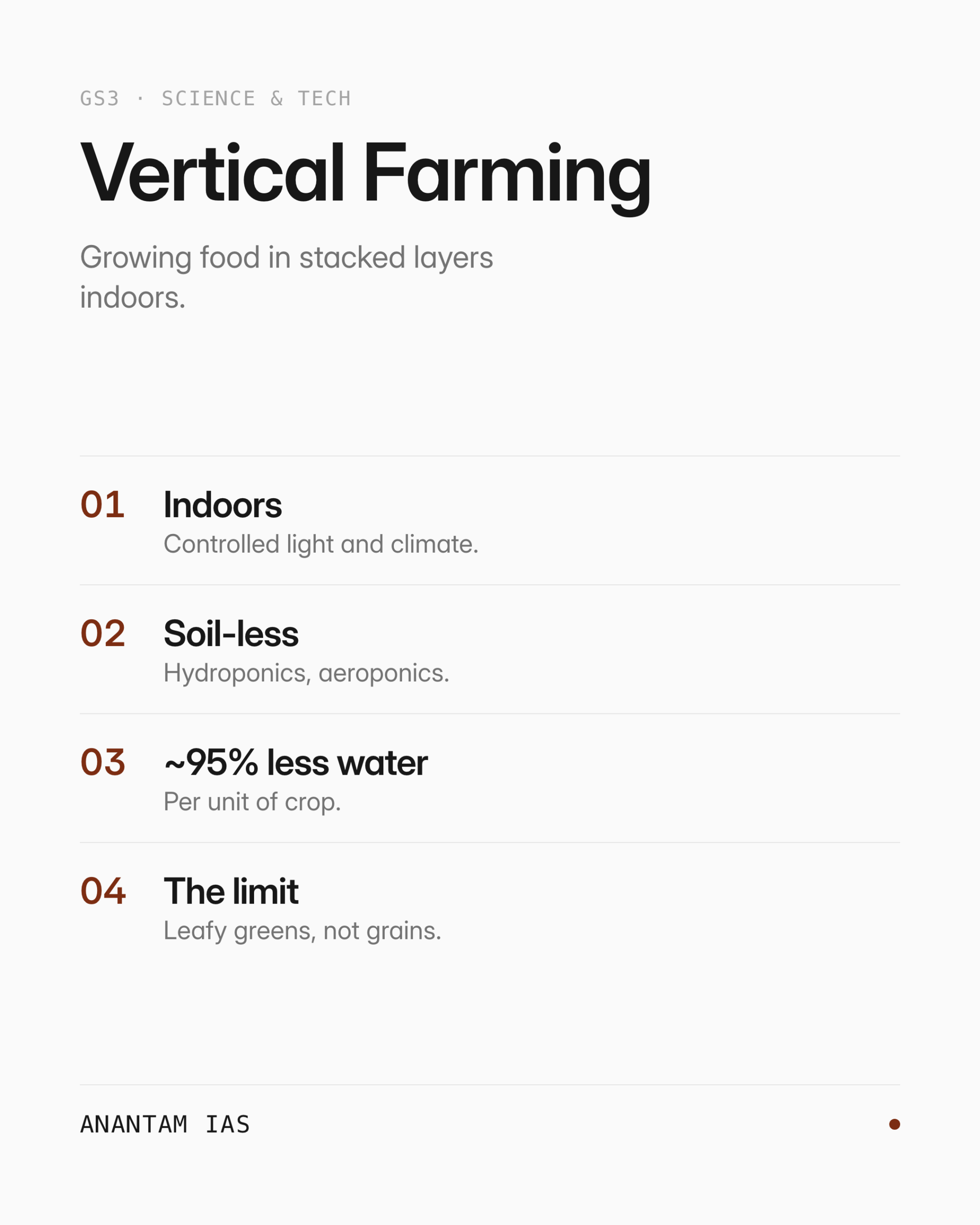
Vertical farming = crops in stacked indoor layers, soil-less (hydroponics/aeroponics/aquaponics), under tuned LEDs and AI-controlled climate → benefits: up to ~95% less water, 10-100× land-and-water efficiency, no pesticides, local and year-round, climate-resilient → the catch: it swaps free sun and rain for paid electricity and capital, so energy is the top cost → viable only for high-value leafy greens/herbs, not staple cereals; Plenty, Bowery and AeroFarms all failed on energy and over-scaling → but the tech keeps improving (efficient LEDs, tunable spectra, cheaper renewables, AI) → India verdict: a supplement for urban, water-scarce produce (UrbanKisaan, Triton, Barton Breeze), not a staple-grain answer.
Diagram or Flowchart Idea
Sketch a simple two-part visual. On one side, a vertical farm cross-section: stacked shelves with crops, LED bars above each layer, and a labelled loop showing recirculating nutrient water — the “how it works.” On the other, a balance scale or two-column table weighing benefits (water, land, no pesticide, local) against costs (energy, capital, crop range). The contrast itself communicates the balanced verdict at a glance and takes seconds to draw.
A Balanced-Conclusion Line
A line that lands the marks: “Vertical farming is best understood not as the future of farming but as a precise tool within it — unbeatable for clean greens in a water-stressed city, irrelevant to the grain that underpins food security, and worth backing only with clear eyes about its energy bill.”
How to Use Data Without Cramming
You need only a handful of anchors, not a spreadsheet: up to 95 per cent less water, ten-to-a-hundred-times land-and-water efficiency, far-red light lifting lettuce yields by about 30 per cent, and the trio of failures (Plenty’s near-$1-billion raise, Bowery’s ~$700 million, fourteen CEA bankruptcies in 2025). Attribute plainly — “as researchers at UCL noted,” “industry operators such as UrbanKisaan claim” — rather than scattering numbers without a home.
Frequently Asked Questions
What exactly is vertical farming, and how is it different from a greenhouse?
Vertical farming grows crops in stacked layers — shelves, racks or towers — inside a building, usually without soil, with the roots fed by a water-based nutrient solution and the plants lit by LEDs. It is the most intensive form of Controlled-Environment Agriculture (CEA), the broader family of growing indoors under engineered conditions. A greenhouse is a gentler CEA cousin: it still uses sunlight and is typically a single growing level, whereas a true vertical farm is fully enclosed, artificially lit and stacked many layers high to multiply the area per square metre.
How much water and land does vertical farming actually save?
A lot, because the systems recirculate their nutrient water in a sealed loop rather than letting irrigation soak away. Vertical and hydroponic farms can use up to 90 to 95 per cent less water than open-field farming for the same crop, and analysts estimate they use land and water somewhere between ten and a hundred times more efficiently overall, while running year-round and using little or no pesticide.
If it’s so efficient, why have so many vertical-farming companies gone bankrupt?
Because it replaces free sunlight and rain with expensive electricity and heavy upfront capital, and energy is the largest running cost. Many crops can’t be sold at a high enough price to cover that bill. Well-funded startups like Plenty, Bowery and AeroFarms scaled up before their economics worked and were sunk by energy costs and debt — about fourteen CEA firms went bankrupt in 2025. The technology kept improving even as the businesses failed, so analysts read it as an industry shakeout rather than the death of the idea.
Can vertical farming solve India’s food security?
No — and that’s the key point for an answer. Vertical farming today is viable mainly for high-value leafy greens, herbs and a few fruits, not for staple cereals like rice and wheat, which are tall, slow and far too cheap per kilo to grow under lights. India’s food security rests on those staples. Vertical farming can supplement the system by supplying clean, local vegetables to water-scarce, land-scarce cities, but it cannot replace field-grown grain.
Practice Questions
Prelims MCQs
- With reference to vertical farming, consider the following statements: 1) It typically grows crops in stacked layers without soil. 2) It relies on natural sunlight as its main light source. 3) It is a form of Controlled-Environment Agriculture.
Which of the statements are correct?
(a) 1 and 2 only
(b) 1 and 3 only
(c) 2 and 3 only
(d) 1, 2 and 3
Answer: (b) Vertical farming is stacked, usually soil-less CEA, but it relies on artificial LED light rather than the sun, so statement 2 is wrong. - Which of the following correctly matches the soil-less growing method with its technique?
(a) Aeroponics — roots suspended in flowing nutrient water
(b) Hydroponics — roots fed by a fine nutrient mist
(c) Aquaponics — fish waste fertilises plants that clean the water
(d) Hydroponics — crops grown in stacked soil beds
Answer: (c) Aquaponics pairs fish and plants in a closed loop; hydroponics uses nutrient water and aeroponics uses a nutrient mist. - The single largest operating cost for most fully indoor vertical farms is usually:
(a) Seeds and nutrients
(b) Energy for lighting and climate control
(c) Land rent
(d) Pesticides
Answer: (b) Because the farm replaces free sunlight with LEDs and adds climate control, energy is typically the biggest running cost — the main reason many ventures failed. - Vertical farming is presently considered commercially viable mainly for which type of crops?
(a) Staple cereals such as rice and wheat
(b) Oilseeds and pulses
(c) Low, fast-growing, high-value leafy greens and herbs
(d) Sugarcane and cotton
Answer: (c) Short, quick-cycling, premium crops like leafy greens, herbs and microgreens suit stacking and can carry the energy cost; tall, cheap staples cannot. - Which of the following are commonly cited benefits of vertical farming? 1) Up to around 95 per cent less water use. 2) Year-round production independent of season. 3) Reduced need for chemical pesticides. 4) Suitability for growing staple grains at scale. Select the correct answer.
(a) 1, 2 and 3 only
(b) 1, 2 and 4 only
(c) 2, 3 and 4 only
(d) 1, 2, 3 and 4
Answer: (a) The water, year-round and low-pesticide benefits are real; growing staple grains at scale is precisely what vertical farming cannot do, so statement 4 is wrong.
Mains Practice Questions
- Explain what is meant by Controlled-Environment Agriculture, and examine why vertical farming is often described as a promising supplement to — rather than a substitute for — conventional agriculture. (15 marks, 250 words)
- “Vertical farming swaps the free gifts of sunlight and rain for the paid inputs of electricity and capital.” In light of recent business failures in the sector, critically analyse the economic viability of indoor vertical farming. (15 marks, 250 words)
- Discuss the relevance of vertical farming and hydroponics for an urbanising, water-stressed India. What role can such technologies play within the country’s wider agritech ecosystem? (15 marks, 250 words)
- Distinguish between hydroponics, aeroponics and aquaponics as soil-less growing techniques, and assess how advances in LED lighting and artificial intelligence are improving their efficiency. (10 marks, 150 words)
- Vertical farming cannot grow India’s staple cereals but can transform urban vegetable supply. Evaluate this statement in the context of food security, sustainable resource use and climate resilience. (15 marks, 250 words)
Tell Google you want more of this.
Add Anantam IAS as a preferred sourceOne tap, and this site shows up more often in your own Top Stories, AI Overviews and AI Mode. Remove it any time.