A windfall tax is a one-time or temporary levy imposed by a government on companies that earn unexpectedly large profits — often due to external circumstances beyond their control. The term "windfall" itself refers to an unearned, sudden gain, much like fruit blown down by the wind. In recent years, windfall taxes have become a globally significant fiscal tool, particularly targeting the oil and gas sector during periods of elevated crude prices.
For UPSC aspirants, windfall tax is a high-value topic that connects public finance, energy economics, and India's fiscal policy under GS Paper III (Economy).
How a Windfall Tax Works
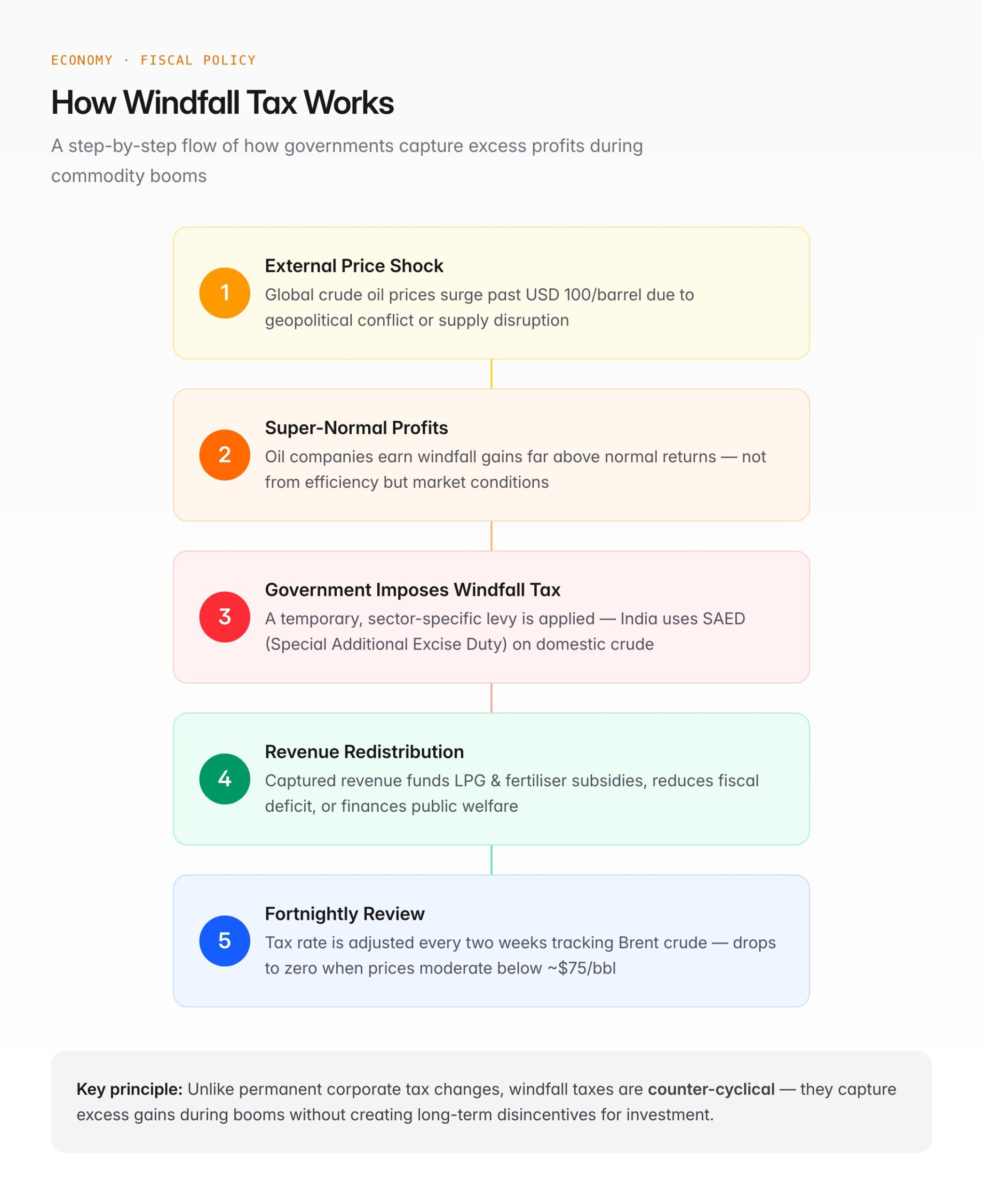
A windfall tax is triggered when a specific sector or set of companies earns profits that are substantially above normal levels due to favourable market conditions rather than operational efficiency. Governments argue that such extraordinary gains are partly a function of public resources (mineral rights, for example) and that the state is entitled to a share.
Key features of a windfall tax:
- Temporary in nature — applied only when prices or profits cross a defined threshold
- Sector-specific — typically targets extractive industries (oil, gas, mining)
- Revenue redistribution — proceeds are used for public welfare, subsidies, or fiscal deficit reduction
- Retrospective or prospective — can apply to past earnings or future profits above a benchmark
Unlike permanent corporate tax changes, windfall taxes are designed to be counter-cyclical, capturing excess gains during booms without creating long-term disincentives for investment.
India's Windfall Tax on Crude Oil
India introduced its windfall tax on July 1, 2022, through a Special Additional Excise Duty (SAED) on domestically produced crude oil and export duties on refined products. The move came after global crude oil prices surged past USD 100 per barrel following the Russia-Ukraine conflict.
What India Taxed
| Product | Mechanism | Initial Rate (July 2022) |
|---|---|---|
| Domestic crude oil | Special Additional Excise Duty (SAED) | Rs 23,250 per tonne |
| Diesel exports | Export duty | Rs 13 per litre |
| ATF (Aviation Turbine Fuel) exports | Export duty | Rs 6 per litre |
| Petrol exports | Export duty | Rs 6 per litre (later removed) |
Fortnightly Review Mechanism
A distinctive feature of India's approach is the fortnightly revision of the SAED rate. The government reviews international crude oil prices every two weeks and adjusts the levy accordingly. When crude prices fall, the tax rate is reduced — sometimes to zero. When prices rise, the tax is increased.
This mechanism ensures that the tax is responsive to market conditions and does not permanently burden producers.
Why India Imposed the Tax
- Revenue capture — domestic oil producers like ONGC, Oil India, and Vedanta were earning extraordinary profits from high global prices while selling crude at international benchmarks
- Subsidy offset — the government needed revenue to fund LPG and fertiliser subsidies without expanding the fiscal deficit
- Refinery export control — private refiners like Reliance Industries and Nayara Energy were exporting refined products at high margins while domestic supply was constrained
Impact on Companies
- ONGC and Oil India saw reduced net realisations per barrel of crude produced domestically
- Reliance Industries faced lower export margins on diesel and ATF
- Industry bodies argued the tax discouraged upstream investment in exploration and production
- The government countered that the tax was temporary and responsive to price movements
India's Windfall Tax Timeline
| Period | Key Development |
|---|---|
| July 2022 | Windfall tax introduced via SAED on crude and export duties on fuels |
| Aug-Dec 2022 | Rates revised fortnightly; petrol export duty removed |
| 2023 | SAED on crude periodically set to zero when prices moderated |
| 2024 | Tax continued with frequent rate adjustments based on crude benchmarks |
Global Examples of Windfall Taxes
Several countries have imposed windfall taxes on energy companies, especially after the 2021-2022 energy price surge.
| Country | Year | Details |
|---|---|---|
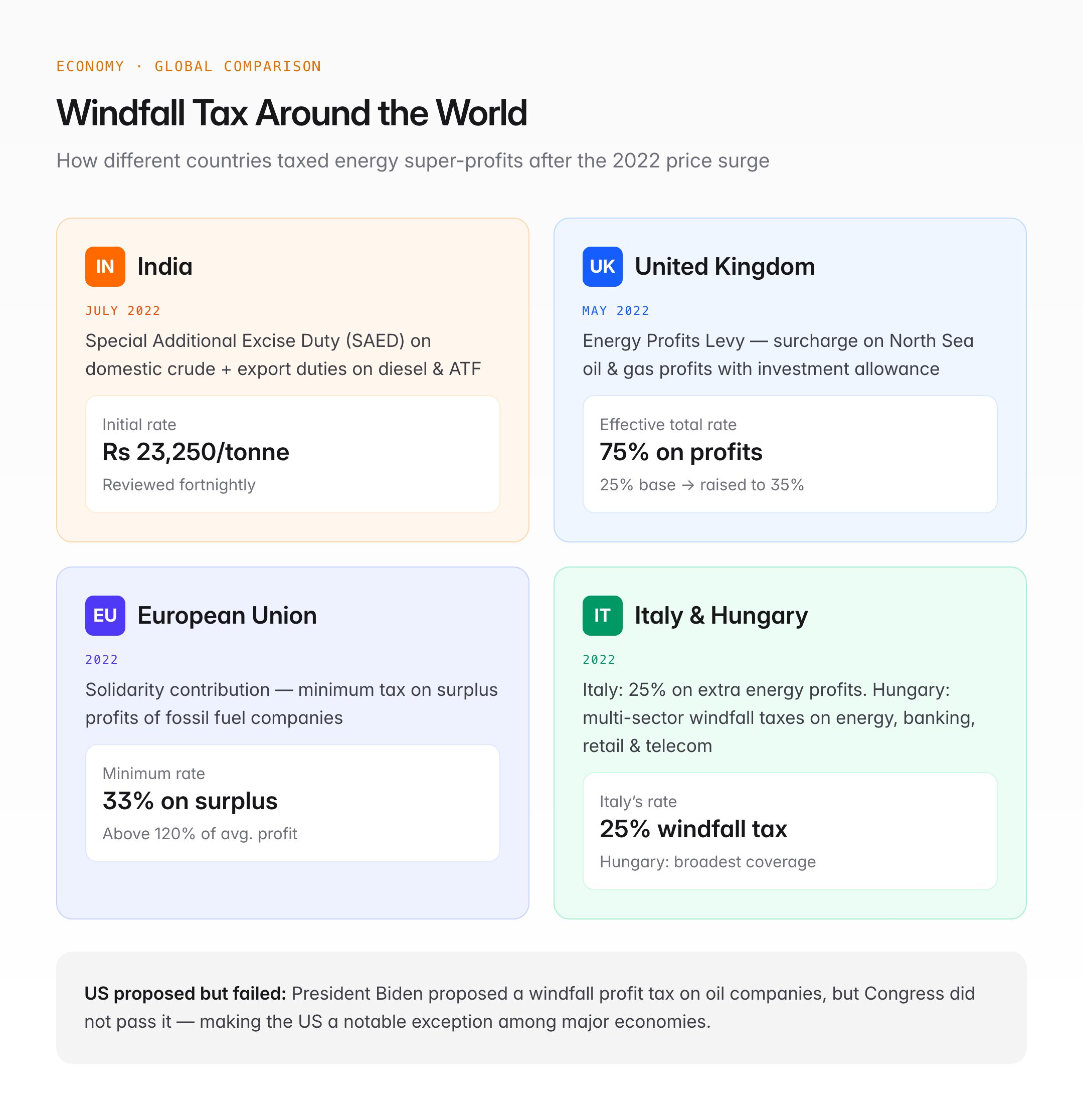
| United Kingdom | 2022 | Energy Profits Levy — 25% surcharge on oil and gas profits (later raised to 35%) |
| European Union | 2022 | Solidarity contribution — minimum 33% tax on surplus profits of fossil fuel companies |
| Italy | 2022 | 25% windfall tax on extra profits of energy companies |
| Hungary | 2022 | Windfall taxes on energy, banking, retail, and telecom sectors |
| United States | Proposed | President Biden proposed but Congress did not pass a windfall profit tax on oil companies |
UK Energy Profits Levy — A Closer Look
The UK's Energy Profits Levy is one of the most discussed global examples. Originally set at 25% in May 2022, it was raised to 35% in November 2022, bringing the total effective tax rate on North Sea oil and gas profits to 75%. The levy includes an investment allowance to incentivise continued capital expenditure.
Arguments For and Against Windfall Taxes
| In Favour | Against |
|---|---|
| Captures unearned super-profits for public benefit | Discourages long-term investment in the sector |
| Helps fund subsidies without increasing fiscal deficit | Creates policy uncertainty for investors |
| Progressive — taxes those who can most afford to pay | Difficult to define "windfall" objectively |
| Counter-cyclical revenue tool | May reduce domestic production, increasing import dependence |
| Addresses inequity during price shocks | Companies may pass the cost to consumers |
Economic Concepts Connected to Windfall Tax
- Resource rent — the concept that natural resources belong to the nation and excess profits from their extraction should accrue to the state
- Tax buoyancy — windfall taxes improve short-term tax buoyancy without structural tax reform
- Fiscal policy — windfall taxes are a discretionary fiscal tool used during external shocks
- Dutch Disease — windfall revenues, if not managed carefully, can lead to currency appreciation and harm non-resource sectors
Calculation Method for India's SAED
India's SAED on domestic crude is calculated based on the difference between the average international crude oil price and a threshold price. The government does not publish an explicit formula, but the fortnightly reviews track Brent crude movements closely. When Brent falls below approximately USD 75 per barrel, the SAED tends to be set at zero.
For exported refined products, the duty is a specific rate (per litre) rather than ad valorem, which simplifies collection but requires frequent recalibration.
Revenue Implications
India's windfall tax generated an estimated Rs 25,000-30,000 crore in its first year of implementation. While this is modest relative to total central revenues (approximately 1-2% of gross tax revenue), it provided targeted fiscal space for subsidy expenditure and deficit management.
The fortnightly revision mechanism means revenue from this source is volatile and cannot be relied upon for structural budgetary commitments.
UPSC Relevance
GS Paper Mapping
| Paper | Topic | Connection |
|---|---|---|
| GS Paper III | Indian Economy — Fiscal Policy | Windfall tax as a revenue and redistribution tool |
| GS Paper III | Effects of Liberalisation | Impact on oil sector investment and FDI |
| GS Paper III | Infrastructure — Energy | Crude oil pricing, refinery economics |
| GS Paper II | Government Policies | Petroleum sector regulation, pricing reform |
Key Points for Prelims
- Windfall tax is a temporary tax on unexpected super-profits, not a permanent levy
- India's windfall tax was introduced in July 2022 as a Special Additional Excise Duty (SAED)
- It applies to domestically produced crude oil and initially to exports of diesel, ATF, and petrol
- The SAED rate is reviewed fortnightly based on international crude oil prices
- The UK imposed an Energy Profits Levy in 2022; the EU imposed a solidarity contribution
- Windfall taxes are linked to the economic concepts of resource rent and counter-cyclical fiscal policy
- Key affected Indian companies: ONGC, Oil India, Reliance Industries
Tell Google you want more of this.
Add Anantam IAS as a preferred sourceOne tap, and this site shows up more often in your own Top Stories, AI Overviews and AI Mode. Remove it any time.