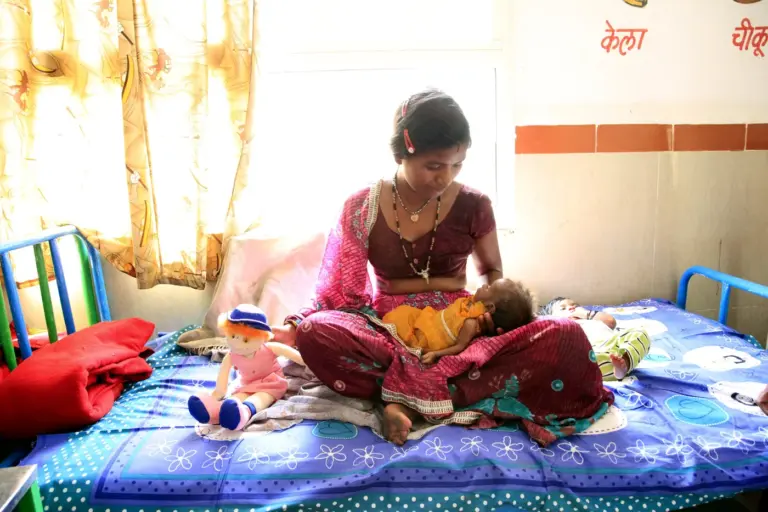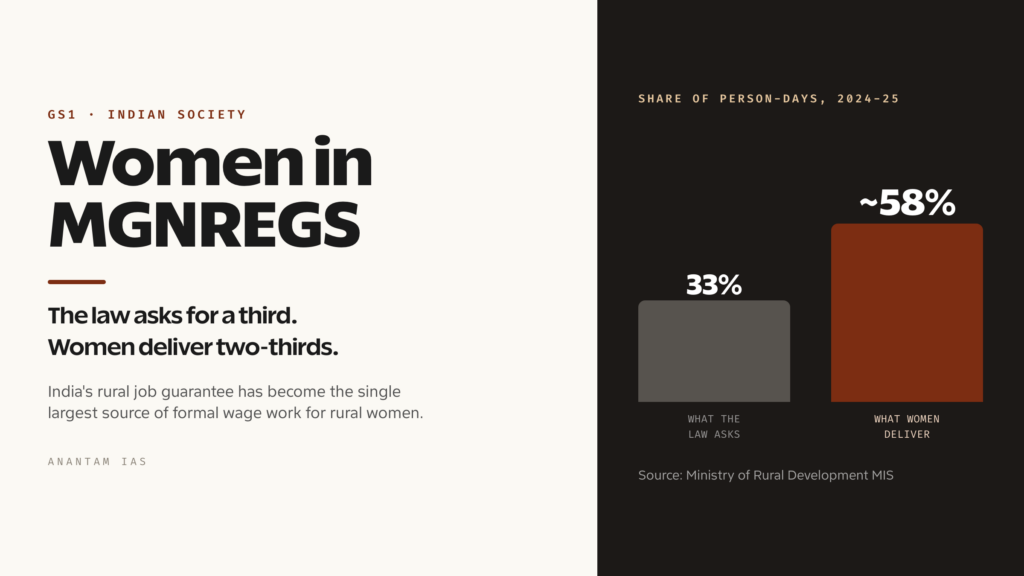
In the financial year 2024-25, women clocked roughly 58 of every 100 days of work generated under India’s rural job guarantee — about 440 lakh women workers turning up at worksites that dot nearly every gram panchayat in the country. No factory, farm or office employs rural Indian women on anything like that scale. The law asks for only a third. Women routinely deliver close to two-thirds.
That gap between the floor and the reality is the whole story. A scheme designed with a modest one-third quota has quietly become the largest single channel of cash wages into rural women’s hands, and through them into the nutrition, schooling and savings of their households. But the same scheme has spent five years on a frozen budget, has shed lakhs of job cards to a digital payment drive, and is now being wound up and replaced by a new law. So the question for any serious student is no longer “do women show up?” — they plainly do — but “what did that participation actually buy them, and what happens to it next?”
What the Scheme Promises Women
Start with the legal scaffolding, because the design explains the outcome. The Mahatma Gandhi National Rural Employment Guarantee Scheme — MGNREGS — is the programme that runs under the 2005 Act of the same name. It gives every rural household a legal entitlement to up to 100 days of unskilled manual wage work in a financial year, at a notified wage, within five kilometres of home, on demand. Miss the deadline to provide that work and the state owes an unemployment allowance. It is a rights-based guarantee, not a discretionary handout, and that distinction is the source of its power.
Now the gender clause. Section 6 and Schedule II of the Act build in a statutory floor: at least one-third — 33% — of beneficiaries must be women. The drafters treated that as a target to be reached. In practice it became a floor that women blew past almost immediately and have never dropped below at the national level. The Act also wires in three quieter provisions that matter more than the headline quota. Wages must be equal for men and women doing the same work — equal pay is not a courtesy here, it is a legal mandate. Worksites with more than five children below the age of six are meant to provide a creche and a designated minder. And wages must be paid into a worker’s own bank or post-office account, not handed over in cash to a male relative.
Put those four design choices together — local work, a legal right to it, equal pay, and money in a woman’s own name — and you have, almost by accident, one of the most consequential instruments of women’s economic participation that independent India has built. The participation numbers are not a happy surprise. They are what the design was always going to produce.
The Numbers: A Two-Thirds Workforce
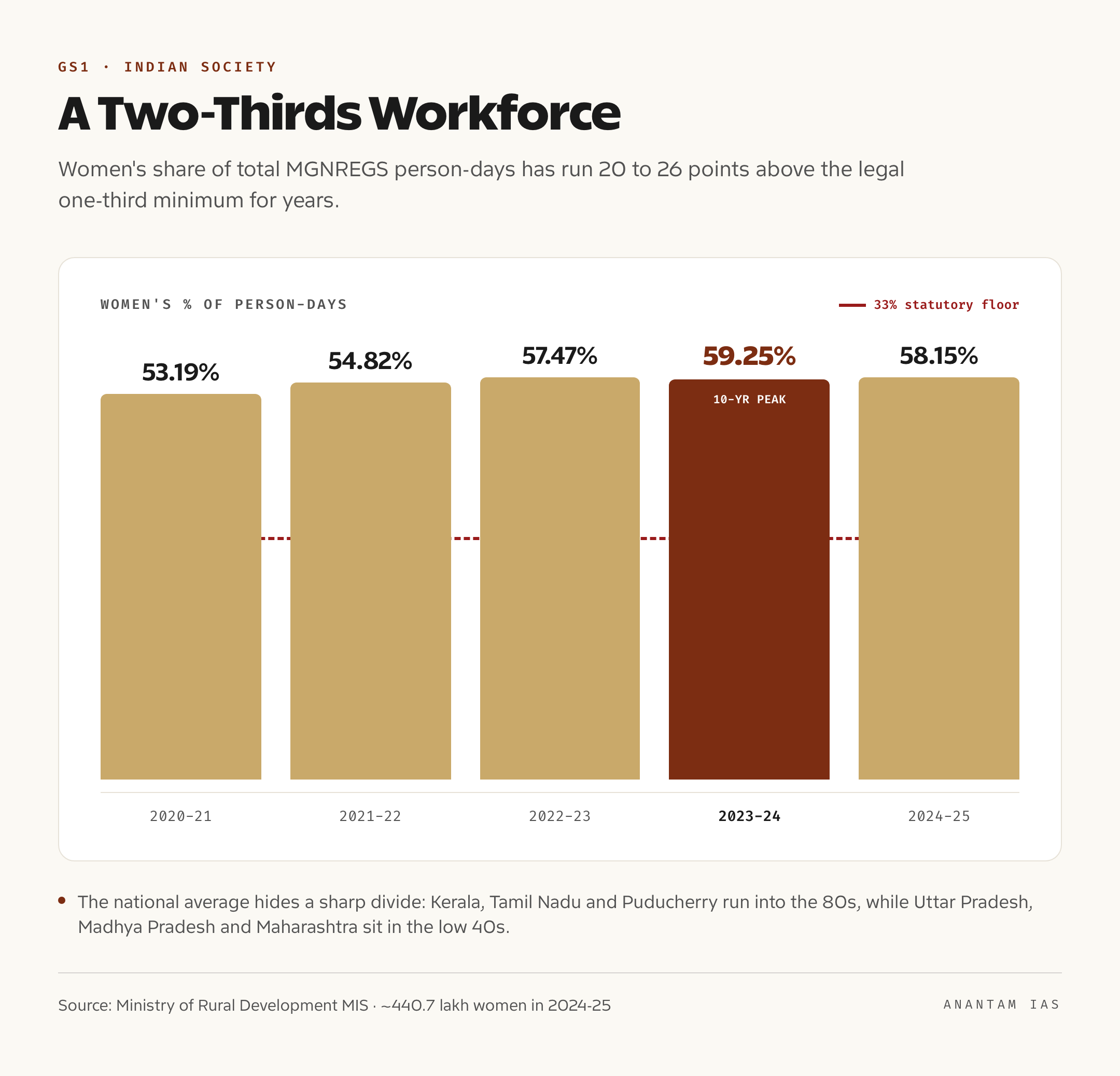
The trend line is clear and recent. Women’s share of total MGNREGS person-days, as the Ministry of Rural Development’s own management information system records it, sat at 53.19% in 2020-21 — itself a decade low, pulled down by the pandemic when distressed men flooded back to rural rolls. It then climbed every year: 54.82% in 2021-22, 57.47% in 2022-23, and a ten-year peak of 59.25% in 2023-24. In 2024-25 it eased slightly to 58.15%, with about 440.7 lakh women working under the scheme. Against a 33% floor, women have run between 20 and 26 percentage points above the minimum for years.
This sits inside a broader recovery in women’s work. The Periodic Labour Force Survey of the Ministry of Statistics and Programme Implementation shows the rural female labour force participation rate rising from 18.2% in 2017-18 to over 30% by the early 2020s, and MGNREGS is widely read as one of the engines behind that climb — it offers exactly the kind of local, flexible, socially acceptable work that pulls women off the sidelines and into measured employment.
But the national average hides a stark map. In Kerala, Tamil Nadu and Puducherry, women’s share of person-days runs into the 80s and even near 90% — Kerala’s figure has touched the high 80s, powered by the Kudumbashree women’s network that organises and dignifies the work. Andhra Pradesh, Telangana and the southern belt generally sit above 60%. Then the line drops. In Uttar Pradesh, Madhya Pradesh and Maharashtra, women’s share hovers in the low 40s; in Jammu and Kashmir it has been around 30%. The all-India figure of 58% is, in truth, the average of a deeply feminised south and a male-dominated Hindi-belt north. Any answer that quotes only the national number has missed the most examinable fact in the topic.
Why Women Choose This Work
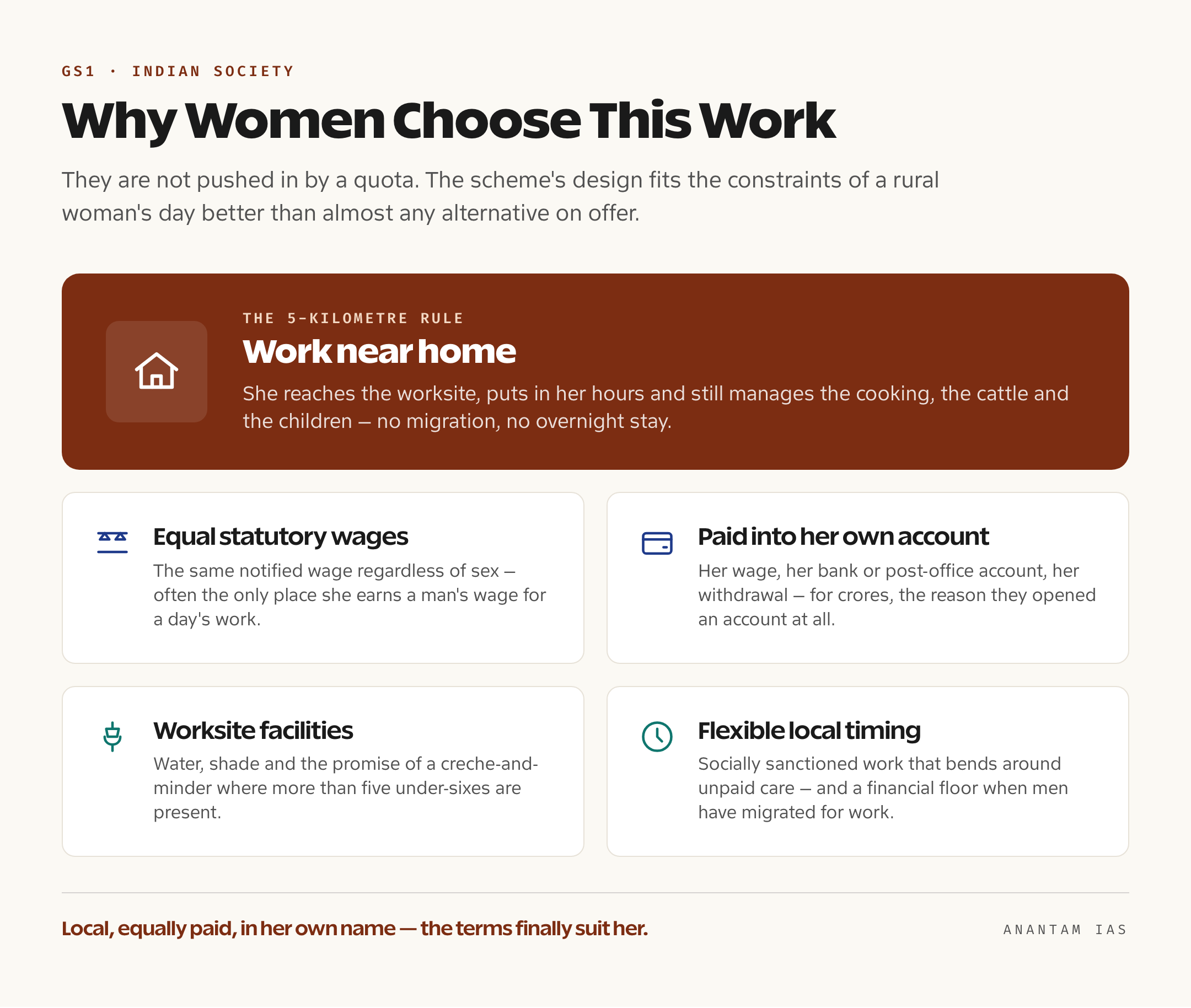
So why do women self-select into MGNREGS at rates that dwarf the quota? The honest answer is that the scheme fits the constraints of a rural woman’s day better than almost any alternative on offer.
Work near home is the first reason. The five-kilometre rule means a woman can reach the worksite, put in her hours and still manage the cooking, the cattle and the children. She does not have to migrate, board a bus to a distant town, or stay overnight away from her family. For women who carry the full weight of unpaid care work, geography is destiny — and MGNREGS keeps the work inside walking distance.
Equal pay is the second. In ordinary agricultural labour the gender wage gap is real and stubborn — men out-earn women for comparable tasks across most of rural India. MGNREGS pays the same notified wage regardless of sex, so for many women it is the only place they earn a man’s wage for a day’s work. Where the local farm wage for women is low, the scheme’s equal rate is a raise, and they vote with their feet.
Then comes money in her own name. Wages land in the worker’s own account, which for crores of women was the reason they opened a bank account at all. That single mechanical fact — her wage, her account, her withdrawal — is the quiet engine of empowerment that researchers keep returning to. Field studies, including work summarised by the Accountability Initiative, find that women exercise genuine independence in collecting and spending MGNREGS earnings, and that this translates into more say in household decisions, more bargaining power, and a documented tendency to steer the income toward children’s food, schooling and health. Add worksite facilities where they actually exist — water, shade, the promise of a creche — and flexible, socially sanctioned local work, and the picture is complete. Women are not being pushed into MGNREGS by a quota. They are pulling themselves in because, for once, the terms suit them.
There is a structural reason too, and it is worth naming. In households where men have migrated to cities for work, the woman who stays behind effectively becomes the head of a rural household. MGNREGS gives her a guaranteed, dignified earning option close to home, so distress does not force her to either migrate with small children or go without income. The scheme has become, in large parts of the country, the financial floor under the woman who keeps the village household running.
Where It Falls Short
A scheme this important deserves an honest accounting of its failures, and there are several that bite women hardest. The first is delayed wages. The law promises payment within fifteen days of the muster roll closing, with delay compensation of 0.05% of the unpaid wage per day from the sixteenth day onward. In practice, payments routinely run late, the compensation is frequently not paid, and a woman who waited weeks for her money learns to fall back on the local moneylender or an informal employer who at least pays on time. A guarantee that pays late is a weaker guarantee.
The second is the wage itself. MGNREGS wages were revised for 2025-26 to range from about ₹241 a day in states like Nagaland and Arunachal Pradesh to ₹400 in Haryana, with the national figure nudged up only modestly. In most major states the MGNREGS wage still sits below the state’s own minimum agricultural wage, so the “equal pay” promise is equal to a low number. For households scraping by, an under-indexed wage caps how much empowerment a hundred days can actually deliver.
The third is shrinking work and a frozen budget. The Union Budget has held the MGNREGS allocation flat at ₹86,000 crore for five years running — which, adjusted for inflation, is a real-terms cut of roughly ₹4,000 crore against the previous year, even before old arrears are deducted from the new pot. When the money runs short late in the financial year, work simply isn’t offered, and it is women — the marginal, flexible part of the workforce — who are turned away first.
The fourth is the digital squeeze. Since 1 January 2024 the Aadhaar-Based Payment System (ABPS) has been mandatory for wage payments, routing money through an Aadhaar-linked bank account. Around 97% of active workers were linked by March 2025, but the transition has been brutal at the margins. A single mismatch between a name on the job card, the Aadhaar database and the bank record can freeze a worker out, and a sudden spike of about 27 lakh job-card deletions between October and November 2025 — tied to a mandatory e-KYC drive — has alarmed researchers who track the scheme. The other digital layer, the National Mobile Monitoring System (NMMS), requires a supervisor to upload time-stamped, geotagged photographs of attendance twice a day from a smartphone. In patchy-network villages, and for women who do not own the phone, a failed upload can mean an unrecorded day and an unpaid one. Technology meant to plug leakages has, at the margins, become a new way to exclude the very women the scheme exists to reach. The Ministry maintains that no one can be denied work merely for failing ABPS — but the deletion data tells a harder story on the ground.
The Way Forward
The fixes are well understood; the gap is in execution. A pragmatic, balanced agenda would do six things.
- Pay on time and pay the compensation. Honour the fifteen-day rule and automatically credit the 0.05%-per-day delay compensation that the MIS already calculates. Nothing rebuilds trust faster than wages that arrive when promised.
- Index the wage to real prices. The Parliamentary Standing Committee on Rural Development has repeatedly urged linking MGNREGS wages to a current inflation index and moving toward parity with state minimum wages, so the “equal pay” promise stops being equal to a sub-poverty number.
- Protect, don’t punish, at the digital edge. Run ABPS and e-KYC as a help desk, not a guillotine — fix Aadhaar-bank mismatches before deleting a card, keep an offline NMMS fallback for no-network worksites, and audit deletions so genuine women workers are not silently dropped.
- Make worksite facilities real. Enforce the creche-and-minder rule, provide water, shade and safe sanitation, and treat these as non-negotiable line items rather than optional extras. Childcare at the worksite is the single most direct lever on women’s participation in the lagging northern states.
- Steer work toward women-friendly, asset-building tasks. Around 57% of MGNREGS assets in 2024-25 were individual assets, and natural-resource works — farm ponds, the 68,000-plus Amrit Sarovar water bodies, plantation and watershed jobs — both employ women well and leave durable assets behind. Linking these to women’s self-help groups under DAY-NRLM multiplies the livelihood return on every day worked.
- Guard the gains through the transition. As the scheme is replaced, the explicit one-third women’s floor, equal pay and own-account payment must be carried into the successor framework, not allowed to lapse in the rule-writing.
That last point is now urgent. In December 2025 Parliament passed the Viksit Bharat-Guarantee for Rozgar and Ajeevika Mission (Gramin) Act — VB-G RAM G — which received Presidential assent on 21 December 2025 and repeals the 2005 MGNREGA, with rollout planned from mid-2026. The new law raises the annual guarantee from 100 to 125 days and ties rural work more tightly to village development plans, skilling and climate-resilient asset creation. What it has so far been notably quiet about, in its headline provisions, is an explicit women’s reservation equivalent to the old 33% clause — which is precisely why women’s groups have flagged the transition as a moment of risk. Whether the next chapter protects the two-thirds workforce that MGNREGS built, or quietly lets the floor slip, is the live policy question of this decade.
For Your Mains Answer
This topic is a workhorse across the General Studies papers. It sits in GS Paper 1 under the role of women and women’s organisations and the issues of rural society; in GS Paper 2 under welfare schemes, government policies for vulnerable sections, and rights-based governance; and in GS Paper 3 under inclusive growth, employment and the rural economy. The same body of facts can be deployed in any of the three with a slight change of emphasis.
How to Build the Answer
Lead with the headline gap — a 33% legal floor against a real participation near 58% — because it frames the whole argument in one sentence. Then explain why the design produces that outcome (local work, equal pay, own-account wages), move to what it changes (financial inclusion, bargaining power, child-directed spending), confront the failures honestly (delayed wages, sub-minimum pay, frozen budget, ABPS and NMMS exclusion), and close on the live transition to the VB-G RAM G Act. That arc — design, outcome, impact, failure, future — works for almost any prompt on the topic.
Common Mistakes to Avoid
Don’t quote only the national figure and stop; the southern-vs-northern divide is where the marks are. Don’t present participation as proof of empowerment — high attendance with delayed, sub-minimum wages is participation without full empowerment, and saying so signals maturity. Don’t ignore the 2024-26 developments; an answer that doesn’t mention the budget freeze, ABPS deletions or the new Act reads as years out of date. And don’t drown the answer in statistics — two or three anchored numbers beat a wall of percentages.
A Compact Answer Spine
Rights-based guarantee with a 33% women’s floor → women actually deliver ~58% of person-days (2024-25), peaking at 59.25% in 2023-24 → why: local work, equal statutory pay, wages in her own account → impact: financial inclusion, bargaining power, child-directed spending → failures: delayed wages, sub-minimum rates, ₹86,000 crore frozen budget, ABPS/NMMS exclusion → way forward: index wages, protect at the digital edge, real creches, women-friendly assets → guard the floor through the VB-G RAM G transition.
Diagram or Flowchart Idea
Draw a simple two-bar comparison: a short bar at 33% labelled “what the law asks” beside a tall bar at ~58% labelled “what women deliver (2024-25),” with three arrows feeding the tall bar — “local work,” “equal pay,” “own account.” It captures the central paradox of the topic in one glance and is quick to sketch in the margin.
A Balanced-Conclusion Line
“MGNREGS proves that when work is local, equally paid and credited to a woman’s own account, rural women participate far beyond any quota — but participation matures into empowerment only when wages arrive on time, keep pace with prices, and survive the move to the new VB-G RAM G framework.”
How to Use Data Without Cramming
Memorise three numbers and one fact: the 33% floor, the ~58% reality for 2024-25, the ₹86,000 crore budget frozen for five years, and the December 2025 passage of the VB-G RAM G Act. Attribute them in-line — “the Ministry of Rural Development’s MIS,” “the Periodic Labour Force Survey,” “the Parliamentary Standing Committee on Rural Development” — and you sound like someone who has read the sources, not just heard the slogans.
FAQ
What percentage of MGNREGS workers are women, and what does the law require? The Act sets a statutory floor of at least one-third — 33% — under Section 6. In practice women have run far above it: their share of person-days was 59.25% in 2023-24, the highest in a decade, and about 58.15% in 2024-25, with roughly 440 lakh women working under the scheme that year.
Why is women’s participation in MGNREGS so high? Because the scheme’s design fits a rural woman’s constraints. Work is guaranteed within five kilometres of home, the wage is equal for men and women by law, and payment goes into the woman’s own bank or post-office account. Local, equally paid work that puts money in her own name is exactly what pulls women in well beyond the quota — though the figure is high in the south and much lower across the Hindi-belt north.
How does MGNREGS empower women beyond just income? By crediting wages to a woman’s own account, it has driven mass financial inclusion and given women independent control over how the money is spent — research finds it strengthens their bargaining power at home and tends to direct income toward children’s nutrition, schooling and health. The catch is that delayed payments, sub-minimum wages and Aadhaar-linked exclusions can blunt these gains.
Is MGNREGA being replaced, and what happens to women’s participation? Yes. In December 2025 Parliament passed the Viksit Bharat-Guarantee for Rozgar and Ajeevika Mission (Gramin) Act, which repeals the 2005 MGNREGA and raises the annual guarantee from 100 to 125 days, with rollout planned from mid-2026. Its headline provisions have not clearly carried over the explicit 33% women’s floor, which is why women’s groups are watching the transition closely — protecting equal pay, own-account wages and the women’s minimum is the key task in writing the new rules.
Practice Questions
Prelims MCQs
- Under the MGNREGA, 2005, what is the statutory minimum share of beneficiaries that must be women?
(a) One-fourth (25%)
(b) One-third (33%)
(c) One-half (50%)
(d) Two-thirds (66%)
Answer: (b) — Section 6 and Schedule II set a floor of at least one-third women, which actual participation has far exceeded. - In which financial year did women’s share of MGNREGS person-days reach its decade peak of 59.25%?
(a) 2020-21
(b) 2021-22
(c) 2023-24
(d) 2024-25
Answer: (c) — The share climbed yearly from 53.19% in 2020-21 to 59.25% in 2023-24, easing to 58.15% in 2024-25. - Which of the following is NOT a statutory provision of the MGNREGA that benefits women?
(a) Equal wages for men and women for the same work
(b) Wages paid into the worker’s own bank or post-office account
(c) Reservation of supervisory NMMS posts for women
(d) A creche and minder at worksites with more than five children under six
Answer: (c) — Equal pay, own-account wages and worksite creches are statutory; there is no NMMS supervisory reservation for women. - Women’s share of MGNREGS person-days is highest in which region of India?
(a) The Hindi-belt north (UP, MP)
(b) Jammu and Kashmir
(c) The southern states (Kerala, Tamil Nadu)
(d) Maharashtra
Answer: (c) — Kerala’s share has touched the high 80s, powered by Kudumbashree, while northern states hover in the low 40s. - The new law that repeals the 2005 MGNREGA and raises the annual work guarantee from 100 to 125 days is:
(a) the DAY-NRLM Act, 2025
(b) the Viksit Bharat-Guarantee for Rozgar and Ajeevika Mission (Gramin) Act, 2025
(c) the National Rural Livelihoods Act, 2025
(d) the Amrit Sarovar Mission Act, 2025
Answer: (b) — VB-G RAM G received Presidential assent on 21 December 2025, with rollout planned from mid-2026.
Mains Practice Questions
- “MGNREGS was designed with a one-third women’s quota but has become a two-thirds women’s workforce.” Examine the design features that explain this outcome. (15 marks, 250 words)
- High participation is not the same as full empowerment. Critically analyse this statement with reference to women in MGNREGS. (15 marks, 250 words)
- The national average of women’s participation in MGNREGS conceals a sharp regional divide. Discuss the north-south contrast and the factors behind it. (10 marks, 150 words)
- Examine how digital interventions such as the Aadhaar-Based Payment System and the National Mobile Monitoring System, intended to plug leakages, have created new risks of exclusion for women workers. (15 marks, 250 words)
- As the MGNREGA is replaced by the VB-G RAM G Act, 2025, what safeguards must be carried into the successor framework to protect the gains women have made? (15 marks, 250 words)
Tell Google you want more of this.
Add Anantam IAS as a preferred sourceOne tap, and this site shows up more often in your own Top Stories, AI Overviews and AI Mode. Remove it any time.