A constitution is the supreme law that defines the structure of government, distributes powers, and guarantees fundamental rights. The most basic classification of constitutions is between written (codified in a single document) and unwritten (evolved through conventions, statutes, and judicial decisions). India has the world's longest written constitution, yet its functioning incorporates significant unwritten elements — conventions, judicial interpretations, and political practices. For UPSC, this distinction is foundational to Polity and forms the basis for understanding constitutional amendment, judicial review, and federal dynamics.
Written Constitution: Definition and Features
A written constitution is one where the fundamental principles and rules of governance are codified in a single, formal document. It's consciously designed, drafted by a constituent assembly or similar body, and adopted at a specific point in time.
Key Features
| Feature | Description |
|---|---|
| Single Document | Fundamental rules contained in one comprehensive text |
| Deliberate Creation | Drafted by a constituent assembly or convention |
| Supremacy | The constitution is the supreme law; all legislation must conform |
| Judicial Review | Courts can strike down laws that violate the constitution |
| Amendment Process | Formal procedure required to change provisions |
| Clarity | Rights and powers explicitly stated; less ambiguity |
| Rigidity | Generally harder to amend than ordinary legislation |
Examples of Written Constitutions
| Country | Year Adopted | Key Feature |
|---|---|---|
| United States | 1787 | World's oldest written constitution still in use; 27 amendments |
| India | 1950 | World's longest written constitution; 448 articles, 12 schedules |
| France | 1958 | Fifth Republic; semi-presidential system |
| Japan | 1947 | Post-WWII; Article 9 renounces war |
| South Africa | 1996 | Post-apartheid; strong Bill of Rights |
| Germany | 1949 | Basic Law (Grundgesetz); federal structure |
Unwritten Constitution: Definition and Features
An unwritten constitution is not contained in a single document. Instead, it consists of statutes, conventions, judicial decisions, and historical documents that together define the governance framework. The term "unwritten" is somewhat misleading — many components are written, but they're not consolidated into one supreme document.
Key Features
| Feature | Description |
|---|---|
| Multiple Sources | Statutes, conventions, judicial precedents, historical documents |
| Evolutionary Growth | Develops over centuries; no single founding moment |
| Parliamentary Sovereignty | Parliament is supreme; no law is unconstitutional |
| No Judicial Review | Courts cannot strike down laws as unconstitutional (in the UK model) |
| Flexibility | Easily amended through ordinary legislative process |
| Conventions | Unwritten rules followed by tradition (not legally enforceable) |
| Adaptability | Can evolve to meet new circumstances without formal amendment |
Sources of the UK's Unwritten Constitution
| Source | Examples |
|---|---|
| Statutes | Magna Carta (1215), Bill of Rights (1689), Parliament Acts (1911, 1949), Human Rights Act (1998) |
| Conventions | PM must command Commons majority; Queen acts on ministerial advice; collective cabinet responsibility |
| Judicial Precedents | Court decisions interpreting statutes and defining rights |
| Works of Authority | Dicey's "Law of the Constitution"; Erskine May's "Parliamentary Practice" |
| Royal Prerogative | Historical powers of the Crown now exercised by ministers |
| EU Law (formerly) | Until Brexit, EU law was a source of constitutional norms |
Written vs Unwritten Constitution: Detailed Comparison
| Parameter | Written Constitution | Unwritten Constitution |
|---|---|---|
| Form | Single codified document | Collection of statutes, conventions, precedents |
| Creation | Deliberate drafting at a specific time | Evolutionary; developed over centuries |
| Supremacy | Constitution is supreme | Parliament is supreme |
| Judicial Review | Courts can strike down unconstitutional laws | No judicial review of legislation (UK model) |
| Amendment | Formal, often difficult process | Changed through ordinary legislation or evolving convention |
| Rigidity | Generally rigid | Generally flexible |
| Clarity | Explicit rights and powers | May be ambiguous; relies on interpretation |
| Stability | More stable; difficult to change | More adaptable; can change quickly |
| Examples | India, USA, France, Germany, South Africa | UK, New Zealand, Israel (partly) |
| Risk | May become outdated without amendment | May lack clarity; conventions can be ignored |
| Federal Structure | Usually preferred for federal systems | Can work in unitary systems |
India's Constitution: A Written Constitution with Unwritten Elements
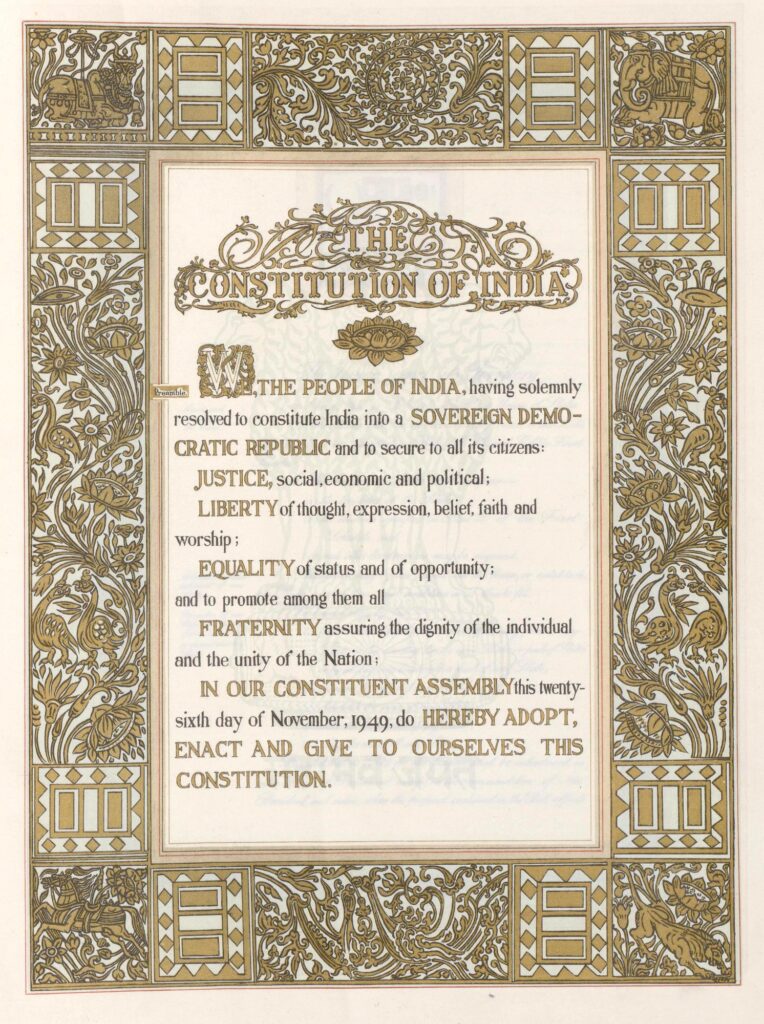
India's Constitution — adopted on 26 November 1949 and enforced on 26 January 1950 — is the world's longest written constitution. Originally containing 395 articles in 22 parts and 8 schedules, it now has 448 articles in 25 parts and 12 schedules (as of 2026, with 106 amendments).
Why India Chose a Written Constitution
| Reason | Explanation |
|---|---|
| Diversity | A diverse nation needs explicit rules for power-sharing among communities, states, and the centre |
| Federal Structure | Written distribution of powers between Union and States (Seventh Schedule) essential for federalism |
| Fundamental Rights | Explicit enumeration protects citizens from state overreach |
| New Nation | India needed a founding document to establish legitimacy and create institutions from scratch |
| Colonial Experience | Distrust of arbitrary power demanded written safeguards |
| Constituent Assembly | Democratic legitimacy through deliberate, recorded constitution-making |
Unwritten Elements in India's Constitutional Practice
Despite being written, India's governance relies heavily on unwritten conventions:
| Convention | Status |
|---|---|
| PM must be Lok Sabha member (or become one within 6 months) | Convention (not in Constitution) |
| Council of Ministers reflects coalition composition | Political convention |
| Speaker usually resigns from party membership | Convention (often violated) |
| Governor invites largest party/coalition to form government | Convention (controversial) |
| Cabinet collective responsibility | Article 75(3) mentions it, but operational details are conventional |
| Seniority principle for CJI appointment | Convention (not in Constitution) |
| Caretaker government during elections | Convention |
Judicial Interpretation as an Unwritten Dimension
The Supreme Court has significantly expanded the Constitution's meaning through interpretation — creating doctrines not explicitly present in the text:
| Doctrine | Case | Significance |
|---|---|---|
| Basic Structure | Kesavananda Bharati (1973) | Parliament cannot amend the Constitution's basic structure — a judge-made rule with no textual basis |
| Right to Privacy | Puttaswamy (2017) | Privacy as a fundamental right under Article 21 — expanded through interpretation |
| Due Process | Maneka Gandhi (1978) | Transformed Article 21 from "procedure established by law" to substantive due process |
| Judicial Review | L. Chandra Kumar (1997) | Judicial review declared part of basic structure |
The Basic Structure Doctrine is itself an unwritten constitutional principle — it exists nowhere in the text of the Constitution but is the most powerful check on Parliament's amending power.
Rigid vs Flexible Constitution
A related classification is the rigidity or flexibility of the amendment process.
Comparison
| Feature | Rigid Constitution | Flexible Constitution |
|---|---|---|
| Amendment Process | Special majority or additional requirements | Ordinary legislative process |
| Stability | High — difficult to change | Lower — easily changed |
| Judicial Review | Usually present | Usually absent |
| Example | USA (2/3 Congress + 3/4 states) | UK (simple parliamentary majority) |
| India's Position | Partly rigid, partly flexible | — |
India: A Blend of Rigid and Flexible
India's Constitution is neither fully rigid nor fully flexible. Article 368 provides three categories of amendment:
| Type | Process | Examples |
|---|---|---|
| By Simple Majority | Ordinary legislative process (like any law) | Admission of new states (Art. 2-3), creation of new UTs, quorum rules |
| By Special Majority | 2/3 of members present and voting + majority of total membership, in each House | Fundamental Rights, DPSPs, most constitutional provisions |
| By Special Majority + State Ratification | Special majority in Parliament + ratification by half the state legislatures | Federal provisions (Art. 54, 55, 73, 162), Seventh Schedule, representation of states |
This three-tier system makes India's Constitution more flexible than the US Constitution (which requires a complex amendment process for any change) but more rigid than the UK's (where Parliament can change any rule by simple majority).
Advantages and Limitations
Written Constitution
| Advantages | Limitations |
|---|---|
| Clarity — rights and powers explicitly stated | May become outdated without regular amendment |
| Protects minorities through entrenched rights | Rigid amendment process can prevent necessary reform |
| Enables judicial review — courts can enforce limits | Judicial interpretation can create uncertainty |
| Provides stability and predictability | Length and complexity may obscure meaning |
Unwritten Constitution
| Advantages | Limitations |
|---|---|
| Flexible — adapts to changing needs quickly | Lacks clarity — conventions can be violated |
| No risk of becoming outdated | No entrenched rights — Parliament can override any right |
| Simple to change | No judicial review of legislation |
| Democratic — Parliament decides everything | Depends on political goodwill to respect conventions |
Frequently Asked Questions
Does India have a written or unwritten constitution?
India has a written constitution — the longest in the world, formally adopted on 26 November 1949. However, significant unwritten elements exist in practice, including political conventions (like the seniority principle for CJI appointment) and judge-made doctrines (like the Basic Structure Doctrine). India's constitutional system blends written text with unwritten practices.
What is the main difference between written and unwritten constitutions?
A written constitution is codified in a single document, has a specific date of adoption, is supreme over Parliament, and enables judicial review. An unwritten constitution consists of multiple sources (statutes, conventions, precedents), evolves over time, treats Parliament as supreme, and generally lacks judicial review of legislation.
Why is the UK constitution called unwritten?
The UK doesn't have a single codified constitutional document. Its governance framework comes from multiple sources: statutes like the Magna Carta and Bill of Rights, conventions like collective cabinet responsibility, judicial precedents, and authoritative texts. Many of these sources are written — the term "uncodified" is more accurate than "unwritten."
What is the Basic Structure Doctrine?
The Basic Structure Doctrine, established in Kesavananda Bharati v. State of Kerala (1973), holds that Parliament cannot amend certain fundamental features of the Constitution. These include judicial review, rule of law, separation of powers, and federalism. The doctrine itself is an unwritten constitutional principle — it appears nowhere in the constitutional text.
Is India's Constitution rigid or flexible?
India's Constitution is a unique blend — neither fully rigid nor fully flexible. Some provisions can be amended by simple majority (like state boundary changes), most require a special majority in Parliament, and federal provisions need ratification by half the state legislatures. This three-tier system provides both stability and adaptability.
Tell Google you want more of this.
Add Anantam IAS as a preferred sourceOne tap, and this site shows up more often in your own Top Stories, AI Overviews and AI Mode. Remove it any time.