
The list of patients waiting for an organ transplant is longer than the supply of donor organs in every country that keeps such a list. In India, the gap is especially severe. Roughly two lakh patients need a kidney each year. Roughly ten thousand receive one. The arithmetic of organ scarcity has driven medicine, for the better part of a century, to look for an alternative source. Xenotransplantation is that alternative. Animal organs, mostly from pigs, transplanted into human patients, with the donor animal’s genome edited to defeat the human immune system’s first wave of rejection.
For most of the twentieth century, xenotransplantation was a series of brief survivals followed by catastrophic immune rejection. The patient died within hours, days, or at best weeks. The combination of CRISPR-Cas9 gene editing, transgenic-animal cloning, and modern immunosuppressive regimens has changed the picture. In 2022, a genetically modified pig heart was transplanted into a living human patient at the University of Maryland. In 2024, a genetically modified pig kidney was transplanted into a living patient at Massachusetts General Hospital. The patients did not survive in the long term, but they survived long enough to make the procedure technically credible for the first time.
This article explains what xenotransplantation is, how the modern procedure works, why it matters for India’s organ-shortage crisis, and what ethical and regulatory questions it raises. It is one of the cleanest examples of biotechnology intersecting with bioethics in the contemporary GS-III syllabus.
Quick Facts on Xenotransplantation
Xenotransplantation is the transplantation of living cells, tissues, or organs from one species to another. Most current research and clinical effort focuses on animal-to-human transplantation, with pigs as the primary donor species. Pig anatomy and organ size are close to human, the species reproduces quickly, and large-scale captive breeding for medical use is feasible.
Three categories exist. Whole-organ xenotransplantation, the most ambitious, covers transplants of hearts, kidneys, livers, and lungs. Tissue xenotransplantation covers grafts such as pig skin for burn patients and pig corneas for vision restoration. Cellular xenotransplantation covers transplants of pancreatic islet cells for diabetes and dopaminergic neurons for Parkinson’s disease.
Modern xenotransplantation depends on three technologies. CRISPR-Cas9 gene editing is used to remove pig genes that trigger human immune rejection and to insert human genes that improve compatibility. Cloning, specifically somatic cell nuclear transfer, is used to produce genetically identical donor animals from edited cell lines. Transgenic-animal technology produces lines of pigs that carry the desired genetic edits across generations.
What Xenotransplantation Actually Is
The biological problem at the heart of xenotransplantation is rejection. The human immune system has evolved to attack anything it identifies as non-self. A pig organ presents a far stronger non-self signal than a transplanted human organ. The first wave, called hyperacute rejection, occurs within minutes. It is triggered by pre-existing human antibodies binding to a sugar on pig cells called alpha-Gal, produced by a pig gene called GGTA1. A second wave, called acute vascular rejection, occurs over days. A third wave, called cellular rejection, plays out over weeks and months as T-cells recognize pig proteins as foreign.
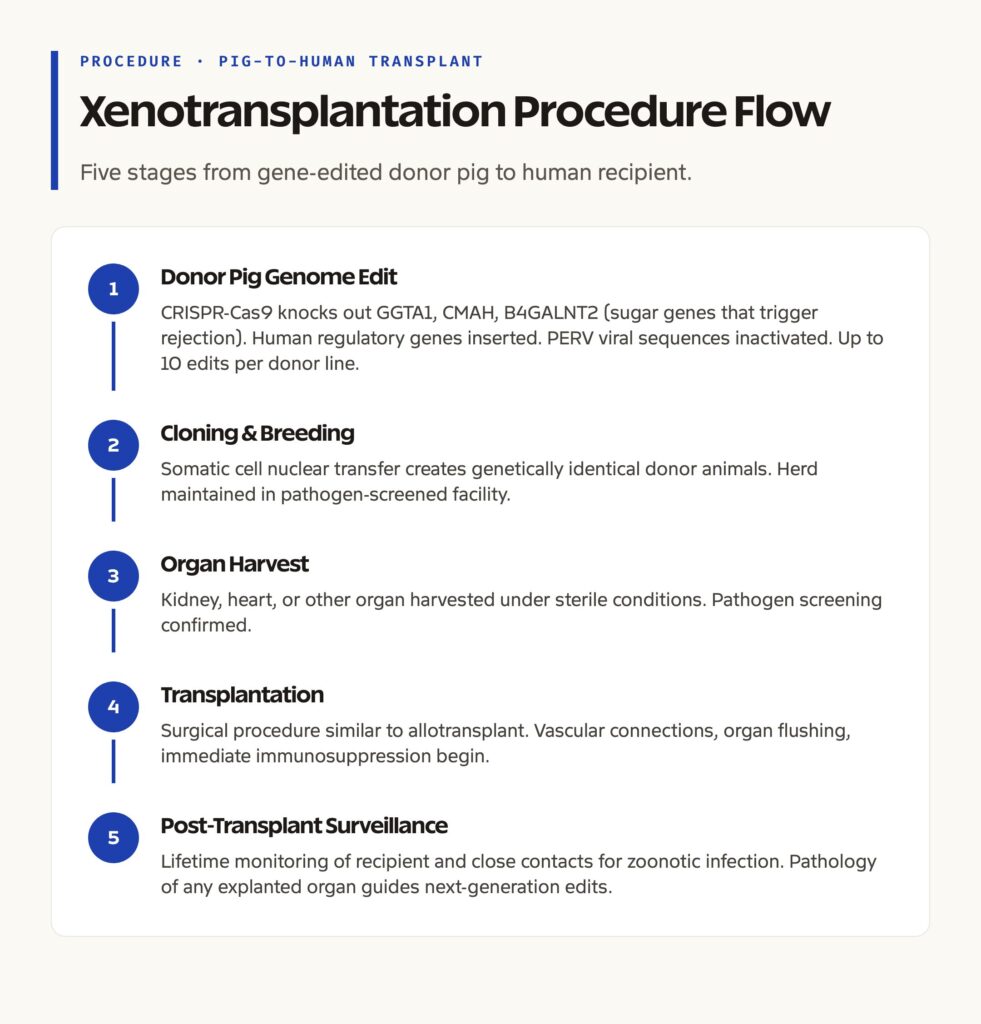
The breakthrough has been to edit the donor pig’s genome before the organ is harvested. The GGTA1 gene that produces alpha-Gal is knocked out. Two other sugar-producing genes, CMAH and B4GALNT2, are also commonly knocked out. Several human regulatory genes that calm the immune response are inserted. A pig gene that encourages organ growth, called the growth hormone receptor, is sometimes knocked out to prevent the transplanted organ from growing too large in the human recipient. The animal that emerges is a pig at the species level but with ten or more targeted genetic edits, designed to make its organs less foreign to a human body.
The recipient is treated with a powerful immunosuppressive regimen, similar in principle to that used in human-to-human transplants but adjusted for the cross-species context. The combination of edited donor and immunosuppressed recipient is what has produced the recent survivals.
Background and Historical Context
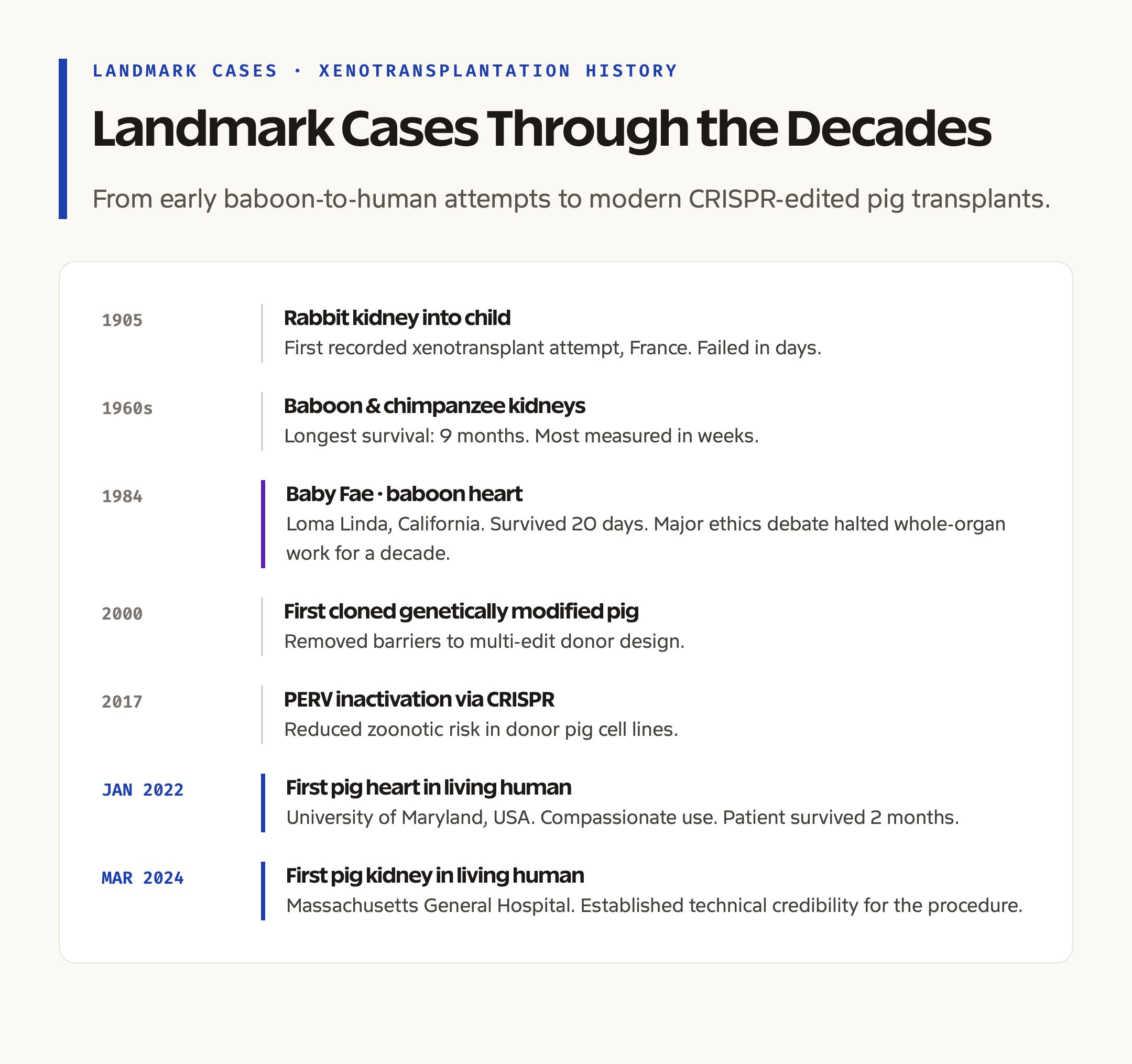
The history of xenotransplantation is a history of brave attempts and short survivals. In 1905, a French surgeon transplanted slices of rabbit kidney into a child with kidney failure. The graft failed in days. Through the 1960s, baboon and chimpanzee kidneys were tried in human patients. The longest survival was nine months, with most cases counted in weeks.
The most widely remembered case is Baby Fae in 1984, when a baboon heart was transplanted into a newborn at Loma Linda University Medical Center in California. The infant survived for twenty days, the longest survival at the time, but ultimately died of immune rejection. The case prompted intense ethical debate about consent and risk, and effectively halted whole-organ xenotransplantation for over a decade.
The shift to pigs began in the 1990s. Pigs were cheaper to breed, raised fewer ethical objections than primates, and presented a lower risk of zoonotic disease transmission than primates because they are evolutionarily more distant from humans. Cloning of the first genetically modified pig in 2000, the demonstration of CRISPR-Cas9 in 2012, and the editing of porcine endogenous retrovirus genes in 2017 each removed a barrier to human trials. The first compassionate-use pig heart transplant followed in January 2022.
Key Features of the Modern Procedure
The modern xenotransplantation procedure has four stages. The first is donor pig design. A line of pigs is established with the necessary gene edits. The most well-known commercial line, developed by United Therapeutics’ subsidiary Revivicor, has ten genetic edits.
The second is organ harvest. The donor pig is housed in a clean facility, screened for porcine pathogens, and the organ is harvested under conditions designed to minimize contamination. The third is transplantation. The surgical procedure is similar to human-to-human transplantation. Vascular connections, careful flushing of the organ, and immediate immunosuppression follow.
The fourth is post-transplant management. The patient is monitored for rejection, infection, and organ function with intensity that exceeds even ordinary human transplant care. Pathology of explanted organs in the early human cases has produced detailed maps of how rejection unfolds over weeks, informing the next generation of edits.
Why It Matters for India
India sits at the wrong end of the organ-shortage curve. The Indian Society of Nephrology estimates roughly two lakh patients enter end-stage renal failure each year. Fewer than ten thousand receive a kidney transplant. The deceased-donor program, run through the National Organ and Tissue Transplant Organisation, has expanded but cannot bridge the gap. Living-donor transplants depend on willing relatives and run into commercial pressures the law tries to suppress.
If pig kidney xenotransplantation matures into a routine clinical option over the next decade, the treatment landscape for Indian patients changes substantially. The donor pig herd can be scaled up to meet demand in a way that human donor supply cannot. The economics of large-scale captive breeding mean the per-organ cost can fall over time. The waiting list, in principle, can shrink.
Several questions remain before this becomes a reality in India. Whether donor pigs would be bred locally or imported. Whether public hospitals or private centres would be the primary sites. How the cost would compare with dialysis and human transplant. And how the regulatory pathway would work given the absence of any existing Indian framework for xenotransplant approval.
Detailed Analysis of Risks
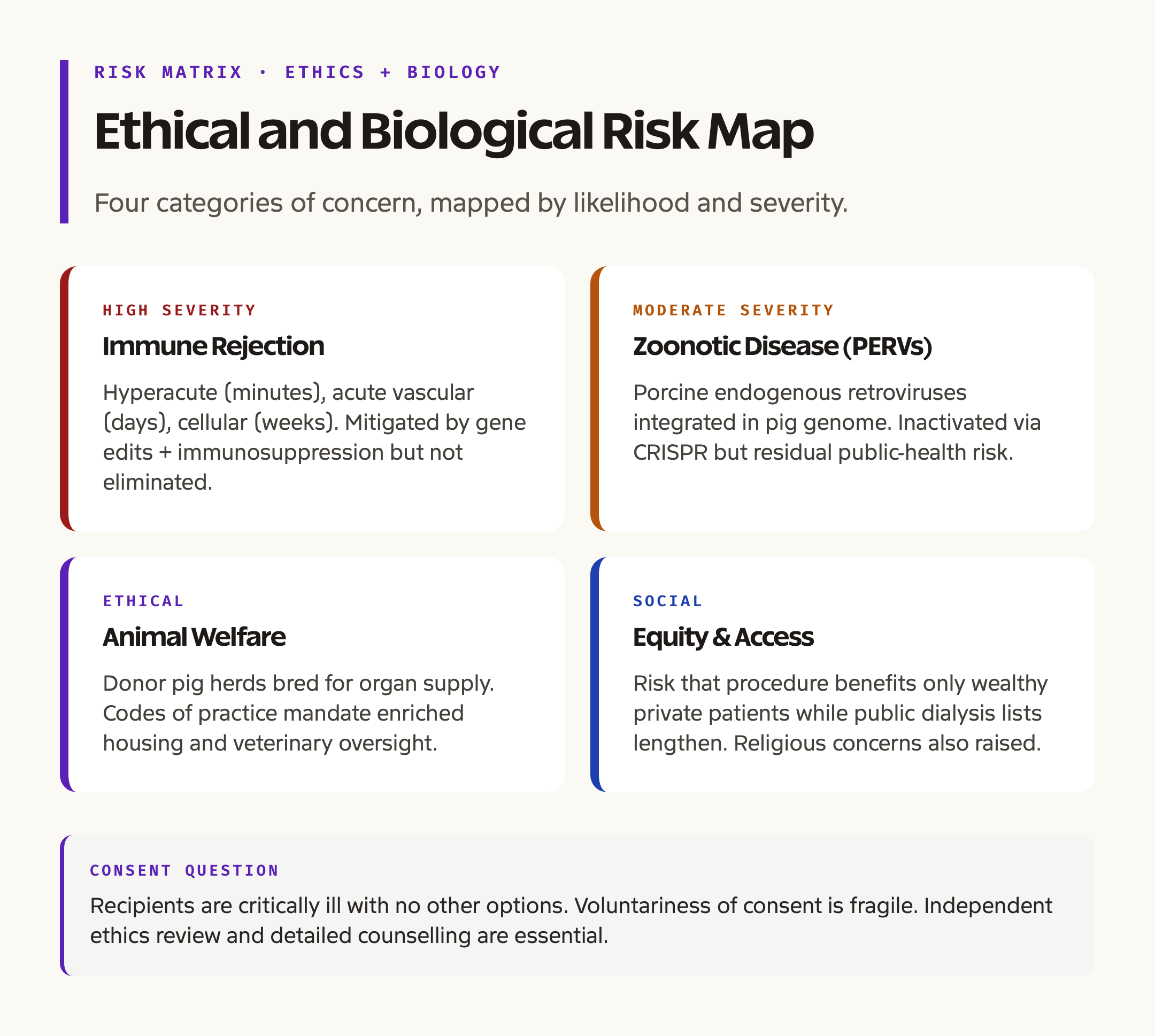
Three categories of risk dominate the safety conversation. The first is immune rejection, addressed through gene editing and immunosuppression but not yet eliminated. The second is zoonotic disease transmission, the risk that a pig virus crosses with the organ into the human recipient. Porcine endogenous retroviruses, abbreviated PERVs, have received the most attention because they are integrated into the pig genome and cannot be removed by ordinary screening. CRISPR-Cas9 has been used to inactivate PERV sequences in donor pig cell lines, reducing but not eliminating the theoretical risk.
The third is the public health dimension of the second risk. A pathogen that crosses through xenotransplantation could in principle spread from the recipient to other humans. Regulatory regimes therefore mandate lifetime monitoring of recipients and their close contacts. The framework draws on lessons from blood-borne disease transmission and from the broader public-health response to HIV.
A fourth, less discussed risk is psychological. Living with an organ from another species raises questions of identity and embodiment that some recipients find difficult. Counselling and post-transplant psychological support are a standard part of trial protocols.
Comparative Snapshot
A clean comparison helps separate the categories most often confused.
| Feature | Xenotransplantation | Allotransplantation | Stem Cell Therapy |
|---|---|---|---|
| Definition | Cross-species transplant | Human-to-human transplant | Repair using stem cells |
| Source | Animal, mostly pig | Living or deceased human | Embryonic, adult, or iPSC |
| Genetic relationship | Different species | Same species | Same or different individual |
| Main biological challenge | Severe rejection, zoonotic risk | Rejection, donor shortage | Differentiation control, tumour risk |
| Need for genetic engineering | Usually required | Not required | Sometimes (reprogramming) |
| Regulatory maturity in India | Absent | Mature, under THOTA | Evolving, ICMR guidelines |
Challenges and Ethical Concerns
The first challenge is animal welfare. Maintaining genetically modified pig herds for organ supply raises questions about the moral status of the donor animal. Codes of practice in jurisdictions where the work is done require enriched housing, veterinary oversight, and minimization of distress, but the underlying ethical question is unresolved.
The second is consent and transparency. Recipients of experimental xenotransplants are usually critically ill, with no other treatment options. The voluntariness of consent under such conditions is fragile. Independent ethics review, careful counselling, and post-procedure transparency are essential.
The third is equity. If xenotransplantation matures into a routine clinical option, who receives it first matters. Without explicit policy, the benefit will flow disproportionately to wealthy private patients while public hospitals continue to manage long dialysis lists. India’s regulatory architecture for organ transplantation, the Transplantation of Human Organs and Tissues Act and the National Organ and Tissue Transplant Organisation, will need an explicit xenotransplant chapter to handle access, cost, and surveillance questions.
The fourth is religious and cultural concern. The use of pig organs raises specific objections in Islamic and Jewish tradition, and broader questions in many traditions about the appropriateness of cross-species transfer. Religious scholars in several jurisdictions have issued nuanced positions distinguishing life-saving medical use from ordinary consumption, but the conversation is ongoing.
Prelims Pointers
- Xenotransplantation is the transplantation of cells, tissues, or organs from one species to another, mostly animal to human.
- The pig is the dominant donor species because of organ-size compatibility, breeding economics, and lower zoonotic risk than primates.
- Allotransplantation refers to transplant within the same species, usually human to human.
- Autotransplantation is the transplantation of tissue from one part of an individual’s body to another.
- CRISPR-Cas9 is the gene-editing technology that has made multi-edit donor pig design feasible.
- Hyperacute rejection is triggered by human antibodies binding to the alpha-Gal sugar produced by the GGTA1 gene in pigs.
- Porcine endogenous retroviruses, PERVs, are a recognized but partially mitigated zoonotic risk.
- The first compassionate-use genetically modified pig heart transplant in a living human took place in January 2022 at the University of Maryland.
- A genetically modified pig kidney was transplanted into a living human at Massachusetts General Hospital in March 2024.
- India’s National Organ and Tissue Transplant Organisation, NOTTO, currently regulates only human-to-human transplantation.
Mains Practice Questions
- Discuss the scientific basis and clinical promise of xenotransplantation. Examine the role of CRISPR-Cas9 gene editing in making pig-to-human organ transplantation feasible, and identify the ethical and regulatory questions that India must address before it permits clinical trials.
- India faces a severe gap between organ demand and supply. Critically evaluate xenotransplantation as a potential solution, comparing its risks and benefits with those of expanded deceased-donor programs and stem-cell-based regenerative therapies.
- Examine the ethical issues raised by xenotransplantation, including animal welfare, informed consent, equity of access, and zoonotic public-health risk. How should India’s regulatory framework for organ transplantation evolve to address these concerns?
Way Forward
A workable Indian framework for xenotransplantation needs four components. First, an explicit xenotransplantation chapter in the Transplantation of Human Organs and Tissues Act or in companion regulations under it, defining donor-animal standards, consent procedures, and post-transplant surveillance obligations. Second, an inter-ministerial review body bringing together CDSCO, the Indian Council of Medical Research, the Department of Biotechnology, and NOTTO to clear individual trials. Third, public investment in domestic capacity for genetically modified donor herds, drawing on existing Indian strength in transgenic-animal research, to avoid dependence on imported donor lines. Fourth, an equity policy that explicitly anticipates the access question, including a route for public-hospital recipients and a framework for pricing in private centres. The technology is moving from impossible to plausible faster than any other area of stem cell and tissue research. India’s response cannot be waiting until it arrives.
Frequently Asked Questions
What is xenotransplantation?
Xenotransplantation is the transplantation of living cells, tissues, or organs from one species to another. Most current effort focuses on transplanting genetically modified pig organs into human patients to address the global shortage of human donor organs.
Why are pigs used as the donor species?
Pigs are used because their organs are similar in size to human organs, they breed quickly, large-scale captive breeding is feasible, and they are evolutionarily more distant from humans than primates, which reduces the risk of zoonotic disease transmission.
Has a pig organ ever been successfully transplanted into a human?
Yes. In January 2022, a genetically modified pig heart was transplanted into a living human at the University of Maryland Medical Center. In March 2024, a genetically modified pig kidney was transplanted into a living patient at Massachusetts General Hospital. The patients did not survive in the long term, but the procedures established the technical feasibility.
What role does CRISPR-Cas9 play in xenotransplantation?
CRISPR-Cas9 is the gene-editing technology used to make multiple precise changes to the donor pig’s genome. It is used to knock out pig genes that trigger human immune rejection, insert human genes that improve compatibility, and inactivate viral sequences such as porcine endogenous retroviruses.
What is hyperacute rejection?
Hyperacute rejection is the immune response that occurs within minutes of a cross-species transplant. It is triggered by pre-existing human antibodies binding to alpha-Gal, a sugar produced by the GGTA1 gene on pig cells. Knocking out GGTA1 in donor pigs largely prevents this first wave of rejection.
What is the difference between xenotransplantation and allotransplantation?
Xenotransplantation is transplant between different species, mostly animal to human. Allotransplantation is transplant between two members of the same species, typically human to human, and is the standard procedure used in clinical organ transplantation today.
What are PERVs and why do they matter?
Porcine endogenous retroviruses, or PERVs, are viral sequences integrated into the pig genome. They are a theoretical zoonotic risk in xenotransplantation because they could in principle cross into the human recipient. CRISPR-Cas9 has been used to inactivate PERV sequences in donor pig cell lines, reducing the risk substantially.
What does Indian law say about xenotransplantation?
Indian law currently regulates only human-to-human organ transplantation, under the Transplantation of Human Organs and Tissues Act and through the National Organ and Tissue Transplant Organisation. There is no dedicated framework for xenotransplantation, though guidelines for any future trials would likely be issued jointly by CDSCO, ICMR, and the Department of Biotechnology.
What ethical concerns does xenotransplantation raise?
The main ethical concerns are animal welfare in donor pig herds, the voluntariness of consent from critically ill recipients, equity of access if the procedure becomes routine, public-health risk from potential zoonotic disease transmission, and religious or cultural concerns about cross-species transfer. Each of these concerns has prompted the development of detailed protocols in jurisdictions where the work is being done.
Could xenotransplantation reduce India’s organ shortage?
Potentially yes. The donor pig herd can be scaled up in a way that human donor supply cannot. If pig kidney xenotransplantation matures into a routine clinical option, the waiting list for end-stage renal disease patients in India could shrink substantially. The full impact will depend on regulatory clearance, cost-effectiveness, public-hospital integration, and the resolution of remaining ethical and clinical questions.
Tell Google you want more of this.
Add Anantam IAS as a preferred sourceOne tap, and this site shows up more often in your own Top Stories, AI Overviews and AI Mode. Remove it any time.





