
Yojana Magazine is India's flagship monthly on socio-economic development, published by the Publications Division under the Ministry of Information and Broadcasting. For UPSC aspirants, Yojana is a trusted, unbiased source that consolidates government policy, expert analysis, and thematic deep dives into a single monthly volume. Each issue builds around one theme, such as infrastructure, agriculture, or women empowerment, and features contributions from bureaucrats, academics, and sector specialists. Because the content is aligned with the government's priority areas, Yojana directly maps to GS papers and essay preparation, making it a staple resource for both Prelims and Mains aspirants.
What Is Yojana Magazine
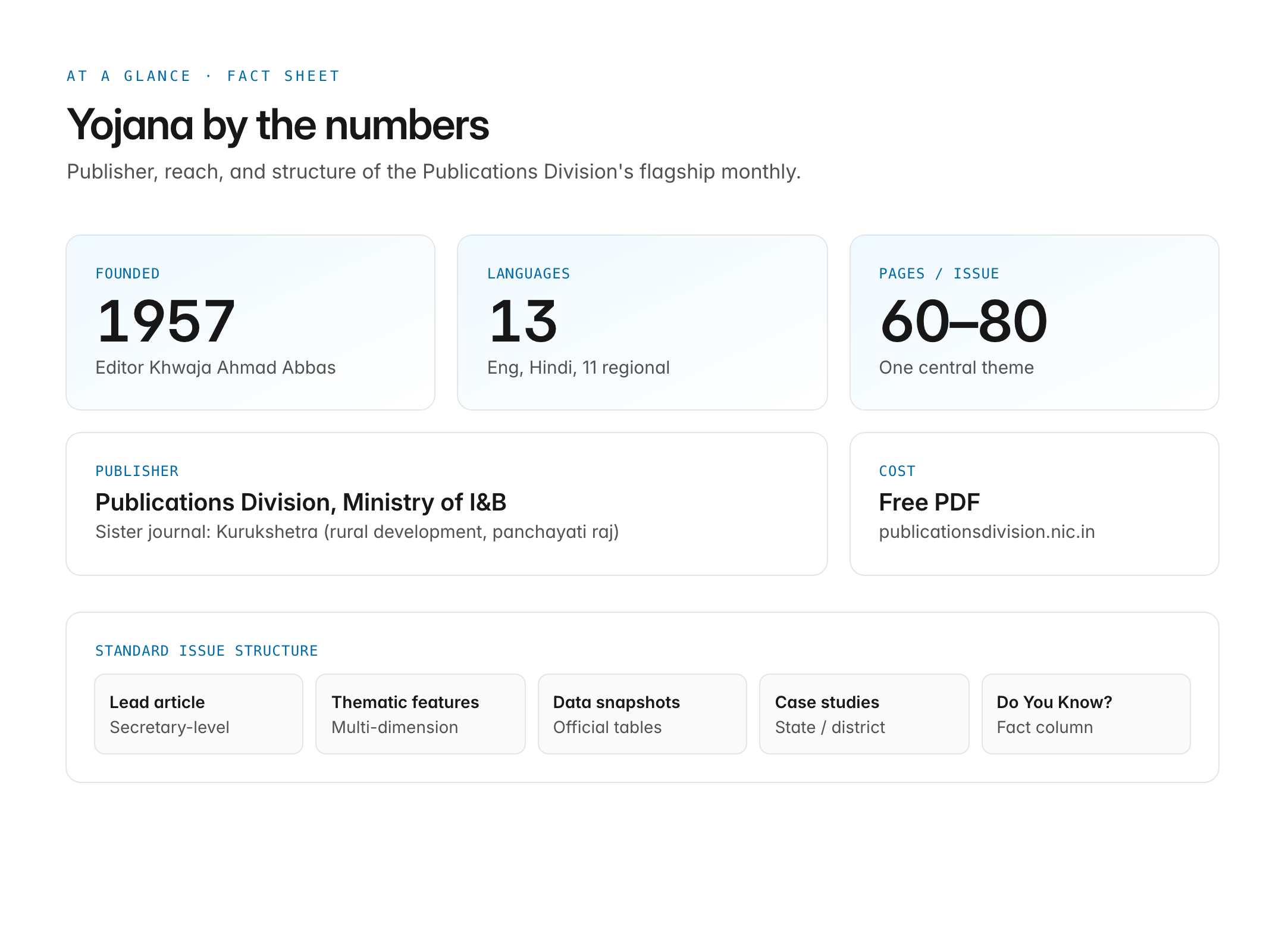
Yojana is a development-focused monthly journal that began in 1957 to popularise the Five-Year Plans and the work of the erstwhile Planning Commission. It is now published in 13 languages, including English, Hindi, Urdu, Tamil, Telugu, Kannada, Malayalam, Gujarati, Marathi, Bengali, Odia, Punjabi, and Assamese, giving it one of the widest reaches among official publications in India.
The magazine is:
- Published monthly by the Publications Division, Ministry of I&B.
- Theme-based, with each issue examining one subject in depth.
- Non-partisan, combining official data with independent expert commentary.
- Priced affordably to stay accessible to students and rural readers.
Yojana's sister publication, Kurukshetra, focuses specifically on rural development and panchayati raj, and together the two cover most of the government-policy syllabus for UPSC.
History and Evolution
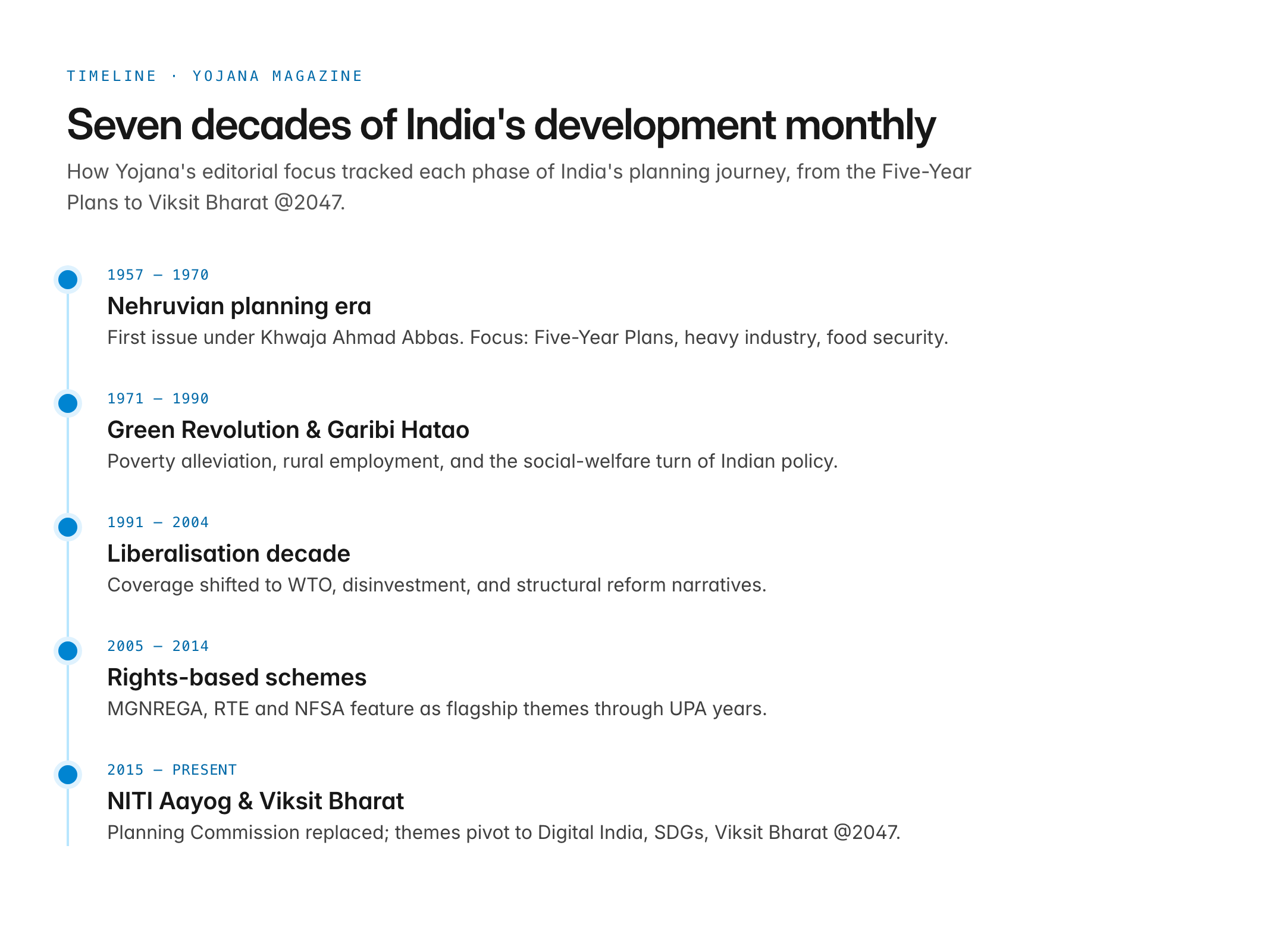
Yojana's first issue appeared in 1957 under the editorship of Khwaja Ahmad Abbas, reflecting the Nehruvian emphasis on planned development. Over the decades, its editorial arc has mirrored India's policy shifts, from centralised planning and import substitution in the 1960s, to liberalisation after 1991, and today to themes around digital economy, climate action, and inclusive growth.
| Era | Editorial Focus |
|---|---|
| 1957–1970 | Five-Year Plans, heavy industry, food security |
| 1971–1990 | Green Revolution, poverty alleviation, garibi hatao |
| 1991–2004 | Liberalisation, WTO, disinvestment |
| 2005–2014 | Rights-based schemes (MGNREGA, RTE, NFSA) |
| 2015–Present | NITI Aayog, Digital India, Viksit Bharat @2047 |
With the replacement of the Planning Commission by NITI Aayog in 2015, Yojana's framing shifted from plan documents to flagship missions like Ayushman Bharat, PM Gati Shakti, and the Sustainable Development Goals (SDGs).
Structure and Content
Each Yojana issue typically runs 60–80 pages and is organised around a central theme announced on the cover. A standard issue contains:
- Lead article by a Secretary-level officer or domain expert.
- Thematic features covering different dimensions of the topic.
- Data snapshots with tables and charts from official sources.
- Case studies of successful implementation at the state or district level.
- Book reviews and a Do You Know? factual column.
Themes in recent years have included green hydrogen, women-led development, circular economy, semiconductor mission, cooperative federalism, and climate resilience. Past themes are archived and freely available on the Publications Division portal.
How to Read Yojana for UPSC
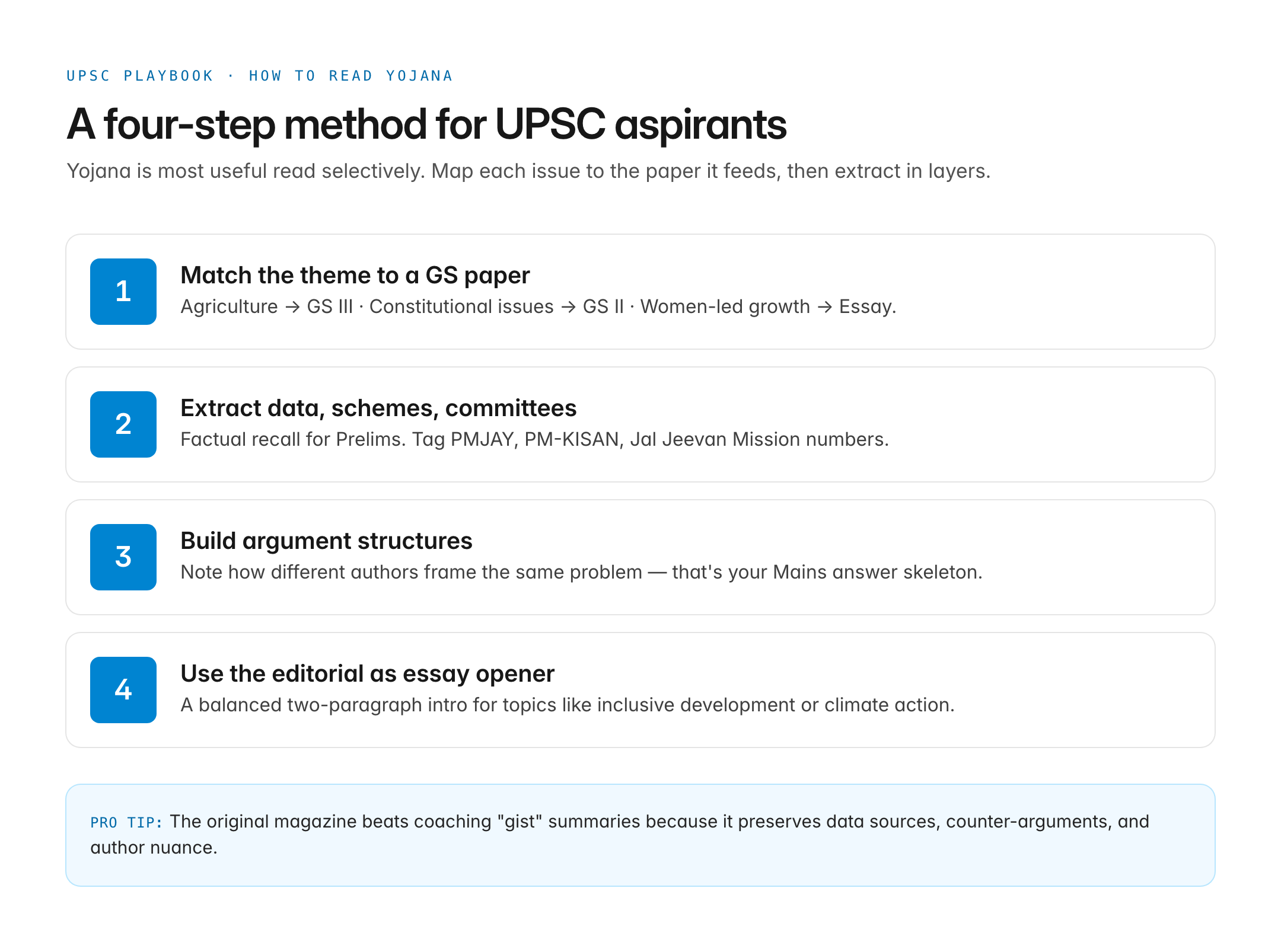
Yojana is most useful when read selectively rather than cover-to-cover. A practical approach is:
- Match the theme to the GS paper it feeds: agriculture issues to GS III, constitutional issues to GS II, and so on.
- Extract data points, scheme names, and committee reports for Prelims factual recall.
- Build argument structures for Mains by noting how different authors frame the same problem.
- Use the editorial for a balanced introductory paragraph in essays.
Many coaching institutes publish monthly Yojana gist summaries, but the original magazine is stronger because it preserves nuance, data sources, and counter-arguments that summaries often flatten.
Access, Subscription, and Languages
Yojana is distributed through the Publications Division with a nominal cover price, and the digital PDF is available free on the official Publications Division website and on the MyGov and DigiLocker platforms. Key access points include:
- Print subscription through Publications Division outlets in major cities.
- Free PDF download from publicationsdivision.nic.in.
- Mobile access via the Digital India Corporation's platforms.
Making the magazine freely downloadable has dramatically expanded its readership among UPSC aspirants, researchers, and students in regional-language universities, aligning it with the government's broader digital public goods agenda.
Significance for Governance and Policy
Beyond examination utility, Yojana plays a quiet but important role in democratic communication. By explaining complex schemes in plain language and in 13 languages, it helps bridge the information gap between Delhi and the last-mile citizen. For researchers, its archives serve as a chronology of Indian policy debates since Independence, making it valuable for longitudinal analysis of development thought.
For civil servants in training at the LBSNAA and state academies, Yojana and Kurukshetra are recommended reading precisely because they model how to write about policy for a general audience: evidence-first, jargon-light, and solution-oriented.
UPSC Relevance
Prelims focus: factual recall on Publications Division, number of languages, parent ministry (I&B), sister magazine Kurukshetra, and specific scheme details highlighted in recent issues.
Mains GS angle:
- GS II — governance, welfare schemes, government policies for vulnerable sections.
- GS III — Indian economy, agriculture, infrastructure, science and technology.
- Essay — thematic framing for topics like inclusive development, women-led growth, climate action.
Sample PYQ angle: UPSC questions on government schemes (e.g., on PMJAY, PM-KISAN, or Jal Jeevan Mission) can be answered with structured arguments and data points drawn directly from corresponding Yojana issues. Aspirants should treat Yojana as a primary source for scheme-related Mains answers rather than relying only on secondary summaries.
Tell Google you want more of this.
Add Anantam IAS as a preferred sourceOne tap, and this site shows up more often in your own Top Stories, AI Overviews and AI Mode. Remove it any time.