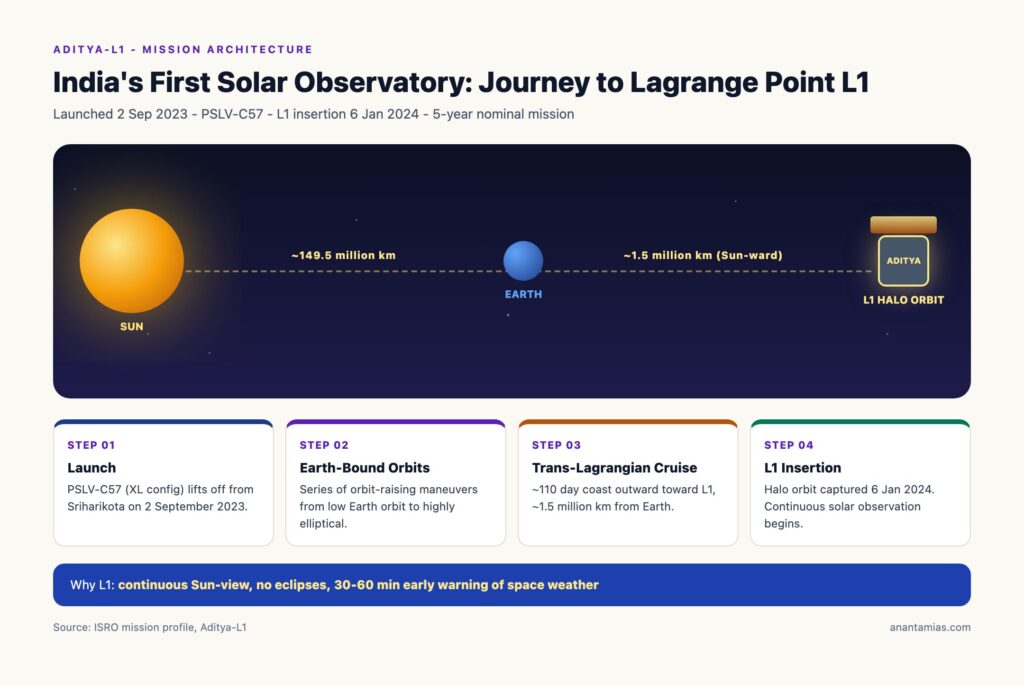
Aditya-L1 is the first dedicated space-based solar observatory ever flown by an Indian agency, and it is parked at one of the most carefully chosen addresses in the inner solar system: Lagrange Point 1. Launched by ISRO on 2 September 2023 aboard a PSLV-C57 from Sriharikota, the spacecraft spent four months coasting outward before settling into a halo orbit around L1 on 6 January 2024, roughly 1.5 million kilometres from Earth in the direction of the Sun. From there, with seven instruments turned permanently sunwards, Aditya-L1 is studying the photosphere, the chromosphere, the corona and the solar wind, and is feeding back data that helps India forecast the space weather that disturbs satellites, navigation signals and power grids.
For UPSC, Aditya-L1 is a textbook case where physics, engineering and policy intersect. The physics explains why L1 is special. The engineering explains how a small Indian spacecraft can match much larger international solar missions on specific science goals. The policy explains why a country with limited science budgets chooses to invest in heliophysics at all.
Quick Facts: Aditya-L1 at a Glance
- Agency: Indian Space Research Organisation (ISRO)
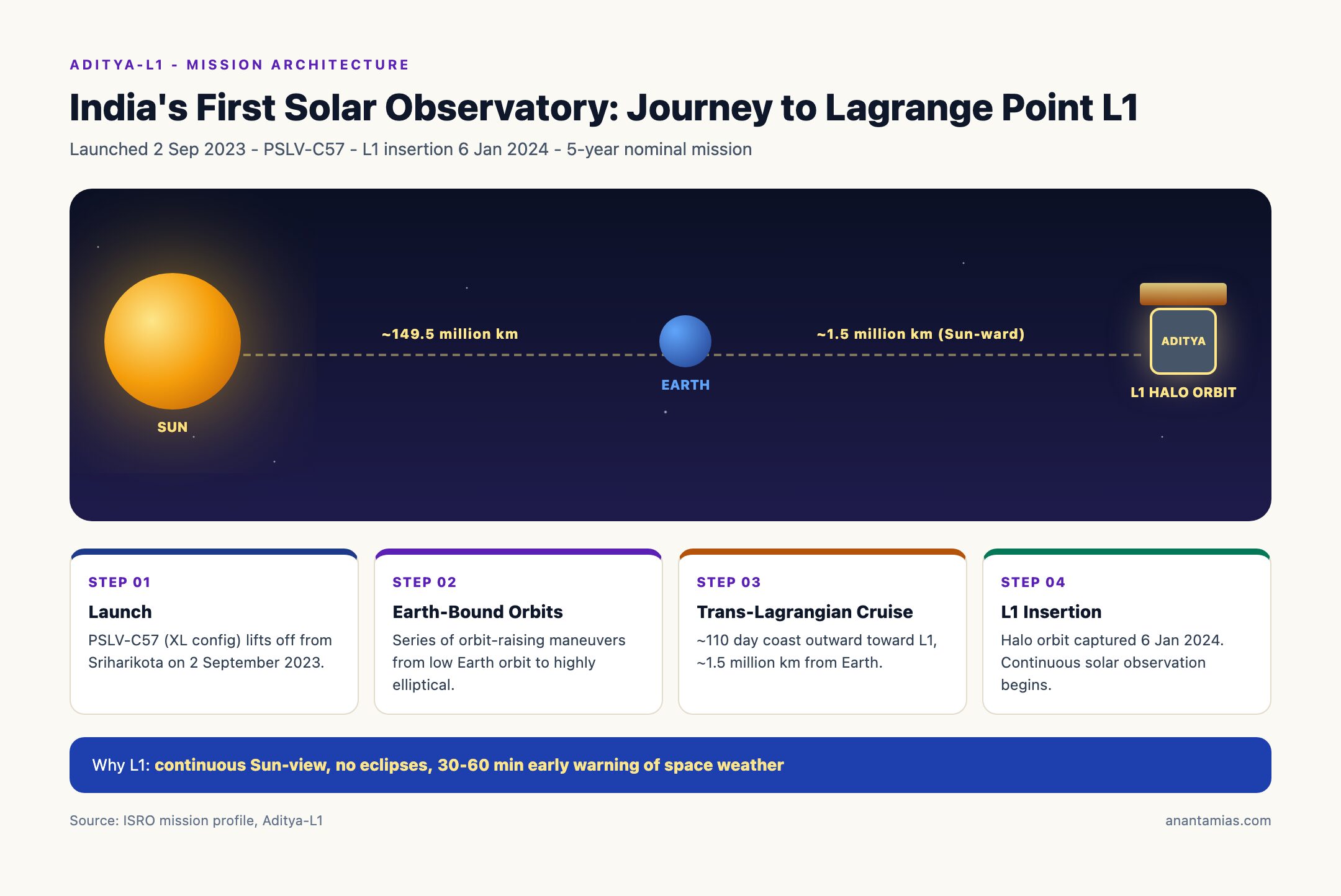
- Launch date: 2 September 2023
- Launch vehicle: PSLV-C57 (XL configuration)
- Final orbit: Halo orbit around Sun-Earth Lagrange Point L1
- Distance from Earth: Approximately 1.5 million kilometres (about 1 percent of the Earth-Sun distance)
- L1 insertion: 6 January 2024
- Mission duration: About 5 years (planned)
- Payloads: 7 instruments (4 remote sensing, 3 in-situ)
- Spacecraft mass: About 1,475 kg at launch
- Lead institute for principal payload: Indian Institute of Astrophysics, Bengaluru (VELC)
What Is the Aditya-L1 Mission?
Aditya-L1 is a heliophysics observatory. Aditya means Sun in Sanskrit, and L1 refers to the Sun-Earth Lagrange Point 1. The mission has two simple but ambitious aims. The first is scientific: to study the structure, dynamics and energetics of the Sun’s outer atmosphere and the inner heliosphere with a tightly integrated set of imagers, spectrometers and particle detectors. The second is operational: to give India a permanent, sovereign vantage point for observing solar activity and forecasting space weather events that affect satellites in orbit, terrestrial communication, GPS and electrical infrastructure.
Aditya-L1 does not fly to the Sun. It flies to a gravitational sweet spot between the Earth and the Sun, where the gravitational pull of both bodies and the orbital motion of the spacecraft cancel out, allowing it to hover with very little fuel expenditure while staring at the Sun without ever being eclipsed by Earth or the Moon.
Background and Historical Context
The Sun has been studied from space for almost six decades. The earliest dedicated solar mission was OSO-1 in 1962. The 1990s brought SOHO, the joint NASA-ESA Solar and Heliospheric Observatory, which is still operating from L1 and has shaped much of our modern understanding of the corona. NASA’s Parker Solar Probe, launched in 2018, took a different route, using Venus flybys to plunge as close as a few solar radii from the Sun’s surface, the closest any spacecraft has ever come.
India’s solar work, until 2023, was largely ground-based. The Kodaikanal Solar Observatory has been recording sunspots since the 1900s, and the multi-application solar telescope at Udaipur and the high-altitude observatory at Hanle have produced excellent science. But ground-based observations are limited by the atmosphere. Crucially, the inner corona, the region just above the visible disc, is washed out at sea level except during a total eclipse. To see it routinely, you need to be in space, and you need an instrument that creates an artificial eclipse using a coronagraph.
That instrument is the Visible Emission Line Coronagraph (VELC), the principal payload of Aditya-L1, designed and built by the Indian Institute of Astrophysics. VELC observes the corona between 1.05 and 3 solar radii continuously, a feat no other space mission currently performs in this combination of wavelengths and field of view. That single capability turned the Aditya-L1 concept, in development since 2008, from a national mission into an internationally significant science platform.
Why Lagrange Point L1 Matters
Joseph-Louis Lagrange showed in 1772 that in any two-body system there are five points where a third, much smaller body can sit in equilibrium. The Sun-Earth system has five such Lagrange points labelled L1 through L5. L1 lies between the Sun and the Earth, about 1.5 million kilometres from Earth. At L1, the gravitational pull of the Sun towards itself is partly cancelled by the Earth’s gravity pulling outward, plus the centrifugal effect of orbital motion. The net effect: a spacecraft placed there orbits the Sun in exactly one year, in lockstep with the Earth.
Three properties make L1 ideal for solar observation. First, the Sun is never eclipsed by anything; the spacecraft has continuous, unbroken access. Second, the spacecraft sees the same patch of the solar surface for hours or days, allowing time-resolved studies of dynamic events. Third, charged particles and solar wind pass the spacecraft about 30 to 60 minutes before they reach Earth, giving it a true early-warning function for space weather forecasters.
A halo orbit, the kind Aditya-L1 occupies, is a three-dimensional loop around L1 itself. Spacecraft cannot sit precisely at L1 because the equilibrium is unstable; small perturbations push them away. By circling around L1 in a halo orbit, the spacecraft uses its station-keeping fuel sparingly and avoids the Sun’s radio glare blocking communications back to Earth.
The Seven Payloads of Aditya-L1
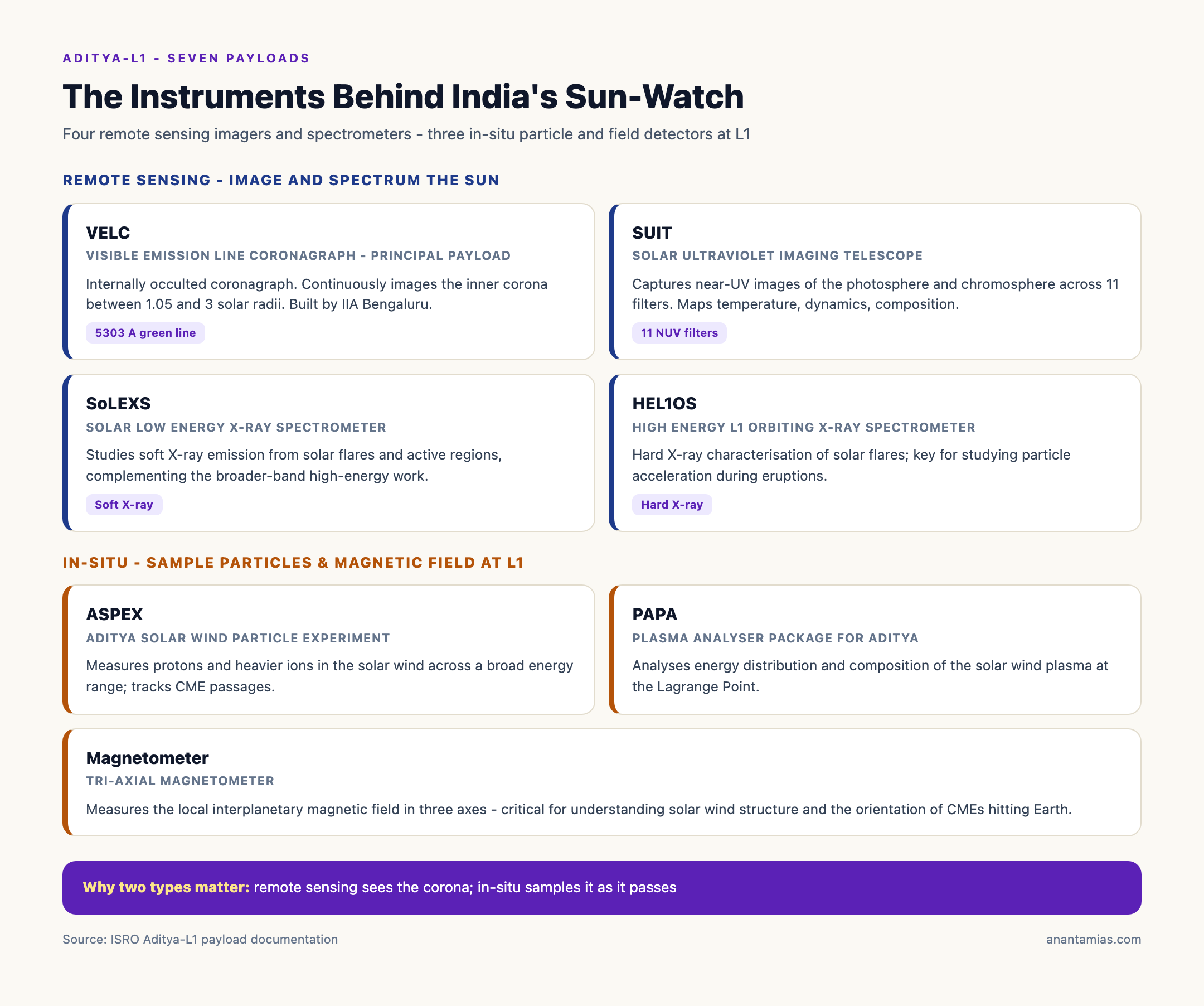
Aditya-L1 carries seven scientific payloads, designed and built by Indian institutions including ISRO centres, the Indian Institute of Astrophysics, the Inter-University Centre for Astronomy and Astrophysics and the Physical Research Laboratory.
Remote sensing instruments (look at the Sun from a distance):
- VELC (Visible Emission Line Coronagraph): Studies the inner solar corona by blocking direct sunlight using an internally occulted coronagraph. Targets emission lines including 5303 Angstrom (green line) and others to map corona temperature, density and magnetic field.
- SUIT (Solar Ultraviolet Imaging Telescope): Captures near-ultraviolet images of the photosphere and chromosphere across 11 filters, providing data on temperature, dynamics and chemical composition.
- SoLEXS (Solar Low Energy X-ray Spectrometer): Studies soft X-rays from solar flares and active regions, complementing the broader-band high-energy work.
- HEL1OS (High Energy L1 Orbiting X-ray Spectrometer): Characterises the high-energy hard X-ray spectrum of solar flares, essential for studying particle acceleration.
In-situ instruments (sample the local environment):
- ASPEX (Aditya Solar Wind Particle Experiment): Measures protons and heavier ions in the solar wind across a wide energy range.
- PAPA (Plasma Analyser Package for Aditya): Analyses energy distribution and composition of the solar wind plasma at L1.
- Magnetometer: Measures the local interplanetary magnetic field in three axes, critical for understanding solar wind structure.
The combination of remote sensing and in-situ payloads is the design philosophy that distinguishes Aditya-L1. The same event, say, a coronal mass ejection (CME), can be imaged as it leaves the Sun by VELC, tracked spectrally by SUIT and SoLEXS, and then sampled directly by ASPEX, PAPA and the magnetometer when it sweeps past L1 several days later.
Mission Objectives in Detail
The science mission of Aditya-L1 reduces to four big questions and one operational task.
Coronal heating mystery. The visible solar surface is around 5,500 degrees Celsius. The corona, just above it, is over 1 million degrees. No simple thermal model explains this jump. By imaging the corona continuously at the wavelengths VELC targets, Aditya-L1 will help test competing theories like nano-flare heating and Alfven wave dissipation.
Solar wind acceleration. The solar wind starts somewhere in the corona and accelerates to over 400 kilometres per second. Where exactly the acceleration happens, and what drives it, is open. ASPEX and PAPA measure the wind directly, and SoLEXS plus VELC observe the source.
Coronal mass ejections. CMEs are large eruptions of magnetised plasma that, when Earth-directed, can damage satellites and trigger geomagnetic storms. Aditya-L1 will image CME initiation and onset, then sample them in-situ as they pass.
Solar flares and particle fluxes. SoLEXS and HEL1OS together cover the soft and hard X-ray spectrum, allowing detailed study of how flares accelerate particles to high energies.
Space weather forecasting. The operational deliverable. Continuous monitoring of solar wind and magnetic field at L1 gives Indian agencies, ground stations and satellite operators a useful warning window before disturbances reach Earth. The data feeds into the National Atmospheric Research Laboratory and ISRO’s space-weather services.
For broader context on space-related missions, see ISRO’s mission roadmap and the recent solar maximum cycle analysis, which dovetails directly with Aditya-L1 science.
Why Aditya-L1 Matters: Strategic and Scientific Significance
Three threads make Aditya-L1 strategically important beyond its science.
Sovereign space-weather capability. A country that depends on satellites for navigation, communication and remote sensing cannot rely entirely on foreign data for space weather warnings. Aditya-L1 provides Indian operational agencies with first-party data, with a clean uplink and downlink chain.
Scientific maturation. Aditya-L1 puts India in the small club of nations operating heliophysics observatories at L1, alongside the United States and the European Space Agency. It signals to the global scientific community that ISRO has moved beyond Earth observation and lunar exploration into deep-space science.
Industrial spillover. Building VELC, SUIT and the rest of the payloads required nationally distributed expertise in precision optics, sensor electronics, cryogenic detectors, ultra-stable mechanical structures and radiation-hardened components. Many of these capabilities directly transfer to defence, semiconductor and biomedical instrumentation, particularly under the Indian Space Policy 2023 framework that encourages technology spillover into private industry.
Detailed Analysis: How Aditya-L1 Compares Globally
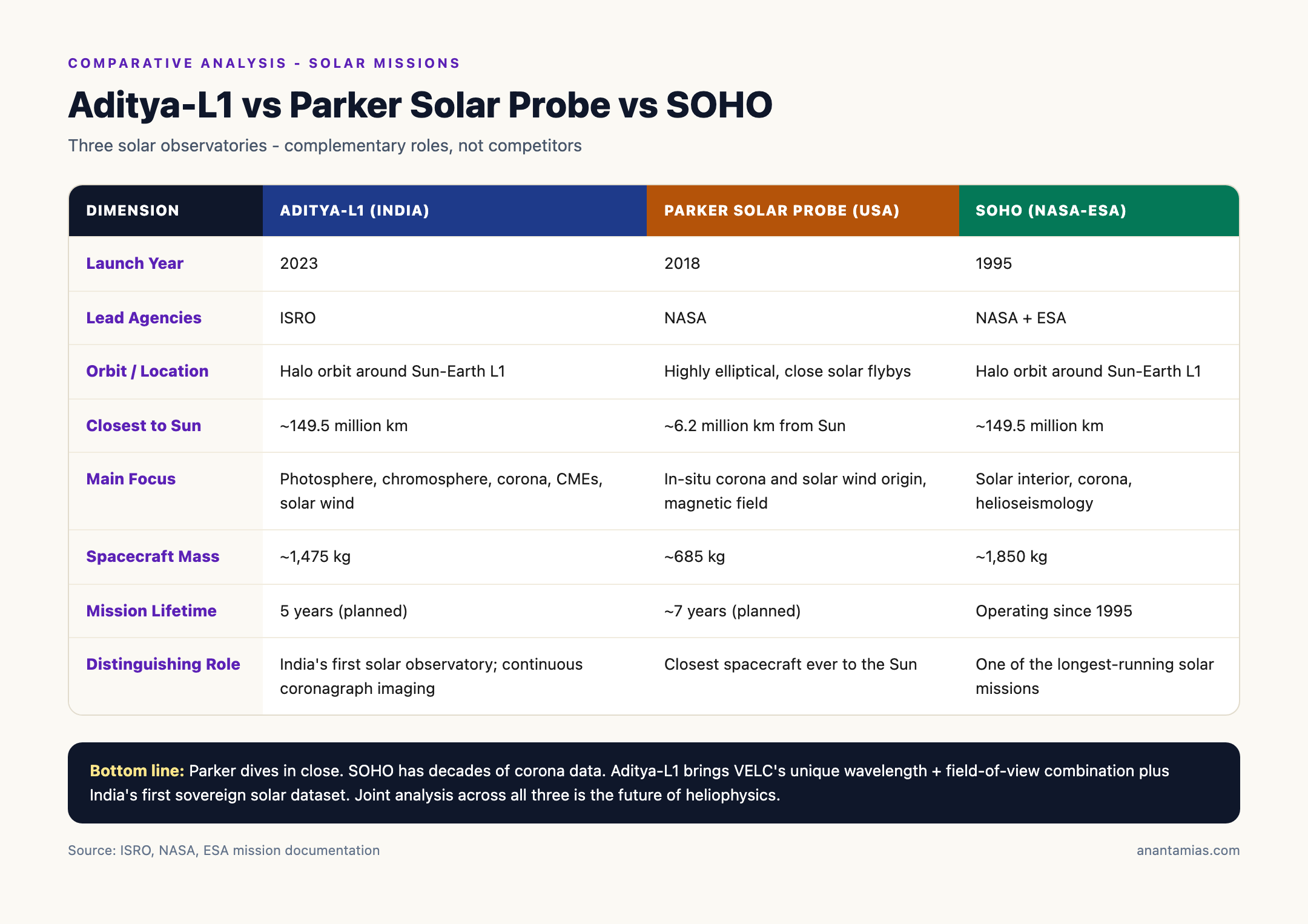
| Dimension | Aditya-L1 (India) | Parker Solar Probe (USA) | SOHO (NASA-ESA) |
|---|---|---|---|
| Launch year | 2023 | 2018 | 1995 |
| Lead agencies | ISRO | NASA | NASA and ESA |
| Orbit and location | Halo orbit around Sun-Earth L1 | Highly elliptical orbit, close solar flybys | Halo orbit around Sun-Earth L1 |
| Closest approach to Sun | About 1.5 million km from Earth (about 149.5 million km from the Sun) | As close as approximately 6.2 million km from the Sun’s surface | About 1.5 million km from Earth |
| Main science focus | Photosphere, chromosphere, corona, CMEs, solar wind, space weather | In-situ corona and solar wind origin, magnetic field | Solar interior, corona, solar wind, helioseismology |
| Distinguishing role | India’s first solar observatory, continuous coronagraph imaging | Closest spacecraft ever to the Sun | One of the longest-running solar missions |
| Spacecraft mass | About 1,475 kg | About 685 kg | About 1,850 kg |
| Mission lifetime | About 5 years planned | About 7 years planned | Operating since 1995 (well beyond design life) |
Aditya-L1 is not in competition with Parker Solar Probe or SOHO. They occupy complementary roles. Parker dives in close to sample the deepest layers no L1 spacecraft can reach. SOHO has accumulated nearly three decades of continuous corona imagery. Aditya-L1 brings VELC’s specific wavelength and field-of-view combination, plus India’s first sovereign solar dataset, into the international mix. Joint analysis with Parker, SOHO and ESA’s Solar Orbiter is the future of solar science, and ISRO has signalled openness to data-sharing protocols.
Challenges and Limitations
Aditya-L1, capable as it is, faces real constraints. Station-keeping at L1 is fuel-limited; once the propellant runs out, the mission ends. The five-year nominal lifetime is conservative, but prolonged operation depends on careful orbit management. Communication bandwidth from L1 is much smaller than from low Earth orbit, capping data downlink rates and forcing onboard prioritisation of observations. Detector degradation under solar radiation is unavoidable; calibration over the mission’s life is a continuous effort. Finally, scientific output depends on a broad, well-funded user community in India to mine the data; without that, the spacecraft becomes a museum piece in orbit.
Prelims Pointers
- Aditya-L1 launched on 2 September 2023 on PSLV-C57 from Sriharikota.
- The spacecraft entered its halo orbit around Sun-Earth Lagrange Point L1 on 6 January 2024.
- L1 lies about 1.5 million kilometres from Earth in the Sun-ward direction.
- Aditya-L1 carries seven payloads: four remote sensing and three in-situ.
- The principal payload, VELC, was developed by the Indian Institute of Astrophysics, Bengaluru.
- VELC stands for Visible Emission Line Coronagraph; SUIT stands for Solar Ultraviolet Imaging Telescope.
- ASPEX, PAPA and the magnetometer are the in-situ payloads.
- A Lagrange Point is where the gravitational forces of two large bodies and the orbital motion of a satellite balance out; the Sun-Earth system has five such points (L1 to L5).
- L1 offers continuous, uninterrupted solar observation, with no Earth or Moon eclipses.
- Aditya-L1 is India’s first space-based solar observatory.
Mains Practice Questions
- Discuss the scientific objectives of the Aditya-L1 mission and its significance for India’s space weather forecasting capability. (GS Paper 3, 250 words)
- Why is the Sun-Earth Lagrange Point L1 chosen for solar observatories? Compare Aditya-L1 with Parker Solar Probe and SOHO. (GS Paper 3, 250 words)
- Examine how missions like Aditya-L1 contribute to India’s transition from an applications-focused space programme to a science-driven one. (GS Paper 3, 150 words)
- Space-based observatories require continuous international collaboration. Critically analyse India’s positioning in global heliophysics through Aditya-L1. (GS Paper 2 / 3, 250 words)
Way Forward
The success of Aditya-L1’s launch and L1 insertion is the beginning, not the destination. Three priorities will determine the long-term value of the mission. First, ISRO and the participating institutes must publish data products on a public archive within an internationally accepted latency, so that researchers worldwide can use the dataset and Indian PhD students can build careers around it. Second, the Indian space-weather operations community at the National Atmospheric Research Laboratory and elsewhere must turn raw L1 measurements into actionable forecasts that are used by ISRO operations, the armed forces and the power grid. Third, ISRO should plan a follow-on mission, possibly to Lagrange Point L5, where a second observatory would give a stereoscopic view of CMEs heading towards Earth, multiplying the value of Aditya-L1 several-fold. With those three pieces in place, India’s first solar observatory becomes the foundation of a long-term Indian heliophysics programme.
Frequently Asked Questions
What is the Aditya-L1 mission?
Aditya-L1 is India’s first space-based solar observatory, launched by ISRO on 2 September 2023. It is positioned in a halo orbit around the Sun-Earth Lagrange Point L1, about 1.5 million kilometres from Earth, and studies the photosphere, chromosphere, corona and solar wind for about five years.
Why was Lagrange Point L1 chosen?
L1 offers continuous, uninterrupted observation of the Sun without any eclipses by Earth or the Moon. It is also a stable gravitational location where station-keeping fuel use is minimal, and solar wind passes the spacecraft about 30 to 60 minutes before reaching Earth, giving early warning of space weather.
How many payloads does Aditya-L1 carry?
Seven. Four remote sensing payloads (VELC, SUIT, SoLEXS, HEL1OS) image and spectrally analyse the Sun, while three in-situ payloads (ASPEX, PAPA, magnetometer) sample particles and the magnetic field at L1.
What is VELC and why is it important?
VELC, the Visible Emission Line Coronagraph, is the principal payload, designed by the Indian Institute of Astrophysics. It blocks direct sunlight to image the inner solar corona between 1.05 and 3 solar radii continuously, a unique combination among current space missions.
How is Aditya-L1 different from the Parker Solar Probe?
Parker Solar Probe flies extremely close to the Sun, as near as about 6.2 million km from the surface, on a highly elliptical orbit. Aditya-L1 stays at L1 about 1.5 million km from Earth and observes the Sun continuously from there. They are complementary, not competing.
How is Aditya-L1 different from SOHO?
SOHO is a NASA-ESA mission operating since 1995, also from L1. Aditya-L1 brings VELC’s specific wavelength coverage and field of view, and gives India a sovereign solar dataset for both science and space weather operations.
What is space weather and how does Aditya-L1 help?
Space weather refers to disturbances in the Earth’s near-space environment caused by solar activity, including solar flares and coronal mass ejections, which can damage satellites and disrupt power grids. Aditya-L1’s continuous monitoring of solar wind and magnetic field at L1 gives operational agencies an advance warning window.
What is the launch vehicle and mass of Aditya-L1?
Aditya-L1 was launched by the PSLV-C57 in its XL configuration. The spacecraft mass at launch was about 1,475 kilograms.
Will the data be shared internationally?
ISRO has indicated that Aditya-L1 data will be made available through standard scientific channels, allowing collaboration with NASA, ESA and other heliophysics groups, particularly for joint observations with Parker Solar Probe and Solar Orbiter.
What comes after Aditya-L1?
The natural follow-on is a Lagrange Point L5 mission, which would provide a stereoscopic view of CMEs heading towards Earth. ISRO has not yet committed publicly to such a mission, but the scientific case is strong and discussions are ongoing.
Tell Google you want more of this.
Add Anantam IAS as a preferred sourceOne tap, and this site shows up more often in your own Top Stories, AI Overviews and AI Mode. Remove it any time.