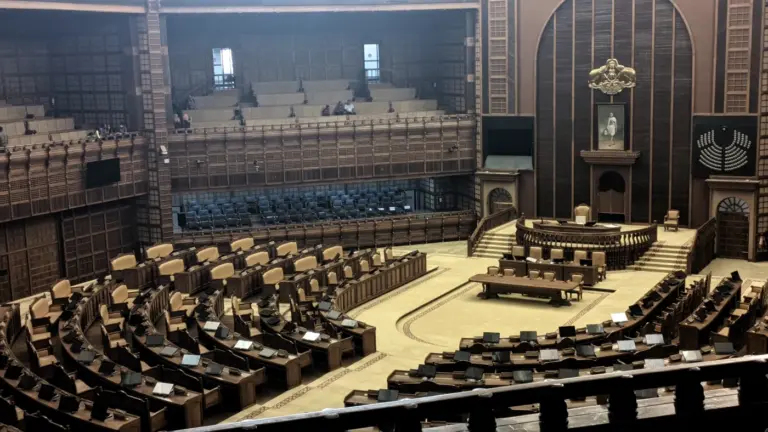
There’s a lawyer in every state who can walk into the Legislative Assembly, take the floor, argue a point of law in front of the whole House, and then walk out without ever casting a vote or facing an electorate. That person is the Advocate General. The office confuses people for a simple reason: it sounds like a junior version of the Attorney General, so aspirants assume the two are the same thing scaled down. Structurally they are twins, and the Constitution built them that way on purpose. But the small textual differences between Article 76 and Article 165 are exactly the places where careless reading costs marks.
Here’s the good news. Article 165 runs to three short clauses. Almost everything worth knowing about this office hangs off those three clauses plus one more provision, Article 177. If you hold four numbers in your head, 165, 177, 194, and 217(2), you hold the whole topic.
Who the Advocate General is and why the office exists
The Advocate General is the highest law officer of a state government, appointed by the Governor under Article 165 to advise the state on legal matters and to represent it in court. Think of a state government as an organisation that gets sued every single working day, over land acquisition, over transfers and promotions, over reservation policy, over a mining lease, over a tender that went to the wrong bidder. Somebody senior has to decide what position the state takes and stand up in the High Court to defend it. That’s the job.
The office sits in Part VI, Chapter II of the Constitution, the chapter titled “The Executive.” That placement is not decorative. The framers grouped the Advocate General with the Governor and the Council of Ministers, not with the judiciary and not with the watchdog institutions. Read that as a signal: the state’s chief lawyer is part of the executive apparatus, the government’s counsel, not an umpire standing over it.
The design is a straight copy of the Union arrangement. Article 76 gives the country an Attorney General of India; Article 165 gives each state its own equivalent. Same idea, different level. Every state in the Union has one Advocate General, and the number of these offices tracks the number of states rather than the number of High Courts, which is why Punjab and Haryana share a common High Court but still appoint separate Advocates General. If that distinction surprises you, it’s worth revisiting how many High Courts India actually has, because the state-to-court map is not one to one.
What Article 165 says, clause by clause
Article 165 has exactly three clauses, and each one answers a different question: who appoints, what the job is, and how long it lasts.
Article 165(1) covers appointment and eligibility in one sentence: the Governor of each state shall appoint a person who is qualified to be appointed a Judge of a High Court to be Advocate General for the state. Notice what it does not say. It does not prescribe a term. It does not prescribe an age. It does not say the person must be a resident of the state or a member of that state’s bar.
Article 165(2) sets out the duties: to give advice to the state government on such legal matters, and to perform such other duties of a legal character, as may from time to time be referred or assigned to him by the Governor, and to discharge the functions conferred on him by or under the Constitution or any other law in force. Three limbs, and the third one is the sleeper. We’ll come back to it.
Article 165(3) handles tenure and pay in twelve words of substance: the Advocate General holds office during the pleasure of the Governor, and receives such remuneration as the Governor may determine. No fixed term. No grounds for removal. No procedure. That single clause is why this office behaves so differently from a constitutional watchdog.
Who can be appointed, and by whom
The qualification is borrowed wholesale from the judiciary: the person must be qualified to be appointed a Judge of a High Court. That takes you to Article 217(2), which sets two routes. The person must be a citizen of India and must either have held a judicial office in India for at least ten years, or have been an advocate of a High Court, or of two or more such courts in succession, for at least ten years.
Now the part that trips up almost everyone. A High Court judge retires at 62 under Article 217(1)(a). So can a 70-year-old be Advocate General? Yes. Article 165 asks only that the person be *qualified to be appointed* a High Court judge, and the qualifications live in Article 217(2), which says nothing about age. The retirement age is a condition of holding judicial office, not a qualification for appointment. Senior advocates well past 62 have held the office in several states, and nothing in the text stops that. Read the two provisions in that order and the confusion dissolves.
The second thing to get right is who really decides. The text says the Governor appoints. In substance, the state Council of Ministers picks the person, because the Governor acts on aid and advice under Article 163 for everything outside his narrow discretionary field, and appointing the Advocate General is not one of the discretionary functions. So “the Governor appoints” means “the state government appoints, through the Governor.” The same reading applies later to the word “pleasure.”
What the Advocate General actually does
The duties under Article 165(2) come in three limbs, and they get progressively more interesting.
The first limb is advice: telling the state government what the law permits before the government acts. This is the quiet bulk of the work and almost none of it is visible. A department wants to cancel a lease, restructure a corporation, or issue a notification under a state Act. The file comes to the Advocate General with the question “can we?” and goes back with an opinion.
The second limb is duties of a legal character assigned by the Governor, which in practice means whatever the state government needs a senior lawyer for. Appearing for the state in the High Court in its heavy matters. Leading the state’s case in the Supreme Court when a High Court judgment goes against it. Signing off on whether the state appeals at all, which is a real gatekeeping power because most litigation dies at that decision.
The third limb, functions conferred by the Constitution or any other law, is where the office picks up powers no minister can hand it or take away. Here’s the cleanest worked example. Under Section 15 of the Contempt of Courts Act, 1971, a High Court can take up a case of criminal contempt on its own motion, or on a motion made by the Advocate General, or on a motion by any other person with the Advocate General’s consent in writing. That’s a statutory gate, and the Advocate General holds the key. A citizen who wants the High Court to punish someone for scandalising the court cannot simply walk in. The Advocate General decides whether the complaint deserves the court’s time. He gets that power from a 1971 statute, not from any instruction the Chief Minister can issue on a Tuesday.
The three rights that make the office unusual
The Advocate General enjoys a right of audience across the state’s courts, a right to speak in the state legislature, and the privileges of a legislator. Those three together are why the office is genuinely odd, and one of them has a textual wrinkle worth knowing.
Right of audience. In performing his official duties, the Advocate General is entitled to appear before any court of law within the state. Here’s the wrinkle: Article 165 does not say so. Article 76(3) expressly gives the Attorney General a right of audience in all courts in the territory of India, and Article 165 has no matching clause. The state office’s right to appear across the state’s courts flows from the office itself and from the state’s engagement of him, not from an express constitutional grant. It’s a small asymmetry, and noticing it is the difference between having read Article 165 and having read a summary of it.
Right to speak in the legislature, under Article 177. Every Minister and the Advocate General for a state has the right to speak in, and otherwise take part in the proceedings of, the Legislative Assembly, or where the state has a second chamber, both Houses, and any committee of the legislature of which he is named a member. But he is not entitled to vote. Read the opening words of Article 177 slowly: “Every Minister and the Advocate-General.” That’s the whole list. Apart from ministers, the Advocate General is the only person the Constitution lets speak on the floor of a state legislature. In states that also have an upper chamber, the right runs to both Houses, which is one more reason to be clear about which states actually have Legislative Councils.
Privileges under Article 194. He enjoys the same privileges and immunities available to a member of the state legislature, which is what makes the Article 177 right usable. Without immunity for what he says on the floor, a lawyer advising the House on a contested bill would be exposed the moment he opened his mouth.
Now the objection an alert reader is already forming: isn’t it strange that an unelected lawyer gets floor time in a democratic chamber? It would be, if he could vote. He can’t. He’s there as the government’s legal voice, to explain why a bill is within the state’s competence or how a court order constrains what the House is proposing. The speech is legal, the vote stays with the elected members, and he isn’t counted for quorum. That split is the whole design.
Term, removal, and the Governor’s pleasure
The Advocate General holds office during the pleasure of the Governor, and that’s the entire law on tenure. The Constitution fixes no term, lists no grounds for removal, and lays down no procedure. Compare that with a High Court judge, who under Article 217(1)(b) can only be removed the way a Supreme Court judge is removed, or with the Comptroller and Auditor General, whose removal needs an address of Parliament. Those offices were designed to survive a hostile government. This one was not.
And once you decode “pleasure” as “the state government’s decision,” the practical rule follows. Convention, not the Constitution, is what actually governs turnover. The Advocate General is appointed on the advice of a particular Council of Ministers, so when that ministry goes, he conventionally resigns and the incoming government appoints its own. This happens after almost every change of government in a state. No provision requires it. It follows from the logic of the office: a counsel serves the client, and the client just changed.
Two more consequences of Article 165(3) are worth pinning down. First, his remuneration is whatever the Governor determines, meaning whatever the state government fixes. It isn’t set by the Constitution and it isn’t charged on the state’s Consolidated Fund the way the Governor’s emoluments and the judges’ salaries are under Article 202(3). Second, he is not a government servant and not a full-time counsel. He can keep private practice, subject to the conditions the state imposes, and the standard conditions bar him from holding a brief against the state or advising a party whose interests conflict with the government’s.
That last point is where the sharpest criticism of the office lives, and it deserves a straight answer rather than a defence. A part-time chief law officer with a private practice is a compromise, and it exists because the alternative is worse. Bar the top state lawyer from all private work and you would attract only those who could not command a practice, which is precisely the wrong filter for the person who argues the state’s hardest cases. The conflict is real and it’s managed by restriction, not eliminated.
Advocate General and Attorney General of India compared
Hold the two side by side and the pattern is clear: same skeleton, different level, and three genuine differences hiding in the details.
| Feature | Advocate General of a State | Attorney General of India |
|---|---|---|
| Constitutional provision | Article 165, Part VI | Article 76, Part V |
| Status | Highest law officer of the state | Highest law officer of the country |
| Appointed by | The Governor | The President |
| Effective decision | State Council of Ministers | Union Council of Ministers |
| Qualification | Qualified to be a High Court judge (Article 217(2)) | Qualified to be a Supreme Court judge (Article 124(3)) |
| Duties | Advise the state on legal matters referred by the Governor, perform legal duties assigned by the Governor, discharge functions under the Constitution or any law | Advise the Union on legal matters referred by the President, perform legal duties assigned by the President, discharge functions under the Constitution or any law |
| Right of audience | All courts within the state; not expressly granted by Article 165 | All courts in the territory of India; expressly granted by Article 76(3) |
| Rights in the legislature | Speak and take part in the state legislature and its committees, no vote (Article 177) | Speak and take part in both Houses of Parliament, their joint sittings, and committees, no vote (Article 88) |
| Privileges | Those of a member of the state legislature (Article 194) | Those of a member of Parliament (Article 105) |
| Term | Not fixed by the Constitution | Not fixed by the Constitution |
| Tenure and removal | Holds office during the Governor’s pleasure; no grounds or procedure prescribed | Holds office during the President’s pleasure; no grounds or procedure prescribed |
| Remuneration | As the Governor determines (Article 165(3)) | As the President determines (Article 76(4)) |
| Assisted by | Additional Advocates General and Government Advocates under state rules | Solicitor General and Additional Solicitors General under the Law Officers (Conditions of Service) Rules, 1987 |
The three rows that carry real weight are the qualification row (High Court judge versus Supreme Court judge), the right-of-audience row (implied versus express), and the legislature row (Article 177 versus Article 88, with the Attorney General also covered for joint sittings). Everything else is the same structure wearing a different label.
Where the office actually gets contested
The Advocate General’s post is a public office, which means a court can ask the holder to justify holding it. That’s the point of G.D. Karkare v. T.L. Shevde (1952), where the Nagpur High Court entertained a quo warranto petition questioning an Advocate General’s appointment. The principle is the useful takeaway: where a public office carries a prescribed qualification, a court can ask “by what authority do you hold this office?” and the holder must show the qualification. If the writ jurisdiction feels shaky, work through the types of writs once and this case slots into place immediately.
The deeper point is about what the office is not. Because there’s no fixed term and no removal procedure, the Advocate General turns over with the government, and that is the correct design for a counsel. It also means the office is nothing like the independent constitutional bodies that exist to check the executive. Anyone who reads Article 165 hoping to find a watchdog is reading the wrong provision. The state’s lawyer is supposed to be the state’s lawyer. The check on the state comes from the courts, not from its own counsel.
The rest of the state’s law officers
Only the Advocate General is in the Constitution. Everyone else in the state’s legal machinery is a creature of ordinary rules: Additional Advocates General, Government Advocates and Government Pleaders for civil matters, and Public Prosecutors appointed under the Bharatiya Nagarik Suraksha Sanhita, 2023, which replaced the Code of Criminal Procedure, 1973. Their terms, numbers, and pay come from state notifications, and a state can create or abolish them without touching a comma of the Constitution.
That two-tier pattern repeats exactly at the Union. Article 76 names only the Attorney General; the Solicitor General and the Additional Solicitors General exist under the Law Officers (Conditions of Service) Rules, 1987. So the rule to carry is this: one constitutional law officer at each level, and a statutory support structure under it. Get that shape right and both halves of the topic collapse into a single idea.
How to study and remember this
Anchor the whole topic on four numbers and let everything else hang off them. 165 is the office. 177 is the right to speak. 194 is the privilege that makes 177 usable. 217(2) is the qualification. If you can produce those four in the right order, you can reconstruct the rest under pressure.
Then attach the details as branches. Under 165, remember three clauses in sequence: appointment plus qualification, duties, pleasure plus pay. Under duties, remember the trio “advise, assigned, conferred,” and keep the contempt example attached to the third one, because a concrete instance survives revision better than an abstract phrase does. Under rights, remember “audience, speak, privileges,” and remember that the first one is implied while the Union version in Article 76(3) is express.
For the comparison, don’t memorise the table row by row. Memorise the three differences that are actually different (High Court judge versus Supreme Court judge, implied versus express audience, Article 177 versus Article 88) and derive the rest from the twin structure. Any question about the Advocate General is answerable by asking “what does the Attorney General get, and does the state text say the same thing?”
The one trap to rehearse deliberately is the age point. Qualified to be appointed a High Court judge does not import the retirement age of 62. Say that sentence out loud once and it stops being a trap.
Frequently Asked Questions
Who is the Advocate General of a state?
The Advocate General is the highest law officer of a state government. Under Article 165, the Governor appoints a person qualified to be a High Court judge to advise the state on legal matters and to represent it in court. Every state has one.
Who appoints the Advocate General and what is the qualification?
The Governor appoints him under Article 165(1), acting on the advice of the state Council of Ministers. The qualification is that the person must be qualified to be appointed a Judge of a High Court under Article 217(2): a citizen of India with ten years in judicial office or ten years as an advocate of a High Court.
What is the term of the Advocate General?
The Constitution fixes no term. Under Article 165(3) he holds office during the pleasure of the Governor, and no grounds or procedure for removal are prescribed. By convention he resigns when the Council of Ministers that advised his appointment leaves office.
Can the Advocate General speak in the state legislature?
Yes. Under Article 177 he can speak in and take part in the proceedings of the Legislative Assembly, or both Houses where the state has a Legislative Council, and any committee he is named to. He cannot vote, and he is not counted for quorum.
What is the difference between the Advocate General and the Attorney General of India?
The Advocate General is the state’s top law officer under Article 165, appointed by the Governor, qualified to be a High Court judge, with rights under Article 177. The Attorney General is the Union’s top law officer under Article 76, appointed by the President, qualified to be a Supreme Court judge, with an express right of audience across India under Article 76(3) and rights in Parliament under Article 88.
Can the Advocate General carry on private legal practice?
Yes. He is not a government servant and not a full-time counsel, so private practice is allowed subject to the conditions the state imposes. The standard conditions bar him from holding a brief against the state government or advising a party whose interest conflicts with the state’s.
Is the Advocate General’s remuneration fixed by the Constitution?
No. Article 165(3) says he receives such remuneration as the Governor may determine, which in practice means the state government fixes it. Unlike the Governor’s emoluments and judges’ salaries, it is not charged on the state’s Consolidated Fund under Article 202(3).
Can the appointment of an Advocate General be challenged in court?
Yes. The post is a public office with a prescribed qualification, so a writ of quo warranto lies to test whether the holder is qualified. That was the issue in G.D. Karkare v. T.L. Shevde (1952) before the Nagpur High Court.
Practice Questions
1. The office of the Advocate General for a State is provided for under which article of the Constitution?
a) Article 76
b) Article 163
c) Article 165
d) Article 177
Answer: c) Article 165
2. A person appointed as the Advocate General for a State must be:
a) A member of the State Legislative Assembly
b) Qualified to be appointed a Judge of a High Court
c) Qualified to be appointed a Judge of the Supreme Court
d) A retired Judge of a High Court
Answer: b) Qualified to be appointed a Judge of a High Court
3. With reference to the Advocate General for a State, consider the following statements:
1. He has the right to speak in the proceedings of the State Legislative Assembly. 2. He has the right to vote in the State Legislative Assembly. 3. He holds office during the pleasure of the Governor.
Which of the statements given above are correct?
a) 1 and 2 only
b) 1 and 3 only
c) 2 and 3 only
d) 1, 2 and 3
Answer: b) 1 and 3 only
4. Under which article does the Advocate General enjoy the privileges and immunities available to a member of the State Legislature?
a) Article 105
b) Article 177
c) Article 194
d) Article 202
Answer: c) Article 194
5. Which of the following is true of the Advocate General’s remuneration and tenure?
a) The remuneration is fixed by the Constitution and the term is five years
b) The remuneration is determined by the Governor and no term is fixed by the Constitution
c) The remuneration is charged on the Consolidated Fund of the State and the term is six years
d) The remuneration is determined by the State Legislature and the term ends at the age of 62
Answer: b) The remuneration is determined by the Governor and no term is fixed by the Constitution
Mains-style questions
1. Examine the constitutional position of the Advocate General for a State under Article 165. To what extent does the office parallel that of the Attorney General of India, and where does it genuinely differ?
2. “The Advocate General is the government’s counsel, not a check on the government.” Discuss with reference to the tenure, removal, and placement of the office within the Constitution.
3. Article 177 allows an unelected law officer to take part in the proceedings of a State Legislature. Analyse the rationale for this provision and the safeguards that accompany it.
4. Discuss the functions conferred on the Advocate General by law rather than by the Constitution, with suitable examples, and explain why this third limb of Article 165(2) matters.
5. The Advocate General is permitted private legal practice while serving as the highest law officer of a State. Critically evaluate this arrangement.
Article 165 is a short provision that rewards slow reading, because the Constitution says less here than most people assume and the gaps are doing the work. It fixes no term, names no grounds for removal, and does not even spell out the right of audience it obviously intends. What it does is create one senior legal voice for the state, put it inside the executive, and then leave the rest to convention and ordinary law. That’s a deliberate choice, and it tells you how to think about the office: the Advocate General is the state’s lawyer, with a lawyer’s loyalties and a lawyer’s tenure. Expecting independence from a provision that was never designed to produce it is the single most common way this topic goes wrong.
Tell Google you want more of this.
Add Anantam IAS as a preferred sourceOne tap, and this site shows up more often in your own Top Stories, AI Overviews and AI Mode. Remove it any time.