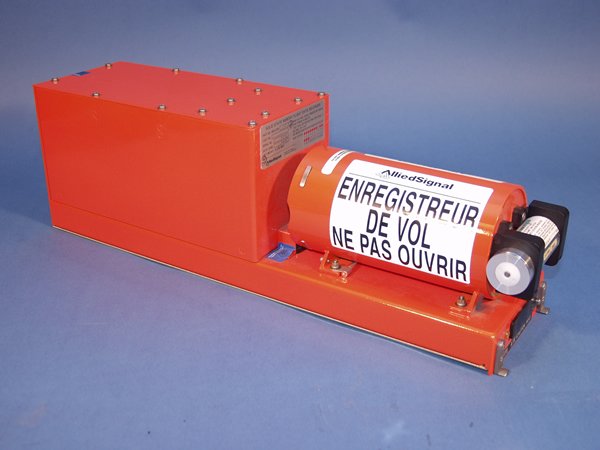
The aircraft black box is the popular name for two separate flight recorders carried by every commercial aircraft: the cockpit voice recorder, or CVR, and the flight data recorder, or FDR. Investigators use the data from these devices to reconstruct what happened in the minutes and seconds before an accident, which is why locating and recovering them is the top priority after any major crash. Despite the name, both devices are painted bright orange to make them easier to spot in wreckage. The “black box” label has stuck for historical reasons.
These recorders are engineered to survive forces that would destroy almost any other electronic device. They face fire, sea water, impact, and pressure, and they are expected to keep their data intact through all of it.
What the Cockpit Voice Recorder Captures
The CVR records the audio environment of the cockpit. It picks up the voices of the flight crew, the audio from radio communications with air traffic control and other aircraft, alarms, switch clicks, engine noise, and ambient sounds that can hint at mechanical problems. Modern CVRs capture at least two hours of audio on a continuous loop, and newer standards require longer durations of up to twenty-five hours.
The CVR audio gives investigators access to crew decision-making, situational awareness, and the precise timing of warnings and responses. Combined with FDR data, it produces a moment-by-moment reconstruction of the final minutes of flight.
What the Flight Data Recorder Captures
The FDR records hundreds of parameters about the aircraft’s state. Modern recorders log altitude, airspeed, heading, pitch, roll, vertical acceleration, engine performance, control surface positions, autopilot status, flap and landing gear positions, fuel flow, and many more variables. The recording loop covers at least twenty-five hours of flight in current-generation aircraft.
The FDR turns an accident from a guess into an engineering problem. If a wing dropped because a particular system failed, the data will show the failure signature. If the engines lost thrust together, the parameters will reveal whether it was fuel, electrical, or mechanical.
How Black Boxes Survive
Survivability is built into every layer of the recorder.
The Protective Housing
The memory module sits inside a crash-survivable memory unit. The outer shell is typically made from stainless steel or titanium, materials chosen for their combination of strength, heat resistance, and corrosion resistance. Inside the metal shell are layers of thermal insulation and shock-absorbing material that protect the memory chips from impact forces and prolonged exposure to fire.
International standards require the recorder to survive impact loads of up to three thousand four hundred g, a fire of around one thousand one hundred degrees Celsius for thirty minutes to one hour, sea-water immersion at depths up to six thousand metres for thirty days, and crushing forces in the order of twenty-five kilonewtons.
Solid-State Memory
Older recorders used magnetic tape, which was vulnerable to physical damage and demagnetisation. Modern recorders use solid-state memory chips, which have no moving parts, retain data without power, and survive impact loads that would destroy spinning disks or tape mechanisms.
The Underwater Locator Beacon
When an aircraft goes down at sea, locating the recorders is the central problem. Each black box carries an underwater locator beacon, a small cylindrical pinger attached to the unit. The beacon activates on contact with water and emits an acoustic signal, typically at a frequency around thirty-seven and a half kilohertz, detectable by sonar from search vessels.
The beacon is acoustic. It does not emit a red light, a flashing strobe, or a visible signal. Visual signals would be useless at the depths where most lost recorders end up. The beacon’s battery powers the ping for at least thirty days, and newer standards extend that to ninety days, in response to incidents where searches ran out of time before finding the device.
Limits and Recent Changes
Black boxes have limits. Recorder data captures what the aircraft did, not why a particular component failed or what the crew was thinking beyond what they said aloud. Some accidents lose the recorders entirely, especially over deep ocean or in fragmented wreckage. Regulators have responded by extending recording duration, requiring image-based cockpit recorders on some new types, and exploring real-time streaming of critical parameters to ground stations.
After the loss of Air France 447 in the Atlantic in 2009, the slow recovery of its recorders prompted international rule changes that extended beacon battery life and standardised twenty-five-hour recording. Indian carriers operate under Directorate General of Civil Aviation rules that align with these international standards.
After a Crash
Once recovered, recorders are read out at a certified laboratory under the supervision of the investigating authority. In India, the Aircraft Accident Investigation Bureau handles major civil aviation investigations and has its own readout facility. Final reports combine recorder data with wreckage examination, witness statements, maintenance records, and air traffic control logs.
For related reading, see our explainer on Indian Air Force ranks and hierarchy and fighter jet generations.
FAQs
Why is the aircraft black box bright orange?
The orange paint makes the recorder easier to spot in wreckage. The “black box” name is historical and has nothing to do with the device’s actual colour.
What is the difference between CVR and FDR?
The cockpit voice recorder captures audio in the cockpit, including crew conversation, radio traffic, and warning sounds. The flight data recorder logs hundreds of flight parameters such as altitude, speed, and control inputs.
What is the black box made of?
The crash-survivable memory unit uses an outer shell of stainless steel or titanium, with thermal insulation and shock-absorbing layers inside to protect the solid-state memory chips.
Does the underwater locator beacon emit a red light?
No. It emits an acoustic pinger signal that sonar equipment can detect. Visible signals would be useless at typical search depths.
How long does the underwater beacon transmit?
Current standards require at least thirty days of battery life. Newer rules adopted after Air France 447 extended this to ninety days for many aircraft types.
Can black boxes be destroyed?
They can be damaged in extreme crashes or lost in inaccessible terrain, but their design enables most recorders to survive forces that destroy the rest of the aircraft.
How long do black boxes record?
Modern flight data recorders log at least twenty-five hours of flight parameters. Cockpit voice recorders historically captured two hours; newer regulations extend this to twenty-five hours as well.
Who investigates air crashes in India?
The Aircraft Accident Investigation Bureau under the Ministry of Civil Aviation conducts major civil aviation crash investigations and operates a recorder readout facility.
Tell Google you want more of this.
Add Anantam IAS as a preferred sourceOne tap, and this site shows up more often in your own Top Stories, AI Overviews and AI Mode. Remove it any time.