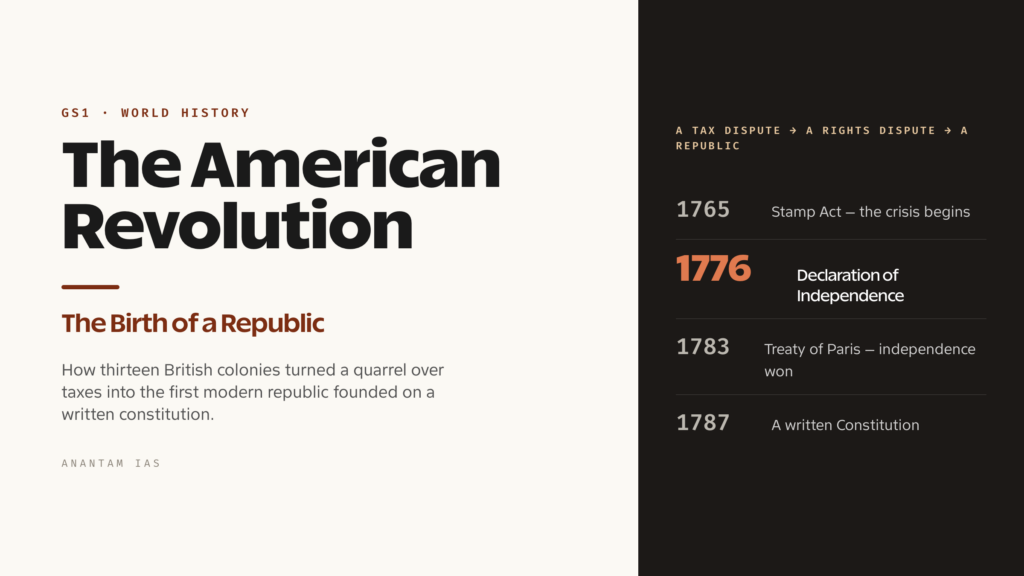
In the spring of 1765, a clerk in London drafting a tax on stamped paper could not have guessed he was helping to invent a country. The tax was small, the logic was reasonable, and the empire that levied it was the most powerful on earth. Eleven years later, thirteen of that empire’s colonies declared themselves free and equal states; eighteen years after that, they had written down a form of government that no large society had ever tried before and made it work. The American Revolution is the story of how a quarrel over money became a quarrel over rights, and how a quarrel over rights became the first modern republic.
That is why it matters far beyond America. Before 1776, “republic” was mostly a word for small, fragile, ancient experiments — Athens, Rome, a few Italian city-states — that had all decayed into tyranny or been swallowed by empires. The Americans gambled that a republic could be built deliberately, on paper, for a continent-sized nation, and that ordinary people rather than a king could be the source of all legitimate power. When that gamble paid off, it handed every later people with a grievance against an empire a working template and a dangerous idea: that government is something a people can choose, and refuse.
The World That Made It
By the 1760s Britain held thirteen colonies strung down the Atlantic coast of North America, from Massachusetts in the north to Georgia in the south. These were not conquered territories run from London. Each had its own elected assembly that voted local taxes and made local laws, and for generations Britain had largely left them to it — a hands-off habit later historians call “salutary neglect.” A colonist in Boston or Virginia thought of himself as a free-born Englishman, entitled to the ancient liberties of Englishmen, who simply happened to live three thousand miles from Westminster.
The trouble began, as trouble in empires so often does, with a war and a bill. Britain had just won the Seven Years’ War against France, known in America as the French and Indian War, which ended in 1763 and stripped France of most of its North American empire. Victory was glorious and ruinously expensive. Britain came out of it with a vast war debt and a new responsibility to defend and garrison the enlarged territory. Parliament reached the obvious conclusion: the colonies had benefited from the war, so the colonies should help pay for it. To Londoners this was common sense. To the colonies it would look like robbery, because of one constitutional point the two sides understood completely differently.
That point was representation. The English principle, going back to Magna Carta in 1215, was that the Crown could not tax free subjects without their consent, given through their representatives in Parliament. The colonists had no members in Parliament. So by their reading, any tax Parliament laid on them directly was a tax without consent — illegitimate by Britain’s own rules. London’s reply was the doctrine of “virtual representation”: every member of Parliament represented the whole empire, they argued, whether or not a given town or colony had actually voted for anyone. The colonists found this absurd. Out of that clash came the slogan that became the revolution’s heartbeat — no taxation without representation.
How It Unfolded
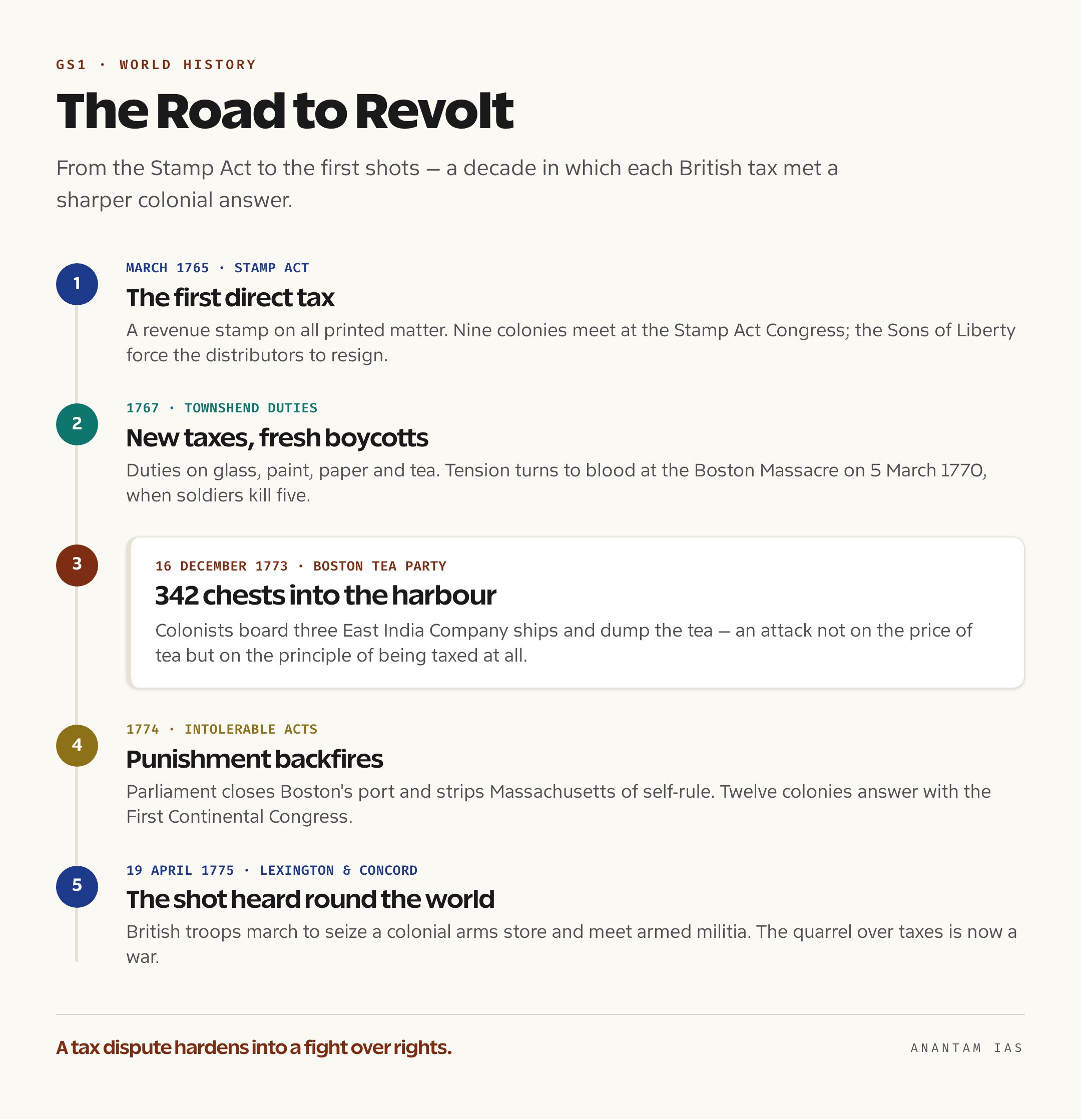
The first spark was the Stamp Act of 1765, passed by Parliament that March. It was the first direct tax Britain had ever placed on the colonies, requiring a revenue stamp on printed matter of all kinds — legal documents, newspapers, pamphlets, even playing cards. The reaction was ferocious and, crucially, coordinated. Nine colonies sent delegates to a Stamp Act Congress in New York in October 1765, the first time the colonies had met to act as one. Crowds calling themselves the Sons of Liberty intimidated the stamp distributors into resigning; merchants boycotted British goods. The Massachusetts lawyer James Otis is remembered for sharpening the argument into a weapon, insisting in this period that taxation without representation was tyranny. Faced with the boycott, Parliament repealed the Stamp Act in 1766 — but in the same breath passed the Declaratory Act, asserting its right to bind the colonies “in all cases whatsoever.” Britain had backed down on the tax while doubling down on the principle. Both sides simply postponed the fight.
It returned with the Townshend duties of 1767, which taxed imports like glass, paint, paper and tea, and brought fresh boycotts and rising anger. Tension turned to blood on 5 March 1770, when British soldiers fired into a Boston crowd and killed five men — the Boston Massacre, a name the patriot printers chose with care. Then came the most theatrical protest of all. On the night of 16 December 1773, colonists, some disguised as Mohawk warriors, boarded three East India Company ships in Boston Harbor and threw 342 chests of tea into the water. The Boston Tea Party was an attack not on the price of tea but on the principle of being taxed at all.
London’s patience snapped. In 1774 Parliament passed a set of punitive laws the colonists named the Intolerable Acts — closing the port of Boston until the tea was paid for, rewriting the Massachusetts charter to strip its self-government, and more. The intent was to isolate and punish Massachusetts. The effect was the opposite: it convinced the other colonies that their own liberties were next. In September 1774 twelve colonies sent delegates to a First Continental Congress in Philadelphia to organise resistance. The argument was now well past taxes.
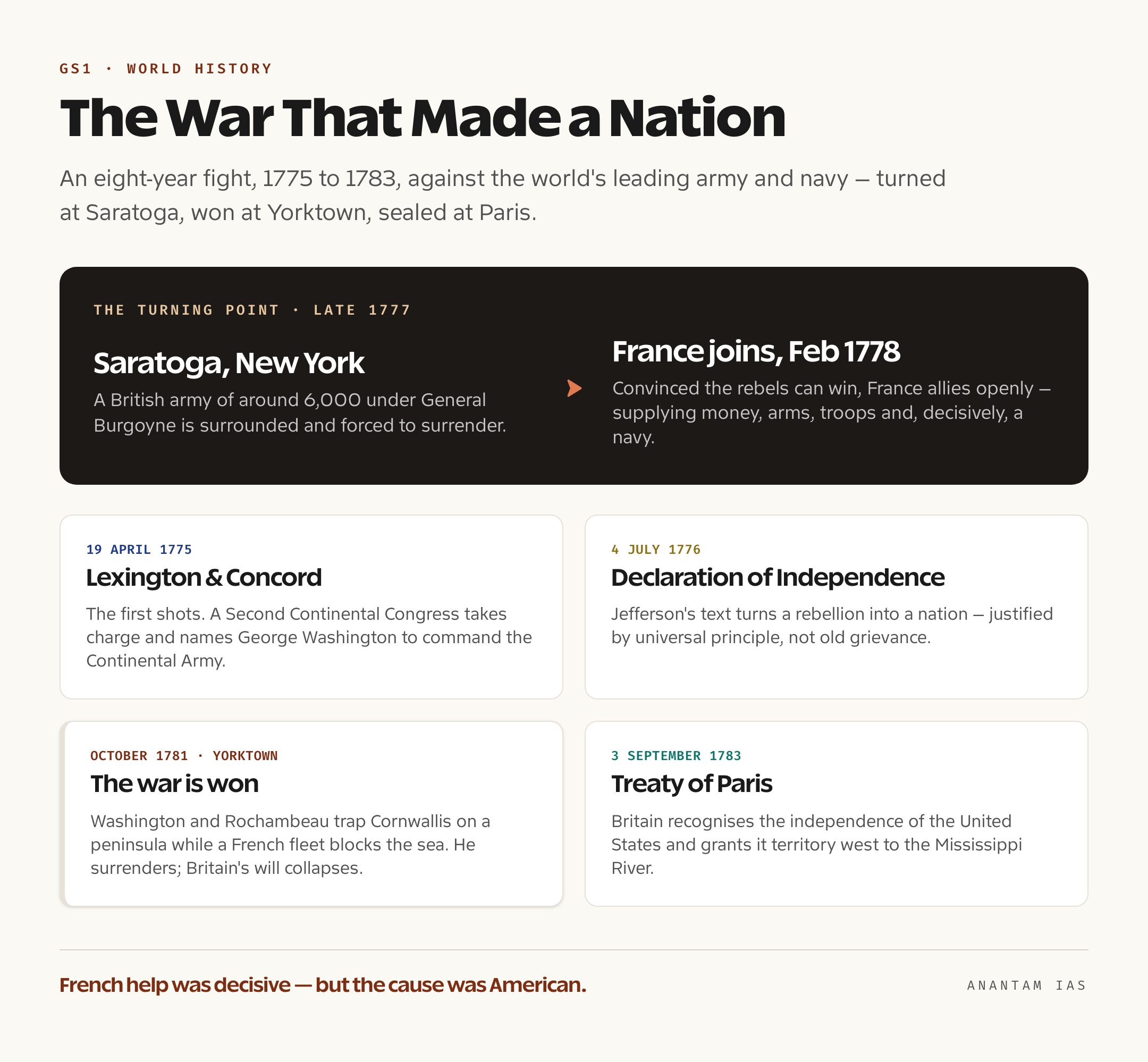
So when British troops marched out of Boston in April 1775 to seize a colonial arms store, they met armed militia at Lexington and Concord on 19 April — “the shot heard round the world,” and the start of an eight-year war. A Second Continental Congress took charge, appointed George Washington to command a Continental Army, and on 4 July 1776 adopted the document that turned a rebellion into a nation. Drafted chiefly by the thirty-three-year-old Thomas Jefferson, the Declaration of Independence did something new: it justified independence not by old grievances but by universal principle — that “all men are created equal,” endowed with “unalienable Rights” to “Life, Liberty and the pursuit of Happiness,” and that governments derive “their just powers from the consent of the governed.”
Why It Happened
It is tempting to read the Revolution backwards, as if a free people always meant to be free and merely waited for the moment. The honest account is more tangled, and more interesting, because several pressures had to converge.
The immediate cause was fiscal and constitutional. An empire deep in debt tried to tax colonies that had grown used to taxing themselves, and did so without offering them a seat at the table. But money alone rarely starts revolutions. What made the taxes explosive was an intellectual current — the European Enlightenment, the eighteenth-century movement that insisted human affairs could be reasoned out from first principles rather than inherited from kings and priests. The colonists, unusually literate and politically engaged, had read it. Above all they had read the English philosopher John Locke, whose Second Treatise of Government, published in 1689, argued that government exists by a “social contract” — a notional agreement in which people trade some freedom for protection of their natural rights to life, liberty and property — and that a government which violates those rights forfeits its authority and may rightly be replaced. Jefferson did not invent the ideas in the Declaration; he distilled Locke, with a debt to thinkers like Montesquieu on the separation of powers, into the clearest political prose ever written.
There were social and economic causes too. A confident colonial merchant and planter class chafed at trade rules written for London’s benefit, an old imperial economic strategy historians call mercantilism, under which a mother country runs its colonies as captive suppliers and markets. A growing population pressed against the Proclamation of 1763, which forbade settlement beyond the Appalachians. And distance itself was a cause: three thousand miles of ocean had bred a people who already governed themselves in practice, so that London’s sudden assertion of control felt less like correction than usurpation.
And we should resist the triumphalist version that treats the rebels as flawless champions of liberty. The same men who proclaimed that all men are created equal owned enslaved people — Jefferson among them — and the new nation’s expansion would come at the expense of Native peoples. The contradiction was not a footnote; it was structural, and it would take a civil war and more to begin to confront. The Revolution’s ideals were genuinely radical for their time. They were also, in their own day, applied to a narrow slice of humanity. Holding both truths at once is the mark of a serious reading.
What It Changed
First, the Americans had to win, and for years that looked unlikely against the world’s leading army and navy. The turning point came in late 1777 at Saratoga in upstate New York, where a British army of around six thousand under General Burgoyne was surrounded and forced to surrender. The victory had a strategic prize larger than the captured troops: it persuaded France, Britain’s great rival, that the rebels could actually win. In February 1778 France signed a formal alliance with the United States and entered the war openly, supplying money, weapons, troops and — decisively — a navy. The final act came at Yorktown in Virginia in October 1781, where Washington’s army and a French force under Rochambeau trapped General Cornwallis on a peninsula while a French fleet blocked his escape by sea. Cornwallis surrendered, and Britain’s will to fight collapsed. The Treaty of Paris, signed on 3 September 1783, recognised the independence of the United States and granted it territory west to the Mississippi River. French help did not cause the Revolution, but without it the Americans might well have lost.
Winning, though, was the easy part. The thirteen states had first bound themselves under the Articles of Confederation, which created a central government so weak it could neither tax nor enforce its decisions, and the young republic nearly came apart. So in the summer of 1787, fifty-five delegates met in Philadelphia and, over four months behind closed doors, wrote an entirely new Constitution. Its two great innovations are worth naming precisely. The first is federalism — the deliberate division of power between a national government and the states, so that authority is shared rather than concentrated in one place. The second is checks and balances — the splitting of the national government into three branches, legislative, executive and judicial, each able to restrain the others, so that no single branch or person could become a tyrant. To win over critics who feared the new central power, the framers added the Bill of Rights, the first ten amendments ratified in 1791, which placed core freedoms like speech, religion and a fair trial beyond the reach of government.
What emerged was the first modern republic founded on a single written constitution — a supreme law, standing above kings and parliaments, that the people themselves had authored. It remains the world’s oldest such constitution still in force. And its example travelled fast. France’s revolutionaries borrowed directly from the American Declaration when they drafted the Declaration of the Rights of Man and of the Citizen in 1789; the proof that a monarchy could be replaced with a republic helped light the fuse of the French Revolution. Across the next two centuries, peoples from Latin America to Asia would reach for the same script. When Ho Chi Minh proclaimed Vietnam’s independence in Hanoi in 1945, he opened by quoting Jefferson’s line that all men are created equal — turning the slave-owning republic’s own words into an anti-colonial weapon.
The Indian Echo
For an Indian reader, the American story is not a foreign curiosity; it is a close cousin of our own. Here was a set of British colonies that decided British rule had become illegitimate, organised across regions to resist it, and finally threw it off to govern themselves. That example — a colony defeating the same empire that would later rule India — sat in the background of Indian nationalist imagination, a standing proof that British power was neither permanent nor invincible.
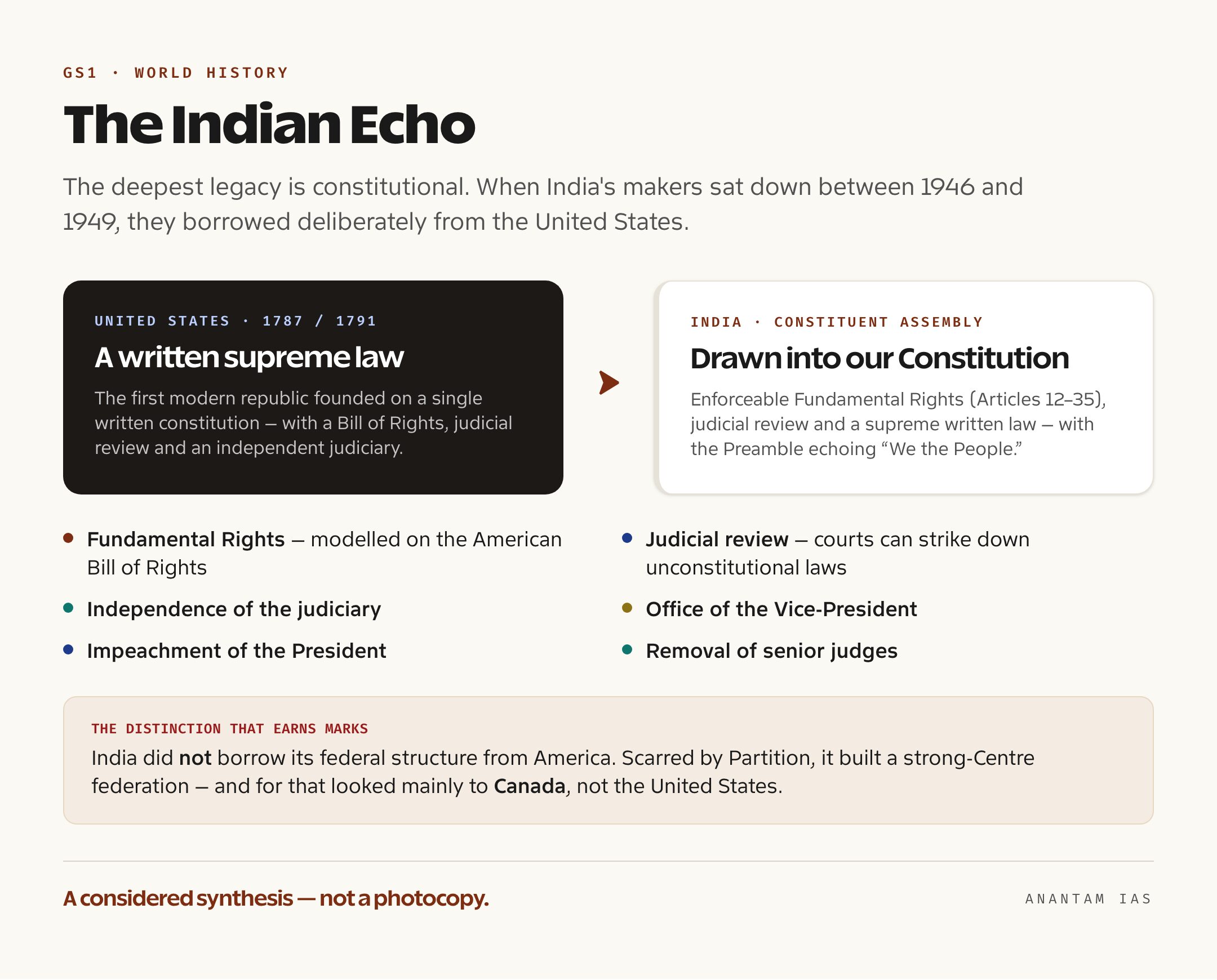
But the deeper Indian echo is constitutional, and this is where care matters, because it is also where candidates most often overclaim. When the makers of the Indian Constitution sat down between 1946 and 1949, they studied the world’s constitutions and borrowed deliberately. From the United States they took the very idea of Fundamental Rights enforceable against the state — our Articles 12 to 35 are the lineal descendants of the American Bill of Rights. They took judicial review, the power of courts to strike down laws that violate the Constitution. They took the independence of the judiciary, the office of Vice-President, the method of impeaching the President, and the procedure for removing senior judges. Even our Preamble’s opening cadence echoes the American “We the People.”
Here is the nuance that separates a sharp answer from a sloppy one. India did not borrow its federal structure from the United States. American federalism is a federation of strong states with a relatively limited centre; India, scarred by the trauma of Partition and the fear of fragmentation, deliberately built a federation with a strong Centre, and for that model looked mainly to Canada, not America. So the accurate statement is that the United States gave India the idea of a written, supreme constitution, of enforceable rights, and of judicial review — but not the design of its federalism. Get that distinction right and you signal that you understand the Constitution as a considered synthesis, not a photocopy.
For Your Mains Answer
The American Revolution maps cleanly onto GS Paper 1, which covers the “history of the world” from the eighteenth century — events, forms and effect on society, including industrialisation, world wars, the redrawal of boundaries, colonisation and decolonisation. It is one of the canonical “revolutions” alongside the French and Russian, and examiners love comparison. It is equally useful in the Essay paper on themes of liberty, the rule of law, nationalism, and rights. Treat it as the origin point of the modern republican idea, and connect it forward to the documents it inspired.
How to Build the Answer
Open with the through-line, not a date dump: a tax dispute became a rights dispute, and a rights dispute produced the first written-constitution republic. Then move in three clean phases — the causes (taxation without representation, plus the Enlightenment), the course (1765 to 1783, ending at Paris), and the consequences (the 1776 Declaration, the 1787 Constitution, and the global ripple to France and the colonised world). Reserve your final paragraph for legacy and a balanced verdict.
Common Mistakes to Avoid
Don’t confuse the Declaration of Independence (1776) with the Constitution (1787) — they are eleven years and two different documents apart. Don’t say India borrowed its federalism from America; it borrowed rights, judicial review and the idea of a written constitution, but federalism mainly from Canada. Don’t present the founders as flawless: name the contradiction of slavery to show balance. And don’t over-credit France — its help was decisive militarily, but the causes were American.
A Compact Answer Spine
Debt from the Seven Years’ War → taxation without representation (Stamp Act 1765, Tea Party 1773, Intolerable Acts 1774) → Enlightenment justification (Locke, social contract) → Declaration of Independence (4 July 1776, Jefferson) → War of Independence (1775-83), Saratoga turning point, French alliance 1778, Yorktown 1781, Treaty of Paris 1783 → US Constitution 1787 (federalism, checks and balances) + Bill of Rights 1791 → first modern written-constitution republic → inspires the French Revolution and later anti-colonial movements → constitutional echo in India (Fundamental Rights, judicial review).
Diagram or Timeline Idea
Draw a single horizontal arrow with five marked nodes: 1765 (Stamp Act), 1773 (Tea Party), 1776 (Declaration), 1781 (Yorktown), 1787 (Constitution). Below the arrow, add two outflow arrows labelled “France 1789” and “anti-colonial world / India” to show the legacy. A clean cause-to-legacy timeline like this earns marks quickly and frees your prose for analysis.
The Cause-and-Consequence Angle
The sophisticated point is that the Revolution’s importance lies less in the war than in what it institutionalised afterwards. Plenty of revolts have driven out a ruler; what was rare was writing down a durable republican government that survived its founders. The cause was a fight over consent; the consequence was a machine — separated powers, enumerated rights, judicial review — designed to keep consent at the centre. Make that move from event to institution and you have said something most answers miss.
How to Use Dates Without Cramming
Anchor on five dates and let the rest hang off them: 1765 (the crisis begins), 1776 (independence declared), 1783 (independence won, Treaty of Paris), 1787 (the Constitution), 1791 (the Bill of Rights). If you can place those five in order and say one sentence about each, you can reconstruct the whole arc without memorising the Townshend duties or the date of Lexington.
FAQ
What does “no taxation without representation” mean? It was the central grievance of the thirteen American colonies against Britain. The colonists held that, by long English constitutional principle, free subjects could be taxed only with their consent through their elected representatives. Since they had no members in the British Parliament, they argued that any tax Parliament imposed on them directly — like the Stamp Act of 1765 — was unconstitutional. Britain countered that the colonists were “virtually” represented, an argument they flatly rejected.
What is the difference between the Declaration of Independence and the US Constitution? They are two separate documents, eleven years apart. The Declaration of Independence (4 July 1776), drafted mainly by Thomas Jefferson, announced and justified the break from Britain using Enlightenment principles of equality and natural rights. The US Constitution (1787) is the actual framework of government — establishing federalism, three branches with checks and balances, and, with the Bill of Rights added in 1791, guaranteed freedoms.
Why was French help so important in the American Revolution? After the American victory at Saratoga in 1777 convinced France the rebels could win, France allied with the United States in 1778 and supplied money, arms, troops and, crucially, naval power. French ships blockaded the sea while French and American land forces trapped the British at Yorktown in 1781, forcing the surrender that effectively ended the war. Without French support, the outnumbered Americans might well have lost.
How did the American Revolution influence India’s Constitution? India borrowed several features from the United States: enforceable Fundamental Rights (modelled on the American Bill of Rights), judicial review, independence of the judiciary, the office of Vice-President, and impeachment procedures. The Preamble’s “We the People” also echoes the US Constitution. Importantly, India did not take its federal structure from America — its strong-Centre federalism was drawn mainly from Canada. The broader inspiration was the example of a British colony successfully governing itself under a written constitution.
Tell Google you want more of this.
Add Anantam IAS as a preferred sourceOne tap, and this site shows up more often in your own Top Stories, AI Overviews and AI Mode. Remove it any time.