Disclosure: this guide contains Amazon affiliate links. As an Amazon Associate, Anantam IAS earns from qualifying purchases — at no extra cost to you.
APPSC Group 1 and 2 are Andhra Pradesh Public Service Commission recruitment tracks for different levels of state service. Group 1 leads to senior gazetted posts and, in Notification 12/2023, used objective screening, descriptive Mains, and an interview. Group 2 used objective screening and objective Mains under Notification 11/2023.
Use this page to compare the two exams, then treat the notification for your own recruitment cycle as final. Age limits, post-specific qualifications, vacancies, examination mode, and selection stages can change from one notification to another.
APPSC Group 1 vs Group 2
| Feature | Group 1, Notification 12/2023 | Group 2, Notification 11/2023 |
|---|---|---|
| Typical level | Senior gazetted state services | Executive and non-executive degree-level services |
| Screening test | Objective, OMR | Objective, OMR |
| Mains | Descriptive; two qualifying language papers and five merit papers | Objective; two papers in the 2023 cycle |
| Final stage | Interview/personality test after Mains | Notification-specific selection plus CPT for specified posts |
| Age | Mostly 18–42, with narrower limits for some posts | Mostly 18–42, with exceptions for some posts |
| What controls | The detailed notification for the current cycle | |
Open the official Group 1 Notification 12/2023, Group 2 Notification 11/2023, and the APPSC recruitment notifications list. The 2023 Group 1 and Group 2 cycles reached selection notifications in January 2026.
What Is APPSC?
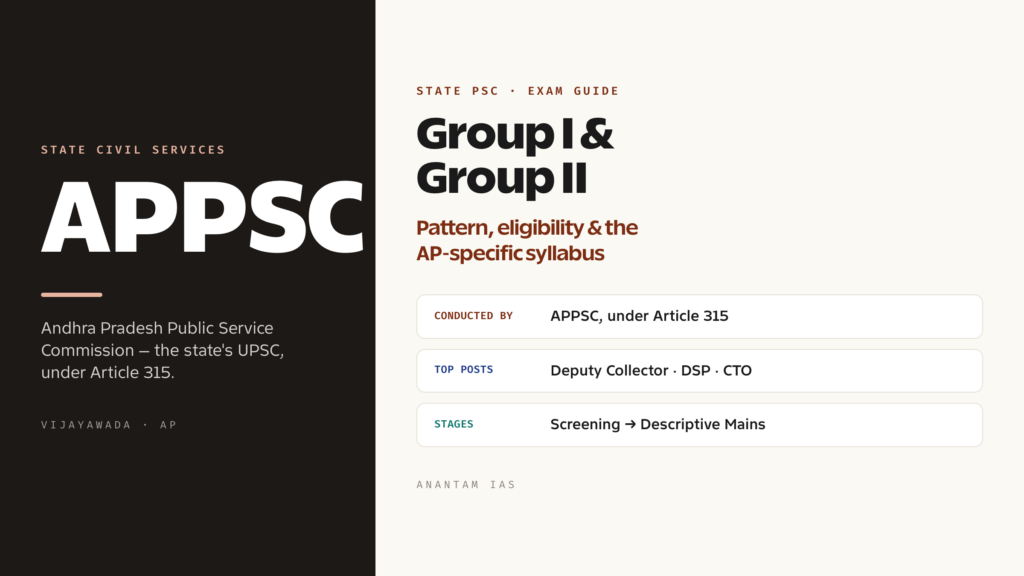
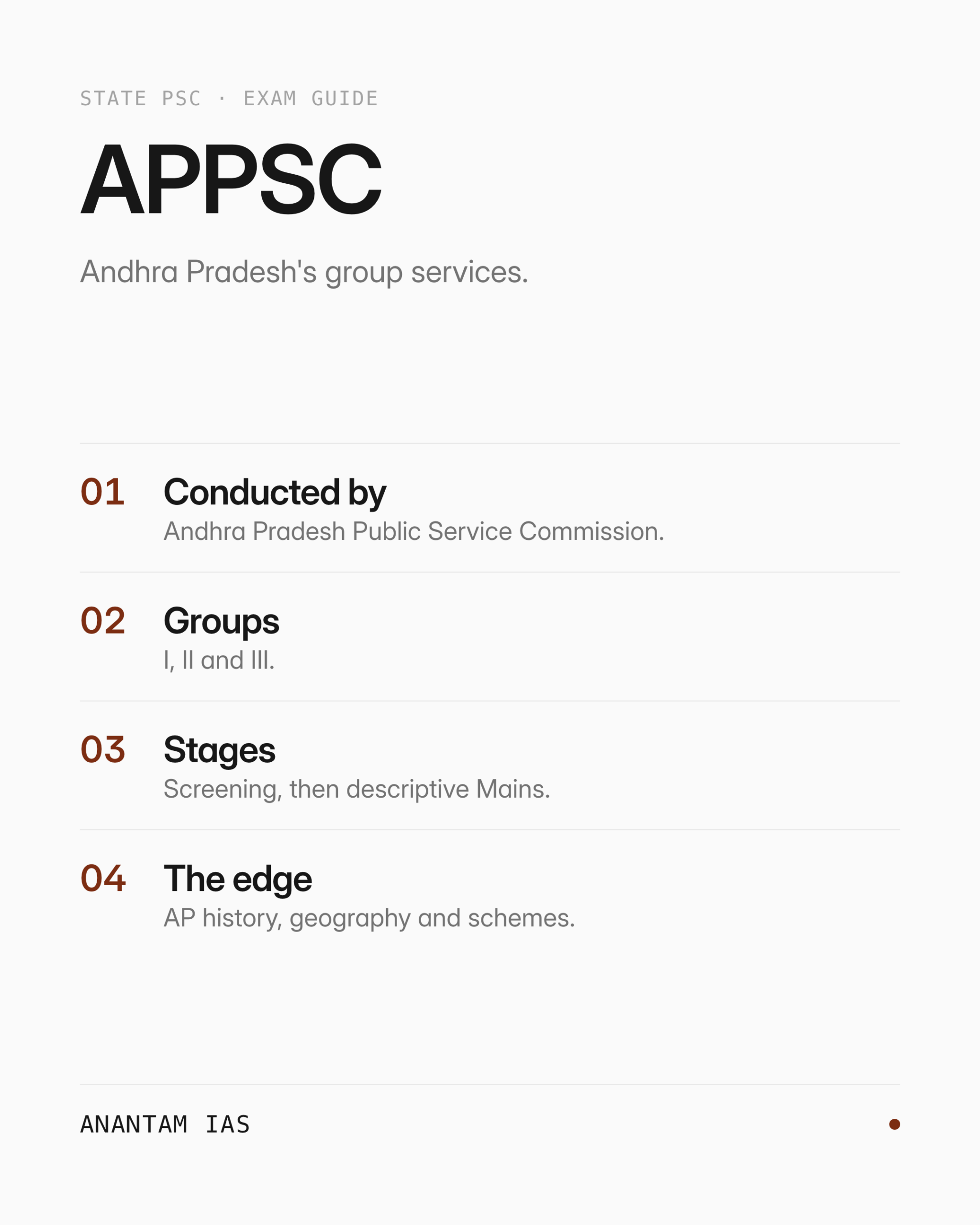
The Andhra Pradesh Public Service Commission is the state-level equivalent of the UPSC — a constitutional body set up under Article 315, whose job is to conduct recruitment exams and advise the state government on appointments to AP’s services. After the 2014 bifurcation that split united Andhra Pradesh into Andhra Pradesh and Telangana, APPSC handles recruitment for residual AP while Telangana set up its own TGPSC, so the two states now run separate exams with separate state syllabi.
APPSC’s exams are grouped by the rank and pay of the posts they fill. Group I is the flagship — it selects officers in the Deputy Collector, DSP, Commercial Tax Officer, and District Registrar grade who head sub-divisions and departments. Group II covers a broad set of degree-level posts: Municipal Commissioner Grade-III, Sub-Registrar, Deputy Tahsildar, Assistant Section Officer in the Secretariat, Senior Auditor, and similar roles. Group III and Group IV sit lower on the ladder — Group III typically covers panchayat-secretary-type rural administration posts, and Group IV fills junior clerical and junior-assistant vacancies that need only a degree and basic aptitude.
Key Facts
- Conducting authority: Andhra Pradesh Public Service Commission, headquartered in Vijayawada, under Article 315.
- Flagship exam: Group I Services — Deputy Collector, DSP, Commercial Tax Officer, and allied gazetted posts.
- Stages: Notification 12/2023 used objective screening, descriptive Mains and an interview for Group 1. Notification 11/2023 used objective screening and objective Mains for Group 2, with CPT for specified posts.
- Latest completed cycles: APPSC published selection notifications for Group 1 Notification 12/2023 on 30 January 2026 and Group 2 Notification 11/2023 on 28 January 2026.
What Is the APPSC Exam Pattern?
The APPSC exam pattern is notification-specific. The two 2023 flagship notifications used different Mains formats, so candidates should not prepare for Group 2 as if it were a shorter version of the descriptive Group 1 examination.
Group 1 Pattern
- Screening: two objective papers, with one-third negative marking for wrong answers.
- Mains: descriptive; Telugu and English are qualifying, followed by five merit papers.
- Interview: Notification 12/2023 called eligible Mains candidates for a personality test in a 1:2 ratio to vacancies.
Group 2 Pattern
- Screening: objective and OMR-based under Notification 11/2023.
- Mains: objective, with two papers in the 2023 cycle and one-third negative marking for wrong answers.
- CPT: Computer Proficiency Test applies to the posts specified in the notification.
Bottom line: prepare descriptive answers for Group 1, but use objective-paper practice for the 2023 Group 2 pattern. Recheck the next detailed notification before carrying this pattern into a new cycle.
APPSC Eligibility
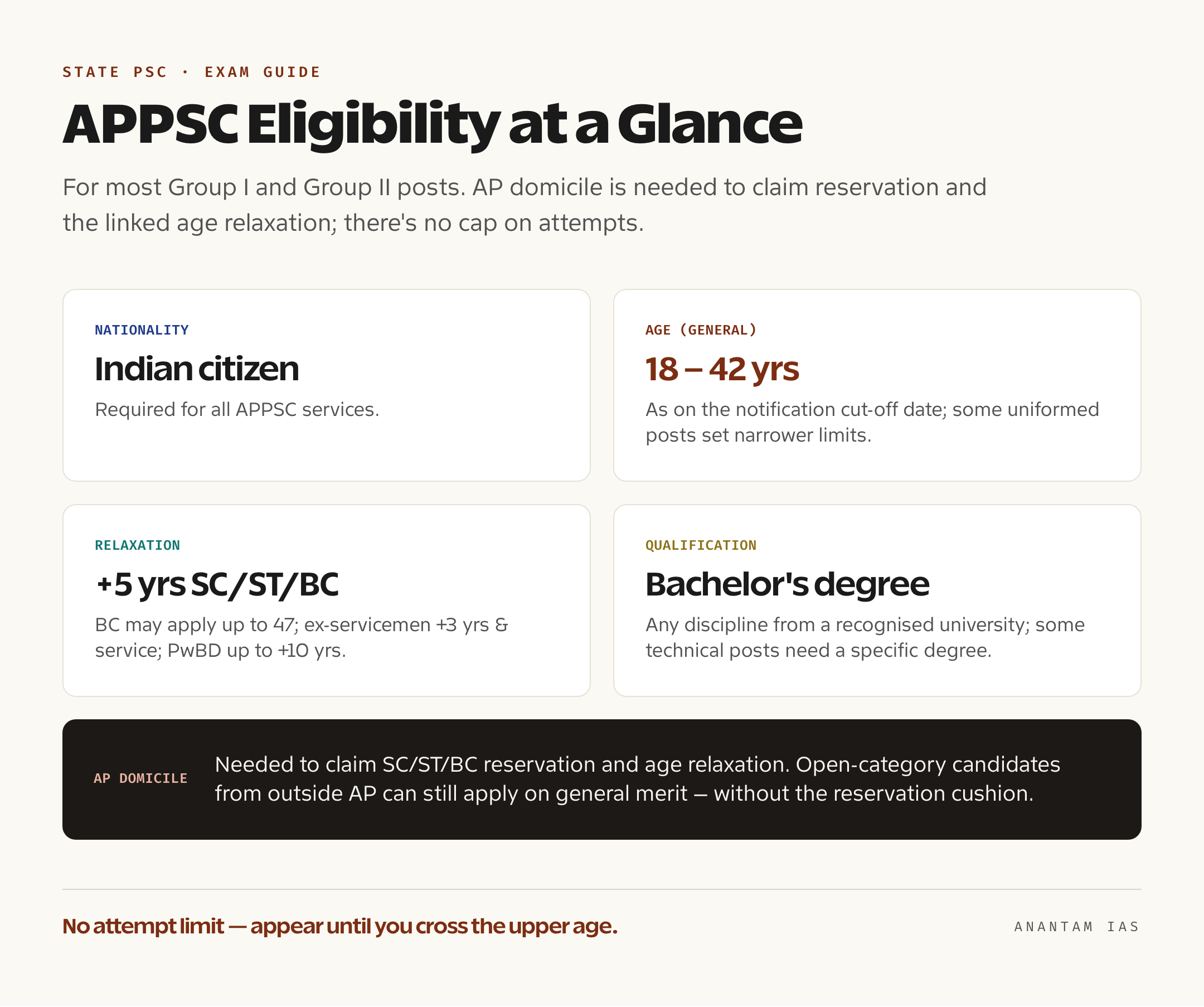
APPSC eligibility turns on four things — citizenship, age, your degree, and, for reservation benefits, your domicile. Most candidates clear the bar easily; the detail that trips people up is the domicile requirement for category relaxation.
You must be an Indian citizen. For most Group I and Group II posts the age band runs from 18 to 42 years, calculated as on the cut-off date in the notification, though some uniformed and specialised posts set narrower limits. Reserved categories get generous relaxation: SC, ST and BC candidates typically get five years (so a BC candidate can apply up to 47), ex-servicemen get three years plus their length of service, and persons with benchmark disabilities get up to ten years. Educationally, you need a Bachelor’s degree in any discipline from a recognised university for the general posts, with some technical posts asking for a specific degree. To claim SC/ST/BC reservation and the linked age relaxation you need an Andhra Pradesh domicile and a community certificate — open-category candidates from outside the state can still apply on general merit, but without the reservation cushion. Unlike UPSC, APPSC doesn’t cap attempts; you can keep appearing until you cross the upper age limit.
APPSC Syllabus
The APPSC syllabus reads like UPSC’s general-studies framework with a heavy Andhra Pradesh layer bolted on. That AP layer — state history, geography, polity, economy, and schemes — is the real differentiator, where serious aspirants separate from casual ones and where most of the easy-to-lose marks sit.
Prelims Syllabus
For Group I, Paper I (General Studies) spans the history and cultural heritage of India and Andhra Pradesh, the Indian Constitution and polity, the geography of India and AP, the economy and planning of India and AP, and environment, ecology and sustainable development. Paper II (General Aptitude) covers logical reasoning and analytical ability, data interpretation, basic numeracy, general science, current science and technology, and current events of regional, national and international importance. The Group II screening syllabus narrows this into general studies and mental ability plus three AP-anchored blocks — the social and cultural history of Andhra Pradesh, the Indian Constitution, and the planning and economy of India and AP.
Mains Syllabus
The Group I Mains paper-by-paper structure tells you where to invest. The Essay paper tests structured argument across general, social, and AP-development themes. The History-Culture-Geography paper splits its weight between Indian and Andhra material. The Polity-Governance-Ethics paper folds in administrative and ethical-case content. The Economy paper pairs the Indian macro picture with AP’s agrarian and industrial story, and the Science and Technology paper rewards current, application-focused reading. Across every paper the examiner wants an AP example wherever a general one would do — cite the Polavaram project, not just any irrigation scheme.
State-Specific Focus
This is the section that wins or loses the exam. AP and united-AP history runs from the Satavahanas and the Andhra Ikshvakus through the Vijayanagara empire, the Qutb Shahis, the Nizam’s Hyderabad, and the modern movement — the 1953 creation of Andhra State after Potti Sriramulu’s fast, the 1956 formation of united Andhra Pradesh, and the 2014 bifurcation under the AP Reorganisation Act. AP geography means the Krishna and Godavari deltas, the Eastern Ghats, the Coromandel coastline, and the state’s rivers, ports, and cyclone-prone climate. AP polity and economy cover the post-bifurcation challenge of a state that lost Hyderabad as its capital, the building of Amaravati, and the agrarian, aquaculture, and pharma-driven economy. And AP government schemes are reliable current-affairs fodder you must track from the state budget and the AP Socio-Economic Survey.
APPSC Preparation Strategy
APPSC rewards a layered approach: build a general-studies base, stack the AP-specific layer on top, then drill with the commission’s past papers. Here’s the sequence that works.
Build The General-Studies Foundation
Start with the NCERT textbooks for history, geography, polity, and economy, exactly as a UPSC aspirant would, because the bulk of Group I’s Indian-side syllabus overlaps with the UPSC general-studies frame. If you’re preparing for both, you’ve done much of this work — our PCS full-form and overview guide explains how state commissions like APPSC map onto that shared foundation. Laxmikanth for polity and a standard economy primer carry you through Prelims and the Mains base.
Add The Andhra Pradesh Layer
This is the layer most out-of-state material skips, so own it. Read a dedicated AP history book covering the Satavahanas to bifurcation, an AP geography and economy handbook, and the Andhra Pradesh state board textbooks for regional depth no national guide gives you. Build a running file on AP schemes, the state budget, and the Socio-Economic Survey — the examiner reaches for these every year.
Master Telugu And English Qualifying Papers
Don’t let the qualifying papers ambush you. Under Group 1 Notification 12/2023, the minimum in each Telugu and English paper was 40% for OC, Sports and EWS, 35% for BC, and 30% for SC, ST and PwBD candidates. The marks were qualifying only, but failing either paper still ended the attempt.
Work The Past Papers And Practice Answer-Writing
APPSC’s previous Group I and Group II papers are the best guide to question style and depth. Solve Group 1 papers under timed descriptive conditions. For Group 2, use objective-paper drills and the official answer keys from the relevant cycle. Pair past-paper analysis with full-length mocks in the last two months. If you’re weighing APPSC against central exams, our UPSC vs SSC comparison shows where a state PSC sits in the wider job landscape.
Revise In Tightening Loops
In the final stretch, stop adding new sources and revise what you have in tightening loops — full syllabus, then weak areas, then one-pagers of AP facts and schemes. The candidate who revises three times beats the one who read three times as much once.
Posts, Salary & Career
A Group I selection is a career, not just a job. The Deputy Collector and DSP posts sit in Group A of the AP services and carry pay in the higher state pay-matrix levels, with the Deputy Collector on the promotion track toward Joint Collector, District Revenue Officer, and eventually IAS-cadre roles through state-to-central promotion; the DSP route climbs through Additional SP toward Superintendent of Police. Group I officers wield real district-level authority over revenue, law and order, and development, which is why the exam draws lakhs of applicants for a handful of seats.
Group II posts — Municipal Commissioner Grade-III, Sub-Registrar, Deputy Tahsildar, Assistant Section Officer, and the audit and accounts cadre — offer stable Group B and ministerial careers with their own promotion ladders into senior administrative and Secretariat roles. The pay is lower than Group I but the vacancy count is far higher, so Group II is the pragmatic target for many graduates and a base for a later Group I attempt. To see where these state-service exams fit among India’s many government-recruitment tracks, read our overview of the different types of government exams.
Books for APPSC Group 1 and 2
Most of what you read for UPSC transfers to APPSC Group 1 and 2: polity, economy, modern history and the NCERT base. What does not transfer is the Andhra Pradesh section, and that is where the selection is decided. One state book, read three times, beats five read once.

Know Your State: Andhra Pradesh 2025 — Arihant
- 306 pages, Arihant
- Andhra Pradesh history, geography, economy and polity after bifurcation
- Updated for APPSC and APSSC exams

Lucent's General Knowledge 2026 — English (15th revised edition)
- 460 pages, Lucent Publications
- Static GK in the compressed, list-heavy format state PSC prelims reward
- Overrated for UPSC, right for this exam
- Indian Polity, M. Laxmikanth (Amazon.in). The polity questions are the same exam everywhere.
- Lucent’s General Knowledge (Amazon.in). Overrated for UPSC, right for the static questions here.
- Indian Economy, Ramesh Singh (Amazon.in). Read the concept chapters; the state budget goes on top.
- A Brief History of Modern India, Spectrum (Amazon.in). The freedom-struggle questions come straight from here.
- Know Your State: Andhra Pradesh 2025 — Arihant (Amazon.in): the AP-specific section for Group 1 and 2.
- NCERTs, Classes 6 to 12, for history, geography and science. Free from NCERT; nothing to buy.
Skip the coaching compilations until you have finished these. They summarise books you have not read yet.
Frequently Asked Questions
Is APPSC Group 1 tougher than Group 2?
Yes, clearly. Group I selects senior gazetted officers — Deputy Collector, DSP and the like — through objective screening, descriptive Mains and an interview under Notification 12/2023. Group II used objective screening and an objective two-paper Mains under Notification 11/2023. Compare the exact notification, vacancies and post list instead of assuming one fixed difficulty ratio.
Do I need to know Telugu to clear APPSC Group 1?
You need a basic working level. Telugu is one of two qualifying language papers in the Group I Mains, alongside English, and the minimum qualifying percentage depends on category. Those language-paper marks don’t count toward merit under Notification 12/2023. But much of the AP source material leans Telugu, so candidates comfortable in the language have a real edge in preparation even though the merit papers can be written in English.
Is there an interview in APPSC now?
It depends on the notification. Group 1 Notification 12/2023 required an interview/personality test after the descriptive Mains. Group 2 Notification 11/2023 used objective screening and objective Mains, with CPT for specified posts. Always read the current detailed notification before planning the final stage.
How many attempts do I get for APPSC?
APPSC sets no fixed cap on attempts, unlike UPSC. You can keep appearing for Group I and Group II as long as you’re within the upper age limit — generally 42 years, extended by five years for SC, ST and BC candidates with an AP domicile, and further for ex-servicemen and persons with disabilities.
Tell Google you want more of this.
Add Anantam IAS as a preferred sourceOne tap, and this site shows up more often in your own Top Stories, AI Overviews and AI Mode. Remove it any time.