Disclosure: this guide contains Amazon affiliate links. As an Amazon Associate, Anantam IAS earns from qualifying purchases — at no extra cost to you.
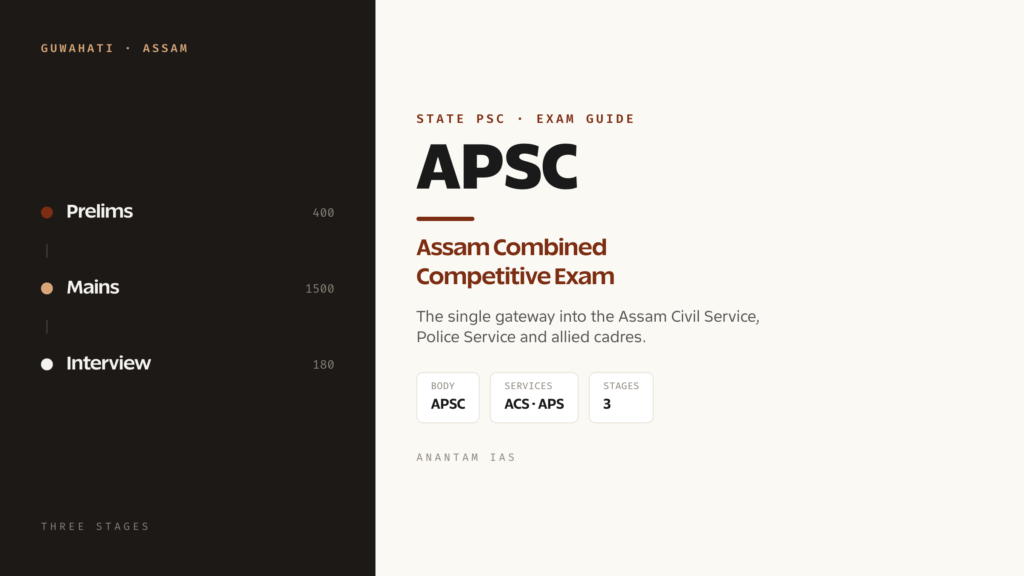
The Assam Public Service Commission (APSC) is the constitutional body that recruits officers for Assam’s civil administration, and its flagship exam — the Combined Competitive Examination (CCE) — is the single gateway into the Assam Civil Service. For a Northeast aspirant who wants a state-level career with the reach of a district administrator or a police officer, the CCE is the exam that matters most.
The CCE recruits for the Assam Civil Service (ACS), the Assam Police Service (APS), and a long list of allied services in one combined notification. The exam now mirrors the UPSC three-stage design — an objective Prelims, a descriptive Mains, and a Personality Test — but with a heavy Assam and Northeast layer woven through the syllabus. If you’ve prepared for UPSC, most of your foundation transfers; what you add on top is Assam.
What Is APSC CCE?
The Combined Competitive Examination is APSC’s primary recruitment exam, conducted under the commission’s constitutional mandate. One notification fills vacancies across roughly twenty services and posts, so a single mark sheet can land you in the ACS, the APS, or a specialist cadre depending on your rank and preference.
The services recruited through a typical CCE cycle include the Assam Civil Service (the state equivalent of the IAS cadre, leading to Sub-Divisional Officer and District Collector-track roles), the Assam Police Service (the APS gazetted police cadre), the Assam Finance Service, the Assam Taxation Service, the Superintendent of Taxes, the Labour Inspector cadre, and several treasury, excise, and inspectorate posts. The exact mix of posts and vacancies is set in each year’s notification.
Key Facts
- Conducting authority: Assam Public Service Commission (APSC), Guwahati — a constitutional body under Article 315.
- Flagship exam: Combined Competitive Examination (CCE), held in three stages.
- Top services: Assam Civil Service (ACS) and Assam Police Service (APS), plus around twenty allied services and posts.
- Frequency: Notified as vacancies arise — broadly once a year in recent cycles, though the calendar has varied.
- Scale: Tens of thousands of candidates apply against a few hundred posts in a strong year, so the effective competition runs to roughly a hundred applicants per vacancy.
APSC CCE Exam Pattern
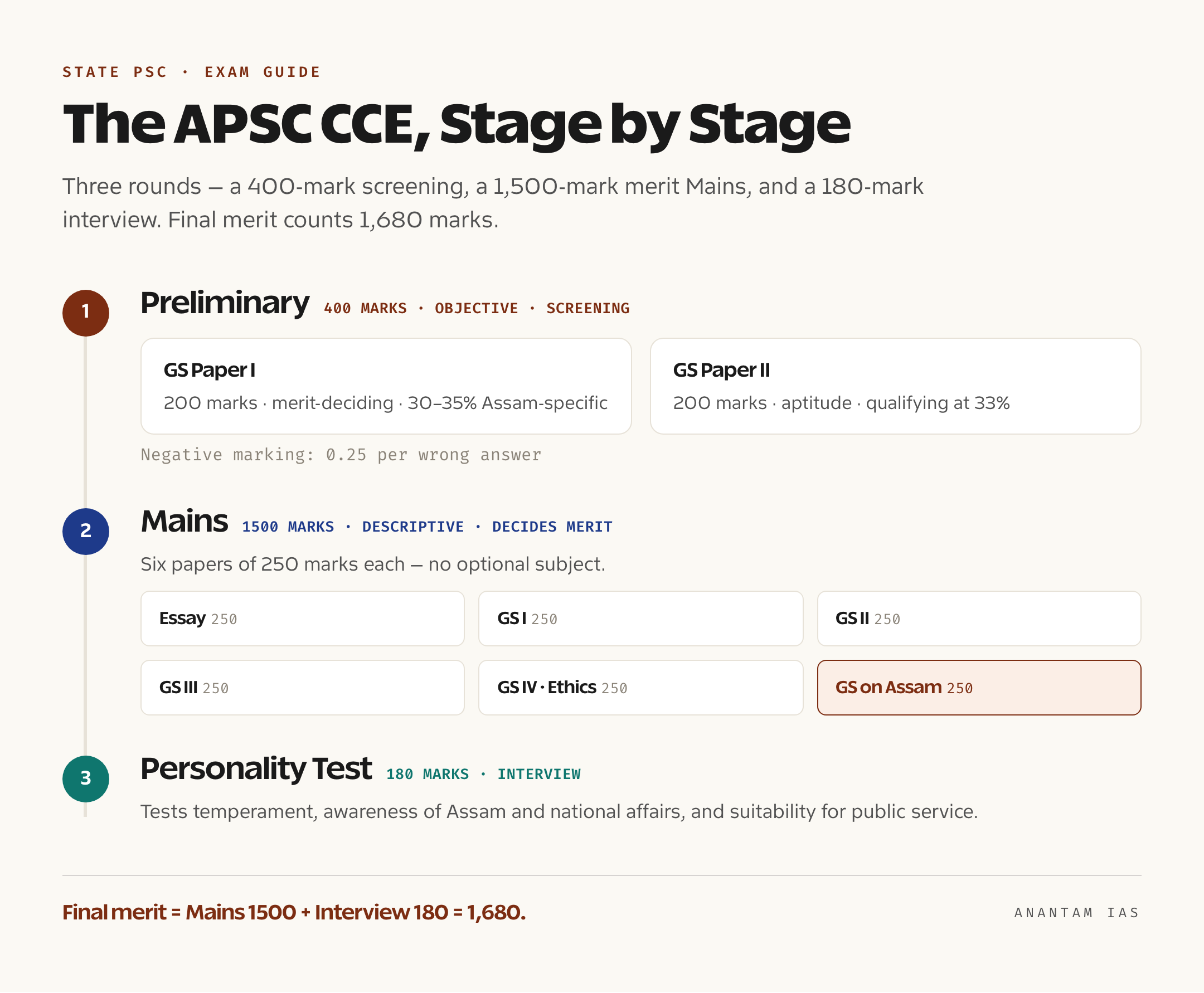
The CCE runs in three stages — Preliminary, Mains, and a Personality Test — and the structure was overhauled in the recent revision to align closely with the UPSC Civil Services Examination. That alignment is good news: the same preparation architecture works, with an Assam overlay.
Prelims
The Preliminary Examination is the screening round — objective, multiple-choice, and not counted in the final merit. It has two papers, each of 200 marks and two hours.
| Feature | Details |
|---|---|
| Paper I | General Studies I — 200 marks, 2 hours |
| Paper II | General Studies II (aptitude/CSAT-style) — 200 marks, 2 hours |
| Total | 400 marks |
| Type | Objective (MCQ) |
| Negative marking | One-fourth (0.25) of the marks per wrong answer |
| Paper I | Merit-deciding for the Prelims cut-off |
| Paper II | Qualifying only — minimum 33% required |
Two design choices stand out. First, roughly 30-35% of Paper I is compulsorily about Assam — its history, geography, polity, and current affairs — a much larger state weighting than most PSCs, so Assam reading matters even at Prelims. Second, Paper II works like the UPSC CSAT: qualifying at 33%, so your aptitude paper only needs to clear the bar, not maximise marks.
Mains
The Main Examination is descriptive and decides your merit. Under the revised scheme it has six papers of 250 marks each, totalling 1,500 marks — the same six-paper architecture as UPSC, minus the optional subject.
| Paper | Subject | Marks |
|---|---|---|
| Paper I | Essay | 250 |
| Paper II | General Studies I (History, Culture, Geography, Society) | 250 |
| Paper III | General Studies II (Polity, Governance, IR, Social Justice) | 250 |
| Paper IV | General Studies III (Economy, Science & Tech, Environment, Disaster Management) | 250 |
| Paper V | General Studies IV (Ethics, Integrity & Aptitude) | 250 |
| Paper VI | General Studies on Assam | 250 |
| Total | 1,500 |
The standout is Paper VI — a full 250-mark paper devoted to Assam, covering the state’s history, culture, geography, economy, and administration. No other major state PSC gives the home state a dedicated descriptive paper of this weight. Candidates write in English or Assamese, and an English-language component is qualifying — it must be passed but doesn’t add to merit. There is no optional subject, so your entire Mains effort stays in the GS-plus-Assam lane rather than splitting into a 500-mark optional the way UPSC does. (The older APSC pattern carried separate language papers; the revised six-paper scheme folds language down to a qualifying requirement.)
Personality Test
Candidates who clear the Mains merit are called for the Personality Test — the interview — carrying 180 marks. The board assesses clarity of thought, administrative temperament, awareness of Assam and national affairs, and overall suitability for public service. With Mains at 1,500 and the interview at 180, the final merit is drawn from a grand total of 1,680 marks.
APSC CCE Eligibility
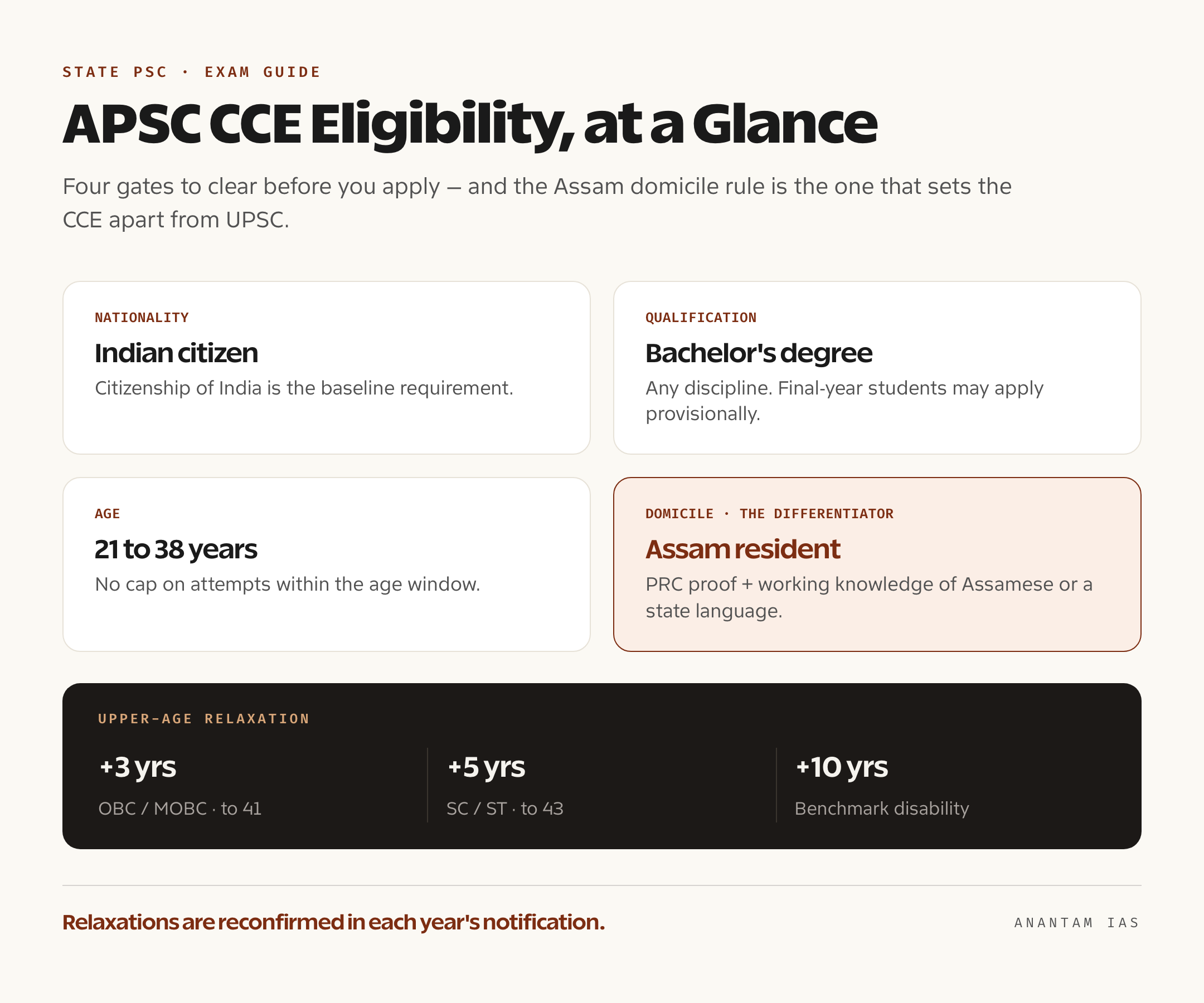
Eligibility for the CCE turns on four things — citizenship, age, qualification, and the Assam domicile rule that sets a state PSC apart from UPSC.
Nationality: You must be an Indian citizen.
Age: Candidates must be between 21 and 38 years as on the cut-off date fixed in the notification (in recent cycles, 1 January of the exam year). The upper limit is relaxed by category — typically 3 years for OBC/MOBC (to 41), 5 years for SC and ST candidates (to 43), and 10 years for Persons with Benchmark Disabilities. The exact relaxation table is reconfirmed in each notification.
Attempts: There is no cap on the number of attempts. You can sit the CCE as many times as you like, as long as you remain within the upper age limit for your category — a meaningful relief compared with UPSC’s attempt limits.
Educational qualification: A Bachelor’s degree in any discipline from a recognised university is the baseline. Final-year students may apply provisionally but must produce their degree at the Mains document-verification stage.
Domicile and language: This is the differentiator. Candidates must be permanent residents of Assam and able to show valid proof — usually a Permanent Resident Certificate (PRC) or equivalent. The CCE also expects a working knowledge of Assamese (or another official, associate-official, or recognised tribal language of the state), reflecting an officer’s need to communicate across Assam’s communities. If you’re weighing state versus national exams, our guide to the PCS full form and what state services mean sets the context.
APSC CCE Syllabus
The syllabus reads like the UPSC blueprint with an Assam chapter bolted onto every section. Master the national GS core, then layer the state material — that’s the whole game.
Prelims Syllabus
Paper I (General Studies): national and Assam-specific current events; history of India and the Indian national movement, with Assam and the Northeast emphasised; Indian and world geography plus Assam’s physical and economic geography; Indian polity and governance; economic and social development; environment, ecology, and biodiversity; and general science. Remember the 30-35% Assam loading here.
Paper II (Aptitude): comprehension; logical reasoning and analytical ability; decision-making; general mental ability; basic numeracy and data interpretation at the Class X level. Qualifying at 33%, on the UPSC CSAT model.
Mains Syllabus
The five national papers track UPSC closely. GS I covers Indian heritage and culture, history, world history, society, and geography. GS II covers the Constitution, polity, governance, social justice, and international relations. GS III covers the economy, agriculture, science and technology, environment, security, and disaster management. GS IV is ethics, integrity, and aptitude with case studies. The Essay paper tests structured argument on social, economic, and contemporary themes.
State-Specific Focus
Paper VI — the dedicated Assam paper — is where the CCE is won or lost, and it’s worth breaking out:
- History: ancient and medieval Assam, the rise of the Ahom kingdom and its six-century rule, the Saint-Reformer Srimanta Sankardeva and the Neo-Vaishnavite movement, the Treaty of Yandaboo (1826) and the British annexation, and Assam’s role in the freedom struggle.
- Geography: the Brahmaputra and Barak river systems, the annual flood cycle, the alluvial plains versus the Karbi Anglong and North Cachar hills, tea-growing tracts, and biodiversity hotspots such as Kaziranga and Manas.
- Polity and administration: the Sixth Schedule and Assam’s autonomous councils (Bodoland Territorial Region, Karbi Anglong, and Dima Hasao), district administration, and the state’s distinctive ethnic and linguistic composition.
- Economy and schemes: tea and the oil-and-natural-gas belt around Digboi and Duliajan, agriculture and handloom, the Inner Line and Northeast connectivity story, and flagship state welfare schemes.
- Current affairs: Assam-specific developments across governance, the economy, and the environment.
This Assam layer is the real workload of CCE preparation. The national GS you read from standard sources; the state material you assemble deliberately from Assam-focused books, the state economic survey, and local news.
APSC CCE Preparation Strategy
The CCE rewards a candidate who treats it as “UPSC core plus Assam,” not as a separate beast. Here’s a sequence that works.
Build the national GS foundation first
Start with NCERTs for history, geography, polity, economy, and science, then move to standard reference books. Because the CCE Mains is all-GS with no optional, every hour you invest in GS pays into multiple papers at once. If you’ve touched UPSC material, you’re most of the way there. Our overview of state versus national exam routes helps map where the CCE sits among government-job pathways.
Add the Assam layer deliberately
Build a dedicated Assam module from day one — one notebook that grows across history, geography, polity, economy, and current affairs. It feeds the 30-35% Assam questions in Prelims and the entire 250-mark Paper VI in Mains. Treat the Ahom dynasty, the autonomous-council structure, and the Brahmaputra system as core, not trivia.
Run a current-affairs system
Read one national daily plus a reliable Assam source, and keep monthly notes split into national and state buckets. State PSC current affairs lean local — schemes, appointments, state budget highlights, Northeast developments — so a UPSC-only feed leaves gaps.
Analyse previous-year papers
APSC’s past CCE papers reveal exactly how the Assam weighting plays out and which themes recur. Work through several years of Prelims and Mains questions before you finalise your reading list — they tell you what depth the examiner actually wants.
Practise answer-writing and mocks
The Mains is descriptive, so writing is a skill you have to drill. Practise timed answers and at least one full essay a week, and take Prelims mock tests to fix your accuracy under negative marking. Since Paper II is only qualifying, allocate just enough mock practice to clear 33% comfortably and pour the rest into Paper I and Mains.
Revise on a cycle
Build a revision rhythm — weekly for current affairs, monthly for static GS, and focused Assam revision in the final weeks. The candidate who revises the Assam paper three times outscores the one who reads ten new books once.
Posts, Salary & Career
A good CCE rank opens a state-administrative career running parallel to the all-India services. The Assam Civil Service is the premier catch — an ACS officer typically starts as a Sub-Divisional Officer or equivalent gazetted role and progresses toward Additional Deputy Commissioner and, on IAS promotion, District-level administration. The Assam Police Service places officers as Deputy Superintendents of Police on a track toward Superintendent-rank roles.
Pay follows the state’s gazetted Group-A and Group-B scales under the Assam pay structure, with the usual dearness allowance, house rent, and administrative perks; the ACS and APS sit at the top of the CCE ladder. Beyond salary, the draw is responsibility and reach — revenue administration, law and order, development schemes, and a direct hand in how Assam is governed. The ACS is also the recognised feeder into the IAS through the state-to-all-India promotion route. The exact posts and vacancy count are fixed in each year’s notification, so read the current advertisement before you apply.
Books for APSC CCE
Most of what you read for UPSC transfers to APSC CCE: polity, economy, modern history and the NCERT base. What does not transfer is the Assam section, and that is where the selection is decided. One state book, read three times, beats five read once.

Assam General Knowledge, 6th edition — Sailen Baishya (McGraw Hill)
- 440 pages, McGraw Hill, 6th edition for APSC 2026
- Assam history, geography, economy, polity and culture
- Also available in Assamese from the same publisher

Lucent's General Knowledge 2026 — English (15th revised edition)
- 460 pages, Lucent Publications
- Static GK in the compressed, list-heavy format state PSC prelims reward
- Overrated for UPSC, right for this exam
- Indian Polity, M. Laxmikanth (Amazon.in). The polity questions are the same exam everywhere.
- Lucent’s General Knowledge (Amazon.in). Overrated for UPSC, right for the static questions here.
- Indian Economy, Ramesh Singh (Amazon.in). Read the concept chapters; the state budget goes on top.
- A Brief History of Modern India, Spectrum (Amazon.in). The freedom-struggle questions come straight from here.
- Assam General Knowledge, 6th edition — Sailen Baishya (McGraw Hill) (Amazon.in): the Assam-specific book for APSC CCE.
- NCERTs, Classes 6 to 12, for history, geography and science. Free from NCERT; nothing to buy.
Skip the coaching compilations until you have finished these. They summarise books you have not read yet.
Frequently Asked Questions
Is the APSC CCE the same as the UPSC Civil Services Exam?
No, but they’re close cousins. APSC conducts the CCE only for Assam services such as the ACS and APS, while UPSC recruits for the all-India IAS, IPS, and IFS. The revised CCE mirrors UPSC’s three-stage design — objective Prelims, a six-paper Mains of 1,500 marks, and a Personality Test — so most preparation transfers, with an added Assam layer.
How many stages does the APSC CCE have and what are the total marks?
Three stages — a 400-mark objective Prelims (screening only), a 1,500-mark descriptive Mains across six papers, and a 180-mark Personality Test. Final merit is drawn from 1,680 marks, since the Prelims is qualifying and not counted in the final total.
What is the age limit for the APSC CCE?
Candidates must be between 21 and 38 years on the notification’s cut-off date. The upper limit is relaxed by category — usually 3 years for OBC/MOBC, 5 years for SC and ST candidates, and 10 years for Persons with Benchmark Disabilities. There’s no limit on the number of attempts within the age window.
How much of the syllabus is Assam-specific?
A lot — that’s the defining feature. Around 30-35% of Prelims Paper I is compulsorily about Assam, and the Mains has a full 250-mark paper (Paper VI) devoted entirely to Assam’s history, geography, polity, economy, and current affairs. Strong national GS alone won’t clear the CCE; the Assam layer is decisive.
Tell Google you want more of this.
Add Anantam IAS as a preferred sourceOne tap, and this site shows up more often in your own Top Stories, AI Overviews and AI Mode. Remove it any time.