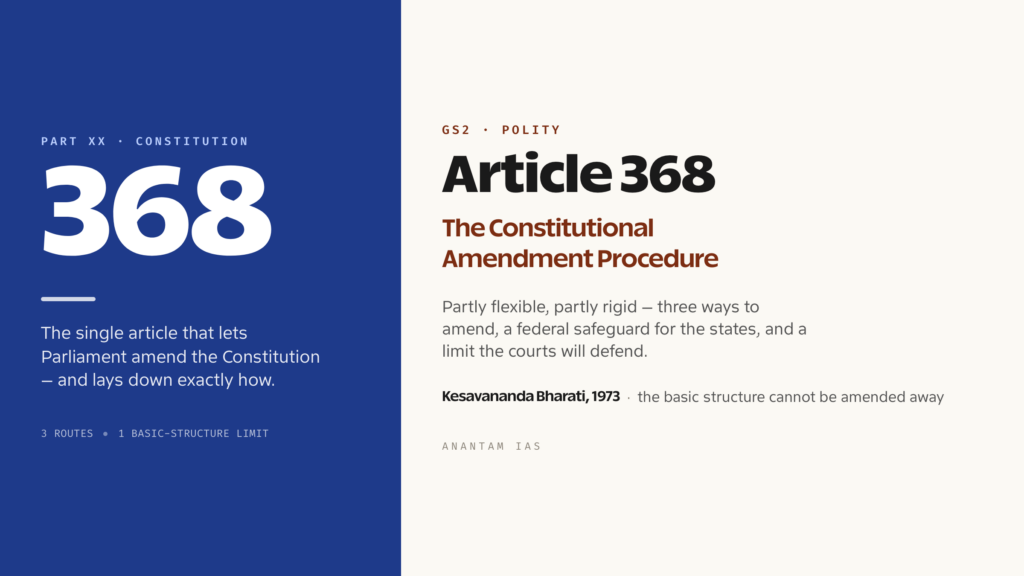
Article 368 of the Indian Constitution lays down the procedure by which Parliament can amend the Constitution. It provides three routes: a simple majority for a few provisions that fall outside Article 368, a special majority of each House for most of the Constitution, and a special majority plus ratification by at least half the state legislatures for provisions that affect the federal structure. The amending power is wide but not unlimited — since Kesavananda Bharati (1973), Parliament cannot alter or destroy the Constitution’s basic structure.
A constitution that can never be changed becomes a cage; one that can be changed too easily stops being a constitution at all. The framers of India’s Constitution knew both dangers, and Article 368 is their answer to the puzzle of how a living document should be allowed to grow. It is the single provision in Part XX that hands Parliament the power to amend the Constitution and lays down, step by step, the procedure it must follow to do so. Most of what a citizen reads about in the news — reservation in legislatures, the goods and services tax, the way states are represented — reached the statute book through this one article. Understanding it is the closest thing in Indian polity to understanding how the whole system updates itself.
And for a UPSC aspirant, Article 368 is rare territory where law, politics and federalism all meet on the same page. It tests whether you can hold a precise procedure in your head — which majority, whose ratification, what the President must do — while also grasping a deeper constitutional idea: that even the power to amend has a boundary the courts will defend. The provision has been fought over in some of the most famous cases in the country’s legal history, redrawn by amendments, and finally fenced in by a doctrine the Constitution never wrote down. So let’s walk through it the way an examiner expects — the text, the three routes, the procedure, and the limit that no Parliament can cross.
What Article 368 Says and Why Amendment Matters
Start with the text, because Article 368 is unusually self-aware. It sits in Part XX of the Constitution, titled simply “Amendment of the Constitution,” and it does two jobs in one breath. It grants Parliament the power to amend the Constitution “by way of addition, variation or repeal of any provision,” and in the same article it prescribes the procedure for using that power. The framers deliberately put the grant and the method together, so the power to change the supreme law could never be exercised casually or by some side door.
The reason this matters goes back to a choice the Constituent Assembly made about rigidity. A rigid constitution, like that of the United States, is hard to amend by design — it needs supermajorities in Congress and approval from three-quarters of the states, which is why the Americans have amended their charter only a handful of times in over two centuries. A flexible constitution, like Britain’s, can be changed by an ordinary Act of Parliament, because there is no single written document standing above regular law. India’s framers picked neither extreme. B.R. Ambedkar argued in the Assembly that the Constitution should be neither so rigid that it could not respond to a changing society, nor so flexible that any passing majority could rewrite it on a whim. So they built a procedure that is partly flexible and partly rigid — easy for ordinary matters, demanding for the core, and demanding-plus-federal for the provisions that touch the states. That blend is the single most important idea in the whole topic, and it explains why there isn’t one amendment procedure but three.
Because of that design, the Indian Constitution has turned out to be a remarkably busy document. It has been amended well over a hundred times since 1950 — by 2024 the count had crossed the 106th Amendment, which brought in one-third reservation of seats for women in the Lok Sabha and state assemblies — making it one of the most frequently amended national constitutions in the world. That pace tells you the framers got the balance roughly right: change is possible without being trivial. But it also raises the question every amendment case eventually circles back to — is there anything Parliament cannot do with this power, however large its majority? Hold that question; the Constitution’s answer took twenty-three years and thirteen judges to settle.
The Three Ways the Constitution Can Be Amended
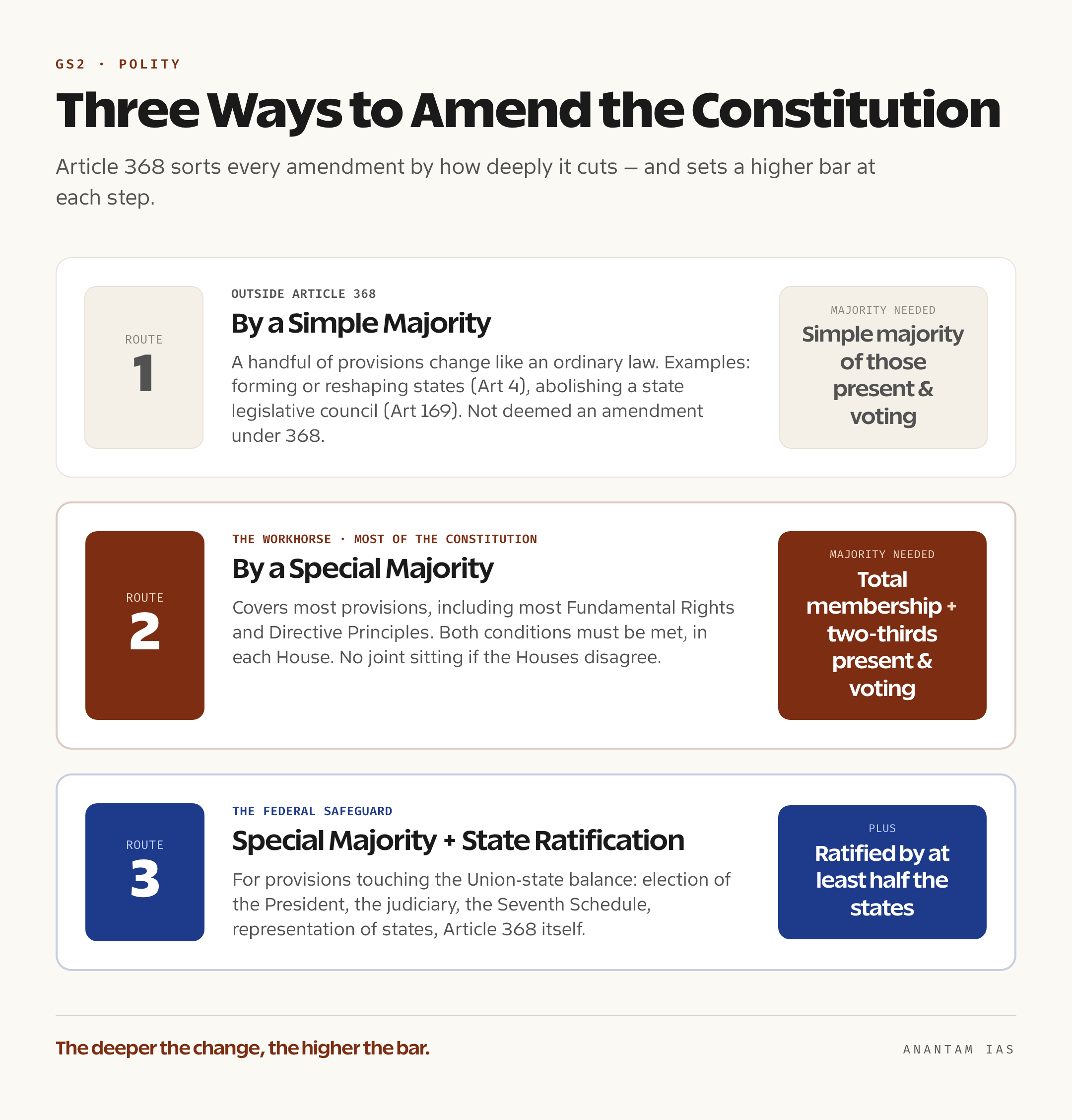
Here is where precision earns marks, so go slowly. India does not have a single amendment procedure — it has three, sorted by how deeply a change cuts into the constitutional order.
The first route is amendment by a simple majority, and it technically sits outside Article 368 altogether. A handful of provisions can be changed by Parliament exactly as it passes an ordinary law — a simple majority of the members present and voting. These include things like the creation of new states or the alteration of their boundaries (Article 4), the abolition or creation of legislative councils in states (Article 169), and certain provisions in the Fifth and Sixth Schedules dealing with scheduled and tribal areas. The Constitution itself says these changes “shall not be deemed to be an amendment of the Constitution for the purposes of Article 368.” So although people loosely call them amendments, they don’t engage the special machinery at all.
The second route is the workhorse: amendment by a special majority of Parliament. This covers the great bulk of the Constitution, including most of the Fundamental Rights and the Directive Principles. A special majority is not one number but two conditions that must both be met in each House. The bill needs the support of a majority of the total membership of the House — more than half of every seat, whether or not the member shows up — and, on top of that, a majority of not less than two-thirds of the members actually present and voting. Both tests at once, in both Houses. That double lock is what makes the core of the Constitution genuinely hard to change while still leaving it reachable for a determined, broadly supported government.
The third route is the most demanding, and it is the one that protects the federal bargain: a special majority plus ratification by the states. When an amendment touches the provisions that share power between the Union and the states, passing it in Parliament is not enough. After both Houses clear it by special majority, the bill must also be ratified by the legislatures of not less than half the states — and crucially, those states need only a simple majority to ratify, and there is no time limit within which they must do it. This is the rigid leg of the design, the safeguard that stops the Centre from quietly rewriting the federal compact on its own. Which provisions trigger it is a favourite examiner trap, so the next thing to nail down is exactly that list.
Which Provisions Need the States to Say Yes
The provisions that demand state ratification are not random — they are precisely the federal features, the parts of the Constitution that define the relationship between the Union and the states. The framers reasoned that if a change alters that balance, the states deserve a formal vote on it, because no one party to a federation should be able to redraw the deal alone.
Six categories trigger the ratification requirement, and it is worth learning them as a short list. First, the manner of electing the President (Articles 54 and 55), since the President is chosen by an electoral college that includes elected members of state legislatures, giving states a stake in the office. Second, the extent of the executive power of the Union and the states (Articles 73 and 162), the line between what the Centre and a state government may each do. Third, matters concerning the Supreme Court and the High Courts — the Union judiciary and the state High Courts — because an independent, uniform judiciary is part of the shared structure. Fourth, the distribution of legislative powers between the Union and the states, including any change to the three Lists in the Seventh Schedule, which is the master sheet allocating subjects between Parliament and the state assemblies. Fifth, the representation of states in Parliament, such as the number of seats a state sends to the Rajya Sabha or the allocation in the Lok Sabha. And sixth — the clever one that catches candidates out — Article 368 itself, so that the amendment procedure cannot be loosened or tightened without the states’ consent.
The logic ties the whole list together. Each item is a place where the Centre, acting alone, could otherwise tilt the federal scales in its own favour — capturing the judiciary, grabbing legislative subjects, or shrinking the states’ voice in Parliament. By forcing at least half the state legislatures to agree first, the Constitution makes such changes a genuinely shared decision. This is why questions on cooperative or competitive federalism so often loop back to Article 368: the ratification proviso is the constitutional proof that India’s federalism, for all its strong-Centre tilt, has real teeth. The goods and services tax is a good live example — bringing in GST through the 101st Amendment in 2016 reorganised taxing powers between the Centre and the states, so it had to clear the ratification bar, and it did.
The Step-by-Step Procedure and the President’s Role
Now run the bill through the machine from start to finish, because the procedure has a few features that exist nowhere else in the Constitution and are tested precisely because they are exceptions.
An amendment begins as a Constitution Amendment Bill, and it can be introduced in either House of Parliament — the Lok Sabha or the Rajya Sabha. This is the first quiet point: unlike a Money Bill, which can only start in the Lok Sabha, an amendment bill has no such restriction. It can be brought by a minister or, in principle, by a private member, and it does not need the President’s prior permission to be introduced. The bill must then be passed in each House separately by the special majority described above; one House cannot carry the other. If the amendment falls into the third category, the ratification by half the states comes after both Houses have passed it and before it goes to the President.
Then comes the second exception, and it is the one examiners love. If the two Houses disagree on an ordinary bill, the Constitution allows the President to call a joint sitting under Article 108 to break the deadlock. That escape hatch does not apply to a Constitution Amendment Bill. There is no provision for a joint sitting over an amendment — each House must pass it on its own by the required majority, or the bill simply fails. The reasoning is sound: a joint sitting lets the larger House (the Lok Sabha) outvote the smaller one, and the framers did not want the supreme law changed by drowning out the Rajya Sabha, the chamber that represents the states.
The final step is presidential assent, and here the position changed with a deliberate constitutional fix. When the bill reaches the President after being duly passed (and ratified, where needed), the President must give assent — there is no choice to withhold it and no power to return the bill for reconsideration. This was not always crystal clear, which is why the 24th Amendment of 1971 stepped in and made assent obligatory, inserting clause (3) into Article 368 to that effect. Once the President signs, the Constitution “stands amended” in the terms of the bill. So the President, who can sit on or return an ordinary bill, is reduced to a rubber stamp for an amendment — a sign of how completely the framers wanted the amending power to rest with the elected Parliament and the states, not the head of state.
The Basic-Structure Doctrine: The Limit Parliament Cannot Cross
For the first two decades the assumption was simple: follow the procedure in Article 368, gather the majorities, and Parliament could amend anything. That assumption was tested, defended, demolished and finally replaced — and the story is the most important sequence of cases in Indian constitutional law, so learn the years as a chain.
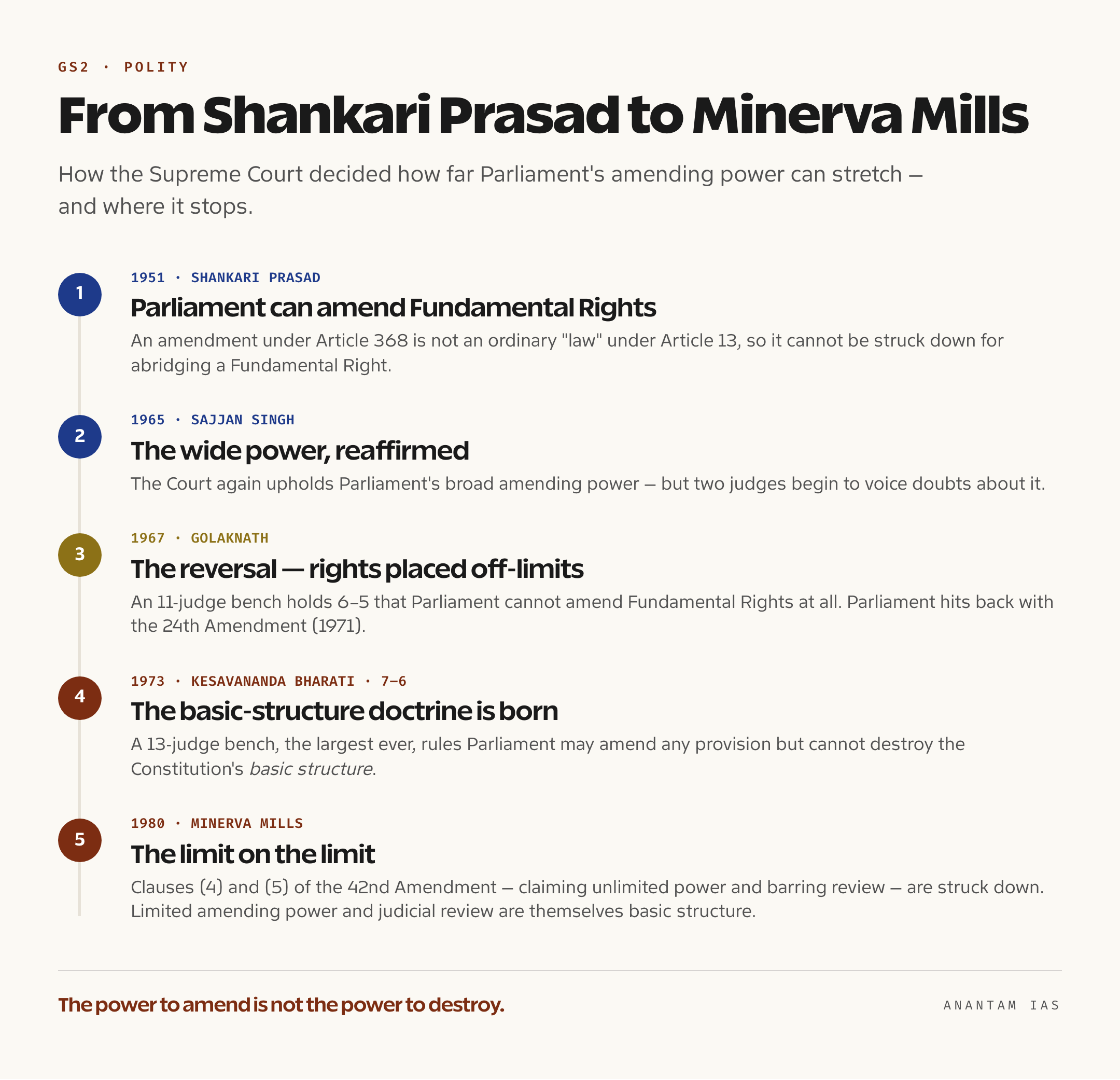
It opened in Shankari Prasad (1951), where the Supreme Court was asked whether Parliament could amend Fundamental Rights. It said yes — an amendment under Article 368 was not an ordinary “law” within the meaning of Article 13, so it could not be struck down for abridging a Fundamental Right. The Court repeated that position in Sajjan Singh (1965), again upholding Parliament’s wide power, though a couple of judges began to voice doubts. Then came the reversal. In Golaknath (1967), an eleven-judge bench changed course by a 6-5 margin and held that Parliament could not amend Fundamental Rights at all — they occupied a “transcendental position” beyond the reach of the amending power. Parliament pushed back hard. Through the 24th Amendment of 1971 it asserted in plain words that it could amend any part of the Constitution, including Fundamental Rights, and that such an amendment was not a “law” under Article 13.
The collision was settled in Kesavananda Bharati (1973), argued before the largest bench the Supreme Court has ever assembled — thirteen judges — and decided on 24 April 1973 by the narrowest of margins, 7-6. The Court overruled Golaknath and accepted that Parliament can amend any provision, Fundamental Rights included. But in the same breath it laid down the idea that has governed the country ever since: Parliament’s amending power, however wide, cannot be used to alter or destroy the basic structure of the Constitution. Features like the supremacy of the Constitution, the republican and democratic form of government, secularism, federalism, the separation of powers, and judicial review form a core that no amendment may touch — not because any clause says so, but because the very word “amend” implies improving the existing framework, not abrogating it. The doctrine appears nowhere in the text; the Court read it into the nature of the Constitution itself.
The story didn’t end there, because Parliament tried once more to escape the leash. Through the sweeping 42nd Amendment of 1976, passed during the Emergency, it inserted clauses (4) and (5) into Article 368 declaring that there would be “no limitation whatever” on the amending power and that no amendment could be questioned in any court. In Minerva Mills (1980) the Supreme Court struck both clauses down, holding that limited amending power and judicial review are themselves part of the basic structure — Parliament cannot grant itself unlimited power to amend, because the limited nature of that power is one of the things it is forbidden to destroy. The Court reaffirmed the doctrine soon after in Waman Rao (1981), which usefully fixed 24 April 1973 — the date of the Kesavananda judgment — as the cut-off from which the basic-structure test would apply, sparing earlier amendments from being reopened. And while the 44th Amendment of 1978 is best remembered for downgrading the right to property from a fundamental right to a mere legal right under Article 300A, it also restored some balance to the system the 42nd Amendment had distorted. Taken together, these cases mean the answer to that earlier question is now firm: yes, there is something Parliament cannot do — it cannot, by any majority, unmake the Constitution’s essential identity.
For Your Mains Answer
This is a core topic for GS Paper 2, which covers the Indian Constitution, its features and significant provisions, the separation of powers, the functioning of the executive and the judiciary, and the structure of federalism. A question can come at it from any of three angles — the procedure (the three routes and the federal safeguard), the judiciary versus Parliament tussle (the case law and basic structure), or the federal dimension (why state ratification exists). The same material also feeds answers on judicial review, constitutionalism, and the rigidity-versus-flexibility debate. The marks go to the candidate who states the procedure precisely and explains the principle behind each step.
How to Build the Answer
Open with the design idea: Article 368 makes the Constitution partly flexible and partly rigid, neither cage nor blank slate. Then move through a clean chain — what the article grants (the power plus the procedure), the three routes sorted by depth (simple majority outside 368, special majority, special majority plus state ratification), which federal provisions trigger ratification and why, the distinctive procedural points (either House, no joint sitting, compulsory presidential assent after the 24th Amendment), and finally the limit (the basic-structure doctrine from Kesavananda, reinforced in Minerva Mills). Close by judging the balance the system strikes. That arc — design, power, routes, federalism, procedure, limit, verdict — fits almost any Article 368 question.
Common Mistakes to Avoid
Don’t say the Constitution has “two” amendment procedures and forget the simple-majority route — list all three, but note that the first sits outside Article 368. Don’t muddle the special majority: it is both a majority of the total membership and two-thirds of those present and voting, in each House. Don’t claim a joint sitting can break an amendment deadlock — it cannot. Don’t say the basic-structure doctrine is written in the Constitution; it is a judicial creation from Kesavananda Bharati. And get the case years right — Shankari Prasad 1951, Sajjan Singh 1965, Golaknath 1967, Kesavananda 1973, Minerva Mills 1980 — because a wrong year undercuts an otherwise strong answer.
A Compact Answer Spine
Article 368 (Part XX) grants the amending power and the procedure → three routes: simple majority outside 368 (Art 4, 169, etc.) · special majority (total membership + two-thirds present and voting, each House) · special majority + ratification by half the states → ratification needed for federal features: election of President (Art 54-55), Union-state executive and legislative powers, the judiciary, Seventh Schedule, representation of states, and Article 368 itself → procedure: bill in either House, no joint sitting, President must assent (24th Amendment, 1971) → limit: basic-structure doctrine (Kesavananda Bharati, 1973, 7-6), clauses 4 and 5 of the 42nd Amendment struck down in Minerva Mills (1980) → verdict: a calibrated balance of flexibility, rigidity and judicial guardianship.
Diagram or Flowchart Idea
Draw the three routes as three rising steps — a low step for simple majority, a taller one for special majority, the tallest for special majority plus state ratification — with the required threshold labelled on each. Beside it, a short horizontal arrow runs Bill → Either House (special majority) → Other House → (states ratify, if federal) → President assents. A small box at the end reads “subject to basic structure.” This single visual carries both the procedure and its limit.
A Balanced-Conclusion Line
A line that lands the marks: “Article 368 captures the genius of India’s constitutional design — flexible enough to evolve with a changing society, rigid enough to protect the federal bargain, and, since Kesavananda Bharati, bounded by a basic structure that keeps the power to amend from becoming the power to destroy.”
How to Use Data Without Cramming
You need only a handful of anchors, not a list of every amendment: the special-majority formula (total membership + two-thirds present and voting), the ratification threshold (half the states, simple majority, no time limit), the 24th Amendment of 1971 (compulsory assent), Kesavananda Bharati 1973 (7-6, thirteen judges), and Minerva Mills 1980 (clauses 4 and 5 struck down). Attribute them plainly — “as the Supreme Court held in Kesavananda Bharati” — rather than scattering numbers loose.
FAQ
What is Article 368 of the Indian Constitution? Article 368 sits in Part XX and gives Parliament the power to amend the Constitution by addition, variation or repeal of any provision, and it lays down the procedure for doing so. It is the main amendment provision, and most constitutional changes — from GST to women’s reservation — have been made through it. A few changes can be made by simple majority outside Article 368, but the article itself governs the special-majority and state-ratification routes.
What are the three types of constitutional amendment in India? There are three. Some provisions can be changed by a simple majority of Parliament, and these technically fall outside Article 368 (for example, creating new states under Article 4). Most provisions need a special majority — a majority of the total membership of each House plus two-thirds of the members present and voting. And provisions affecting federal features need that special majority plus ratification by the legislatures of at least half the states.
Which amendments require ratification by the states? Those that touch the federal balance: the manner of electing the President (Articles 54 and 55), the extent of the Union’s and the states’ executive power, the Supreme Court and the High Courts, the distribution of legislative powers and the Seventh Schedule, the representation of states in Parliament, and Article 368 itself. At least half the state legislatures must ratify by a simple majority, and there is no time limit on doing so.
Can Parliament amend any part of the Constitution under Article 368? Almost, but not quite. In Kesavananda Bharati (1973) the Supreme Court held that Parliament can amend any provision, including Fundamental Rights, but cannot alter or destroy the “basic structure” of the Constitution — features like democracy, secularism, federalism, judicial review and the rule of law. So the amending power is very wide, but it is not unlimited, and an amendment that damages the basic structure can be struck down by the courts.
Practice Questions
Prelims MCQs
- With reference to the amendment of the Indian Constitution, consider the routes available:
(a) Only a special majority of Parliament
(b) A simple majority outside Article 368, a special majority, and a special majority plus state ratification
(c) Only a special majority plus a referendum
(d) Only ratification by all the states
Answer: (b) India has three routes — simple-majority changes that fall outside Article 368, special-majority amendments, and special-majority-plus-state-ratification amendments. - A “special majority” required to amend most provisions of the Constitution means:
(a) Two-thirds of the members present and voting only
(b) A majority of the total membership of the House only
(c) A majority of the total membership of the House and two-thirds of the members present and voting
(d) A simple majority in a joint sitting
Answer: (c) Both conditions must be met in each House — a majority of total membership and at least two-thirds of those present and voting. - Which of the following amendments would require ratification by at least half the state legislatures?
(a) Creation of a new state under Article 4
(b) A change in the distribution of legislative powers in the Seventh Schedule
(c) Abolition of a state legislative council
(d) A change to a Directive Principle of State Policy
Answer: (b) Changes to the Seventh Schedule and the Union-state distribution of powers are federal features that need state ratification; the others do not. - Which statement about the procedure under Article 368 is correct?
(a) A Constitution Amendment Bill can be introduced only in the Lok Sabha
(b) A joint sitting can be called to resolve a deadlock between the Houses
(c) The President must give assent and cannot withhold or return the bill
(d) The amendment bill needs the President’s prior recommendation to be introduced
Answer: (c) Since the 24th Amendment of 1971, presidential assent to a duly passed amendment is compulsory; the bill may start in either House and no joint sitting is available. - The “basic structure” doctrine, which limits Parliament’s amending power, was propounded in which case?
(a) Golaknath v. State of Punjab (1967)
(b) Shankari Prasad v. Union of India (1951)
(c) Minerva Mills v. Union of India (1980)
(d) Kesavananda Bharati v. State of Kerala (1973)
Answer: (d) The doctrine was laid down by a thirteen-judge bench in Kesavananda Bharati (1973) by a 7-6 majority; Minerva Mills (1980) later reinforced it.
Mains Practice Questions
- “Article 368 makes the Indian Constitution neither too rigid nor too flexible.” Examine this statement with reference to the different procedures of amendment. (15 marks, 250 words)
- Discuss the provisions that require ratification by the states for a constitutional amendment. How do they protect the federal character of the Constitution? (15 marks, 250 words)
- Trace the evolution of the basic-structure doctrine through the major cases from Shankari Prasad to Minerva Mills. How did it redefine the relationship between Parliament and the judiciary? (15 marks, 250 words)
- The procedure for amending the Constitution under Article 368 contains features found nowhere else in the document. Identify these distinctive features and explain the reasoning behind each. (10 marks, 150 words)
- “The power to amend is not the power to destroy.” Critically analyse the limits placed on Parliament’s amending power and assess whether they strike the right balance between constitutional stability and democratic change. (15 marks, 250 words)
Tell Google you want more of this.
Add Anantam IAS as a preferred sourceOne tap, and this site shows up more often in your own Top Stories, AI Overviews and AI Mode. Remove it any time.