The Thirukkural is quoted more often than it is read, and the quoting has done it damage. Reduced to a supply of uplifting one-liners, it looks like a collection of proverbs. Read as a structured work, it is something else: a treatise in which the longest of three books is about governing, and about governing in the practical sense of taxation, appointments, delegation, counsel and the use of force.
That is unusual in classical Indian ethical literature, where the material on statecraft usually sits in a separate genre from the material on virtue. Valluvar puts them in one work and lets them constrain each other. The result is a text that says both what a ruler must do to survive and what a ruler must not do to remain legitimate, without treating those as separate questions.
What the Text Is
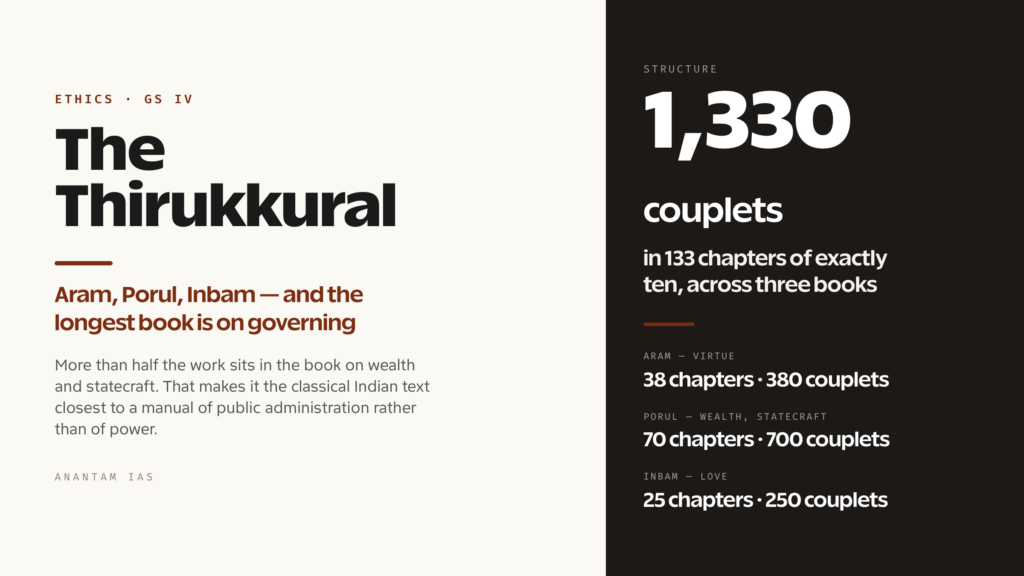
The Thirukkural consists of 1,330 couplets arranged in 133 chapters of exactly ten couplets each. Each couplet is in the kural venba metre — two lines, the first of four metrical feet and the second of three — which is close to the shortest form in which a complete Tamil sentence can carry an argument. The compression is the point and also the problem, as discussed below.
The chapters fall into three books. Aram, virtue, runs to 38 chapters and 380 couplets. Porul, wealth and statecraft, runs to 70 chapters and 700 couplets. Inbam, love, runs to 25 chapters and 250 couplets. More than half the work is in the second book.
Its dating is contested and should be stated as contested. Proposals range from the last centuries BCE to the sixth century CE; the position with the widest scholarly support places it around the fourth or fifth century CE, on grounds of language and of its relation to other Tamil and Sanskrit material. The Tamil calendar used officially in Tamil Nadu counts a Thiruvalluvar era from 31 BCE, which is a matter of convention rather than of evidence. Nothing reliable is known about Valluvar himself, and the various traditions claiming him — Jain, Shaiva, Vaishnava, later Christian — are claims rather than findings.
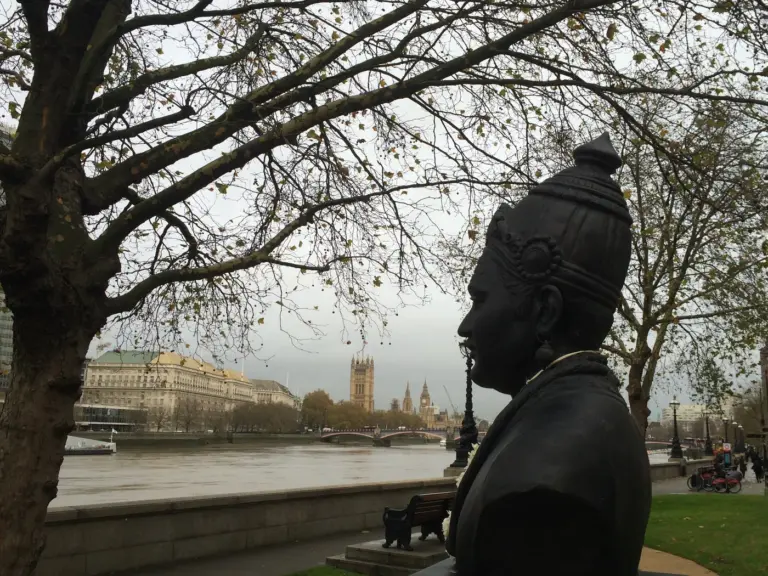
What is not in dispute is the text’s non-sectarian character. The opening chapter praises the divine without naming a sectarian deity or endorsing a ritual system, and no chapter requires a temple, a priest or a scripture. That is why the work crosses religious lines and why every tradition in the region has tried to annex it. Ten medieval commentaries survive, of which Parimelalhagar’s in the thirteenth century became standard; a Latin translation was made by the Jesuit Beschi in the eighteenth century and G. U. Pope’s English verse translation appeared in 1886. The 133-foot statue at Kanyakumari, dedicated in 2000, takes its height from the chapter count.
Aram: Virtue as Conduct, Not Ritual
The first book locates virtue in conduct and speech rather than in observance, and its chapters are organised around specific behaviours rather than around abstract qualities.
Non-injury is the load-bearing virtue. There is a chapter on not causing pain to others, a chapter on not killing, and a chapter on abstaining from flesh which argues that the eater sustains the killing and cannot be separated from it. The reasoning is closer to the position examined in Jain and Buddhist restraint than to a ritual purity rule: what is objected to is the harm, not the pollution.
Speech is treated as action. Separate chapters cover the speaking of pleasant words, the avoidance of harsh speech, the avoidance of backbiting, and the avoidance of speech that serves no purpose. One of the more useful couplets holds that a person who knows the value of a kind word will not choose an unkind one, since the sweet fruit is available and the bitter one costs the same. For an administration whose ordinary output is written and spoken instruction, a virtue ethics that treats speech as conduct rather than as a wrapper around conduct is more usable than one that does not.
Gratitude is given its own chapter, with the well-known image that help the size of a millet seed, rightly weighed, is as large as a palmyra fruit. The point is not sentiment; it is that a benefit received creates an obligation whose measure is set by the receiver’s need at the time and not by the giver’s cost.
Three chapters name the failure modes: envy, coveting what belongs to another, and speaking ill behind a person’s back. A separate chapter on impartiality — naduvu nilaimai — asks for even-handedness as a settled disposition rather than as a performance for particular occasions, which is where it connects to the classical treatment in virtue ethics of character as the thing that produces right action reliably.

Porul: The Longest Book Is About Governing
The second book opens with the ruler, moves through ministers, envoys, spies and the qualities required of those who act for the state, and closes with chapters on the ordinary citizen, agriculture, wealth and poverty. Its opening chapter on the greatness of a king lists the six components of a state — army, subjects, wealth, ministers, allies and fortifications — which places the work in the same conversation as the arthashastra literature while reaching different conclusions about what constrains the ruler.
Two things separate Porul from a pure manual of power. The first is that the constraints are not prudential dressing; they are stated as the conditions of rule. The second is that the book spends as much attention on subordinates as on the ruler — on how they are chosen, what they are told, what they may be trusted with, and how they should speak to power. That combination is why the Kural is the classical Indian text that reads closest to a manual of public administration rather than a manual of statecraft.
Sengonmai and Kodungonmai: The Two Sceptres
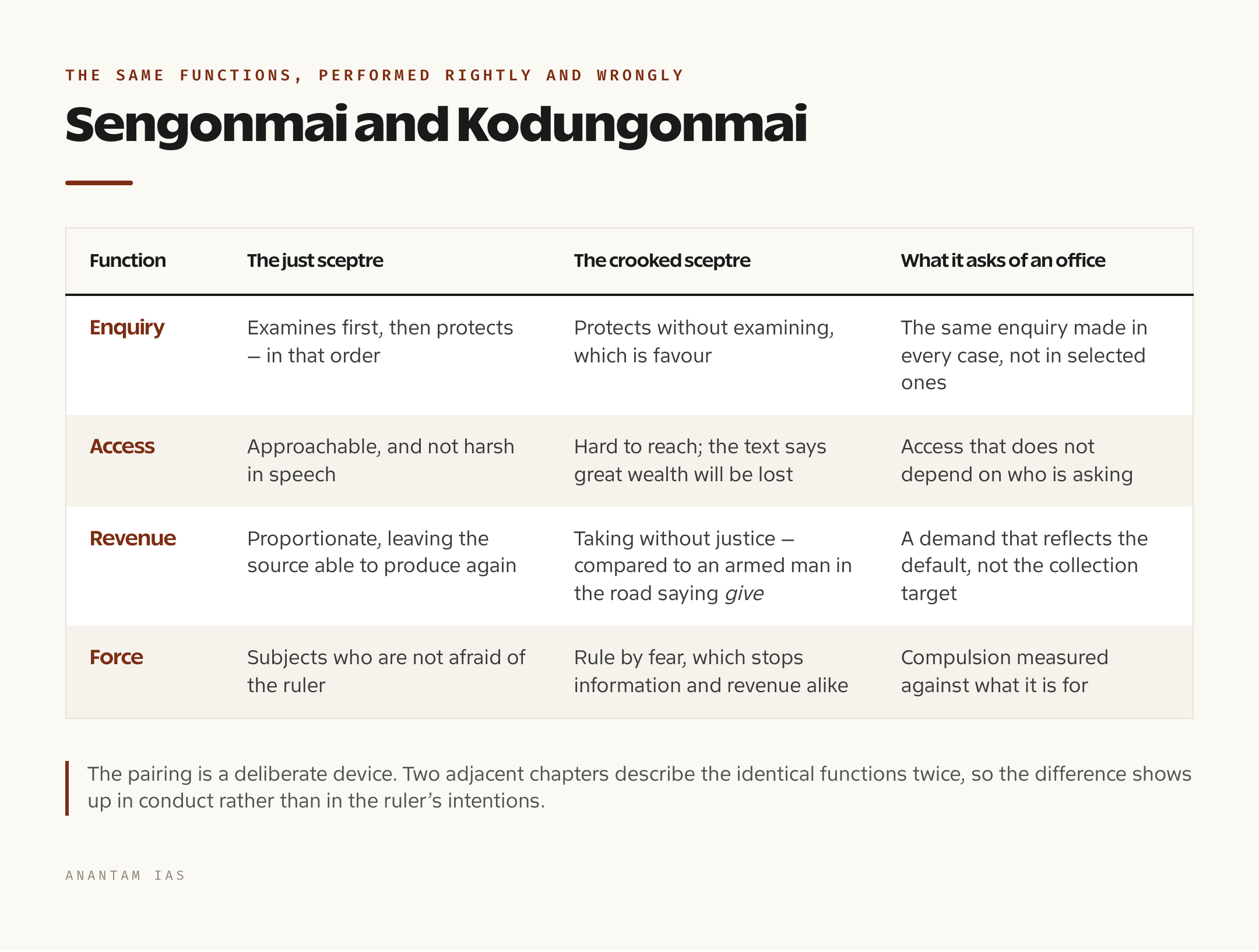
The book’s ethical core is a pair of adjacent chapters: sengonmai, the just or straight sceptre, and kodungonmai, the crooked or cruel one. Setting them side by side is a deliberate device — the same functions are described twice, once performed rightly and once wrongly, so that the difference is legible in behaviour rather than in intention.
The just ruler examines and then protects, in that order. Protection without examination is favour, and examination without protection is inspection. The pairing appears repeatedly: the ruler who investigates impartially and then acts is the one whose sceptre stands.
The just ruler is accessible. One of the sharpest couplets in the cluster holds that the ruler who is hard to approach and harsh in speech will lose great wealth. Inaccessibility is treated not as a personal failing but as a structural cause of loss, because a ruler who cannot be approached does not learn what is happening.
The crooked sceptre is described in terms of what it produces rather than what it intends — the subjects who wither, the seasons that fail, the wealth that leaves. The chapter that follows on the absence of terror asks the ruler not to be a person whose subjects are afraid of him, on the ground that fear destroys the flow of information and of revenue alike. This is a functional argument for a substantive constraint, and it is stronger for being functional: the text does not ask the ruler to be gentle out of sentiment but shows that cruelty is self-defeating.
The distinction transfers directly to office. An official exercises a straight sceptre when the same enquiry is made in every case, the decision is explained, and access does not depend on who is asking. The crooked version does not require malice; it requires only that some applicants are heard and others are not.
Taxation and the Duty Not to Oppress
The Kural’s treatment of revenue is its most quoted contribution to governance and one of its most precise. A ruler who takes from subjects without justice is compared to an armed man standing in the road saying “give” — the difference between taxation and robbery is not the taking but the justification and the return.
Two conditions run through the material. The first is proportionality: the ruler is to take as the milkman takes milk or as the calf is allowed to suckle, which is to say in a measure that leaves the source capable of producing again. The second is return: revenue is legitimate because protection is provided, and a ruler who takes and does not protect has broken the terms.
Set against the modern administrative reality, this is a usable standard. A demand notice served to meet a collection target, a penalty computed to maximise recovery rather than to reflect the default, a fee that exists because a licence can be withheld — each fails the Kural’s test while satisfying a rule. The general principle that the state’s coercive powers are held in trust and measured against what they are for is the same principle that runs through the recommendations discussed under ethics in governance.
Choosing People, and Then Watching Them
The chapters on selection are the closest thing in classical Indian literature to a personnel policy, and they are unsentimental.
The best-known couplet sets out a fourfold test: examine a person in respect of virtue, of wealth, of pleasure and of fear for life, and then employ them. The four are chosen because they are the four things that reliably corrupt a decision, and the sequence matters — the testing comes before the trusting, not after the appointment.
A second couplet, in the same cluster, does the work that makes the first honest: even those who have been tested may turn out otherwise when actually set to the task. The text does not claim that vetting settles the matter. That is a more mature position than most integrity frameworks manage, and it argues for continuing supervision rather than for confidence in a clearance.
A third principle: weigh a person’s merits against their faults and judge by which preponderates, since a person without faults does not exist. Applied to an appointment, this rules out both the search for the flawless candidate and the tolerance of the disqualifying flaw. The practical difficulty — deciding which faults are disqualifying rather than merely present — is precisely the judgement examined in the article on integrity.
The Information Environment of Power
The Kural is unusually attentive to the fact that power distorts what reaches it, and the material here is worth more than its aphoristic surface suggests.
One couplet holds that a ruler who has nobody to reprove him will be destroyed even in the absence of an enemy. The minister’s chapter states the duty from the other side: the counsellor is to say what is right even when the ruler does not wish to hear it, and one who cannot do that is not performing the function. This is the classical statement of the obligation to record an inconvenient view, and its converse — that a decision-maker who has arranged to hear only agreement has already lost.
The text also warns against the ruler surrounded by those who study his moods, and against the counsellor whose skill is in anticipating what will please. Set against modern practice, this is the ethics of the note that is drafted to be signed rather than to be read, and of the review meeting in which nobody reports a shortfall.
There is a counter-current here that an honest reading should name. A separate chapter endorses espionage as an instrument of rule, advising the ruler to employ spies, to test them, and to accept only intelligence corroborated by more than one. A text that recommends a secret information system and also warns against a court insulated from correction is not simply contradicting itself — the spy is precisely the ruler’s attempt to get around the flatterer. But it is not a coherent theory of accountability either, and it sits uneasily with the modern position on disclosure and record examined under accountability and responsibility.
The Honest Objections
A couplet is not an argument. The form gives the Kural its reach and takes away its reasoning. What survives is a conclusion in seven words with the premises removed, which makes the text quotable on both sides of most questions. It counsels both firmness and forbearance, both spies and openness, both accumulation of wealth and indifference to it, and the reader supplies the resolution. Quoting a couplet in support of a position is a rhetorical move, not a demonstration, and an answer built on one is weaker than it looks.
The social assumptions are of their period. The chapter on the worth of a wife praises the woman who guards her chastity and serves her husband, with a couplet holding that she who worships her husband rather than a god commands the rain. A later chapter treats being led by a wife as a defect in a man. These are not incidental to the household material; they are its frame. The right handling is to say so, and to note that a text can be sound on taxation and unusable on the family without either judgement affecting the other.
Its secularity can be overstated. The absence of sectarian markers is real, but the text assumes a monarchical order, a caste-structured society, and a moral universe in which aram is embedded in the shared assumptions examined under dharma. Calling it secular in the modern constitutional sense reads a later category backwards.
The dating problem has consequences. A text whose century is uncertain within several hundred years cannot be used to establish that a particular idea was Tamil before it was Sanskritic, or the reverse. Claims of priority in either direction outrun the evidence, and the honest position is that the relationship between the Kural and the Sanskrit dharma and artha literature is unsettled.
FAQ
What are aram, porul and inbam? The three books of the Thirukkural: aram is virtue or right conduct, porul is wealth and statecraft, and inbam is love. Porul is much the longest at 70 chapters, and it is explicitly about governing.
How is the Thirukkural structured? 1,330 couplets in 133 chapters of exactly ten each, composed in the kural venba metre of two lines, the first of four feet and the second of three.
When was the Thirukkural written? The dating is contested. Estimates range from the last centuries BCE to the sixth century CE, with the widest scholarly support for around the fourth or fifth century CE. The Tamil era counted from 31 BCE is a convention, not a finding.
What is the difference between sengonmai and kodungonmai? Sengonmai is the just or straight sceptre and kodungonmai the crooked one. The two chapters describe the same functions performed rightly and wrongly — examination before protection, accessibility, proportionate taxation — so that the difference shows in conduct rather than in intention.
What does the Thirukkural say about taxation? That a ruler who takes without justice is no different from an armed robber demanding money. Revenue is legitimate only if it is proportionate, leaving the source able to produce again, and only if protection is actually provided in return.
Why is the Thirukkural called non-sectarian? Because it names no sectarian deity, requires no ritual, priest or scripture, and grounds virtue in conduct and speech. This is why traditions across the religious spectrum have claimed it, and why it is quoted across communities in Tamil Nadu.
Practice Questions
Prelims MCQs
- The Thirukkural consists of: (a) 1,330 couplets in 133 chapters (b) 1,000 verses in 100 chapters (c) 700 couplets in 70 chapters (d) 2,000 couplets in three books — Answer: (a) each chapter carries exactly ten couplets, and the three books hold 380, 700 and 250 couplets respectively.
- Which book of the Thirukkural is the longest? (a) Aram, on virtue (b) Porul, on wealth and statecraft (c) Inbam, on love (d) All three are of equal length — Answer: (b) Porul runs to 70 of the 133 chapters, which is why the text reads as a work on governing.
- Kodungonmai in the Thirukkural refers to: (a) The just sceptre (b) The cruel or crooked sceptre (c) The six components of the state (d) The employment of spies — Answer: (b) it is set immediately beside sengonmai, the just sceptre, so the same functions can be compared performed rightly and wrongly.
- The Kural compares a ruler who exacts revenue without justice to: (a) A father chastising a child (b) A physician administering bitter medicine (c) An armed man in the road demanding money (d) A cowherd who overmilks the herd — Answer: (c) the couplet’s force is that the difference between tax and robbery lies in justification and return, not in the taking.
- In the Kural’s chapter on selection, a person is to be tested in respect of: (a) Birth, learning, wealth and age (b) Virtue, wealth, pleasure and fear for life (c) Courage, speech, memory and loyalty (d) Caste, occupation, family and reputation — Answer: (b) the four are the standard sources of a corrupted decision, and the testing is to precede the employment.
Mains Practice Questions
- “The Thirukkural’s longest book is about governing.” Discuss what this implies about the relationship between virtue and statecraft in the text. (150 words)
- Examine the Kural’s treatment of taxation as a test of legitimate power, and apply it to a contemporary revenue or penalty practice. (150 words)
- The chapters on sengonmai and kodungonmai describe the same functions performed rightly and wrongly. Analyse this device and its usefulness for evaluating administrative conduct. (250 words)
- “A couplet is not an argument.” Critically examine the limits of aphoristic ethical texts as a source of guidance for public officials. (250 words)
- The Kural warns against a ruler who has nobody to reprove him and also recommends the employment of spies. Discuss what this tension reveals about the problem of information in the exercise of power. (250 words)
Tell Google you want more of this.
Add Anantam IAS as a preferred sourceOne tap, and this site shows up more often in your own Top Stories, AI Overviews and AI Mode. Remove it any time.