Sikh ethics is the one tradition in this part of the syllabus that begins by refusing the monastery. Its founding move is not a technique for reducing desire; it is a claim about where moral life happens — in a household, in paid work, in a shared meal, and in a fight one did not start.
That refusal changes what the ethics is for. A framework built for renouncers has to be diluted before a farmer, a soldier or an officer can use it, and the dilution is usually where the interesting content leaks out. Sikh ethics was built for those people from the beginning, which is why its vocabulary — honest earning, sharing, service, welfare of all, the saint-soldier — reads less like counsel for the spiritually ambitious and more like a description of duties attaching to a station. It also carries the hardest doctrine in the set: a duty to resist injustice, by force where certain conditions are met.
The Refusal of Renunciation
Guru Nanak (1469-1539) travelled widely, argued with ascetics, and then settled at Kartarpur to farm. That biography is the doctrine in compressed form. The Siddh Gosht, his recorded dialogue with the yogis, is an argument against the position that spiritual seriousness requires leaving society — the yogis have withdrawn to the mountain, and Nanak’s reply is that the discipline they claim is available inside a working life, and that withdrawal has quietly transferred the cost of feeding them onto the people they left.
The contrast with the two traditions immediately adjacent is sharp. Buddhist ethics grades its precepts precisely because the complete form belongs to the sangha; the lay ethic is an approximation. Jain ethics is more explicit still — the mahavratas are for ascetics and the householder takes graded anuvratas. Both frameworks treat the person who governs, polices or trades as morally handicapped by their station.
Sikh ethics inverts that. The grihasti, the householder, is the normative figure, not the compromise. Nothing is held back for a professional religious class, because there is no professional religious class: the tenth Guru vested authority in the scripture and the community rather than in a successor. What follows is an ethic in which the office, the trade and the family are the sites of moral achievement rather than obstacles to it.
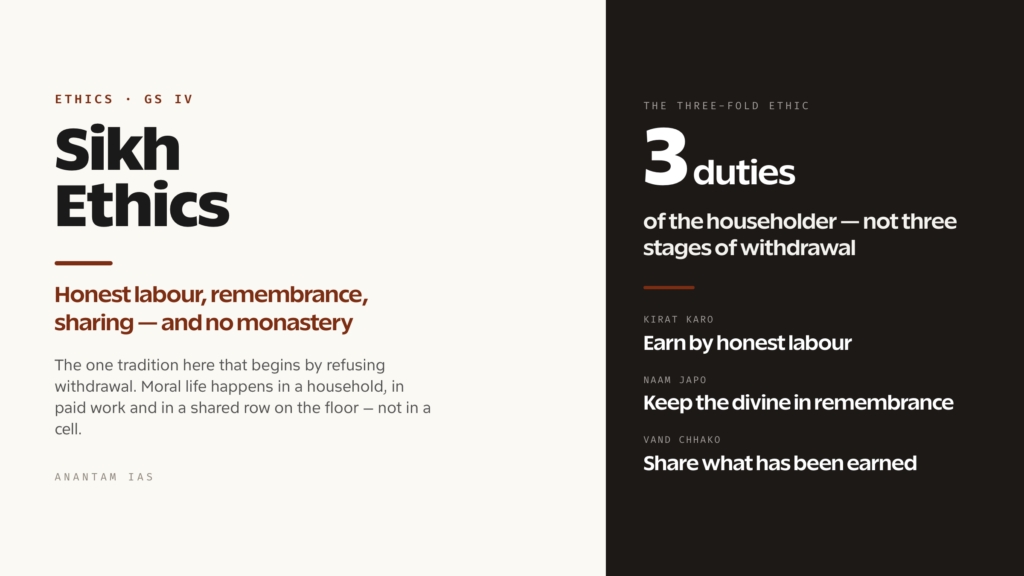
Kirat Karo, Naam Japo, Vand Chhako
The three-fold formulation is the tradition’s compressed answer to how a householder should live, and each element is doing work the others cannot.
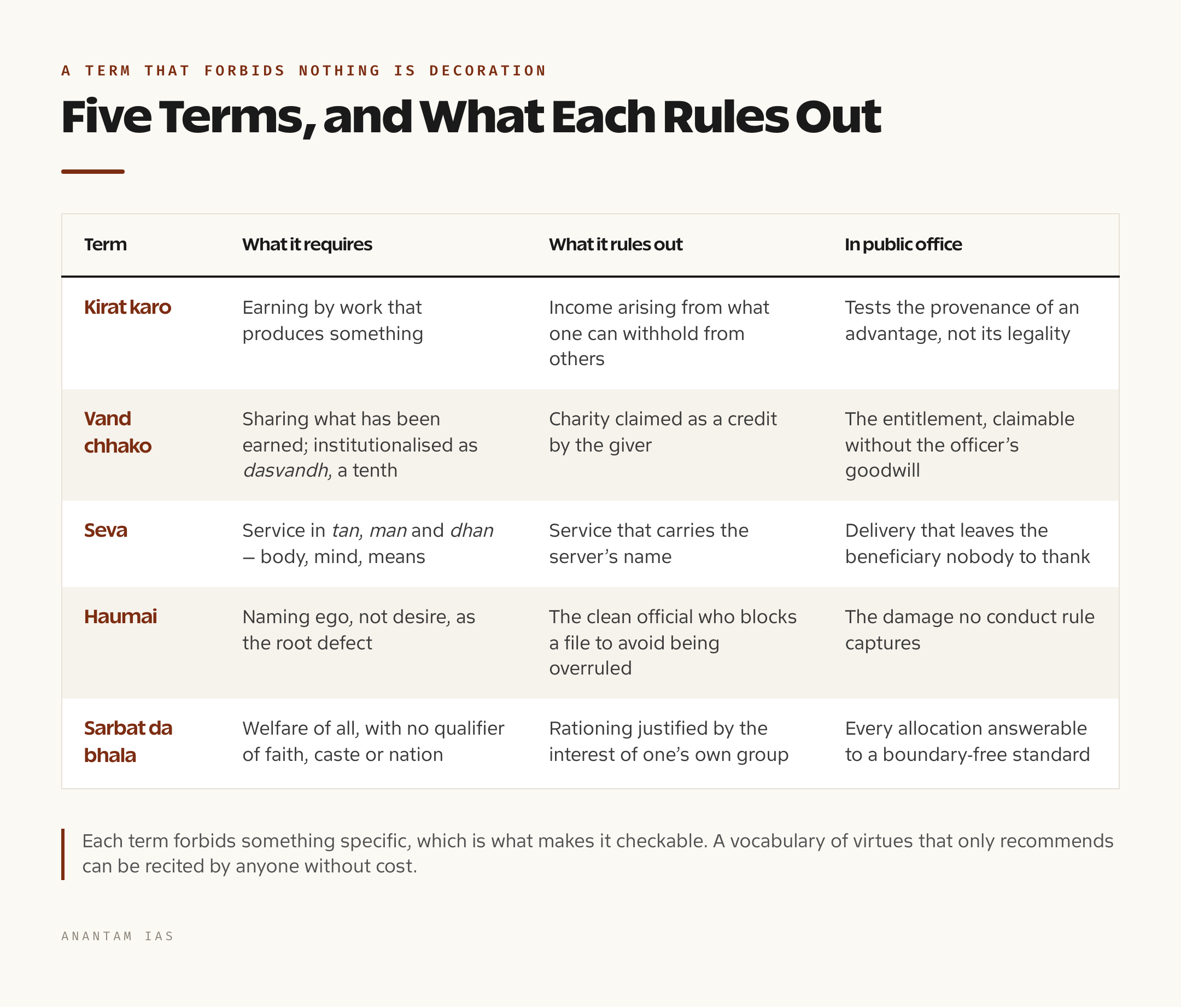
Kirat karo — earn by honest labour. The emphasis falls on kirat, work that produces something, as against income extracted from position. The janamsakhi tradition preserves the point as a story: invited by a wealthy official whose feast he refused, Nanak is said to have compared the coarse bread of Bhai Lalo the carpenter with the official’s rich food, and found labour in the one and extraction in the other. The moral test is not the size of the earning but its provenance. An income that arrives because of what one can withhold from others fails the test regardless of its legality.
Naam japo — keep the divine name in remembrance. Read as ethics rather than as devotion, this is a discipline of continuous attention that runs alongside work rather than replacing it. Its function is to prevent the drift by which a person becomes the role they perform. The tradition’s word for that drift is haumai.
Vand chhako — share what has been earned. Note the tense: sharing applies to earnings, which presupposes the first duty. And note that the tradition institutionalised it. Under the fifth Guru, dasvandh — the giving of a tenth — was collected through the masand network for community purposes. That converts sharing from a discretionary virtue into a standing obligation with a known rate and an accounting. The distinction matters more than it looks: charity is something the giver may claim credit for, and an obligation is not.
Seva, Langar and the Shared Row
Seva is service rendered without expectation of return, classically in three forms: tan (physical labour), man (mental effort and attention) and dhan (material means). Its institutional expression is the langar, the free kitchen attached to a gurdwara, where food is cooked by volunteers and served to anyone who arrives.
The ethically interesting part is not the feeding. It is the pangat — the requirement that all who eat do so seated in a single row, on the floor, in the order they arrived. In a society organised around rules about who may eat with whom and from whose hand, a shared row is not hospitality but a direct attack on the ranking system. Tradition records that the third Guru, Amar Das, required every visitor to eat in the langar before being received, and that the rule was applied without exception for rank. Commensality was chosen as the instrument precisely because it was the practice through which hierarchy was maintained.
Two features make seva useful as a public-service value rather than a pious sentiment.
First, it is anonymous and unranked. The volunteer washing utensils is not identifiable by station, and the work chosen is usually the work nobody claims credit for. Service that carries the server’s name is a different transaction.
Second, and more sharply: seva is structurally opposed to patronage. Patronage also delivers goods to people who need them, and it is the dominant idiom of Indian public service delivery — the benefit arrives, but it arrives as a favour, from a named person, creating an obligation. Seva removes the giver from the transaction. An officer who clears a pension file and lets the beneficiary know who to thank has delivered the service and destroyed its ethical character.
Haumai: The Defect Named First
Sikh ethical psychology locates the root problem in haumai — literally I-am-ness, the ego. It is not vanity in the ordinary sense; it is the condition of taking the self as the centre from which everything is measured. From it the tradition derives five vices: kam (lust), krodh (anger), lobh (greed), moh (attachment) and ahankar (pride). A person governed by haumai is manmukh, self-facing; one oriented outward is gurmukh.
Naming ego rather than desire as the root defect has a consequence worth carrying into administration. A framework that targets desire produces rules against taking things. A framework that targets ego produces something harder — a warning that the officer who never took a rupee may still be the problem. Most institutional damage done by honest officials is done by haumai: the file kept because releasing it would look like being overruled, the correct order delayed because it originated with a junior, the transfer engineered to punish a subordinate who was right. None of that appears in a conduct rule, and all of it is legible in this vocabulary.
The Critique of Ritual, Caste and Rank
Nanak’s criticism of religious formalism is unusually specific, and it is criticism from inside rather than from a position of unbelief. The janamsakhis record the refusal of the sacred thread on the ground that the thread that matters cannot be spun; and the scene at Hardwar where, watching pilgrims throw water eastward to the ancestors, he threw water westward toward his fields in Punjab — if their water could reach the dead, his could reach his crops. The argument in both is the same: a rite that has become detachable from conduct is doing no moral work.
On caste the position is stated rather than implied. Nanak’s lifelong companion was Mardana, a Muslim musician of a low-ranked hereditary caste. The scripture compiled by the fifth Guru includes the compositions not only of the Gurus but of some fifteen bhagats from outside the tradition, among them Kabir the weaver, Ravidas the leather-worker, Namdev the tailor and the Sufi Sheikh Farid. Placing those voices inside the canon is a stronger act than praising them from outside it.
On women, the stated norm is equality of access — to the congregation, to the kitchen, to initiation and to scripture-reading. The verse in Asa di Var asking why one should call inferior the person from whom kings are born is the text most often cited, and the third Guru is recorded as having opposed sati and the veil and encouraged widow remarriage. What the tradition states and what its societies practise have not converged, which belongs in the objections below rather than here.
Sarbat da Bhala and the Sant-Sipahi
The Ardas, the congregational prayer, closes by asking for sarbat da bhala — the welfare of all. The formulation has no qualifier. It does not ask for the welfare of the community, the co-religionist or the nation, and a welfare claim without a boundary is a demanding thing to hold, because every act of rationing has to be justified against it rather than against the interest of one’s own group.
The tradition then does something most ethical systems avoid: it accepts that this may require force. The sixth Guru, Hargobind, is said to have worn two swords signifying miri and piri — temporal and spiritual authority — and built the Akal Takht facing the Harmandir Sahib in 1606, an assertion that the community would exercise temporal judgement rather than confine itself to worship. The ideal that emerges is the sant-sipahi, saint-soldier: one person, both roles, neither optional.
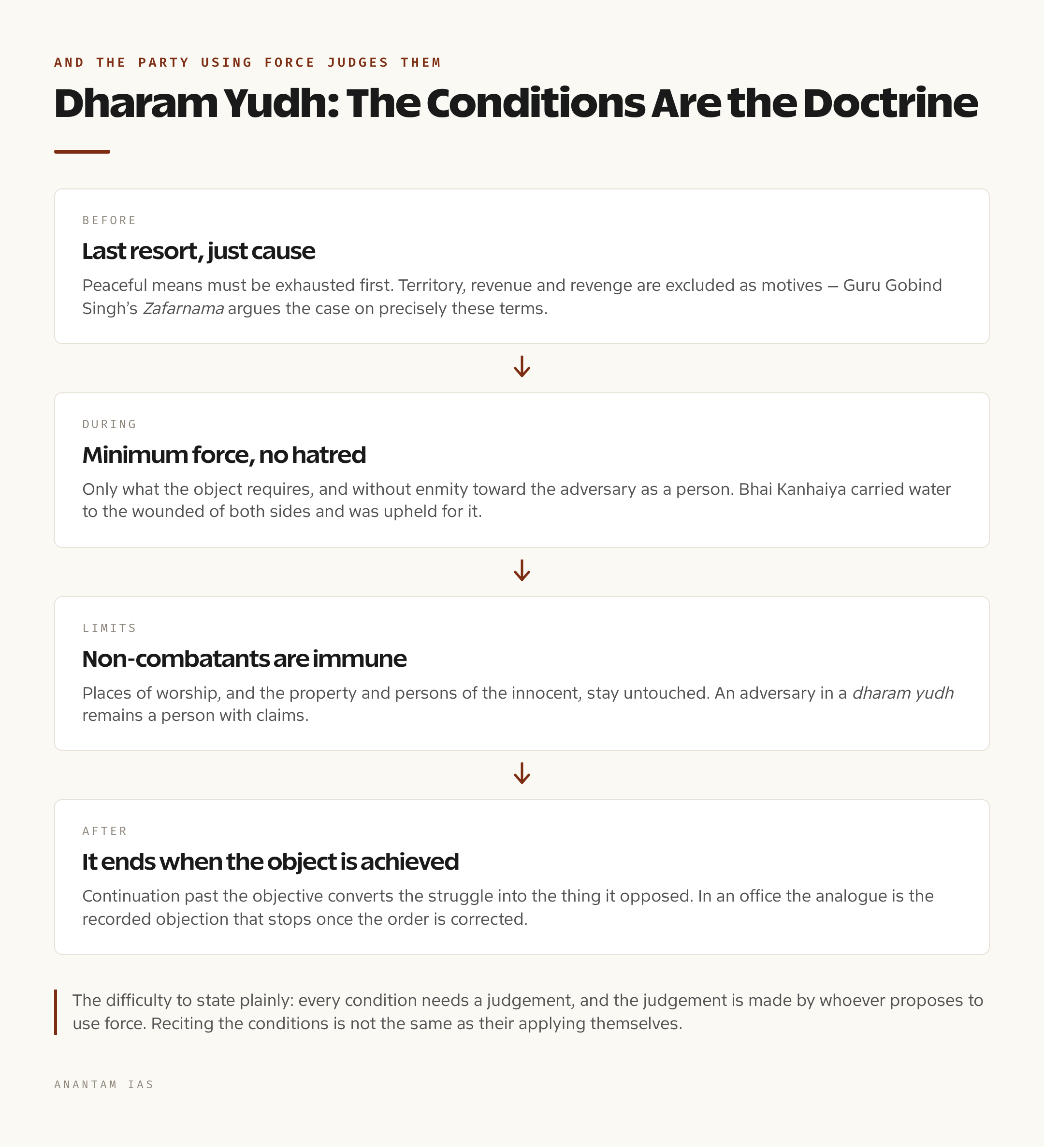
The associated doctrine is dharam yudh, righteous struggle, and its interest lies entirely in its conditions. As stated in the tradition, force is permissible only as a last resort after peaceful means are exhausted; only for a just cause and never for territory, revenue or revenge; without hatred of the adversary; with the minimum required; with non-combatants, places of worship and the property of the innocent left untouched; and it ends when the object is achieved. The ninth Guru, Tegh Bahadur, was executed at Delhi in 1675 in defence of the religious freedom of a community not his own — the clearest available instance of the cost being paid for someone else’s right. Guru Gobind Singh’s Zafarnama, addressed to Aurangzeb, argues the case for taking up arms in exactly these terms, as a resort forced by the breach of undertakings.
The best illustration of the conditions doing real work is Bhai Kanhaiya, who carried water to the wounded of both sides at Anandpur; challenged for aiding the enemy, he was upheld by Guru Gobind Singh and told to carry ointment as well. An adversary in a dharam yudh remains a person. Compare this with the position examined in the ethics of protest, where purity of means is treated as constitutive rather than instrumental: Sikh ethics accepts force and then constrains it, which is a different structure from ruling it out.
What Transfers to an Office
Honest labour as an ethic of office, not of self-denial. Kirat karo asks where the earning came from, and the administrative version of the question is whether an income or advantage arose from work done or from the power to obstruct. Speed money is the textbook violation, but so is the consultancy, the study tour and the post-retirement placement that exist because of what the office could withhold.
Sharing as duty, not discretion. Dasvandh is a rate, not a mood. Its administrative analogue is the entitlement — a benefit that a citizen may claim, at a known standard, without the officer’s goodwill entering the transaction. Every discretionary welfare mechanism converts a duty into a favour, which is the ethical objection to discretion quite apart from its efficiency costs.
Service without the hierarchy of patronage. The test is whether the beneficiary knows whom to thank. Where they do, the service has generated a debt, and debts are collected. This is the practical content of the impartiality and non-partisanship discussed under accountability and responsibility.
Refusal, with conditions attached. The doctrine of righteous resistance has a direct bureaucratic form: the unlawful oral instruction. The conditions transfer almost unchanged — exhaust the internal route first, record the disagreement in writing, keep the objection to the substance rather than the person, use the minimum available means, and stop when the object is achieved rather than continuing the fight. Where the internal route is closed, the statutory channel is the one described in the article on whistleblowing in India, with its documented record of what happens to people who use it.
The Honest Objections
Stated equality and social practice have not converged. Caste persists among Sikhs. Punjab has the highest proportion of Scheduled Castes of any Indian state, separate gurdwaras associated with particular communities exist in parts of Punjab and in the diaspora, and Ravidasia and Mazhabi identities have formed partly in response to exclusion within the fold. A tradition whose scripture carries a cobbler’s verses has communities that will not share a gurdwara with his descendants. An honest answer states the norm and the gap, and does not use the norm as evidence about the practice.
A doctrine of justified force is genuinely difficult. Every condition on dharam yudh requires a judgement, and the judgement is made by the party proposing to use force. “Peaceful means are exhausted” and “the cause is just” have been asserted by people whose causes were not. The tradition’s own history includes the doctrine being invoked for ends its conditions do not obviously licence. Naming the difficulty is better than reciting the conditions as though they were self-applying.
Reading a religious tradition as an administrative code distorts both. Naam japo is not a mindfulness technique for reducing official stress, and seva is not volunteering. Extracting the transferable parts is legitimate; presenting the extract as the tradition is not. The same caution applies to the miri-piri formulation, which is a claim about religious authority in temporal matters and does not translate into a constitutional order built on the separation of the two.
The institutions have their own record. Gurdwara management is governed by the Sikh Gurdwaras Act, 1925, and the bodies it created have been the site of the ordinary contests over money and control that afflict every large religious establishment. A tradition is not refuted by the conduct of its institutions, but an article that describes the ethic without noticing them is not describing the world.
FAQ
What do kirat karo, naam japo and vand chhako mean? Earn by honest labour, keep the divine name in remembrance, and share what has been earned. The three together describe the duties of a householder, and the order matters — sharing presupposes that the earning was honest.
How is seva different from charity? Charity leaves the giver identifiable and creates an obligation in the receiver. Seva is service rendered without expectation of return and classically without the server’s name attached, in the forms of tan, man and dhan — body, mind and means.
What is the significance of langar and pangat? The langar is the free community kitchen; pangat is the requirement that all eat seated in one row regardless of rank or caste. Commensality was chosen deliberately, because shared eating was the practice through which hierarchy was maintained.
What does sarbat da bhala mean? The welfare of all, the phrase that closes the Ardas. It carries no qualifier of community, faith or nation, which makes it a demanding standard for anyone who has to ration scarce resources.
What is the sant-sipahi ideal? The saint-soldier: one person combining spiritual discipline with the readiness to resist injustice by force where necessary. It is associated with the sixth Guru’s assertion of miri and piri, temporal and spiritual authority together.
Is dharam yudh a doctrine of holy war? It is a doctrine of righteous struggle with stated conditions — last resort, just cause, no territorial or vengeful motive, no hatred, minimum force, immunity for non-combatants and places of worship, and an end when the object is achieved. The conditions are its substance, and the difficulty is that the party using force also judges whether they are met.
Practice Questions
Prelims MCQs
- In Sikh ethics, kirat karo refers to: (a) Remembrance of the divine name (b) Earning one’s living by honest labour (c) Sharing one’s earnings with the community (d) Voluntary renunciation of household life — Answer: (b) the emphasis is on work that produces something, as against income extracted from position.
- The Akal Takht, facing the Harmandir Sahib, was established in 1606 by: (a) Guru Nanak (b) Guru Amar Das (c) Guru Hargobind (d) Guru Gobind Singh — Answer: (c) it expressed the miri-piri claim that the community would exercise temporal judgement and not only worship.
- Haumai in Sikh thought is best described as: (a) The desire for liberation from rebirth (b) Ego or I-am-ness, treated as the root moral defect (c) The duty of hospitality to strangers (d) A condition permitting the use of force — Answer: (b) from it the tradition derives kam, krodh, lobh, moh and ahankar.
- Which of the following is NOT a stated condition of dharam yudh? (a) All peaceful means have been exhausted (b) Non-combatants and places of worship are left untouched (c) Territory or revenue is acquired for the community (d) The struggle ends once its object is achieved — Answer: (c) the doctrine explicitly excludes territorial gain, revenue and revenge as motives.
- Pangat refers to: (a) Congregational singing of scripture (b) Eating seated in a single row regardless of caste or rank (c) The tenth of income given for community purposes (d) Initiation into the Khalsa order — Answer: (b) the giving of a tenth is dasvandh, and pangat is the commensal rule attached to the langar.
Mains Practice Questions
- “Sikh ethics locates moral life in the household rather than in withdrawal.” Examine what this changes about the usefulness of the framework for those who exercise power. (150 words)
- Distinguish seva from charity and from patronage. Discuss its value as a norm for public service delivery. (150 words)
- Langar and pangat were social instruments as much as religious ones. Analyse commensality as a device of reform, and account for the persistence of caste among the communities that adopted it. (250 words)
- The doctrine of dharam yudh permits force under stated conditions. Critically examine the difficulty of building a public ethic on a doctrine of justified resistance, with reference to the problem of who judges whether the conditions are met. (250 words)
- “Sarbat da bhala sets no boundary to the group whose welfare is intended.” Discuss what a boundary-free welfare claim demands of an administrator who must ration scarce resources. (250 words)
Tell Google you want more of this.
Add Anantam IAS as a preferred sourceOne tap, and this site shows up more often in your own Top Stories, AI Overviews and AI Mode. Remove it any time.