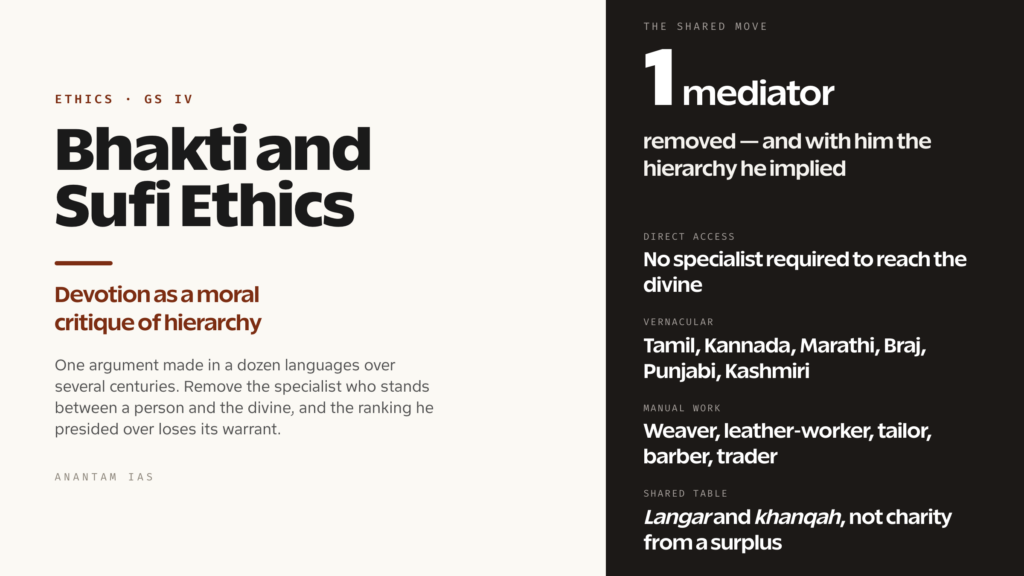
Bhakti and Sufi thought are almost always taught as medieval history — chronology, regions, poets, orders, the question of influence. Read that way they belong to a different paper, and the ethics gets lost in the dates. Read as ethics, they contain a single argument made in a dozen languages over several centuries, and it is an argument about hierarchy.
The argument runs like this. If the divine is directly reachable by any person, without a specialist, a language, a rite or a place of worship, then whoever claimed to stand in between was not standing on divine authority. Everything else follows from that: the choice of the spoken language over the sacred one, the elevation of the weaver and the cobbler, the shared kitchen, the woman’s first-person voice, and the refusal of the state’s money. None of it required a theory of rights, and all of it was social criticism rather than withdrawal.
Two Movements, Read as Ethics
The Bhakti current runs from the Tamil Alvars and Nayanars of roughly the sixth to ninth centuries, through the Kannada vachana poets of the twelfth, into the Marathi, Braj, Awadhi, Punjabi and Bengali material of the thirteenth to seventeenth centuries. It divides between nirguna devotion to a formless divine — Kabir, Ravidas, Dadu — and saguna devotion to a named form, as with Mirabai, Surdas and Chaitanya. Sufism in India organised itself into silsilas, chiefly the Chishti, Suhrawardi, Qadiri and Naqshbandi orders, each with its own position on poverty, music and the state. The historical development of both is treated separately in the articles on the Bhakti and Sufi movements and on Sufism in India.
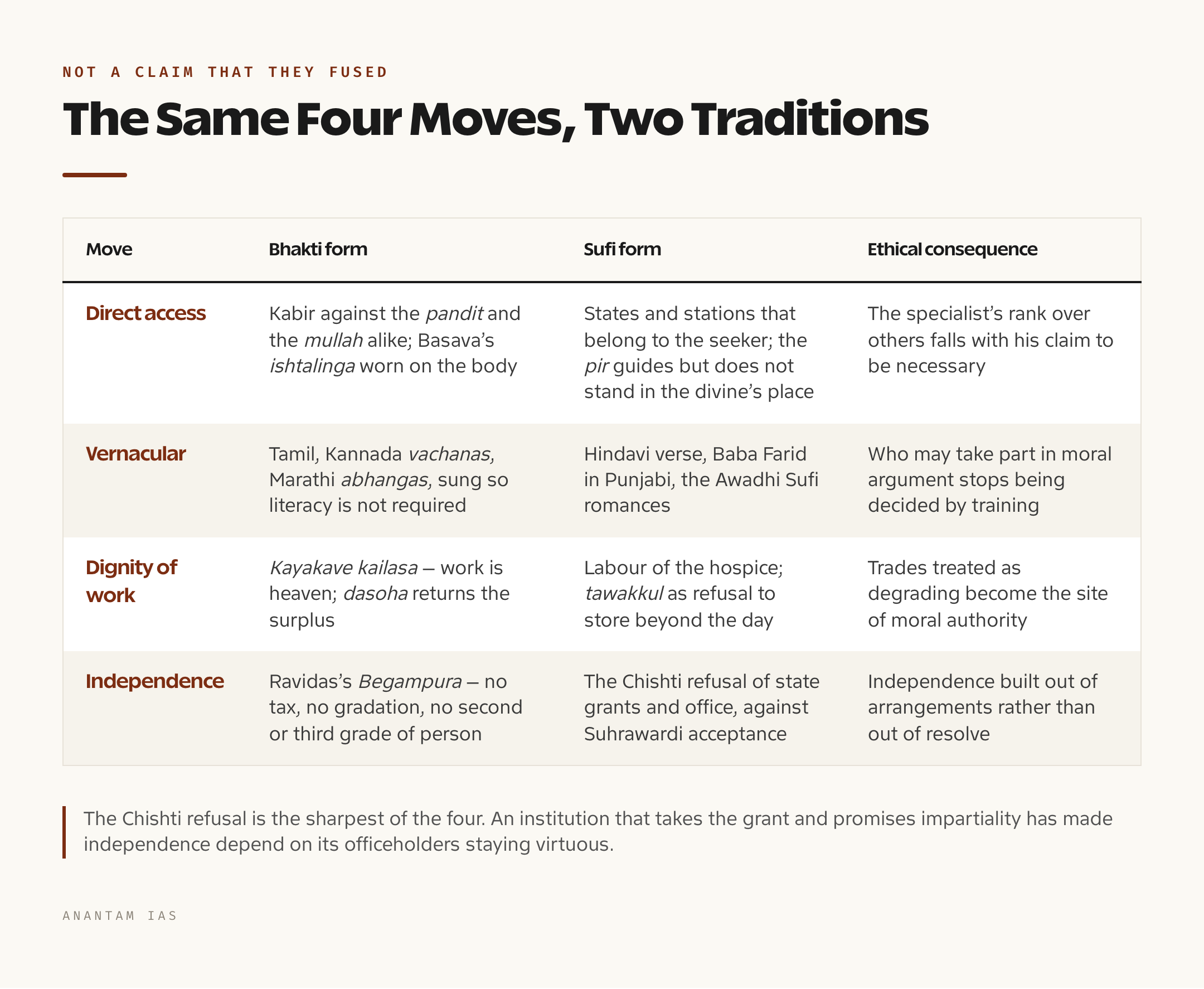
What justifies treating them together here is not a claim that they fused. It is that both made the same set of moral moves, from different starting points, and that the moves have consequences an administrator can still recognise.
The Shared Move: Removing the Mediator
The doctrinal position is about access to the divine. Its immediate effect is on authority over other people.
Kabir’s verses attack the pandit and the mullah with the same instrument, and the instrument is not scepticism about God — it is the observation that neither of them has anything the ordinary person lacks. The claim that a specialist is required to reach the divine is also the claim that a specialist ranks above those who need him, and the second claim falls with the first.
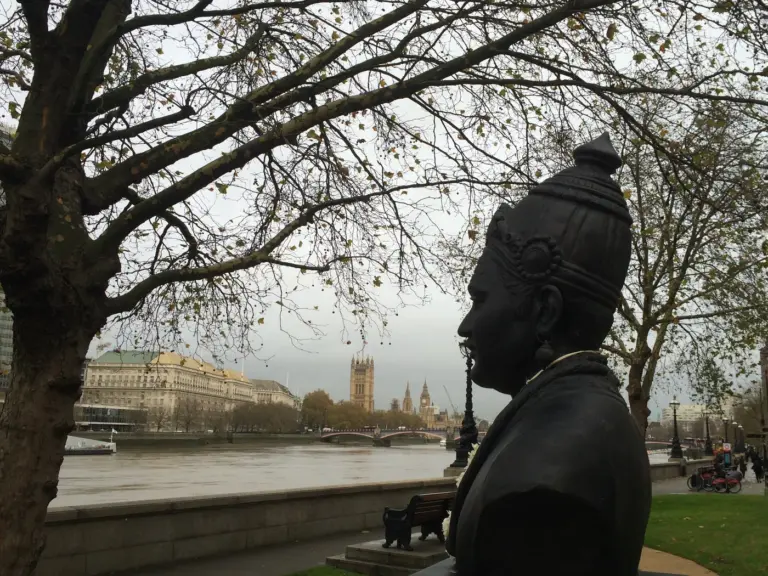
The clearest institutional expression is Basava’s twelfth-century Virashaiva movement in Karnataka. The ishtalinga, worn on the body, relocates the deity from a building to a person — which makes the temple gatekeeper irrelevant rather than merely wrong. The Anubhava Mantapa at Kalyana was an assembly where questions of conduct were argued out, open to men and women across castes, and the record of those arguments survives in the vachanas themselves. A movement that produces a transcript of its own moral deliberation, in the spoken language, by people of every rank, has done something structurally different from a movement that produces a doctrine.
Sufi practice reaches a similar place through experience rather than through argument. The seeker’s progress is described in states and stations that are the seeker’s own; the pir guides but does not stand in the place of the divine. That the pir relationship later hardened into something else is the objection, and it belongs below.
Vernacular as an Ethical Choice
The Bhakti poets composed in Tamil, Kannada, Marathi, Braj, Awadhi, Punjabi, Bengali and Kashmiri. That was not a literary preference. A tradition whose authoritative texts exist only in a language requiring years of restricted training has settled in advance who may take part in moral argument, and the vernacular decision undoes that settlement.
The evidence that this was understood at the time is that the vernacular compositions circulated as sung material. Andal’s Tiruppavai in Tamil, Lal Ded’s vakhs in Kashmiri, the Marathi abhangas of the Varkaris and the Kannada vachanas were all learnable by people who could not read. Transmission by singing removes literacy as a barrier, which is a stronger equality claim than translation.
The Sufi record is comparable. Persian remained the language of learning, but Amir Khusrau composed in Hindavi, Baba Farid’s Punjabi verses were preserved to the point of entering the Sikh scripture, and the Awadhi Sufi romances — Jayasi’s Padmavat of 1540 among them — carried Sufi doctrine in a narrative form that a village audience could follow. Choosing the form the audience already possesses, rather than requiring the audience to acquire the form, is an ethical decision about whose participation counts.
The Dignity of Work
The list is well known and its significance is usually understated. Kabir was a weaver, Ravidas a leather-worker, Namdev a tailor or calico-printer, Sena a barber, Sadhana a butcher, Dhanna a cultivator, Tukaram a small trader. Their compositions were collected and, in several cases, placed inside a scripture — the Guru Granth Sahib carries the verses of Kabir, Ravidas, Namdev and Sheikh Farid alongside those of the Sikh Gurus.
The point is not that labour was praised in the abstract. It is that trades treated as ritually degrading became the location of moral authority. That inverts the purity ranking rather than softening it, and it is a claim about the ranking itself, not a plea for kindness towards those at the bottom of it.
Basava’s tradition states the principle directly. Kayaka holds that labour performed honestly is itself worship — kayakave kailasa, work is heaven — and dasoha requires that what the labour produces beyond need be returned to the community. Taken together these are a complete work ethic: the value is in the doing, and accumulation past sufficiency is not a reward but a debt.
Ravidas takes it furthest. His composition on Begampura — the city without sorrow — describes a place with no tax and no tax-gatherer, no property and no grief, no second or third grade of person, where anyone may walk wherever they please. A leather-worker in fifteenth-century Varanasi setting out a polity without gradation is doing political philosophy, and the fact that he does it in a devotional register does not make it less so.
Women’s Moral Voice
The Bhakti corpus contains the first substantial body of women’s moral reflection in Indian vernaculars, and it is in the first person.
Akka Mahadevi’s Kannada vachanas record a woman who left a marriage and wrote about shame, the body and the refusal of the roles offered to her. Lal Ded’s Kashmiri vakhs are compressed statements of a moral position rather than devotional expressions. Mirabai’s Rajasthani and Braj compositions describe the cost of a woman’s refusal in a princely household. Andal’s Tamil verse is centuries older than any of them. Janabai, a domestic servant in Namdev’s household, wrote of grinding and sweeping as the site of her devotion, which fuses the labour and gender arguments in a single image. The Sufi precedent is Rabia of Basra, whose position — love of God with no expectation of reward and no fear of punishment — is the reference point for disinterested love in the tradition.
Read as ethics, the mode matters as much as the content. These are testimonies rather than treatises, grounded in relationship and in particular circumstance, and they make their claims by describing a situation rather than by deriving a rule. That is the structure examined in the ethics of care, and its strength and weakness are the same in both places: it is very hard to dismiss and very hard to generalise.
Sufi Ethics: Ishq, Fana, Tawakkul and the Refused Grant
Tasawwuf supplies a vocabulary that is about the self before it is about God.
Ishq distinguishes ishq-i-haqiqi, love of the real, from ishq-i-majazi, love of the metaphorical or created — and treats the second as a training for the first rather than as a rival to it. Fana is the annihilation of the self, followed by baqa, subsistence in the divine. Read ethically, fana is a doctrine about the ego, and it names the same defect that Sikh thought names as haumai: the self as the point from which everything is measured. Tawakkul is trust in divine provision, and in Chishti practice it took a demanding operational form — provisions were not to be stored beyond the day’s need.
The khanqah or jama’at khana is where this becomes institutional. The kitchen fed whoever arrived, without enquiry into faith or standing, and the day’s futuh — unsolicited offerings — were distributed rather than accumulated. Hospitality here is not generosity from a position of surplus; it is the deliberate refusal to hold a surplus.
The sharpest ethical decision the Indian Sufi tradition made is the Chishti refusal of state grants and state office. Where the Suhrawardi order accepted land grants and positions under the Sultanate, and defended doing so, the Chishtis of the classical period held distance from the court as a condition of the order’s integrity, and Nizamuddin Auliya’s avoidance of the Sultanate court is the standard instance. That is a structural choice, not a declaration of character: an institution that takes the grant and promises to stay independent has made independence depend on the continuing virtue of its officeholders, while one that refuses the grant has removed the lever. It is the same reasoning that runs through the design of independent regulatory bodies — independence is built out of funding, tenure and appointment, not out of resolve.
The related state doctrine is sulh-i-kul, peace with all, articulated as Mughal policy under Akbar and defended by Abul Fazl, drawing on the monist strand of Sufi thought; Dara Shukoh’s Majma-ul-Bahrain pursued the comparison between Sufi and Upanishadic positions directly. This is a state’s use of a religious idea rather than a religious idea about the state, and the distinction is worth keeping.
What Transfers: The Ethics of Access
An office that requires an intermediary has reproduced what these movements attacked. This is the transferable core and it is not a metaphor. Where a citizen cannot obtain a land record, a mutation, a certificate or a licence without a broker, a fixer or a known person inside, the office has re-established mediated access to something the citizen is entitled to reach directly. The tout is a priest with a smaller catchment. Statutory right-to-service regimes — Madhya Pradesh legislated the first of them in 2010, and several states followed — attack exactly this by naming the designated officer, the time limit and the appeal, which removes the discretion the intermediary was selling.
Language is an equality question, not a convenience. A notice a citizen cannot read has not given notice. Article 350 of the Constitution secures the right to submit a representation for redress of a grievance in any language used in the Union or in a State, and that right is hollow if the reply comes back in a register nobody outside the office uses. The Bhakti decision to sing rather than to write is the same decision as issuing a summary in plain language alongside the order.
Independence has to be structural. The Chishti argument applies to every body that must decide against the interests of those who fund it — regulators, audit bodies, universities, inquiry commissions. The relevant question is never whether the officeholders are people of integrity but whether the arrangement would survive their being ordinary. That is the reasoning behind the institutional recommendations discussed under ethics in governance.
The Honest Objections
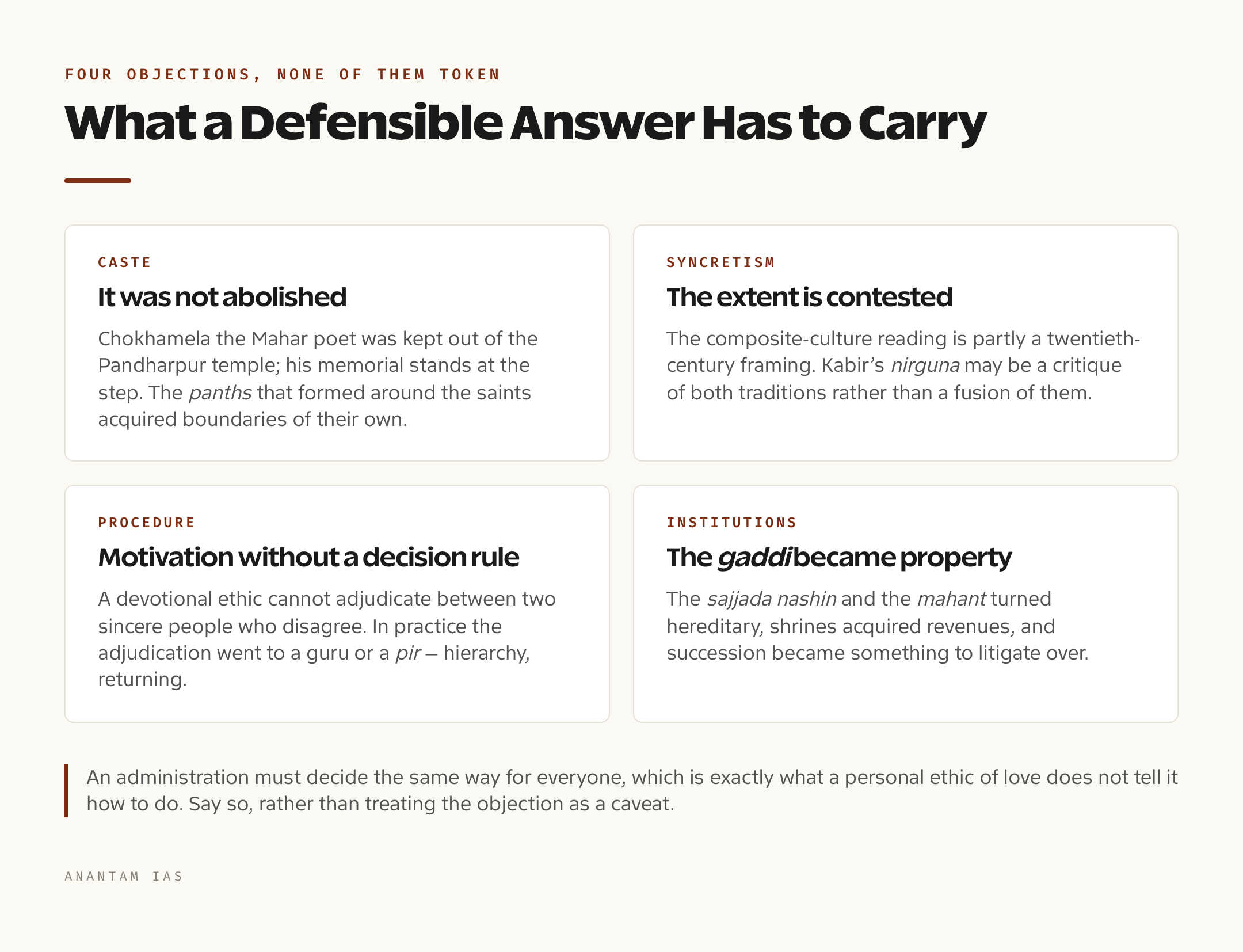
The movements did not abolish caste, and in places were absorbed by it. Chokhamela, the Mahar Varkari poet, was not admitted to the Pandharpur temple, and his memorial stands at the step. The panths that formed around the saints became social groups with boundaries of their own — the Kabir Panth, the Ravidasia community, the Lingayats as a consolidated bloc with its own internal gradations. A movement whose founding voices were artisans produced institutions whose members observed the same distinctions their founders attacked. Anyone writing that Bhakti ended caste is asserting something the evidence does not support.
Syncretism claims are contested and often overstated. The reading in which Bhakti and Sufism merged into a composite culture is partly a twentieth-century framing with its own politics. Scholars have argued that Kabir’s nirguna position was a critique of both traditions rather than a fusion of them; that shared veneration at a dargah does not establish doctrinal convergence; and that Sufi institutions coexisted with political power and with conversion in ways the harmony narrative smooths over. Textual instances of crossing are real — Baba Farid’s verses in the Guru Granth Sahib is the hardest of them — but the correct position is that the extent of convergence is unsettled.
A devotional ethic gives strong motivation and weak decision procedures. It supplies enormous motive force and no rule for adjudicating between two sincere people who disagree. In practice the adjudication fell to the authority of a guru or a pir — which is a hierarchy re-entering through the door the movement had closed. The sajjada nashin and the mahant became hereditary, shrines and temples acquired revenues, and the gaddi became property to be litigated over. An administration cannot run on charisma, because it must decide the same way for everyone, and that is precisely what a personal ethic of love does not tell it how to do.
Reading either movement as a programme overstates it. The critique of hierarchy rarely became a demand on the state, and where it did produce a durable institution the institution hardened. Treating a body of devotional poetry as a policy position is the mirror error of treating it as mere piety.
FAQ
What do the Bhakti and Sufi movements share as ethics? Four moves: direct access to the divine, which withdraws the mediator’s authority; the vernacular, which decides who may take part in moral argument; the dignity of manual work; and hospitality organised as a shared table rather than as charity from a surplus.
What are kayaka and dasoha? Principles of Basava’s Virashaiva tradition. Kayaka treats honest labour as worship — kayakave kailasa, work is heaven. Dasoha requires that what labour produces beyond need be returned to the community, so accumulation past sufficiency is treated as a debt.
What do ishq, fana and tawakkul mean? Ishq is love, distinguished between love of the real and love of the created. Fana is the annihilation of the self, followed by baqa, subsistence in the divine. Tawakkul is trust in provision, which in Chishti practice meant not storing beyond the day’s need.
Why did the Chishtis refuse state grants? Because independence maintained by refusing the money is structural, while independence maintained by taking it and promising impartiality depends on the continuing virtue of the officeholder. The Suhrawardi order took the opposite view and accepted grants and offices.
Did these movements end caste? No. Chokhamela was excluded from the Pandharpur temple, and the sects that formed around the saints developed boundaries of their own. The movements produced a sustained moral critique of hierarchy without dismantling it.
What is sulh-i-kul? “Peace with all”, articulated as Mughal policy under Akbar and defended by Abul Fazl, drawing on the monist strand of Sufi thought. It is a state’s use of a religious idea rather than a religious doctrine about the state.
Practice Questions
Prelims MCQs
- Kayaka, in the Virashaiva tradition associated with Basava, refers to: (a) The personal linga worn on the body (b) Labour performed honestly and treated as worship (c) The assembly at Kalyana where conduct was debated (d) A composition in Kannada — Answer: (b) the sharing of what labour produces beyond need is the companion principle, dasoha.
- Which pairing of a Bhakti figure with his occupation is correct? (a) Kabir — leather-worker (b) Ravidas — weaver (c) Namdev — tailor (d) Sena — butcher — Answer: (c) Kabir was a weaver, Ravidas a leather-worker and Sena a barber.
- In Sufi thought, fana refers to: (a) Trust in divine provision (b) Annihilation of the self (c) The audition of music and verse (d) Unsolicited offerings received by a hospice — Answer: (b) it is followed by baqa, subsistence in the divine; trust is tawakkul and offerings are futuh.
- Begampura, the city without sorrow, appears in a composition attributed to: (a) Kabir (b) Ravidas (c) Namdev (d) Tukaram — Answer: (b) the poem describes a polity with no tax, no grief and no second or third grade of person.
- The Chishti order in India is distinguished from the Suhrawardi order chiefly by its: (a) Use of vernacular rather than Persian (b) Refusal of state grants and state office (c) Rejection of the pir-disciple relationship (d) Location outside the Delhi Sultanate — Answer: (b) the Suhrawardis accepted land grants and positions and defended doing so.
Mains Practice Questions
- “Direct access to the divine withdraws the mediator’s authority over other people.” Examine this as an ethical argument, with reference to Bhakti and Sufi thought. (150 words)
- The Bhakti poets’ choice of the vernacular was an ethical decision rather than a literary one. Discuss, and relate it to the communication duties of a public authority. (150 words)
- Examine the treatment of manual labour in Bhakti thought, and account for the fact that a movement centred on artisan saints did not dismantle caste. (250 words)
- “The Chishti refusal of state grants made independence structural rather than a matter of character.” Analyse with reference to the design of institutions that must decide against those who fund them. (250 words)
- “A devotional ethic supplies strong motivation and weak decision procedures.” Critically examine this claim against the requirements of administrative decision-making. (250 words)
Tell Google you want more of this.
Add Anantam IAS as a preferred sourceOne tap, and this site shows up more often in your own Top Stories, AI Overviews and AI Mode. Remove it any time.