Purana Qila, Delhi’s Old Fort, stands beside Mathura Road near Pragati Maidan, on what was once the bank of the Yamuna. It is the citadel of Dinpanah, the city Humayun founded in 1533, which Sher Shah Suri took over and rebuilt after he drove Humayun out in 1540. Its best-known buildings are Sher Shah’s Qila-i-Kuhna mosque and the Sher Mandal, the octagonal tower from whose stairs Humayun fell to his death in January 1556.
The usual mistake is to give the fort to one man. Some books call it Humayun’s fort and others call it Sher Shah’s, and the official sources don’t agree either: a Delhi Tourism page says Humayun built the walls and gateway and Sher Shah carried the work forward, while Britannica says Sher Shah razed Dinpanah and built his own capital on the spot. The honest answer is a shared one, and this note sorts out which parts belong to whom. It also goes below the fort, where ASI excavations have reached layers they date to before the Mauryas.
Where Purana Qila is and who built it
The short answer: Humayun founded it and Sher Shah rebuilt and extended it; Humayun then came back to it for the last months of his life. Underneath all three chapters lies a settlement mound that the ASI says was lived on for about 2,500 years.
| Fact | Detail |
|---|---|
| Location | Mathura Road, New Delhi, near the Delhi Zoo and Pragati Maidan |
| Founded by | Humayun, as the citadel of Dinpanah, in 1533 |
| Rebuilt by | Sher Shah Suri, 1540 to 1545, who renamed it Shergarh |
| Returned to | Humayun in 1555; he died there in January 1556 |
| Type | Land fort on the old Yamuna bank; the citadel of a walled city |
| Walls and gates | 18 m high and about 1.5 to 2 km around; three gates: Bara Darwaza, Humayun Darwaza and Talaqi Darwaza |
| Protection | Centrally protected by the Archaeological Survey of India |
| UNESCO status | Not inscribed (neighboring Humayun’s Tomb was inscribed in 1993) |
| Beneath the fort | Nine cultural levels from pre-Mauryan to Mughal, by ASI excavation |
What lies beneath the fort: the ASI excavations
Purana Qila sits on a much older settlement, and the ASI has dug into it over several seasons. The digs show a long run of occupation; on their own they can’t prove which ancient city it was.
The seasons of excavation
The ASI’s own releases list the campaigns:
- 1954-55 and 1969 to 1973: excavations by the archaeologist B.B. Lal.
- 2013-14 and 2017-18: two seasons led by Vasant Kumar Swarnkar of the ASI; the second closed with evidence of layers older than the Mauryan period.
- From January 2023: a third season under Swarnkar, meant to expose and preserve the earlier trenches and to find painted grey ware in its proper layer.
Painted grey ware needs a word of explanation. It’s a fine grey pottery painted with simple designs in black, associated with early Iron Age settlements of the Ganga-Yamuna plains, and earlier seasons at Purana Qila recovered it; the ASI dates it to about 900 BCE. The catch, which the ASI flagged itself, is context. A sherd is strong evidence only when it comes out of an undisturbed layer in its proper sequence, and finding the painted grey ware in that stratigraphic context was a stated aim of the 2023 season. The ASI’s update of May 2023 reported that the trenches had reached structures of the early Kushana level at a depth of 5.5 m.
What nine layers mean
The 2023 releases sum up the evidence as nine cultural levels, from the bottom up:
- Pre-Mauryan
- Mauryan
- Shunga
- Kushana
- Gupta
- Post-Gupta
- Rajput
- Sultanate
- Mughal
A layer, here, is a band of debris and buildings left by one period of life on the site and sealed under the next. Reading them from bottom to top is reading Delhi’s history in order, which is why the Union Culture Minister, inspecting the dig in May 2023, called Purana Qila the only site in the Delhi region where that continuous story can be seen in excavated remains. The 2023 season added more than 136 coins and 35 seals and sealings from a small area, which the ASI reads as a sign of trade. Among the finds were a stone image of Vaikuntha Vishnu and a terracotta plaque of Gaja Lakshmi, and the trenches also exposed a ring well of the Mauryan period.
Indraprastha: tradition, not proof
Now the question every reader asks. The ASI’s releases describe the site as identified with Indraprastha, the Pandavas’ city in the Mahabharata. That identification rests on tradition. Archaeology can show that people lived and traded here from before the Mauryas, and the painted grey ware may take the story further back. What it can’t do by itself is name the settlement, because a pottery layer doesn’t carry a name. Write it as “traditionally identified with Indraprastha” and you’ll be accurate.
Humayun’s Dinpanah, 1533
Humayun began a new city here in 1533 and called it Dinpanah, “refuge of the faith”. The Delhi government’s heritage page describes Purana Qila as its inner citadel, founded that year and completed five years later, and Delhi Tourism credits Humayun with the massive gateway and walls. Britannica agrees on the founding: in 1533 Humayun laid out a new city on the bank of the Yamuna.
It was a hard time to be building a capital. Humayun spent those years fighting Bahadur Shah of Gujarat in the west and Sher Shah Suri, then gathering power in Bihar and Bengal, in the east. Sher Shah beat him at Chausa in 1539 and at Kannauj in 1540. Humayun was driven out of India, and his new capital passed to the man who had beaten him. For how close the Mughal Empire came to ending there, the dynasty note is the place to start.
What Sher Shah built between 1540 and 1545
Sher Shah held Delhi for five years, from 1540 until his death in 1545, and he made the fort his own. The Delhi government’s heritage page says he renamed it Shergarh and added several structures. The two interior buildings that still stand, the Qila-i-Kuhna mosque and the Sher Mandal, are both credited to him.
The credit dispute, stated fairly
Here the sources genuinely split, and it helps to see exactly how:
- Humayun built, Sher Shah continued. Delhi Tourism’s Purana Qila page credits Humayun with the walls and gateway and says Sher Shah carried the work forward.
- Sher Shah razed and rebuilt. Britannica, and Delhi Tourism’s own page on Shergarh, say Sher Shah razed Dinpanah to the ground and built his own capital on the site.
- Joint credit. The ASI’s January 2023 release says simply that the fort was built by Sher Shah Suri and Humayun.
The sensible reading combines them. Humayun chose the site and founded the city in 1533. Sher Shah, between 1540 and 1545, completed or rebuilt the fortifications and put up the buildings that survive inside. Humayun returned in 1555 and lived in what Sher Shah had built. It is wise neither to hand the fort to Humayun alone nor to write him out of it.
How easily the two men run together shows up even in official writing. Delhi Tourism’s Shergarh page, in the same paragraph that credits Sher Shah, says he died in 1556 on the stairs of the Sher Mandal. Sher Shah had died in 1545. The fall was Humayun’s.
Humayun’s return and his fall from the Sher Mandal
Humayun got his fort back in 1555. By Britannica’s account he recovered Delhi and Agra that July, after civil wars among Sher Shah’s successors. He had about six months left. The Delhi government’s heritage page gives the date: on 24 January 1556 he slipped on the stairs of the Sher Mandal on his way to evening prayer, fell headlong and died of his injuries two days later. Britannica records only that he died in January 1556 after falling down the staircase of his library.
The building matters as much as the fall. The Sher Mandal is a two-story octagonal tower of red sandstone, built by Sher Shah and used by Humayun as his library, and the Delhi government’s page counts it among Delhi’s first observatories. So the tower in which Humayun died was his rival’s work, which is about as neat a summary of the fort’s shared authorship as you’ll find.
His death put his 13-year-old son on the throne, and it took the Second Battle of Panipat, in November 1556, to secure Delhi for the new reign. That story continues in the notes on Akbar and the battles of Panipat.
Purana Qila in the 20th century: New Delhi’s axis and a refugee camp
The fort’s modern history is less known and more painful. In the 1920s, as New Delhi was built to Edwin Lutyens’s plan, the capital’s central vista was aligned on Purana Qila, as the Delhi government’s heritage page notes. Two decades later the fort was a camp.
In 1942, according to the historian Deborah Sutton’s study of Delhi’s Partition camps, Purana Qila held 2,115 Japanese internees arrested in Southeast Asia and sent to India. Five years later it held refugees. In 1947 Purana Qila, along with Humayun’s Tomb and other sites in Nizamuddin, became a camp for Muslims displaced by the violence in the city. In 1948 the Ministry of Relief and Rehabilitation ran these sites as camps for Hindu refugees moving into or through Delhi.
Life inside was hard and it lasted. Refugees lived in tents and in the dalans, the small recessed verandas under the walls, for the first 18 months, and then in single-room tenements with asbestos roofs. In 1959 about 5,000 people still settled inside the walls were served what the government called a “Positively Final Notice to Quit”. It’s a useful reminder that Partition was lived in places you can still walk through.
How to read Purana Qila’s walls, gates and buildings
Purana Qila is simpler than the great hill forts, which makes it a good place to learn fort vocabulary. Walk it the way an attacker would have met it.
The moat and the walls. Delhi Tourism describes a wide moat once connected to the Yamuna, which then flowed on the fort’s east side. Behind it rise thick ramparts crowned by merlons, the solid blocks of a battlement that alternate with firing gaps. The Delhi government’s heritage page gives the walls as 18 m high and about 1.5 km long, while Delhi Tourism gives a circuit of nearly 2 km. The two figures come from different official pages, so quote a range.
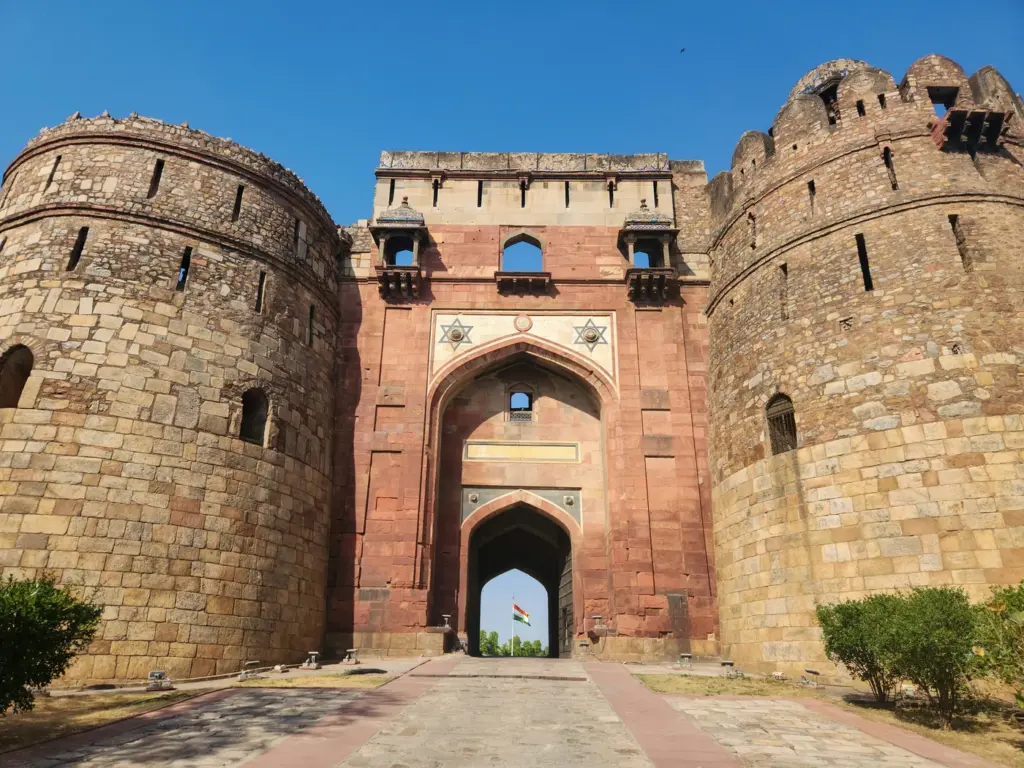
The gates. Each of the three is a two-story sandstone gateway flanked by large semicircular bastions and decorated with marble inlay and blue tiles, with jharokhas (projecting balcony windows) and chhatris (small domed pavilions on pillars) above:
- Bara Darwaza, the Big Gate, faces west and is the entrance in use today.
- Humayun Darwaza faces south; the heritage page says it may be named for Humayun as its builder, or because Humayun’s Tomb can be seen from it.
- Talaqi Darwaza, the forbidden gate, faces north; Delhi Tourism notes that it joins the Islamic pointed arch with Hindu-style chhatris and brackets.
A bastion, here, is a rounded tower projecting from the wall on either side of the gate, so that defenders on it could fire along the face of the gate at anyone forcing it. That is the logic of the whole entrance: an attacker had to cross the moat, then stand in crossfire from two towers while breaking one door. The balconies and pavilions above are the other half of the design, features that later Mughal architecture repeated on a much larger scale.
Inside, most of the interior is gone. The two buildings that survive are both Sher Shah’s.
The Qila-i-Kuhna mosque
The Qila-i-Kuhna mosque, the “mosque of the old fort”, is the best-preserved building in the complex, and the Delhi government’s page credits it to Sher Shah. It’s usually described as a transitional building, standing between the mosques of the Lodi dynasty and the Mughal mosques that followed, and it’s worth knowing as an early landmark of Indo-Islamic architecture in Delhi. An inscription on a marble slab inside asks that the building be frequented, and its people happy and cheerful, for as long as there are people on the earth.
The Sher Mandal
The Sher Mandal stands to the south of the mosque: the two-story octagonal tower described above, topped by an octagonal chhatri on eight pillars. The Delhi government’s page says it was meant to rise higher and that work stopped when Sher Shah died. Its steep stairs are the reason the building is remembered.
Beyond the walls. Across Mathura Road stands the Lal Darwaza, which the heritage page identifies as the southern gate of Sher Shah’s city of Shergarh. Purana Qila was only the citadel; the walled city around it has mostly vanished under modern Delhi.
Purana Qila today: protection, museum and excavation site
Purana Qila is a centrally protected monument under the ASI, and it is not a UNESCO World Heritage Site. Humayun’s Tomb, visible from the fort’s south gate, is: UNESCO inscribed it in 1993. The two are easy to merge in memory, so keep them apart, and see the roundup of UNESCO World Heritage Sites in India for the full list.
The ASI’s Archaeological Museum inside the fort displays finds from the earlier excavations, among them painted grey ware and terracotta figurines. On 30 May 2023 the Union Culture Minister announced that the newly excavated remains would be conserved under a shed and shown as an open-air site museum, as the government’s release records. In June 2023 the chief excavator walked embassy delegates through the trenches, and the Minister of State for Culture urged the ASI to run LiDAR surveys before digging further. LiDAR uses laser pulses to map the ground surface in fine detail, which can reveal the faint surface traces of buried walls that the eye misses.
How to study Purana Qila for exams
Purana Qila touches four parts of the syllabus, which is why it’s worth more than its size suggests:
- Ancient history: painted grey ware, the Indraprastha tradition and a nine-level sequence from pre-Mauryan to Mughal.
- Medieval history: Humayun’s first reign, the Sur interlude and Humayun’s return, at the join between the Delhi Sultanate and the Mughals.
- Art and culture: early Mughal and Sur gateways, and the Qila-i-Kuhna mosque as a transitional building.
- Modern history: the 1947 camp and the Partition city.
The architecture thread is how this ground gets tested. History Optional 2026 Paper I asked “How far can the Qutub Complex at Mehrauli be considered as an ideal specimen for the study on the development of architecture under the Delhi Sultanate? Analyze.“, and History Optional 2023 Paper I set “Mughal architecture was syncretic in character. Comment.” Purana Qila sits between those two questions in time and style, which makes it the Delhi example that links a Sultanate answer to a Mughal one.
These are the facts to revise:
- 1533: Humayun founds Dinpanah, with Purana Qila as its citadel.
- 1540 to 1545: Sher Shah holds Delhi, renames the fort Shergarh and builds the Qila-i-Kuhna mosque and the Sher Mandal.
- 1555 and 1556: Humayun recovers Delhi, then dies in January 1556 after a fall on the Sher Mandal stairs.
- Gates: Bara Darwaza (west, in use), Humayun Darwaza (south), Talaqi Darwaza (north, the forbidden gate).
- Excavations: B.B. Lal in 1954-55 and 1969 to 1973; Vasant Kumar Swarnkar in 2013-14, 2017-18 and from 2023.
- Layers: nine cultural levels; painted grey ware dated to about 900 BCE; Indraprastha is a tradition, not a proven identification.
- 1947: a camp for displaced Muslims; from 1948, for Hindu refugees.
Three confusions are worth settling now:
- Humayun or Sher Shah? Both. Humayun founded the city; Sher Shah rebuilt the fort and built its surviving interior; Humayun died in Sher Shah’s tower.
- Purana Qila or Humayun’s Tomb? The fort is Humayun’s city; the tomb, built after his death, is the UNESCO site.
- Whose death on the stairs? Sher Shah died in 1545; the fall on the Sher Mandal stairs in 1556 was Humayun’s.
It also helps to place the fort among Delhi’s other citadels of the period, including Shah Jahan’s Red Fort:
| Fort | Built by | Period | UNESCO status |
|---|---|---|---|
| Purana Qila | Humayun, then Sher Shah Suri | 1533 to 1545 | Not inscribed |
| Salimgarh | Islam Shah Suri, Sher Shah’s son | 1546 | Part of the Red Fort Complex, 2007 |
| Red Fort | Shah Jahan | 1639 to 1648 | Red Fort Complex, 2007 |
Purana Qila is small, but it’s the one place in Delhi where you can stand on about 2,500 years of layers and beside the tower where Humayun’s reign ended. Learn it as a shared fort, Humayun’s city with Sher Shah’s buildings, and resist turning a tradition into a fact. That habit is what separates a careful answer from a confident one.
Frequently Asked Questions
Who built Purana Qila?
Purana Qila was begun by the Mughal emperor Humayun as the citadel of his city Dinpanah, founded in 1533. Sher Shah Suri, who drove Humayun out in 1540, rebuilt and extended it as Shergarh and built its surviving mosque and tower, so the fort is best credited to both.
What is the Sher Mandal?
The Sher Mandal is a two-story octagonal tower of red sandstone inside Purana Qila, built by Sher Shah Suri. Humayun used it as his library after he regained Delhi, and he died in January 1556 after falling on its stairs.
Is Purana Qila the site of Indraprastha?
Tradition identifies the site with Indraprastha, the Pandavas’ city in the Mahabharata, and ASI releases repeat that identification. The excavations prove a long settlement going back before the Mauryas, but no find by itself proves that this was the city of the epic.
What did the ASI find at Purana Qila?
Excavations found nine cultural levels, from pre-Mauryan to Mughal, and earlier seasons recovered painted grey ware that the ASI dates to about 900 BCE. The 2023 season reached early Kushana structures at 5.5 m and produced more than 136 coins and a stone image of Vaikuntha Vishnu.
Why is it called Purana Qila?
Purana Qila means Old Fort. It is roughly a century older than Shah Jahan’s Red Fort, and its mosque, the Qila-i-Kuhna, takes its name from the same idea of the old fort.
Is Purana Qila a UNESCO World Heritage Site?
No. Purana Qila is protected by the Archaeological Survey of India but is not on the World Heritage List. Its neighbor, Humayun’s Tomb, was inscribed by UNESCO in 1993.
What are the gates of Purana Qila?
The fort has three gates. The Bara Darwaza on the west is the entrance in use today; the Humayun Darwaza faces south and the Talaqi Darwaza, usually translated as the forbidden gate, faces north.
What happened at Purana Qila in 1947?
In 1947 Purana Qila became a camp for Muslims driven from their homes by violence in Delhi, and from 1948 it housed Hindu refugees moving into the city. Refugees lived in tents and in the recesses under the walls, and some families were still there in 1959, when the government served them a final notice to quit.
Practice Questions
Prelims
1. Consider the following statements about Purana Qila:
1. Humayun founded the city of Dinpanah, of which it is the citadel, in 1533.
2. The Qila-i-Kuhna mosque inside it is credited to Sher Shah Suri.
3. It was inscribed on the UNESCO World Heritage List in 1993.
Which of the statements given above is/are correct?
- (a) 1 and 2 only
- (b) 2 and 3 only
- (c) 1 and 3 only
- (d) 1, 2 and 3
Answer: (a) 1993 is the inscription year of Humayun’s Tomb; Purana Qila is not inscribed.
2. The Sher Mandal, where Humayun suffered his fatal fall in 1556, is:
- (a) a pavilion with twelve openings built by Humayun
- (b) a two-story octagonal red sandstone tower built by Sher Shah and used by Humayun as a library
- (c) the western gate of Purana Qila
- (d) a stepwell built by Islam Shah Suri
Answer: (b) Sher Shah built the tower, and Humayun used it as his library after he regained Delhi.
3. Consider the following statements about excavations at Purana Qila:
1. They have revealed cultural levels from the pre-Mauryan to the Mughal period.
2. The recovery of painted grey ware conclusively proves that the site was the Indraprastha of the Mahabharata.
Which of the statements given above is/are correct?
- (a) 1 only
- (b) 2 only
- (c) Both 1 and 2
- (d) Neither 1 nor 2
Answer: (a) The pottery shows an old settlement, but it cannot by itself identify the city of the epic.
4. Which gate of Purana Qila is known as the ‘forbidden gate’?
- (a) Bara Darwaza
- (b) Humayun Darwaza
- (c) Talaqi Darwaza
- (d) Lal Darwaza
Answer: (c) Talaqi Darwaza, the north gate, is usually translated as the forbidden gate.
5. The Salimgarh fort, which forms part of the Red Fort Complex in Delhi, was built by:
- (a) Humayun
- (b) Sher Shah Suri
- (c) Islam Shah Suri
- (d) Shah Jahan
Answer: (c) UNESCO records that Islam Shah Suri built Salimgarh in 1546.
Mains
- Purana Qila is often credited to either Humayun or Sher Shah Suri. Critically examine the evidence for a shared authorship. (15 marks, 250 words)
- What can archaeology at Purana Qila establish about ancient Delhi, and what can it not? Discuss with reference to the Indraprastha tradition. (15 marks, 250 words)
- Examine the Qila-i-Kuhna mosque as a transitional monument in Indo-Islamic architecture. (10 marks, 150 words)
- What were the major technological changes introduced during the Sultanate period? How did those technological changes influence the Indian society? (15 marks, 250 words) Previous year: Mains 2023, GS Paper I.
- Monuments carry modern as well as medieval history. Discuss with reference to the use of Delhi’s monuments as refugee camps after Partition. (10 marks, 150 words)
Tell Google you want more of this.
Add Anantam IAS as a preferred sourceOne tap, and this site shows up more often in your own Top Stories, AI Overviews and AI Mode. Remove it any time.