The British annexation of Awadh on 7 February 1856 was the last great act of territorial absorption in Lord Dalhousie’s tenure, and arguably the most politically reckless. It dispossessed Wajid Ali Shah, hollowed out the *taluqdari* establishment that had stitched the countryside together, and converted hundreds of thousands of sepoys — many of whom were drawn from Awadh’s villages — into men with a personal grievance against the East India Company. Within fifteen months the Revolt of 1857 would erupt, and Awadh would be its bloodiest theatre.
The political pretext
Dalhousie chose to annex Awadh not under the Doctrine of Lapse — which required the failure of natural heirs — but under the more sweeping charge of “misgovernment.” A series of British residents, beginning with William Sleeman and culminating in James Outram, had drafted reports describing Awadh as a kingdom drowning in corruption, peasant oppression, and royal frivolity. Sleeman’s tour of 1849–50 painted Wajid Ali Shah as a debauched aesthete who delegated state business to dancers and eunuchs while *zamindars* and *taluqdars* extracted rents at musket point. The reports were edited, sharpened, and forwarded to the Court of Directors, and in November 1855 the Court authorised annexation on the ground that the Nawab had failed to honour a treaty obligation to govern well.
Outram presented the demand for abdication on 4 February 1856. Wajid Ali Shah refused to sign, removed his turban, placed it in Outram’s hands, and was escorted to Calcutta. Awadh was formally annexed three days later. A pension of 12 lakh rupees per year was settled on the Nawab and his immediate family.
A treaty of doubtful provenance
The “obligation to govern well” was traced back to a 1801 treaty between Saadat Ali Khan and the Company. Indian and British critics — including Henry Lawrence — pointed out that the Company itself had drained Awadh’s military and financial autonomy under the same treaty and was therefore the principal architect of the conditions it now condemned. Karl Marx, writing in the *New York Daily Tribune* the same year, called the annexation “the first case of pure conquest” in India.
The taluqdars dispossessed
Awadh’s revenue settlement before annexation rested on the *taluqdars* — magnate landholders who held forts (*garhis*), maintained armed retainers, and collected revenue from clusters of villages on behalf of the Nawab. Approximately two-thirds of Awadh’s villages lay within *taluqdari* estates.
The Summary Revenue Settlement of 1856, drafted by Coverley Jackson and applied by his successor Henry Lawrence, started from the premise that the *taluqdars* were intruders — “outsiders” — who had usurped the rights of village proprietors during the late Nawabi years. The British therefore proposed to settle revenue directly with the village *zamindars* and cultivators, restoring what they imagined was an older village republic.
In practice this meant the *taluqdars* lost between two-thirds and four-fifths of their estates within months. Roughly 21,000 villages changed hands. The dispossessed magnates kept their family forts and personal arms — Lawrence resisted disarming them, fearing it would push them into open revolt — but their political and economic base evaporated. Many *taluqdars* who had served in the Nawab’s army or court found themselves financially ruined and surrounded by hostile new village proprietors who were not always able to pay the assessed revenue either.
What the British misread
The British framing of the *taluqdars* as parasitic outsiders mistook a stable patron-client equilibrium for fraud. Studies after 1857 — particularly the painstaking village-level inquiries ordered by Lord Canning — concluded that village *zamindars* and *taluqdars* were tied together by marriage, kinship, and ritual obligation; that the *taluqdars* often advanced loans, protected against bandits, and arbitrated disputes; and that summary dispossession had created a class of grievously aggrieved magnates whose forts were still standing and whose armed retainers were still nominally loyal.
The Summary Settlement also alienated the new village proprietors. Revenue assessments under the British system were heavier than the old, more flexible Nawabi demand, and arrears piled up within the first season.
The sepoy connection
Roughly one-third of the Bengal Army’s sepoys in 1856 were recruited from Awadh, particularly from the high-caste Brahmin and Rajput villages along the Ganga–Ghaghra doab. These soldiers held two grievances simultaneously.
First, the annexation stripped them of their privileged status as subjects of an independent kingdom. Under the Nawab’s writ, an Awadhi sepoy in Company service enjoyed a kind of dual citizenship — a foreign service contract abroad, family land and prestige at home. Annexation collapsed this duality. Now Company subjects in their own villages, their letters home reported humiliations: revenue demands on their families’ lands, *taluqdar* relatives ruined, the customary deference of subordinate castes eroding.
Second, the new revenue regime hit the very villages from which sepoys drew their household income. Letters intercepted by Outram’s residency in early 1857 carry a recurring complaint: that an Awadhi soldier’s pay no longer compensated for what his family was losing in revenue exactions and lost *taluqdari* patronage.
When the cartridge controversy reached Meerut and Barrackpore, the Awadhi sepoy was already politically dry tinder.
The Oudh Proclamation of 1858
After 1857 was crushed in Awadh — at huge cost, with Lucknow besieged and relieved twice — Lord Canning issued the Oudh Proclamation of 15 March 1858. It confiscated proprietary rights in the soil of Awadh in absolute terms, save for six loyal *taluqdars*. The proclamation provoked the angriest dispatch of John Bright in the Commons and was effectively reversed within months: Canning settled directly with the *taluqdars*, restored their estates under sanads, and turned them into a permanent landed gentry tied to the British state. The Awadh *taluqdars* became, in Tom Metcalf’s phrase, “the bedrock of British rule” — a remarkable U-turn that conceded the 1856 settlement had been a strategic blunder.
Wajid Ali Shah’s later years
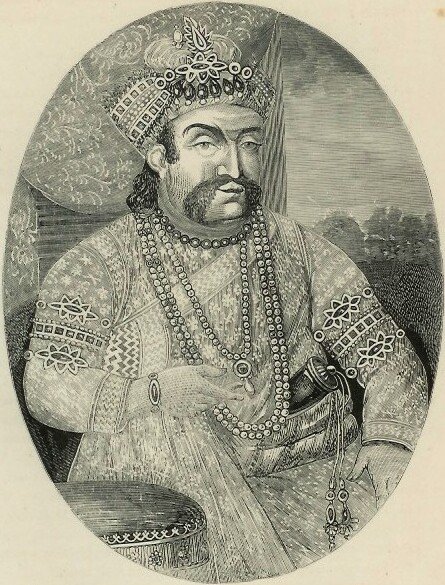
Wajid Ali Shah lived in Garden Reach, near Calcutta, until his death on 21 September 1887. He maintained a court in exile, kept singers and dancers from the Lucknow tradition employed, and wrote poetry under the pen name *Akhtar*. His Begum, Hazrat Mahal, declined to follow him into exile and became one of the principal leaders of the 1857 Revolt in Awadh, declaring her son Birjis Qadr the Nawab in June 1857. Hazrat Mahal refused British amnesty after the Revolt’s defeat and died in exile in Kathmandu in 1879.
Three facts often forgotten
The Awadh annexation is the hinge between the Doctrine of Lapse era and the structural causes of the 1857 Revolt. Three points about the post-annexation regime are routinely misremembered:
- The *taluqdars* were dispossessed of their estates but allowed to retain their arms and forts. Henry Lawrence’s caution against disarming them backfired spectacularly in 1857.
- The Summary Settlement of 1856 assumed the *taluqdars* were outsiders to the village community — a framing that did not survive contact with the actual social structure of Awadh.
- The British policy was to take revenue directly from the peasants, removing the *taluqdars* from the intermediary position. Canning reversed this within two years.
FAQs
When was Awadh annexed and by whom?
Awadh was annexed on 7 February 1856 by the East India Company under Governor-General Lord Dalhousie. James Outram, the British Resident, was the executor on the ground.
Was the annexation based on the Doctrine of Lapse?
No. Wajid Ali Shah had heirs. The annexation was justified by “misgovernment,” not the absence of an heir. This made it more controversial because it set no clear limit on when the Company could absorb a princely state.
What happened to the taluqdars after annexation?
Under the Summary Settlement of 1856 the *taluqdars* lost most of their estates — roughly 21,000 villages were resettled directly with village proprietors. They retained personal arms and their family forts, which proved consequential in 1857. After the Oudh Proclamation of 1858 and Canning’s settlement, their estates were restored under sanads, and they became a loyal landed gentry under British rule.
How did the annexation contribute to the 1857 Revolt?
Three channels. Dispossessed *taluqdars* led local uprisings. Revenue distress in the villages mobilised peasant participation. And one-third of the Bengal Army sepoys, who came from Awadh, carried personal grievances into their barracks. Lucknow became the longest-running theatre of the Revolt.
Who led the 1857 Revolt in Awadh?
Begum Hazrat Mahal, Wajid Ali Shah’s second wife, declared her son Birjis Qadr Nawab in June 1857 and led the resistance from Lucknow. After the Revolt’s defeat she retreated to Nepal and refused British amnesty.
What was the Oudh Proclamation of 1858?
Canning’s proclamation that confiscated proprietary rights in the soil of Awadh, exempting only six loyal *taluqdars*. It was politically reversed within months: Canning struck individual settlements with the *taluqdars*, restoring their estates in exchange for loyalty, and converted them into the landed backbone of British rule.
What was Karl Marx’s view of the annexation?
Writing in the *New York Daily Tribune* in 1856, Marx called the annexation “the first case of pure conquest” by the Company, criticising the gap between the British claim of moral improvement and the underlying logic of territorial absorption.
What happened to Wajid Ali Shah after annexation?
He was pensioned off to Garden Reach near Calcutta with an annual stipend of 12 lakh rupees, where he kept a court of musicians and poets and wrote under the pen name *Akhtar* until his death in 1887.
Tell Google you want more of this.
Add Anantam IAS as a preferred sourceOne tap, and this site shows up more often in your own Top Stories, AI Overviews and AI Mode. Remove it any time.