The Bahmani Kingdom was the first major Muslim sultanate in the Deccan, founded in 1347 by Alauddin Hasan Bahman Shah (originally Zafar Khan) and lasting for nearly 180 years until its disintegration in 1527. Based initially at Gulbarga (Ahsanabad) and later at Bidar (Muhammadabad), the kingdom produced one of South India's most distinctive syntheses of Persian, Turkish, Arab, Deccani, and local cultural traditions — from the military reforms of Mahmud Gawan to the Indo-Persian architecture of Gulbarga and Bidar.
Its fragmentation produced the five Deccan Sultanates — Ahmadnagar, Bijapur, Berar, Bidar, and Golconda — whose combined 1565 victory at the Battle of Talikota ended the Vijayanagara empire and set the stage for Mughal expansion into the Deccan.
Historical Context: Why the Bahmani Rose

- In 1327, Muhammad bin Tughlaq shifted his capital from Delhi to Daulatabad (Devagiri), bringing a large Turkic-Afghan nobility to the Deccan.
- After the plan collapsed, many of these nobles remained in the Deccan as "Amiran-i-Sadah" (centurion-commanders).
- In 1347, led by Hasan Gangu (a Deccan noble of Afghan / Persian origin), the centurions revolted against Delhi and declared independence.
- Hasan assumed the title Alauddin Hasan Bahman Shah — the dynasty was named after him (some chronicles trace the "Bahman" to a patron, Gangu Brahmin, hence also "Bahmani").
Geographical Extent
- At its height under Firoz Shah (1397–1422) and Ahmad Shah Wali (1422–1436), the kingdom stretched across most of the Deccan plateau:
- From the Arabian Sea to the Bay of Bengal.
- From Tapti in the north to Krishna-Tungabhadra doab in the south.
- Covered modern Karnataka, Maharashtra (Marathwada, Vidarbha), Telangana, and parts of Andhra Pradesh.
- Faced constant rivalry with:
- Vijayanagara Empire to the south (Tungabhadra frontier).
- Gujarat Sultanate and Malwa to the north.
- Khandesh and Gondwana chiefs.
Major Rulers
| Sultan | Reign | Contribution |
|---|---|---|
| Alauddin Bahman Shah | 1347–58 | Founder; capital at Gulbarga |
| Muhammad Shah I | 1358–75 | Consolidated administration; artillery introduced |
| Firoz Shah Bahmani | 1397–1422 | Patron of learning; built observatory at Daulatabad; married a Vijayanagara princess |
| Ahmad Shah Wali | 1422–1436 | Shifted capital to Bidar (1429); patron of Sufi Khwaja Bande Nawaz Gesudaraz |
| Alauddin Ahmad II | 1436–58 | Struggled with factional politics |
| Humayun "Zalim" Shah | 1458–61 | Short, violent reign |
| Muhammad Shah III | 1463–82 | Reign saw Mahmud Gawan's reforms; territorial peak |
| Mahmud Shah | 1482–1518 | Weak ruler; real power with Qasim Barid |
| Kalimullah | 1525–27 | Last Bahmani; kingdom dissolved |
Capitals of the Bahmani Kingdom
| Phase | Capital | Years |
|---|---|---|
| Founding | Gulbarga (Ahsanabad) | 1347–1429 |
| Expansion | Bidar (Muhammadabad) | 1429–1527 |
Why the shift? Gulbarga became administratively difficult as the kingdom expanded. Ahmad Shah Wali moved to Bidar for its central location, cooler climate, and defensive plateau geography.
Administration
- Kingdom divided into four provinces (tarafs) — Daulatabad, Berar, Bidar, Gulbarga.
- Each taraf headed by a Tarafdar (governor) with civil, military and revenue authority.
- Amir-ul-Umara — chief noble; often the king-maker in later years.
- Wazir — prime minister.
- Majlis-i-Diwan — the consultative council.
- Strong mansabdari-like cavalry system — each noble maintained a quota of horsemen.
- Dakhni (a dialect that became an ancestor of Urdu) emerged as a court and military language alongside Persian.
Mahmud Gawan: The Reformer
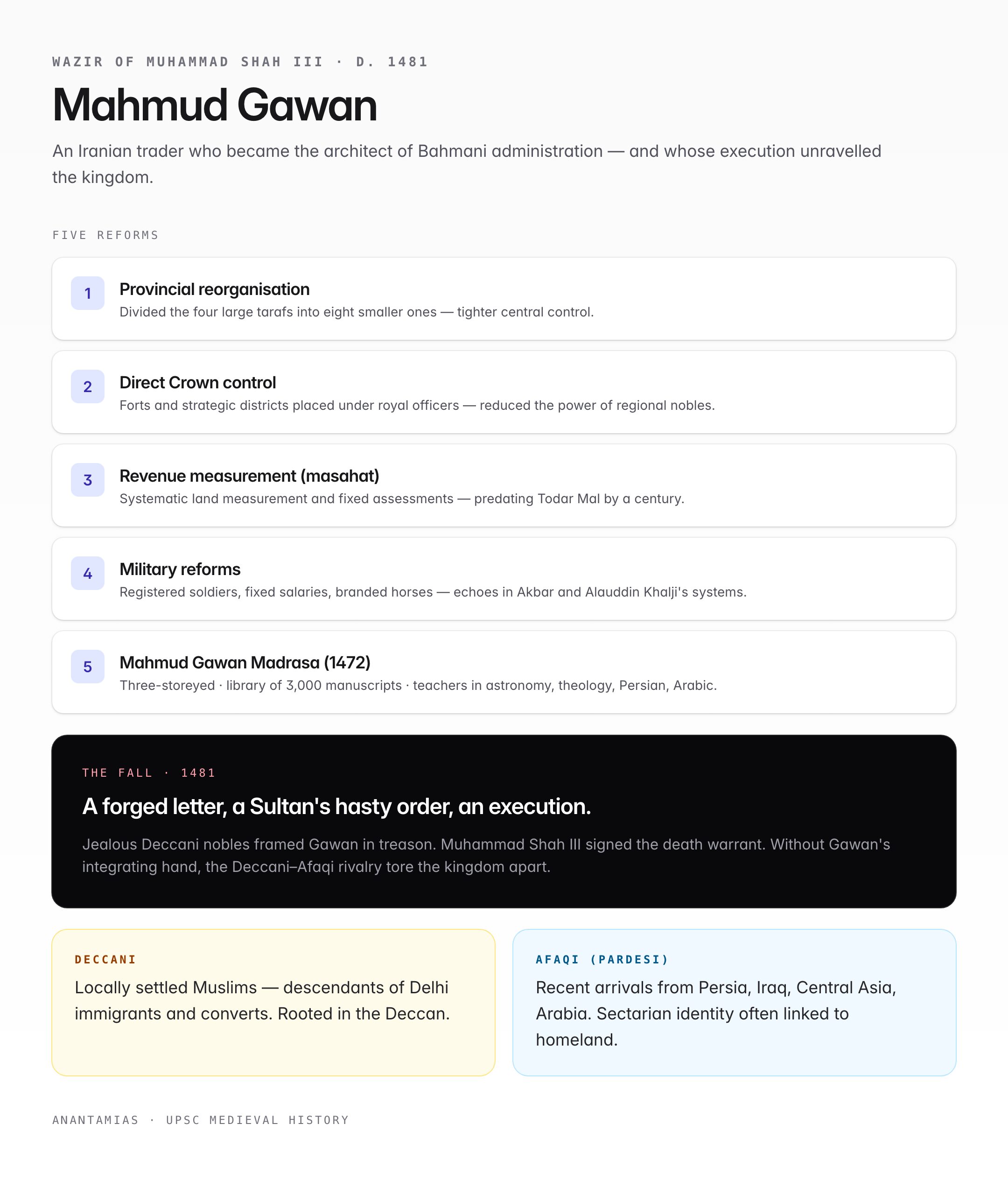
Khwaja Mahmud Gawan (d. 1481) — an Iranian trader who rose to become Wazir under Muhammad Shah III — is remembered as the architect of Bahmani administrative reforms.
Gawan's Reforms
- Provincial reorganisation: Divided the kingdom's four large tarafs into eight smaller ones for better control.
- Direct Crown control: Forts and strategic districts placed under royal officers, reducing the power of regional nobles.
- Revenue measurement: Introduced systematic land measurement (masahat) and fixed assessments.
- Military reforms: Registered soldiers, fixed salaries, branded horses — reducing corruption.
- Madrasa at Bidar (1472): One of the finest centres of learning in the Islamic world — three-storeyed, with a library of 3,000 manuscripts and teachers in astronomy, theology, Persian, and Arabic.
Fall of Gawan
- Jealous Deccani nobles forged a letter implicating Gawan in treason.
- Sultan Muhammad Shah III had him executed in 1481 — a turning point.
- Without Gawan's integrating leadership, Deccani vs Afaqi (foreign-born) noble factions tore the kingdom apart.
Deccani vs Afaqi Nobility
A recurring theme in Bahmani politics was the rivalry between two factions of nobles:
| Faction | Composition | Loyalty |
|---|---|---|
| Deccani | Locally settled Muslims, including descendants of Delhi immigrants and converts | Rooted in the Deccan |
| Afaqi (Pardesi) | Recent arrivals from Persia, Iraq, Central Asia, Arabia | Sunni / Shia identity often linked to homeland |
Sectarian overtones (Shia–Sunni) and patronage struggles weakened central authority, particularly after 1481.
Disintegration: Five Deccan Sultanates
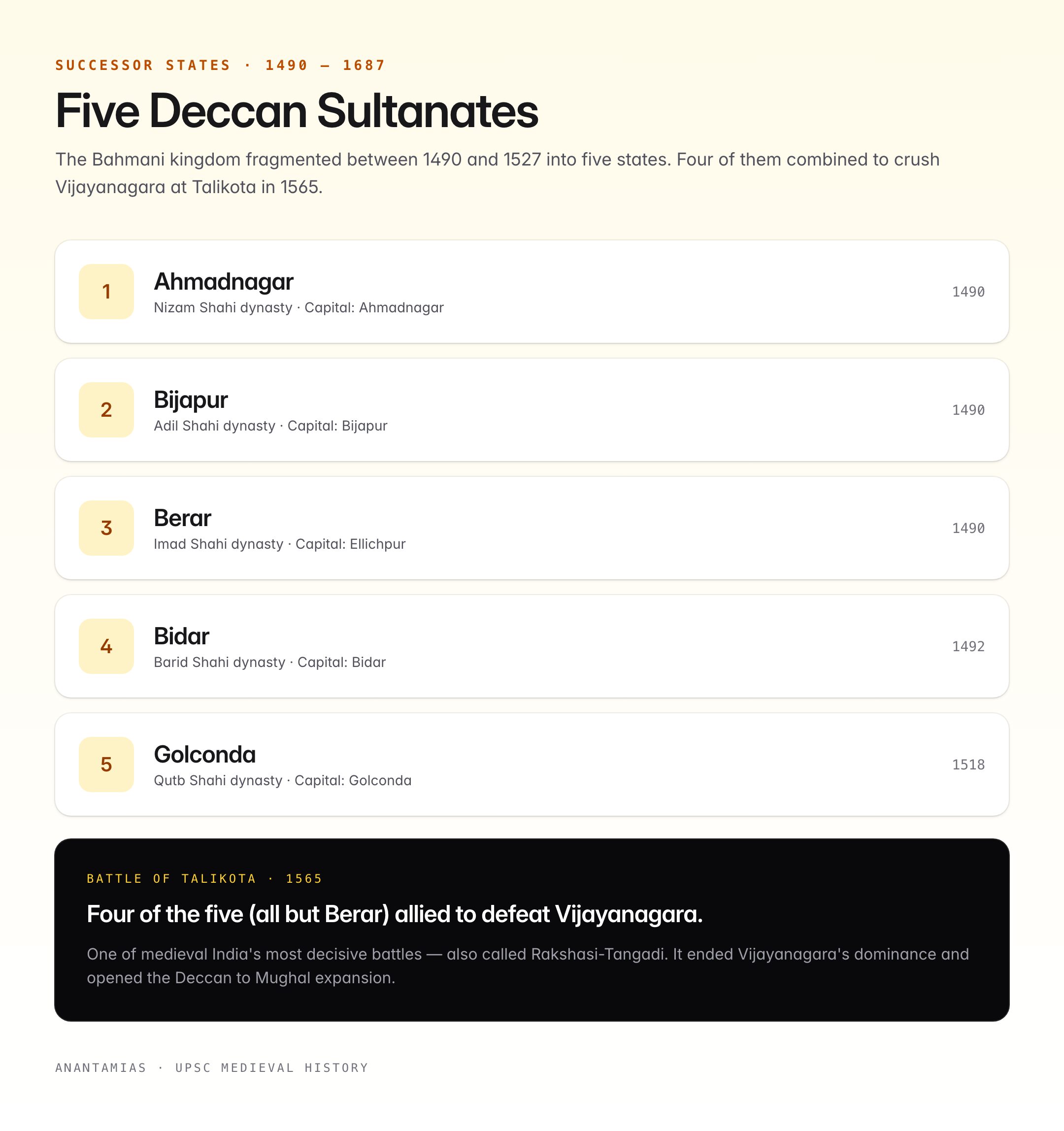
Between 1490 and 1527, the Bahmani kingdom broke up into five independent sultanates — known collectively as the Deccan Sultanates:
| Sultanate | Founding dynasty | Year | Capital |
|---|---|---|---|
| Ahmadnagar | Nizam Shahi | 1490 | Ahmadnagar |
| Bijapur | Adil Shahi | 1490 | Bijapur |
| Berar | Imad Shahi | 1490 | Ellichpur |
| Bidar | Barid Shahi | 1492 | Bidar |
| Golconda | Qutb Shahi | 1518 | Golconda |
In 1565, four of the five (all except Berar) allied to defeat Vijayanagara at the Battle of Talikota (Rakshasi-Tangadi) — one of medieval India's most decisive battles.
Architecture and Culture
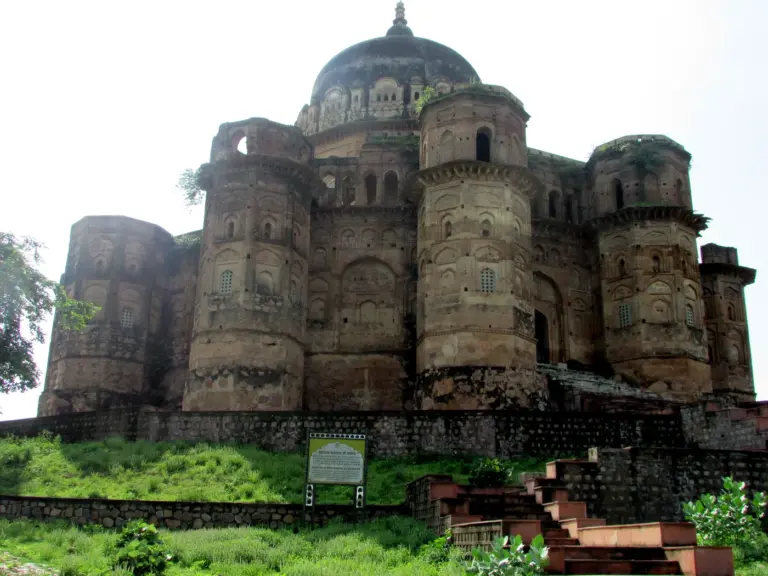
Gulbarga (Ahsanabad)
- Gulbarga Fort — concentric walls and a deep moat.
- Jama Masjid, Gulbarga (1367) — unique in India for having no open courtyard; covered by 63 domes.
- Tomb of Bande Nawaz Gesudaraz — major Sufi dargah.
Bidar (Muhammadabad)
- Bidar Fort — with 37 bastions, one of the largest in the Deccan.
- Mahmud Gawan Madrasa — Timurid-inspired architecture, blue-tile calligraphy.
- Chaubara clocktower — cylindrical watchtower.
- Bahmani tombs at Ashtur — octagonal domes, Persian tile work.
- Bidriware — a distinctive silver-inlaid metalware tradition that survives today with a GI tag.
Literary and Scientific Patronage
- Persian was the official and literary language.
- Dakhni (proto-Urdu) emerged as a vernacular.
- Major Sufi centres — Khanqah-i-Junaidiya, Dargah of Bande Nawaz.
- Firoz Shah was fluent in several languages and married a Vijayanagara princess.
- Nikitin, a Russian traveller, visited Bidar around 1470 and described the prosperity and military power of the kingdom.
Economy and Trade
- Rich cotton textiles, diamonds (Golconda), iron and steel (wootz), indigo, spices.
- Ports like Dabhol, Chaul, and Goa (until 1510) linked the Deccan to the Arabian Sea and the Red Sea trade.
- Horse trade from Arabia and Persia was strategically vital.
- Arrival of the Portuguese in the 16th century disrupted the Bahmani maritime economy.
Significance for Indian History
- First major independent Deccan power challenging Delhi.
- Laid the foundation for the Indo-Islamic synthesis in South India — a cultural lineage that flows into Hyderabad's Qutb Shahi–Asaf Jahi traditions.
- Created Dakhni, an ancestor of modern Urdu.
- Its successor states' Talikota victory (1565) reshaped South India.
- Architecture and crafts (Bidriware, Bidar tilework) remain living legacies.
- Its fall is a classic case of how factional politics and weak succession can unravel a strong state.
Quick Revision
- Founded: 1347 by Alauddin Hasan Bahman Shah.
- Capitals: Gulbarga → Bidar (1429).
- Great reformer: Mahmud Gawan (Wazir to Muhammad Shah III).
- Languages: Persian (official), Dakhni (vernacular).
- Rival: Vijayanagara (Tungabhadra frontier).
- Disintegrated into: Ahmadnagar, Bijapur, Berar, Bidar, Golconda.
- End date: 1527.
UPSC Relevance
Prelims (GS Paper I): Bahmani founders, capital shifts, Mahmud Gawan, Deccan Sultanates, and Battle of Talikota are classic prelims topics. Architecture (Gulbarga Jama Masjid, Bidar Fort, Mahmud Gawan Madrasa) appears in art-and-culture questions.
Mains (GS Paper I — Medieval History):
- Evaluate the contribution of Mahmud Gawan to the administration of the Bahmani kingdom.
- Examine the causes and consequences of the disintegration of the Bahmani kingdom.
- Discuss the architectural and cultural legacy of the Bahmani Sultanate.
Mains (GS Paper I — Art & Culture): Bahmani architecture, Bidriware (GI), Dakhni literature, and Sufi traditions in the Deccan.
Essay: Themes like "unity and fragmentation in medieval India," "frontier states and cultural synthesis," and "administrative reform as a test of leadership" fit the Bahmani arc.
Tell Google you want more of this.
Add Anantam IAS as a preferred sourceOne tap, and this site shows up more often in your own Top Stories, AI Overviews and AI Mode. Remove it any time.