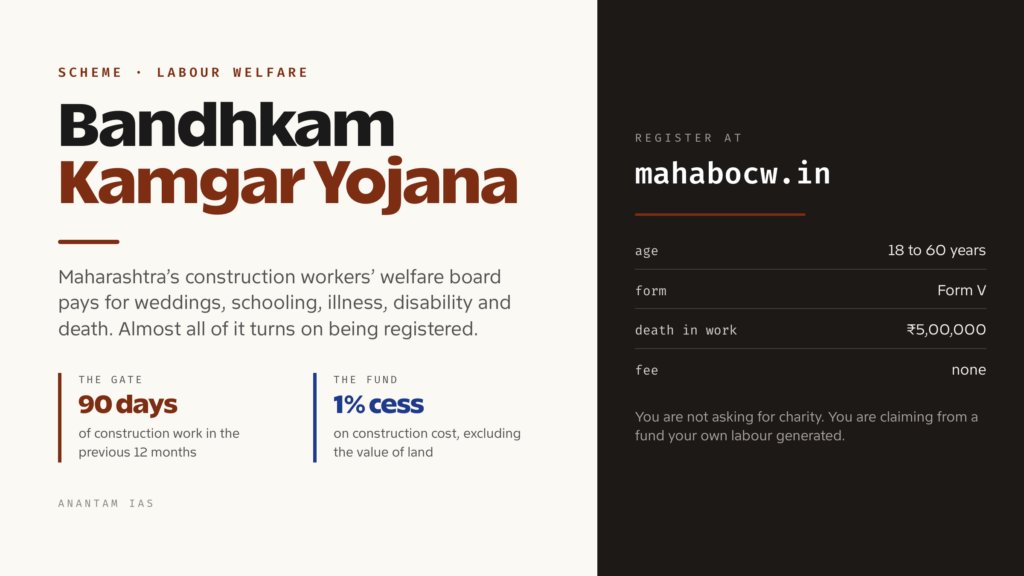
Bandhkam kamgar yojana is the everyday name for the welfare schemes run by the Maharashtra Building and Other Construction Workers Welfare Board. If you lay bricks, bend bar, plaster walls, wire buildings, carry material on a site or work on a road, bridge, canal or dam anywhere in Maharashtra, this board exists for you — and almost everything it pays for depends on one thing: being registered with it.
The money is not a state budget handout. Under the Building and Other Construction Workers Welfare Cess Act, 1996, a cess of one per cent of construction cost, excluding the value of land, is collected from every qualifying project and pooled in a workers’ welfare fund. The board, constituted by Maharashtra’s Labour Department in August 2007, spends that fund on the people who built the projects the cess came from. Understanding that changes how you should think about it. You are not asking for charity. You are claiming from a fund your own labour generated.
What the Board Offers
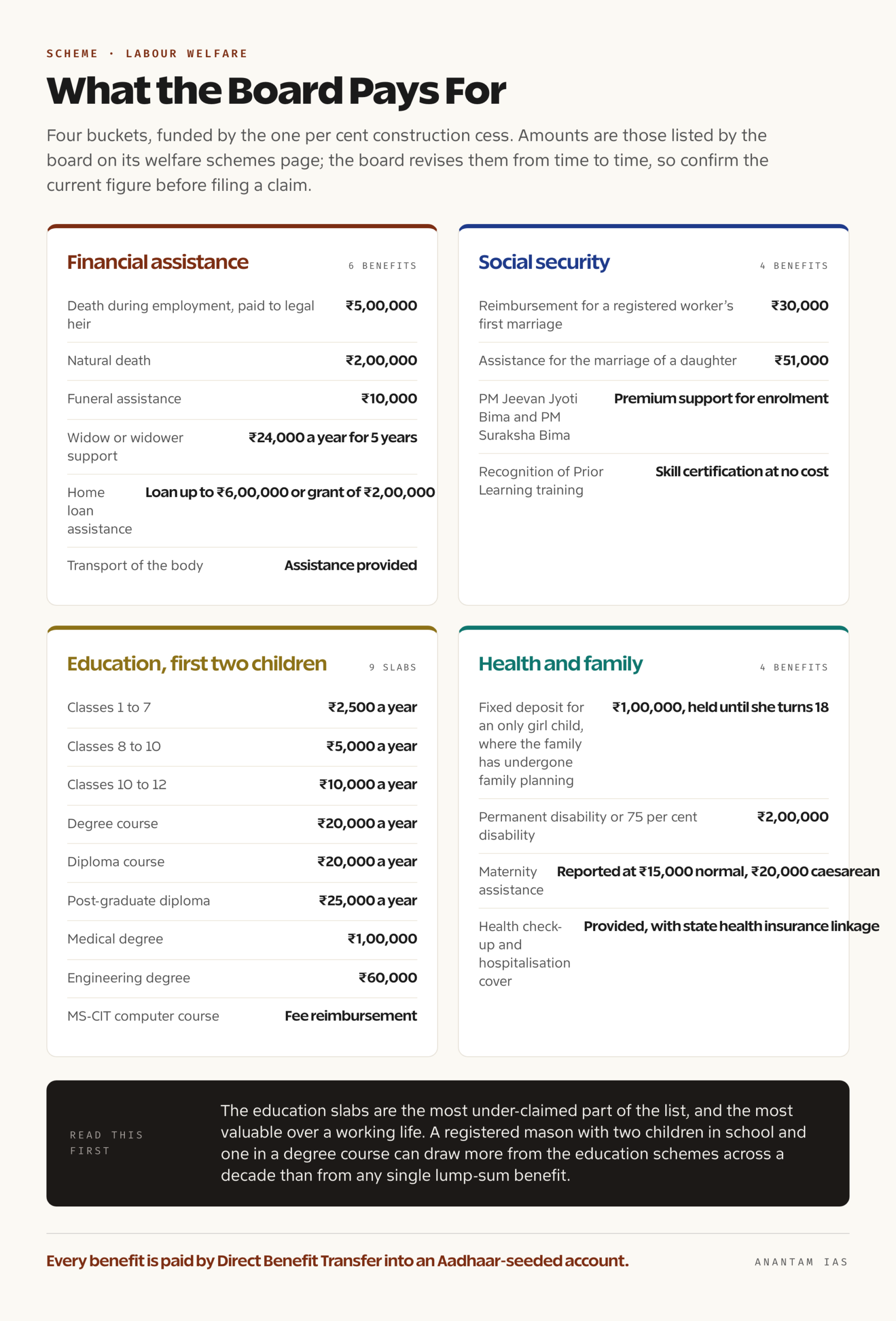
The benefits fall into four buckets. Amounts below are those listed on the Maharashtra Building and Other Construction Workers Welfare Board portal; the board revises them from time to time, so confirm the current figure before you file a claim.
Financial assistance
| Benefit | Amount |
|---|---|
| Death during employment (paid to legal heir) | ₹5,00,000 |
| Natural death | ₹2,00,000 |
| Funeral assistance | ₹10,000 |
| Widow or widower support | ₹24,000 a year for five years |
| Home loan assistance | Loan up to ₹6,00,000 or a grant of ₹2,00,000 |
| Transport of the body | Assistance provided |
Social security
| Benefit | Amount |
|---|---|
| Reimbursement for a registered worker’s first marriage | ₹30,000 |
| Assistance for the marriage of a daughter | ₹51,000 |
| Pradhan Mantri Jeevan Jyoti Bima Yojana and Pradhan Mantri Suraksha Bima Yojana | Premium support for enrolment |
| Recognition of Prior Learning training | Skill certification at no cost to the worker |
Education, for the first two children
| Stage | Amount |
|---|---|
| Classes 1 to 7 | ₹2,500 a year |
| Classes 8 to 10 | ₹5,000 a year |
| Classes 10 to 12 | ₹10,000 a year |
| Degree course | ₹20,000 a year |
| Diploma course | ₹20,000 a year |
| Post-graduate diploma | ₹25,000 a year |
| Medical degree | ₹1,00,000 |
| Engineering degree | ₹60,000 |
| MS-CIT computer course | Fee reimbursement |
Health and family
| Benefit | Amount |
|---|---|
| Fixed deposit for an only girl child, where the family has undergone family planning | ₹1,00,000, held until she turns 18 |
| Permanent disability or 75 per cent disability | ₹2,00,000 |
| Maternity assistance to the wife of a registered male worker or a registered woman worker | Reported at ₹15,000 for normal delivery and ₹20,000 for a caesarean |
| Health check-up and hospitalisation cover | Provided, including linkage to the state health insurance scheme |
The education slabs are the most under-claimed part of the list, and the most valuable over a working life. A registered mason with two children in school and one in a degree course can draw more from the education schemes across a decade than from any single lump-sum benefit.
Who Is Eligible and Who Counts as a Construction Worker
Registration turns on three conditions.
| Condition | Requirement |
|---|---|
| Age | 18 to 60 years at the time of registration |
| Work | At least 90 days of construction work in the preceding 12 months |
| Place | Employment in Maharashtra, with proof of residence in the state |
The 90-day rule is the gate, and it is the reason most eligible workers are not registered. You need a certificate confirming those 90 days, issued by the employer, the contractor, the engineer on the site, or — where no formal employer exists, which is the common case for daily-wage workers — by the local authority such as the municipal corporation, municipal council or gram panchayat. Getting that certificate is the single hardest step in the whole process, and it is worth starting there rather than at the portal.
“Construction work” is defined broadly by the Building and Other Construction Workers (Regulation of Employment and Conditions of Service) Act, 1996, and it covers far more trades than people assume: masons, carpenters, bar-benders and steel fixers, plumbers, electricians, welders, painters, tile and marble layers, glaziers, well diggers, stone cutters, road and bridge workers, canal, dam and irrigation workers, workers on transmission towers and pipelines, and the helpers and headload carriers who work alongside all of them. Building repair, alteration and demolition count too.
Two exclusions matter. Supervisory and managerial staff drawing above a specified wage are outside the definition, and workers already covered by a different statutory welfare board for the same employment cannot be registered twice.
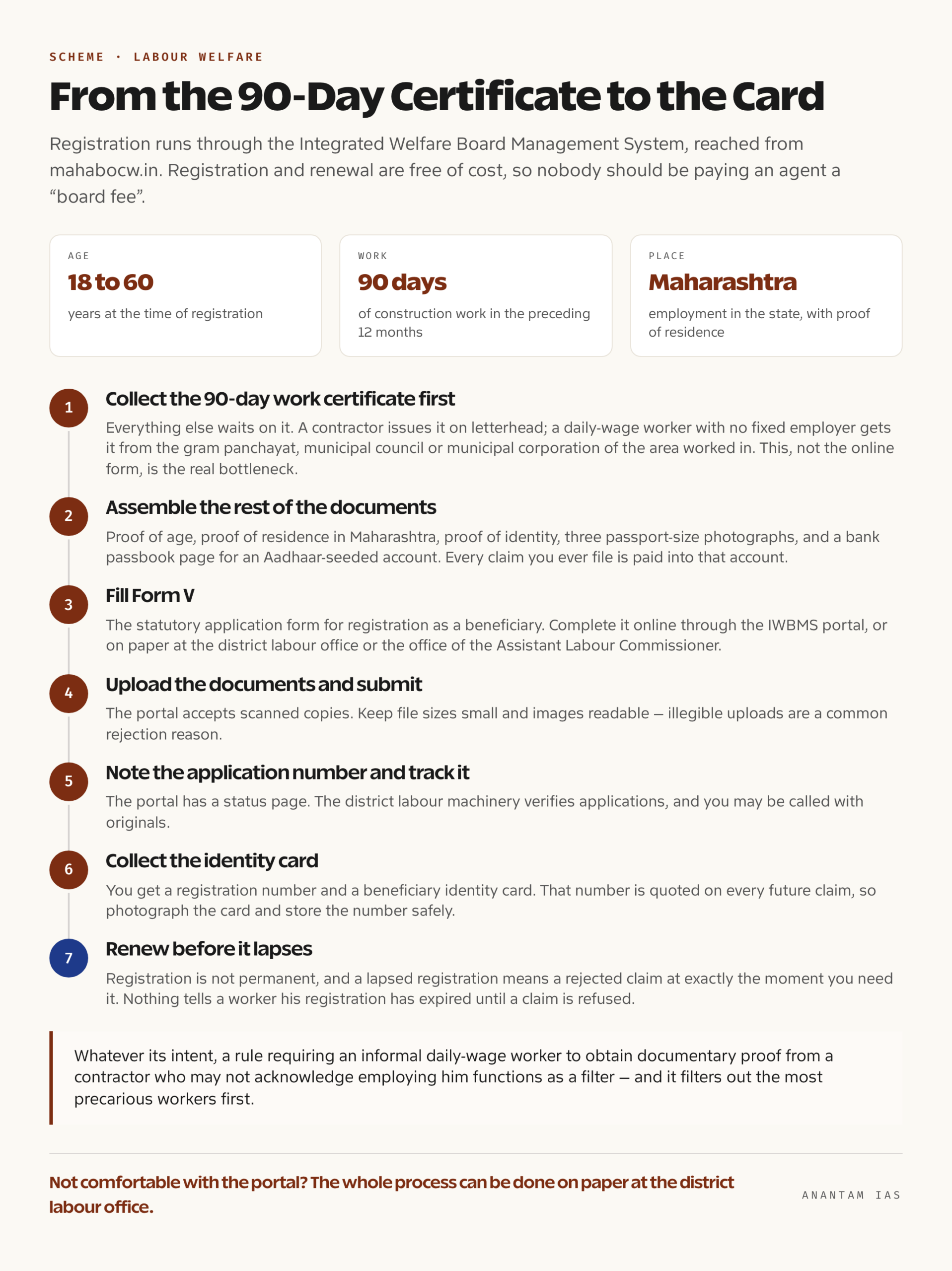
How to Register Online, Step by Step
The board runs its registration through the Integrated Welfare Board Management System, reached from the board’s official site. Registration and renewal were made free of cost in August 2025, so nobody should be paying an agent a “board fee”.
- Collect the 90-day work certificate first. Everything else waits on it. If you work for a contractor, ask for it on letterhead. If you work daily-wage without a fixed employer, approach the gram panchayat, municipal council or municipal corporation of the area where you have been working.
- Assemble the rest of the documents. Proof of age — Aadhaar, birth certificate, school leaving certificate or a valid identity document. Proof of residence in Maharashtra — ration card, electricity bill or Aadhaar. Proof of identity — Aadhaar, voter card or PAN. Three passport-size photographs. A bank passbook page for an Aadhaar-seeded account. Every claim you ever file will be paid into that account, so open one before you register if you do not have one.
- Fill Form V. This is the statutory application form for registration as a beneficiary. You can complete it online through the IWBMS portal or fill it physically and submit it at the district labour office or the office of the Assistant Labour Commissioner.
- Upload the documents and submit. The portal accepts scanned copies. Keep file sizes small and the images readable — illegible uploads are a common rejection reason.
- Note the application number and track it. The portal has a status page. Applications are verified by the district labour machinery, and you may be called with originals.
- Collect the identity card. Once approved you get a registration number and a beneficiary identity card. That number is what you quote on every future claim, so photograph the card and store the number somewhere you will not lose it.
Workers who are not comfortable with the portal can complete the whole process on paper at the district labour office, or through a Common Service Centre or a registered union. The scheme documents are in Marathi and English, and the board publishes district-wise office contacts on its site.
Renewal, Claims and Keeping the Card Alive
Registration is not permanent. Beneficiary status has to be renewed, and a lapsed registration means a rejected claim at exactly the moment you need it — a hospitalisation, an accident, a child’s admission. The board has extended the window for registration, renewal and claim appointments to 31 December 2026, which is a grace period, not a permanent arrangement.
Filing a claim follows the same shape as registration: log in with your registration number, pick the scheme, upload the scheme-specific proof, and submit. What the proofs are depends on the benefit — a marriage certificate for the wedding reimbursement, admission receipts and marksheets for education assistance, hospital records and a discharge summary for medical claims, a death certificate and heirship papers for death benefits, and a disability certificate from a competent medical authority for the disability benefit.
Three habits protect a claim. Keep the registration current. Keep the bank account Aadhaar-seeded and active, because everything is paid by Direct Benefit Transfer. And file within the time limit specified for that scheme — several benefits, particularly the education and marriage assistance, must be claimed within a defined period of the event, and a late file is a dead file.
Where It Stands on the Ground
Maharashtra has one of the larger construction workforces in India. The state’s own assessment, working forward from Census figures, put the number of construction workers at roughly 17.5 lakh, and the real figure today is certainly higher given the scale of building activity across Mumbai, Pune, Nagpur and the highway and metro corridors.
Registration has never matched that base. Construction labour is migrant, seasonal and contracted through layers of subcontractors, and workers move between districts and states within a single year. A worker who spends eight months in Maharashtra and four in his home district may struggle to assemble 90 documented days with any one authority, even though he has worked 250.
The board has responded by simplifying — abolishing registration and renewal fees, moving to an integrated online system, extending deadlines, and running Recognition of Prior Learning camps that certify skills workers already have. Whether that is enough to close the gap between the workforce and the register is the honest open question.
Challenges and What to Watch
Unspent cess is the scandal underneath all of this. Figures placed by the Union Labour Ministry before Parliament indicate that roughly ₹1.17 lakh crore has been collected as BOCW cess nationally since 1996, and under ₹68,000 crore of it has actually been spent on workers. Money sitting in a welfare fund while the workers it belongs to go unregistered is not a funding problem. It is a delivery problem, and the Supreme Court has more than once pushed states to fix it.
The 90-day certificate is a rationing device. Whatever its intent, a rule that requires an informal daily-wage worker to obtain documentary proof from a contractor who may not acknowledge employing him functions as a filter, and it filters out the most precarious workers first.
Renewal lapses quietly. Nothing tells a worker his registration has expired until a claim is rejected. An SMS-based renewal reminder tied to the registered mobile number would fix a large share of rejected claims at almost no cost.
Benefits are event-based, not income-based. The board pays generously for weddings, deaths and degrees, and pays nothing for the ordinary problem of a construction worker’s life — irregular work and no income floor between projects. Broader thinking on this gap runs through India’s wider debate on social security for informal workers at https://anantamias.com/gig-informal-workers-social-security/.
Portability is unresolved. A worker registered in Maharashtra who moves to Gujarat or Telangana starts again. Each state has its own board, its own scheme list and its own registration. Until boards recognise each other’s registrations, mobility and welfare will keep pulling in opposite directions.
FAQ
Who can register under the bandhkam kamgar yojana? Any construction worker aged 18 to 60 who has completed at least 90 days of construction work in Maharashtra in the previous 12 months, and can produce a certificate to that effect from an employer, contractor, site engineer or the local authority. The trade definition is broad and includes masons, bar-benders, carpenters, plumbers, electricians, painters, road and canal workers, and helpers.
Is there a fee for registration or renewal? No. The board made registration and renewal free of cost in August 2025. If anyone is charging you a “board fee” for either, that money is not going to the board.
What is the biggest benefit available? The largest single payout is ₹5,00,000 to the legal heir on the death of a registered worker during employment, followed by ₹2,00,000 on natural death and ₹2,00,000 for permanent or 75 per cent disability. Over a working life, the education assistance for two children usually adds up to more than any one of these.
Where do I register online? Through the board’s Integrated Welfare Board Management System, linked from mahabocw.in. You can also register on paper at the district labour office or the office of the Assistant Labour Commissioner, or with the help of a Common Service Centre or a registered union.
My registration lapsed. Can I still claim? Claims filed against a lapsed registration are normally rejected. Renew first, then file. The board has extended registration, renewal and claim-visit dates to 31 December 2026, so a lapsed worker should use that window rather than wait for a claim to be refused.
Practice Questions
Prelims MCQs
- The welfare fund of a state Building and Other Construction Workers Welfare Board is financed mainly by: (a) A Union budgetary grant (b) A cess on the cost of construction (c) A share of state GST collections (d) Employer contributions under the Employees’ Provident Fund — Answer: (b) A cess of one per cent of construction cost, excluding land value, is levied under the BOCW Welfare Cess Act, 1996.
- To register as a beneficiary of the Maharashtra board, a construction worker must have worked at least how many days in the preceding 12 months? (a) 30 days (b) 60 days (c) 90 days (d) 120 days — Answer: (c) Ninety days of construction work in the previous twelve months is the statutory requirement.
- The age limit for registration with the Maharashtra Building and Other Construction Workers Welfare Board is: (a) 16 to 58 years (b) 18 to 60 years (c) 21 to 60 years (d) 18 to 65 years — Answer: (b) Registration is open to workers aged 18 to 60.
- Which of the following is the statutory application form for registration as a beneficiary? (a) Form I (b) Form III (c) Form V (d) Form XII — Answer: (c) Form V is the registration application form prescribed for beneficiary registration.
- Under the Maharashtra board’s schemes, assistance for the marriage of a registered worker’s daughter is: (a) ₹30,000 (b) ₹51,000 (c) ₹1,00,000 (d) ₹2,00,000 — Answer: (b) ₹51,000 is listed for a daughter’s marriage; ₹30,000 is the reimbursement for the registered worker’s own first marriage.
Mains Practice Questions
- “The BOCW cess is collected efficiently and spent poorly.” Examine this claim with reference to the working of state construction workers’ welfare boards in India. (15 marks, 250 words)
- Discuss how documentation requirements such as the 90-day work certificate create exclusion in welfare schemes for informal workers, and suggest administrative alternatives. (15 marks, 250 words)
- Evaluate the case for portability of welfare board registration across states in the context of India’s migrant construction workforce. (15 marks, 250 words)
- Compare event-based welfare benefits with income-support instruments as approaches to protecting informal workers. Which is more suited to construction labour? (10 marks, 150 words)
- Analyse the role of the judiciary in enforcing statutory welfare entitlements for construction workers in India, and assess the limits of judicial intervention in welfare delivery. (15 marks, 250 words)
Tell Google you want more of this.
Add Anantam IAS as a preferred sourceOne tap, and this site shows up more often in your own Top Stories, AI Overviews and AI Mode. Remove it any time.