
Introduction
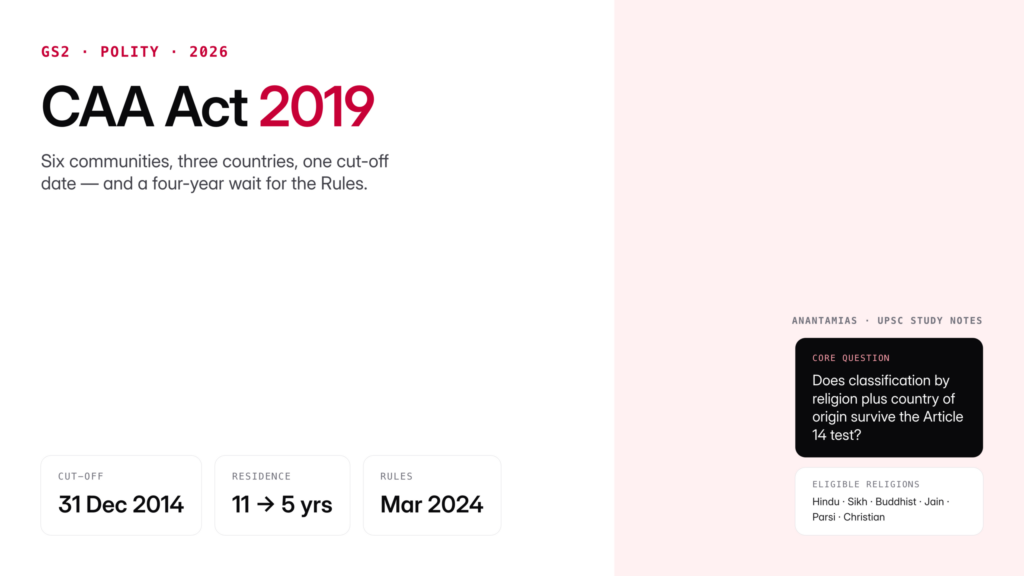
The Citizenship (Amendment) Act, 2019, commonly called the CAA, is one of the most debated federal laws of post-Emergency India. Passed by Parliament on 11 December 2019 and notified on 12 December 2019, it amends the Citizenship Act, 1955 to offer a fast-track to Indian citizenship for Hindu, Sikh, Buddhist, Jain, Parsi and Christian migrants who entered India from Afghanistan, Bangladesh or Pakistan on or before 31 December 2014. The CAA Rules, 2024, notified on 11 March 2024, finally operationalised the law after a four-year delay, triggering renewed debate.
For UPSC aspirants, the CAA is a set-piece topic. It tests Articles 14 and 21 doctrine, the federal question through Kerala and West Bengal resolutions, the India-Bangladesh diplomatic arc, and the linkage with the National Register of Citizens. This note breaks down the law, the rules, the litigation, the global precedents and the enduring political questions.
Quick Facts at a Glance
| Particular | Detail |
|---|---|
| Full name | Citizenship (Amendment) Act, 2019 |
| Parent Act | Citizenship Act, 1955 |
| Passed by Lok Sabha | 9 December 2019 |
| Passed by Rajya Sabha | 11 December 2019 |
| Presidential assent | 12 December 2019 |
| CAA Rules notified | 11 March 2024 |
| Cut-off date | 31 December 2014 |
| Eligible countries | Afghanistan, Bangladesh, Pakistan |
| Eligible communities | Hindu, Sikh, Buddhist, Jain, Parsi, Christian |
| Excluded community | Muslim |
| Reduction in residence requirement | 11 years → 5 years |
| Portal for application | indiancitizenshiponline.nic.in |
| Lead challenger in SC | Indian Union Muslim League (IUML) & others |
| Total petitions in SC | 200+ |
Background and Historical Context
Indian citizenship is governed by Articles 5 to 11 of the Constitution and the Citizenship Act, 1955. The 1955 Act recognises five modes of acquiring citizenship: birth, descent, registration, naturalisation and incorporation of territory. Naturalisation ordinarily requires 11 years of residence in India, a good-character certification and renunciation of prior citizenship.
From the 1970s, successive governments confronted the problem of undocumented migrants, especially from East Pakistan and later Bangladesh after the 1971 war. The Assam Accord of 1985, signed after the six-year anti-foreigner agitation led by the AASU, fixed the cut-off date of 24 March 1971 for inclusion in the Assam voter rolls and led to Section 6A of the 1955 Act. The Illegal Migrants (Determination by Tribunals) Act, 1983 was struck down by the Supreme Court in Sarbananda Sonowal v Union of India (2005) for making it too difficult to identify illegal migrants.
A parallel track emerged for religious minorities fleeing persecution in neighbouring Islamic states. In 2015 and 2016, the NDA government amended the Passport (Entry into India) Rules, 1920 and Foreigners Order, 1948 to exempt Hindu, Sikh, Buddhist, Jain, Parsi and Christian migrants from the three countries, provided they arrived before 31 December 2014. The CAA 2019 built on these exemptions and created a statutory route to citizenship for the same class, cutting the residence requirement from 11 to 5 years for them.
The Bill became law after bitter debates. Mass protests erupted at Shaheen Bagh in Delhi, at Jamia Millia Islamia and Aligarh Muslim University, and in multiple Northeastern states though for different reasons. In the Northeast, protesters feared demographic change; elsewhere, critics argued the law violated the secular basis of the Constitution by excluding Muslims.
Key Provisions of the CAA
Section 2: Definition of Illegal Migrant
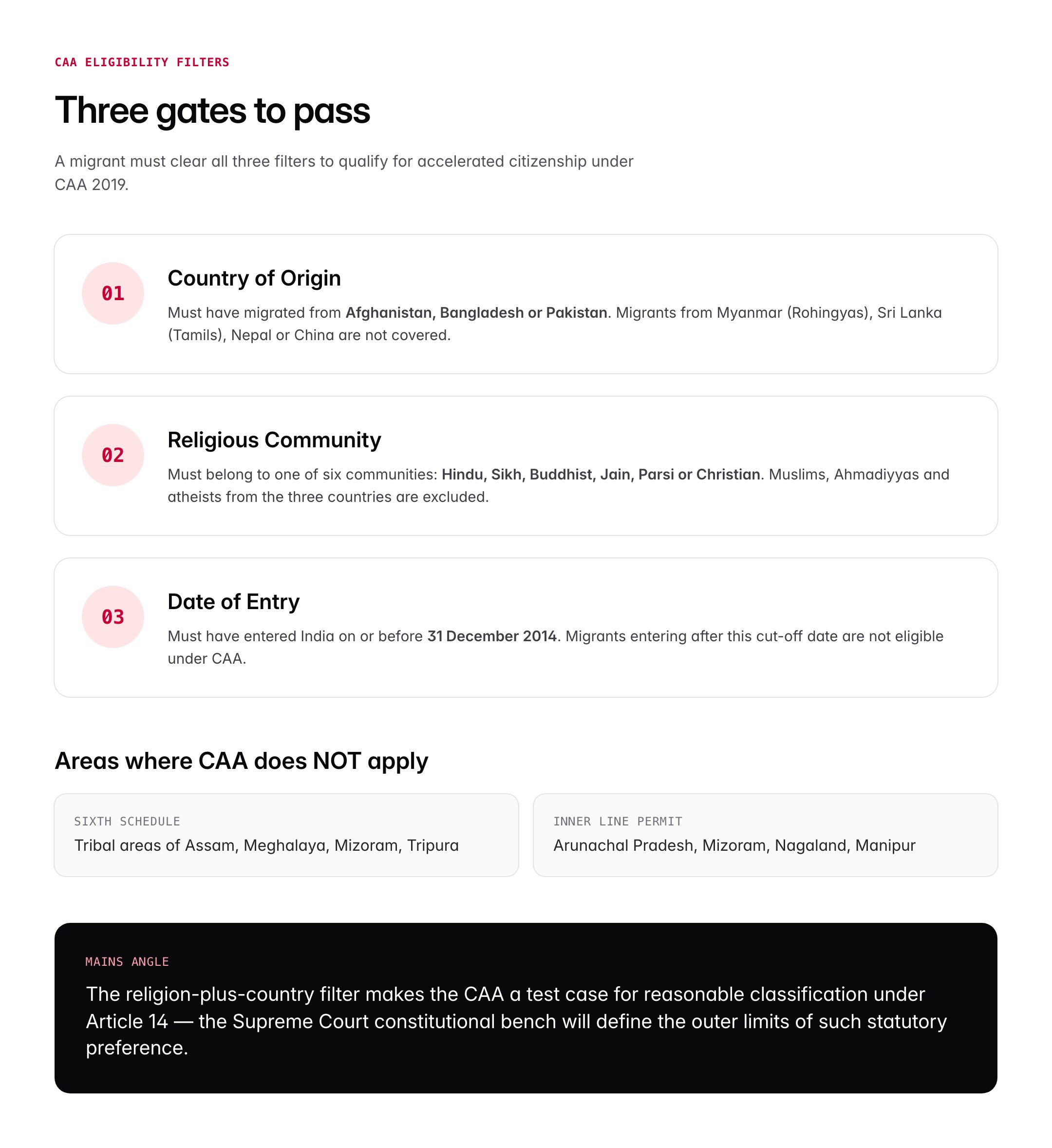
The CAA inserts a proviso in Section 2(1)(b) of the 1955 Act. Any person belonging to Hindu, Sikh, Buddhist, Jain, Parsi or Christian community from Afghanistan, Bangladesh or Pakistan, who entered India on or before 31 December 2014 and has been exempted by the government from the Foreigners Act, 1946 or the Passport (Entry into India) Act, 1920, shall not be treated as an illegal migrant.
Section 6B: Accelerated Citizenship by Registration or Naturalisation
A new Section 6B permits eligible migrants to apply for citizenship by registration under Section 5 or naturalisation under Section 6, with the aggregate residence requirement reduced to five years from the earlier 11. The date of citizenship, once granted, is deemed to be the date of entry into India.
Section 6B(4): Exemption for Northeast
The CAA does not apply to:
- Tribal areas of Assam, Meghalaya, Mizoram and Tripura included in the Sixth Schedule of the Constitution.
- The areas covered under the Inner Line Permit regime under the Bengal Eastern Frontier Regulation, 1873, namely Arunachal Pradesh, Mizoram, Nagaland and Manipur (ILP extended to Manipur in 2019).
Section 7D: Cancellation of Overseas Citizen of India (OCI)
The CAA broadens the grounds for OCI cancellation, adding violation of any law that carries at least a two-year imprisonment term. Critics argue this gives the Centre wide discretion over diaspora status.
Other Safeguards
- Applications under the CAA do not affect pending proceedings under the Foreigners Act, 1946.
- Migrants are entitled to the same rights and obligations as other citizens from the date of entry.
- Documentary proof requirements were clarified only in the 2024 Rules.
The CAA Rules, 2024
Notified on 11 March 2024, more than four years after the parent Act, the CAA Rules create a fully digital application process through indiancitizenshiponline.nic.in. Applicants must:
- Submit nine categories of documents or provide an affidavit of identity if the document is unavailable.
- Obtain an eligibility certificate from a locally reputed community institution, confirming the applicant belongs to one of the six notified communities.
- Appear before an Empowered Committee headed by the Director of Census Operations in each state, with members from IB, Postal, Railway, State Home Department and FRRO.
- Collect citizenship electronically without the need for a physical oath in most cases.
Within the first three months of operation, the Ministry of Home Affairs reported that over 8,000 eligible migrants had been granted Indian citizenship under the CAA route.
Significance for UPSC and General Knowledge
- Tests the doctrine of reasonable classification under Article 14 — whether religion plus country of origin can form the basis of a valid class.
- Central to understanding Indian citizenship jurisprudence: Articles 5 to 11, Sections 3 to 9 of the 1955 Act, and the landmark Assam case Assam Sanmilita Mahasangha v Union of India.
- Tests cooperative federalism as multiple states passed resolutions against CAA implementation.
- Offers a case study in judicial deference vs intervention — the Supreme Court has issued notices but not stayed the Act.
- Connects to India’s neighbourhood policy with Bangladesh and Afghanistan, especially after the 2021 Taliban takeover of Kabul.
- Tests the link between CAA and NRC that drove much of the 2019-20 street protest.
Detailed Analysis: Constitutional and Political Controversies
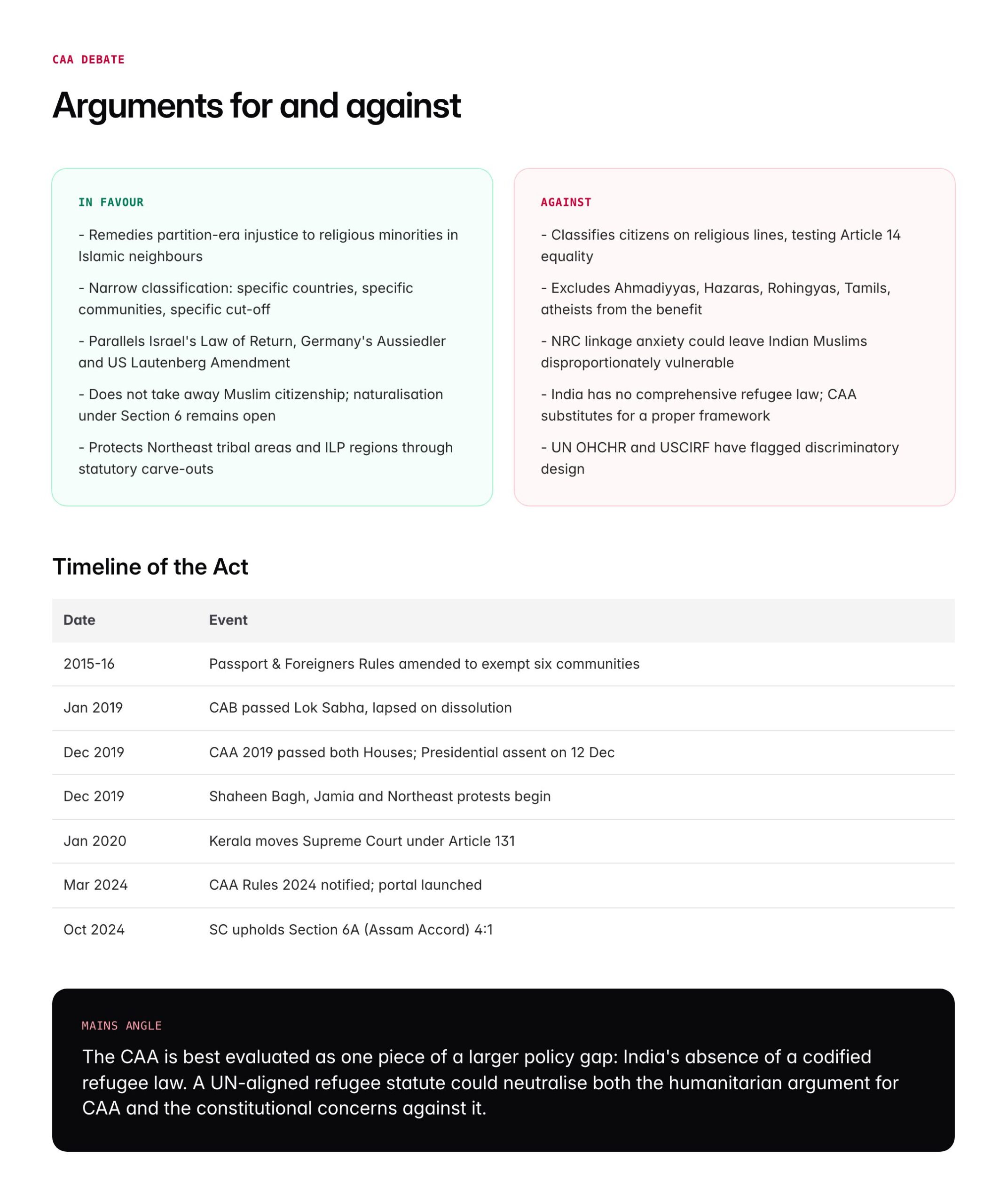
The core constitutional challenge pits the CAA against Article 14 equality. The law classifies prospective citizens on two axes simultaneously: religion and country of origin. Opponents, led by the Indian Union Muslim League in the Supreme Court, argue this is manifestly arbitrary because it excludes persecuted minorities from neighbouring states such as Ahmadiyyas in Pakistan, Rohingyas from Myanmar, Tamils from Sri Lanka and atheists from Bangladesh, while including Christians who face less persecution than the excluded groups.
The government’s defence rests on the argument that the CAA is narrow remedial legislation for a specific historical injustice: partition and its aftermath in the three neighbouring Islamic states. It contends that Muslims are not persecuted on religious grounds in these majority-Muslim states and that the classification therefore has a rational nexus with the object.
The second axis of controversy is the linkage with the NRC. A nationwide National Register of Citizens, combined with the CAA, would, critics argue, leave many Indian Muslims stateless if they cannot produce documents, while non-Muslims excluded from the NRC could re-enter through the CAA route. The Union government has since clarified that there is no plan for a nationwide NRC, and the Assam NRC process remains confined to that state.
Federal resistance has been stark. The Kerala Assembly was the first to pass a resolution against CAA in December 2019, followed by West Bengal, Rajasthan, Punjab, Madhya Pradesh and Telangana. Kerala also moved the Supreme Court under Article 131 questioning the Act’s constitutionality. Northeastern states like Assam and Tripura saw unique protest dynamics: here, the concern was not religious exclusion but the arrival of any new entrants, which could dilute indigenous culture and land rights.
Internationally, the UN Office of the High Commissioner for Human Rights called the Act “fundamentally discriminatory”, while the United States Commission on International Religious Freedom recommended sanctions. India pushed back, treating the matter as a sovereign policy question.
Comparative Perspective: Ancestry and Refuge Laws Globally
| Country | Law / Provision | Basis of Preference | Comparable Feature |
|---|---|---|---|
| Israel | Law of Return, 1950 | Jewish descent | Ancestry-based citizenship |
| Germany | Grundgesetz Article 116 | Ethnic Germans (Aussiedler) | Post-war ethnic return |
| Spain | 2015 Sephardic Citizenship Law | Jewish ancestors expelled in 1492 | Historical restitution |
| Hungary | 2010 Simplified Naturalisation | Ethnic Hungarians abroad | Ancestry-based fast-track |
| USA | Lautenberg Amendment, 1990 | Specific persecuted minorities | Country-of-origin presumption |
| India | CAA, 2019 | Six religions + three countries | Religion + country restriction |
India’s CAA resembles the Lautenberg Amendment in its country-specific structure but differs by naming religions in statute rather than in subordinate policy. Critics argue this elevates the religious criterion to a constitutional concern.
Challenges and Criticisms
The CAA has faced four sustained criticisms. First, the religious filter departs from the general Indian tradition of religion-neutral citizenship criteria. Second, the exclusion of specific persecuted groups — Ahmadiyyas, Hazaras, Rohingyas, Sri Lankan Tamils — undermines the law’s humanitarian framing. Third, the linkage anxiety with NRC, even if politically disavowed, has not been legally laid to rest. Fourth, the federal and Northeast concerns about indigenous populations and land rights remain partially addressed only through Sixth Schedule and ILP carve-outs.
Supporters answer that democracies regularly offer differentiated citizenship to specific groups, citing the Law of Return and Germany’s Aussiedler policy. They argue that 2014 as a cut-off and the focus on three countries creates a legally defensible narrow class. The four-year delay in notifying the Rules, however, made the law’s implementation politically combustible and kept the topic on Supreme Court dockets, with over 200 petitions still pending.
Beyond law, the CAA highlights the challenge of drafting refugee policy in a country that has not signed the 1951 UN Refugee Convention. A comprehensive refugee law, repeatedly recommended by experts, could allow India to address groups excluded from the CAA without provoking a religion-based statute.
Prelims Pointers
- CAA 2019 amends the Citizenship Act, 1955.
- Cut-off date for migration: 31 December 2014.
- Six eligible communities: Hindu, Sikh, Buddhist, Jain, Parsi, Christian.
- Three eligible countries: Afghanistan, Bangladesh, Pakistan.
- Residence requirement for naturalisation reduced from 11 to 5 years.
- CAA does NOT apply to Sixth Schedule tribal areas and Inner Line Permit regions.
- CAA Rules notified on 11 March 2024.
- Application portal: indiancitizenshiponline.nic.in.
- Apex court on citizenship: IUML v Union of India (pending constitutional bench).
- Section 6A of the Citizenship Act, 1955 covers Assam Accord (1985) and was upheld 4:1 by the SC in October 2024.
- Citizenship provisions are in Articles 5 to 11 of the Indian Constitution.
- India is NOT a signatory to the 1951 UN Refugee Convention or its 1967 Protocol.
Mains Practice Questions
Question 1: “The Citizenship (Amendment) Act, 2019 raises fundamental questions about the constitutional morality of religion-neutral citizenship.” Critically examine.
- Explain the religion-plus-country classification and the Article 14 test of reasonable classification and rational nexus.
- Present criticisms regarding Ahmadiyyas, Rohingyas and Sri Lankan Tamils; contrast with the government’s neighbourhood argument.
- Suggest a comprehensive refugee law as a way to reconcile humanitarian obligations with constitutional morality.
Question 2: Discuss the federal tensions generated by the CAA 2019 and evaluate the constitutional mechanisms available to states to resist or shape central citizenship law.
- Cite state assembly resolutions, Article 131 Kerala suit, implementation challenges.
- Explain the constitutional distribution: Union List entry 17 (citizenship) versus state role in registering births and maintaining residence records.
- Argue for cooperative federalism tools: inter-state councils, GST-model consultation, state data protocols.
Conclusion
The CAA is neither the purely humanitarian measure its supporters describe nor the purely communal enactment its opponents fear. It is a narrow, country-specific, religion-specific statute that sits uneasily in a Constitution that promises religion-neutral citizenship. Its four-year delay in implementation and the pending Supreme Court challenges mean its full contours are still being drawn.
For UPSC aspirants, the CAA is a textbook example of how legal drafting, constitutional interpretation, federal politics and foreign policy converge in a single legislation. Master the text, the rules, the global comparators and the litigation map, and the CAA becomes a versatile hook for Prelims facts, Mains arguments and Essay themes on citizenship, identity and justice.
Frequently Asked Questions
What is the CAA Act?
The Citizenship (Amendment) Act, 2019 amends the Citizenship Act, 1955 to offer accelerated Indian citizenship to Hindu, Sikh, Buddhist, Jain, Parsi and Christian migrants from Afghanistan, Bangladesh and Pakistan who entered India on or before 31 December 2014. It cuts the residence requirement for naturalisation from 11 years to 5 years for these groups.
Why is the CAA Act important for UPSC preparation?
The CAA is central to GS Paper 2 topics on citizenship, fundamental rights under Article 14, federal tensions, and India’s neighbourhood policy. It also appears in Prelims questions on Citizenship Act provisions, Sixth Schedule, Inner Line Permit areas and the CAA Rules 2024, making it a high-yield revision topic.
How is the CAA related to the National Register of Citizens (NRC)?
The CAA offers a citizenship route by including named communities, while the NRC identifies residents as citizens or non-citizens. Critics fear that combined, the two could disadvantage Muslims excluded from the NRC who cannot use the CAA. The government has stated there is no plan for a nationwide NRC; only Assam’s NRC remains operational.
Who is excluded from the CAA?
The CAA excludes Muslim migrants from the three named countries and also excludes other persecuted groups such as Ahmadiyyas from Pakistan, Hazaras from Afghanistan, Rohingyas from Myanmar, Sri Lankan Tamils and atheists from Bangladesh, because they either fall outside the six communities or outside the three source countries.
What are the CAA Rules 2024?
Notified on 11 March 2024, the CAA Rules operationalise the Act through a digital portal at indiancitizenshiponline.nic.in. Applicants submit documents or affidavits, obtain an eligibility certificate from a local community institution, and appear before an Empowered Committee led by the Director of Census Operations in each state.
Why does the CAA not apply to the Northeast?
Section 6B(4) exempts tribal areas listed in the Sixth Schedule of Assam, Meghalaya, Mizoram and Tripura, as well as Inner Line Permit regions of Arunachal Pradesh, Mizoram, Nagaland and Manipur. The objective is to protect indigenous demography, culture and land rights in these sensitive areas from demographic change.
What is the constitutional challenge to the CAA?
Over 200 petitions led by the Indian Union Muslim League argue the CAA violates Article 14 by classifying prospective citizens on the basis of religion, excluding persecuted Muslim minorities such as Ahmadiyyas and Rohingyas. The Supreme Court has issued notices but has not stayed the Act; a constitutional bench hearing is pending.
How does the CAA compare to similar laws abroad?
Israel’s Law of Return grants citizenship to people of Jewish descent, Germany extends it to ethnic Germans, Hungary to ethnic Hungarians and the US Lautenberg Amendment offered a preference for Soviet Jews and Christians. India’s CAA is distinctive in naming religions in statute and limiting eligibility to migrants from three specific countries, not diaspora in general.
Tell Google you want more of this.
Add Anantam IAS as a preferred sourceOne tap, and this site shows up more often in your own Top Stories, AI Overviews and AI Mode. Remove it any time.