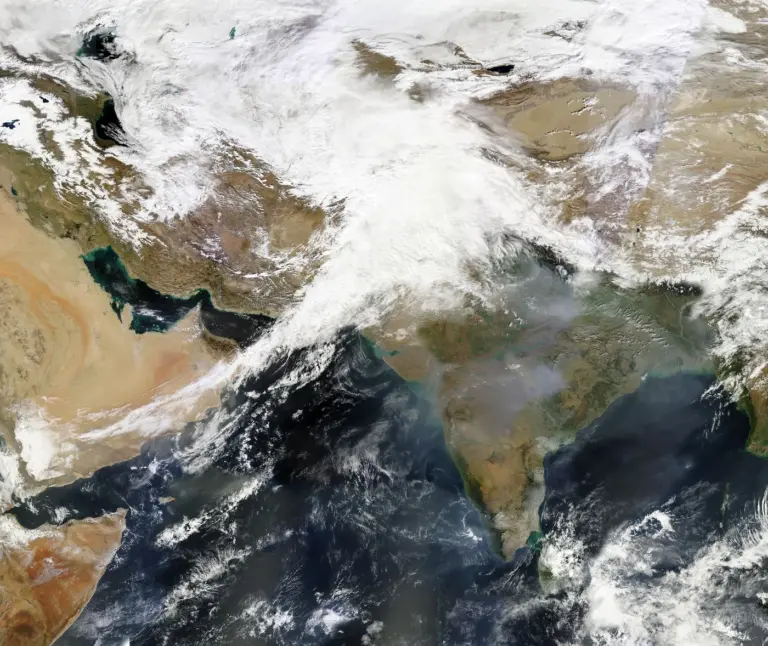
India has 25 major river basins and 103 sub-basins, and most of its rivers traverse more than one state. The sharing of these waters — for drinking, irrigation, industrial use and hydropower — is one of the most politically charged domains in Indian federalism. Disputes like Cauvery, Krishna, Ravi-Beas, Mahanadi and Mahadayi have produced riots, bandhs, Supreme Court references and decades of tribunal litigation.
For UPSC aspirants, interstate river water disputes are core GS II material, with strong links to federalism (GS II), environment (GS III) and ethics of resource sharing (essay).
Constitutional framework
Article 262 — special carve-out for water disputes
The general scheme of federal dispute resolution is judicial:
- Article 131 gives the Supreme Court original jurisdiction over disputes between states, or between the Union and states, where legal rights are at stake.
- However, Article 262 carves out an exception for inter-state river water disputes:
- Article 262(1) — Parliament may by law provide for the adjudication of any dispute regarding use, distribution or control of the waters of any inter-state river or river valley.
- Article 262(2) — Parliament may by law provide that neither the Supreme Court nor any other court shall exercise jurisdiction over any such dispute.
This gives Parliament a choice between political negotiation, quasi-judicial adjudication, or judicial adjudication.
Seventh Schedule entries
- Union List, Entry 56: Regulation and development of inter-state rivers and river valleys (to the extent Parliament declares by law).
- State List, Entry 17: Water — water supply, irrigation, canals, drainage, embankments, water storage and water power, subject to Entry 56 of the Union List.
Traditionally, consumptive use is local (irrigation, drinking water) and hence with states. Regulation of an inter-state river can be taken over by the Union through a declaratory law — which would denude states of Entry 17 powers in that river basin.
Why Article 262? The Constituent Assembly's choice
The Constituent Assembly faced a political vs judicial dilemma:
- Political negotiation preserves federalism but risks gridlock when parties diverge.
- Pure judicial adjudication (Article 131) is slow and inflexible for dynamic water resources.
- The compromise: Parliament can set up quasi-judicial tribunals outside regular courts, specifically for water disputes.
The rationale was that democratically elected governments at the Centre and states would find pure Union mediation politically untenable, and a specialised forum could combine negotiation with expertise-based adjudication.
The legal architecture
River Boards Act, 1956
- Enacted under Entry 56 of the Union List.
- Envisaged River Boards for the regulation and development of inter-state rivers.
- Has never been effectively used — no board was set up under this Act.
Inter-State River Water Disputes Act, 1956 (ISRWDA)
The more consequential statute. It:
- Defines "water disputes" (Section 2).
- Excludes the Supreme Court's jurisdiction in a water dispute.
- Empowers the Union government to constitute tribunals when a dispute cannot be settled by negotiation.
- Section 5: Tribunal submits its report to the Union government.
- Section 6: The Union government shall publish the decision in the Official Gazette; the decision is then final and binding on the parties.
How the tribunal process works
- A state perceives a dispute or its likelihood.
- The state requests the Union to refer the dispute to a tribunal.
- The Union government, if of the opinion that negotiation cannot settle it, constitutes a tribunal.
- 2002 amendment: Tribunal must be constituted within one year of receipt of request.
- The tribunal submits its report and decision; the Union publishes it in the Gazette.
- The decision is final and binding.
Major tribunals constituted
| Tribunal | Year | States |
|---|---|---|
| Krishna Water Disputes Tribunal I | 1969 | Maharashtra, Karnataka, Andhra Pradesh |
| Godavari Water Disputes Tribunal | 1969 | Maharashtra, Karnataka, AP, MP, Odisha |
| Narmada Water Disputes Tribunal | 1969 | MP, Gujarat, Maharashtra, Rajasthan |
| Ravi and Beas Waters Tribunal | 1986 | Punjab, Haryana, Rajasthan |
| Cauvery Water Disputes Tribunal | 1990 | Karnataka, Kerala, Tamil Nadu, Puducherry |
| Krishna Water Disputes Tribunal II | 2004 | Maharashtra, Karnataka, AP, Telangana |
| Vansadhara Water Disputes Tribunal | 2010 | Andhra Pradesh, Odisha |
| Mahadayi Water Disputes Tribunal | 2010 | Goa, Karnataka, Maharashtra |
| Mahanadi Water Disputes Tribunal | 2018 | Odisha, Chhattisgarh |
Concerns with the current framework
No guiding principles
- ISRWDA does not lay down principles that tribunals must apply (equitable apportionment, Helsinki Rules, prior use, riparian rights). Each tribunal develops its own methodology.
Supreme Court's bar on jurisdiction
- On water dispute matters, the SC jurisdiction is barred.
- But the Court has carved out exceptions — it can hear matters where the issue is not about use, distribution or control (e.g., interpretation of an award, enforcement, constitutional or legal questions).
- Locus standi: Only states may raise "water disputes". Private groups cannot, except through ancillary issues like right to water under Article 21.
Enforcement challenges
- Central and state governments often treat tribunals as less authoritative than the Supreme Court.
- Contempt powers are limited.
- The Supreme Court, armed with contempt jurisdiction, is more effective in compelling compliance on politically charged matters.
Post-award litigation
- Article 136 grants Special Leave to the Supreme Court — appeals from tribunal awards have reached SC despite Article 262.
- Enforcement disputes are maintainable before the Supreme Court as they do not constitute a fresh "water dispute".
- In State of Tamil Nadu v State of Karnataka and the Cauvery case, the SC has examined constitutional and legal issues arising from awards.
Delays
- Delays begin at the constitution stage — when the Centre decides whether negotiation has failed.
- Publication delays — awards become binding only upon publication in the Gazette.
- Cauvery took over 15 years; Krishna II has seen extensive post-award litigation.
The ISRWD (Amendment) Bill, 2019
The Bill (still pending in Parliament) proposed:
- Single permanent tribunal with multiple benches for different disputes, replacing ad hoc tribunals.
- Dispute Resolution Committee (DRC) for pre-tribunal negotiated settlement, mandatory for one year.
- Fixed timelines: DRC to attempt settlement in one year; tribunal to give decision in two years, extendable by one year.
- Award effective from date of notification.
The Bill has seen concerns from states about over-centralisation and the political dominance of the Union in constituting the permanent tribunal.
Contemporary partisan politics
A recurring pattern:
- No Chief Minister can agree to give up a share of water in favour of a neighbouring state — the political backlash is immediate.
- Courts and tribunals have found that the exclusion of SC jurisdiction is only partial — the Court has intervened:
- Before the constitution of a tribunal.
- Against a tribunal's decision (on constitutional grounds).
- After an award, on implementation issues.
Latest developments (2024-26)
- Cauvery Water Management Authority (CWMA) continues to monitor water sharing; monsoon shortfalls regularly trigger SC intervention.
- Mahanadi Tribunal continues its adjudication with supplementary data hearings.
- Krishna II remains in final stages with Telangana and Andhra Pradesh disputing final apportionment.
- Updated context: The ISRWD Amendment Bill 2019 has not been passed; it continues to be part of the Union government’s reform agenda. Climate change is emerging as a new variable — reduced glacier melt, erratic monsoons and groundwater depletion are straining pre-existing allocations.
- The Supreme Court has been pushing for real-time data sharing through digital platforms — WRIS (Water Resources Information System) is being upgraded.
Way forward
- Codify guiding principles in the ISRWDA — equitable apportionment, environmental flows, prior use, riparian rights.
- Permanent tribunal as proposed in the 2019 Bill, with multiple benches.
- Time-bound adjudication with statutory deadlines.
- Data-driven decision making using IoT sensors, remote sensing and real-time WRIS.
- Climate-responsive revisiting of old awards.
- Capacity building of state water bureaucracies.
UPSC relevance
For Prelims, remember:
- Article 262 — water disputes adjudication.
- Article 131 — general federal dispute jurisdiction of SC.
- Entry 56 Union List, Entry 17 State List.
- ISRWDA 1956 and the River Boards Act 1956.
- Cauvery, Krishna, Ravi-Beas, Godavari, Narmada — flagship disputes.
For Mains:
- Critically examine the framework for resolving inter-state river water disputes in India.
- Evaluate the ISRWD (Amendment) Bill, 2019.
- How has the Supreme Court navigated the Article 262 bar on its jurisdiction?
In essays, water disputes are excellent for exploring the tension between federalism and national interest, the limits of adjudication, and climate-era water governance — all forward-looking UPSC themes.
Tell Google you want more of this.
Add Anantam IAS as a preferred sourceOne tap, and this site shows up more often in your own Top Stories, AI Overviews and AI Mode. Remove it any time.