Disclosure: this guide contains Amazon affiliate links. As an Amazon Associate, Anantam IAS earns from qualifying purchases — at no extra cost to you.
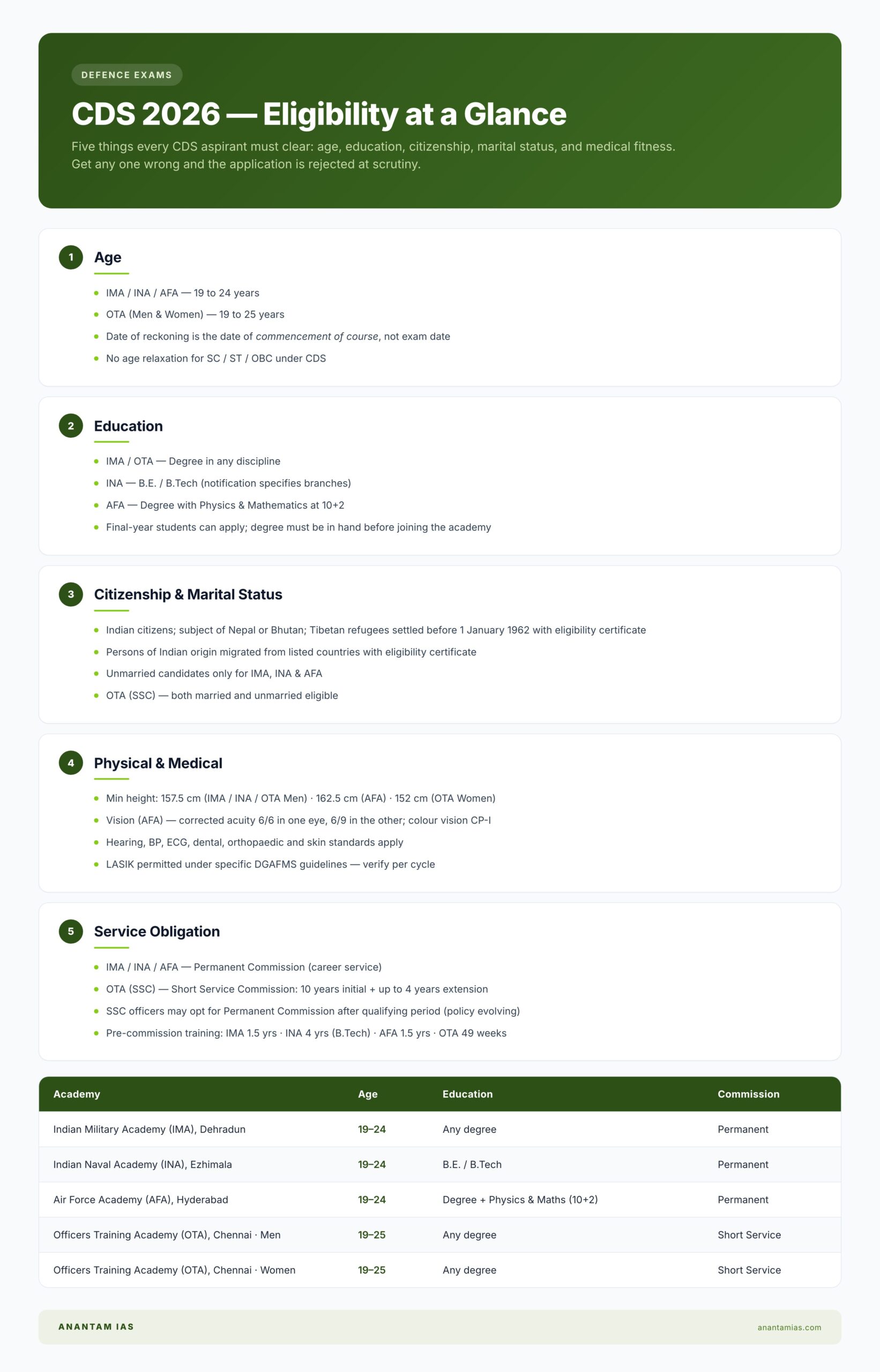
The CDS age limit 2026 depends on the academy and the course date. For CDS II 2026, IMA and INA accept unmarried men born from 1 July 2003 to 1 July 2008; OTA accepts eligible men and women born from 1 July 2002 to 1 July 2008.
For the Air Force Academy, the limit is 20 to 24 years on 1 July 2027, with a birth window of 1 July 2003 to 1 July 2007. A valid current DGCA commercial pilot licence can relax the AFA upper limit to 26, subject to the notification’s exact date window and marital-status conditions.
Use the official CDS II 2026 notification for the final date-of-birth, education, sex and marital-status rules. An age range alone is not enough because UPSC tests eligibility through exact dates.
CDS II 2026 Schedule and Course Dates
| Event | Official CDS II 2026 date |
|---|---|
| Notification | 20 May 2026 |
| Application deadline | 9 June 2026 |
| Written examination | 13 September 2026 |
| IMA, INA and AFA courses | Commence in July 2027 |
| OTA courses | Commence in October 2027 |
CDS II 2026 Age Limit and Date-of-Birth Windows
| Academy | Age rule | Eligible birth dates for CDS II 2026 |
|---|---|---|
| IMA | 19 to 24; unmarried men | 1 July 2003 to 1 July 2008 |
| INA | 19 to 24; unmarried men | 1 July 2003 to 1 July 2008 |
| AFA | 20 to 24 on 1 July 2027 | 1 July 2003 to 1 July 2007 |
| AFA with valid current CPL | Upper limit relaxed to 26 | 1 July 2001 to 1 July 2007 |
| OTA, men | 19 to 25; unmarried men | 1 July 2002 to 1 July 2008 |
| OTA, women | 19 to 25; notification-specific marital status | 1 July 2002 to 1 July 2008 |
Women applying to OTA may be unmarried, issueless widows who have not remarried, or issueless divorcees who have not remarried and possess the required divorce documents. Male divorcees and widowers are not treated as unmarried men for these courses.
Educational Qualification for CDS 2026
Clearing the age gate isn’t enough. Each academy has its own minimum qualification — and INA + AFA are stricter than IMA + OTA.
| Academy | Minimum Qualification |
|---|---|
| IMA (Indian Military Academy) | Degree from a recognised university — any discipline |
| INA (Indian Naval Academy) | B.E. / B.Tech in an Engineering branch specified in the notification |
| AFA (Air Force Academy) | Degree from a recognised university plus Physics & Mathematics at the 10+2 level |
| OTA (Men) | Degree from a recognised university — any discipline |
| OTA (Women — SSC Women Non-Technical) | Degree from a recognised university — any discipline |
INA engineering branches: Typically Mechanical, Electrical, Electronics, Computer Science, Telecommunications, Naval Architecture and a few specialised branches. Pure Science (B.Sc.) and Commerce graduates can’t apply for INA under CDS. Check the exact branch list in each notification — UPSC occasionally adds or excludes branches.
AFA requirement: The degree itself can be in any discipline — what matters is Physics and Mathematics at Class 12. A B.A. with Physics and Maths at 12th qualifies. A B.Sc. without Physics or Maths at the 10+2 level does not. The Class 12 board mark-sheet is checked at SSB.
Final-Year Students
Candidates in the final year of graduation are eligible to apply and sit the written exam. The completed degree must be available before the course commences — not at the application stage and not at SSB. A provisional certificate suffices at SSB; the original is verified before academy joining.
Common Eligibility Mistakes
- Wrong age reckoning: Calculating age on the exam date instead of the course commencement date. Read the notification line by line.
- Applying for INA without an engineering degree in an accepted branch. Final-year B.E. students must verify branch eligibility.
- Applying for AFA without Physics & Maths at 10+2 on the assumption that a B.Sc. degree compensates. It does not.
- Single application for multiple academies: You select preferences within one application — there isn’t a separate IMA application and OTA application for the same cycle.
- Ignoring marital status restrictions for IMA, INA and AFA (see below).
Citizenship and Nationality Requirements
CDS is open to:
- A citizen of India
- A subject of Nepal
- A subject of Bhutan
- A Tibetan refugee who came to India before 1 January 1962 with the intention of permanently settling, holding an eligibility certificate from the Government of India
- A person of Indian origin who has migrated from Pakistan, Burma, Sri Lanka, East African countries (Kenya, Uganda, Tanzania), Zambia, Malawi, Zaire, Ethiopia or Vietnam with the intention of permanently settling, holding an eligibility certificate
Categories two through five require a Government of India eligibility certificate at the application stage. Indian citizens don’t need this certificate — the application form’s nationality declaration suffices.
Marital Status
| Entry | Marital Status |
|---|---|
| IMA (Men) | Unmarried only |
| INA (Men) | Unmarried only |
| AFA (Men) | Unmarried only |
| OTA SSC — Men | Both married and unmarried eligible |
| OTA SSC — Women | Both married and unmarried eligible; widows / divorcees / issueless candidates included |
For IMA, INA and AFA, marriage during training is grounds for dismissal — the unmarried status must be maintained until the end of training. OTA SSC entries do not impose this restriction.
Type of Commission — Permanent vs Short Service
- IMA, INA, AFA — Permanent Commission. Career service until superannuation. Pension and full retirement benefits apply.
- OTA — Short Service Commission. Initial engagement of 10 years, extendable by 4 years. The 14-year cap historically did not count for pension; SSC officers may now opt for Permanent Commission after the qualifying period under evolving policy, particularly for the Army.
The Supreme Court’s Lt. Cdr. Annie Nagaraja v Union of India (2020) and subsequent rulings have progressively expanded Permanent Commission options for SSC women officers. If long service is the goal, choose academy preference accordingly — IMA/INA/AFA give it from day one, OTA requires an opt-in process later.
Vacancies — Typical Numbers per Cycle
| Academy | Indicative Vacancies | Notes |
|---|---|---|
| IMA | ~100 | Includes 13 vacancies reserved for NCC C-certificate holders |
| INA | ~32 | Specific engineering branches as per notification |
| AFA | ~32 | Includes vacancies through NCC Special Entry |
| OTA — Men (SSC) | ~169 | Largest CDS intake; widest eligibility |
| OTA — Women (SSC) | ~16 | Women Non-Technical entry |
Physical and Medical Standards
The medical board sits between SSB recommendation and academy joining. Civilian fitness certificates have no standing — DGAFMS standards are the only benchmark.
Height and Weight
| Entry | Minimum Height |
|---|---|
| IMA, INA, OTA (Men) | 157.5 cm |
| AFA | 162.5 cm (with corresponding leg length and sitting height limits) |
| OTA (Women) | 152 cm |
Weight is assessed against the AFMS height-weight tables and adjusted for age. Variations beyond ±10 % of the standard are flagged.
Vision Standards
AFA (Air Force): The strictest visual standards. Corrected acuity must be 6/6 in one eye and 6/9 in the other; colour vision CP-I; manifest myopia/hypermetropia within specified dioptre limits. Even with spectacles, uncorrected vision matters for cockpit-related selection tests.
IMA / INA / OTA: Less demanding than AFA but still strict. Specific limits on refractive error vary by entry. Service of arms has additional refractive limits applied during the SSB stage.
Refractive surgery (LASIK): Permitted under specific DGAFMS conditions — minimum age at surgery (typically 20), stable refraction post-op, no complications, time elapsed since surgery (commonly 12 months). The guidelines are revised periodically; verify against the active notification.
Other Medical Standards
- Hearing: Normal hearing in both ears; audiometry threshold within prescribed limits
- Cardiovascular: No history of cardiac conditions; resting BP and ECG within normal range
- Orthopaedic: No flat feet (Pes Planus Grade 3 or above), no varicose veins, scoliosis within limits
- Dental: Minimum 14 dental points scored; oral hygiene assessed
- Skin: Certain chronic conditions disqualify; tattoos beyond defined location/size restrictions can be disqualifying
Candidates declared unfit can request an Appeal Medical Board (AMB) and, if still aggrieved, a Review Medical Board (RMB). Most appeals fail — the original board’s call usually stands.
Gender Eligibility
| Academy | Men | Women |
|---|---|---|
| IMA | Yes | No |
| INA | Yes | No |
| AFA | Yes | No (separate entry through AFCAT) |
| OTA (SSC) | Yes | Yes |
Women aspirants targeting permanent commission can route through IMA via the NCC Special Entry for Women officers, AFA via AFCAT for the Air Force, and INA via the Navy’s separate notifications. CDS itself opens IMA/INA/AFA to men only.
How to prepare for the SSB interview →
Written Exam Pattern
| Paper | Subject | Duration | Maximum Marks |
|---|---|---|---|
| Paper I | English | 2 hours | 100 |
| Paper II | General Knowledge | 2 hours | 100 |
| Paper III | Elementary Mathematics | 2 hours | 100 |
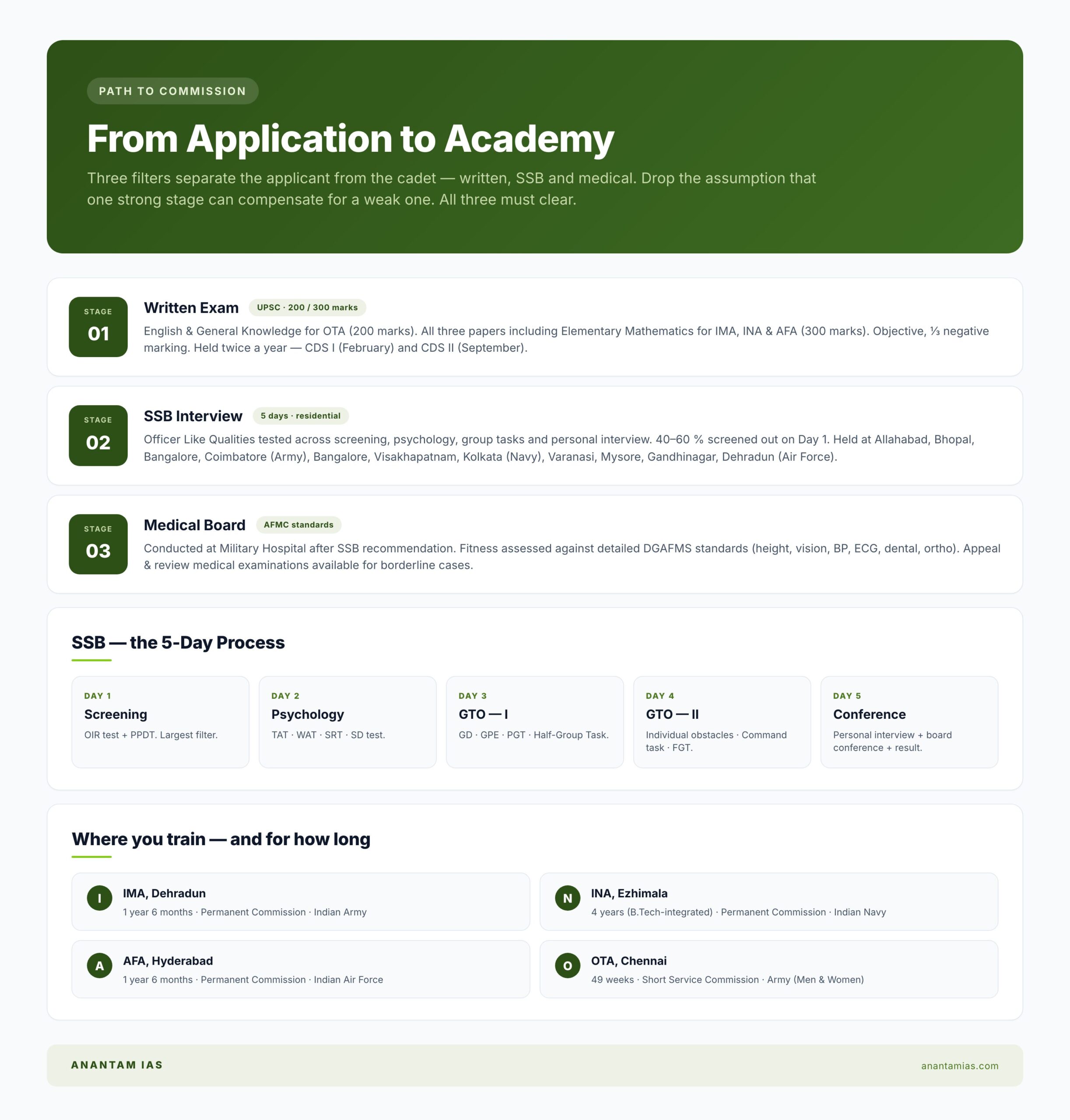
Paper III applies only to IMA, INA and AFA. OTA candidates sit Papers I and II — total 200 marks. All papers are objective; the exam is in English only.
Negative marking: ⅓ mark per wrong answer. A wrong guess costs 0.33 marks; a correct guess earns 1. Net expected value of a fully random guess across 4 options is +0.083 marks per question — slightly positive, but only if you can eliminate even one option. The well-disciplined strategy is to skip questions where you can’t eliminate at least one option.
SSB Interview — the Five-Day Filter
Written-exam qualifiers are called for the Service Selection Board interview. A five-day residential process across one of the SSB centres (Allahabad, Bhopal, Bangalore, Coimbatore for Army; Bangalore, Visakhapatnam, Kolkata for Navy; Varanasi, Mysore, Gandhinagar, Dehradun for Air Force).
Day 1 — Screening: Officer Intelligence Rating (OIR) and Picture Perception and Description Test (PPDT). 40–60 % of reporting candidates are screened out here. The single largest filter in the entire process.
Day 2 — Psychology: Thematic Apperception Test (TAT), Word Association Test (WAT), Situation Reaction Test (SRT), Self Description Test (SD). Tests internal stability under stress and projected personality.
Days 3–4 — Group Testing (GTO): Group Discussion, Group Planning Exercise, Progressive Group Task, Half Group Task, Individual Obstacles, Command Task, Final Group Task. Tests teamwork, decision-making under pressure, and observable Officer Like Qualities.
Day 5 — Personal Interview and Conference: The Interviewing Officer conducts a deep personal interview. The board then holds a conference where all assessors discuss every candidate. Final recommendation is communicated the same day.
The SSB assesses fifteen Officer Like Qualities — Effective Intelligence, Reasoning Ability, Organising Ability, Power of Expression, Social Adaptability, Cooperation, Sense of Responsibility, Initiative, Self-Confidence, Speed of Decision, Determination, Courage, Stamina, Loyalty and Liveliness. These are evaluated through behaviour, not declared traits. Coaching can polish presentation; the underlying qualities require sustained habit-building over months.
Merit and Allocation
SSB-recommended candidates who clear the medical board are placed in a merit list combining written and SSB marks. UPSC publishes the final merit list. Academy allocation follows merit-order preference: candidates list IMA/INA/AFA/OTA preferences during the application; merit positions are matched against academy vacancies. IMA typically fills earliest.
Salary, Allowances and Posting Trajectory
Pay during training is fixed (currently around ₹56,100 per month as stipend). On commission as Lieutenant / Sub-Lieutenant / Flying Officer, basic pay enters Level 10 of the 7th CPC Pay Matrix (₹56,100), with Military Service Pay of ₹15,500 added across the board. Dearness Allowance, House Rent Allowance / Government Quarters, Field Area Allowance, Travel Concession, ration and free medical cover apply.
Promotion to Captain (or equivalent) is time-bound at 2 years. Major at 6 years. Beyond that, promotion is selection-based. A Lt. Col. is typically reached at 13 years; subsequent ranks (Col., Brig., Major General) are competitive.
Posting trajectory is unpredictable — field postings to high-altitude, desert and counter-insurgency areas alternate with peace stations. Service life isn’t a 9-to-5 in any sense. Aspirants who treat the uniform as a “stable government job” misjudge the role entirely.
Preparation — A Realistic Framework

High School English Grammar & Composition — Wren & Martin (S. Chand)
- 384 pages, the regular edition, S. Chand
- Grammar first, then composition: précis, letters, reports, essays
- The exercises are the point; each rule is a page

Quantitative Aptitude — R.S. Aggarwal (Revised 2026–27)
- The standard drill book for arithmetic and data interpretation
- Graded exercises from basics to exam level
- Far more questions than a CSAT candidate needs
- 4–6 months of preparation suffices for OTA-only candidates with strong English and GK fundamentals. For IMA/INA/AFA, build in extra time for Mathematics revision.
- English: Grammar, vocabulary, comprehension, sentence improvement. Wren & Martin for fundamentals; daily reading of The Hindu editorial for usage.
- General Knowledge: History, Polity, Geography, Economy, Science & Tech, Current Affairs. PYQs suggest defence-specific GK gets ~20 % of the paper — make this a separate focus.
- Mathematics: Arithmetic, Algebra, Geometry, Mensuration, Statistics. NCERT Class 9–10 + R.S. Aggarwal for practice. Speed matters as much as accuracy.
- PYQs: Solve at least the last 8 years’ papers under timed conditions before the exam. Pattern recognition matters more than rote.
- SSB: Build observable OLQs over months — daily exercise, structured reading, group activities, public speaking. Last-week “SSB coaching” is too late.
Number of Attempts
CDS has no explicit attempt limit. The effective ceiling is the age window. With twice-yearly cycles, an aspirant entering at 19 gets 8–10 written-exam attempts before the IMA/INA/AFA upper bound. OTA candidates get two to four additional attempts thanks to the 25-year ceiling.
Treat each attempt as the only one. The cycle that you mentally write off as a “warm-up” is the cycle you’ll lose by a few marks.
CDS vs NDA — Which is Right for You?
| Parameter | NDA | CDS |
|---|---|---|
| Eligibility | 10+2 pass or appearing | Graduation complete or final-year |
| Age window | 16.5–19.5 years | 19–25 years, academy-specific |
| Training | 3 years at NDA + 1 year at academy | Academy-specific (49 weeks – 4 years) |
| Commission | Permanent | Permanent (IMA/INA/AFA), Short Service (OTA) |
| Vacancies per cycle | ~400 | ~350 |
NDA suits aspirants who decided on the uniform in Class 11. CDS opens up after graduation. Many candidates run both — NDA in Class 12, then shift to CDS if NDA doesn’t convert. The age windows don’t overlap, so it’s a sequential strategy, not a parallel one.
NDA Age Limit and Eligibility Criteria 2026 →
Frequently Asked Questions
What is the CDS exam age limit for 2026?
CDS upper age limit is 24 years for IMA, INA and AFA entries, and 25 years for OTA. The lower limit is 19 across all four. Age is reckoned on the date of commencement of the course, not the exam or notification date. The exact cut-off dates are specified in each cycle’s notification.
Is there any age relaxation for SC, ST or OBC under CDS?
No. Unlike civilian UPSC examinations, CDS does not provide age relaxation for SC, ST or OBC candidates. The age ceilings are absolute. Limited relaxations apply only to ex-servicemen under specific conditions defined in the OTA notification for that cycle.
Can women appear for the CDS exam?
Yes — through the OTA (Officers Training Academy) entry for the Short Service Commission Women Non-Technical course. The age window is 19–25 and any graduate degree qualifies. IMA, INA and AFA entries under CDS remain male-only; women aspirants targeting the Air Force can apply through AFCAT instead.
Do final-year students qualify for CDS?
Yes. Final-year graduation students can apply. Proof of degree completion is required before joining the academy, not at the time of application. UPSC accepts a provisional certificate at SSB; the final degree must be produced before the course commences.
Is there negative marking in the CDS written exam?
Yes. ⅓ mark is deducted per wrong answer. Multiple shaded options on the OMR are also treated as wrong, even if one of them is correct. OTA candidates write English and General Knowledge (200 marks total). IMA, INA and AFA candidates write all three papers including Elementary Mathematics (300 marks total).
How many vacancies does CDS typically have per cycle?
Vacancies vary cycle to cycle but typical numbers are roughly: IMA — 100, INA — 32, AFA — 32, OTA Men — 169, OTA Women — 16. Exact numbers are notified per cycle. Reservation as per government policy applies on these totals.
How many attempts can I make at the CDS exam?
There’s no explicit attempt limit. The effective cap is the age ceiling. With CDS held twice a year and an upper limit of 24 (IMA/INA/AFA), most aspirants get 8–10 attempts in the eligible window. OTA candidates with the higher 25-year ceiling get a couple more.
Does LASIK surgery disqualify me from the Air Force Academy?
Not absolutely. Current DGAFMS guidelines permit LASIK-corrected candidates under specific conditions — minimum age at surgery, residual prescription limits, stable visual acuity, and time elapsed since surgery. The exact thresholds are revised periodically. Verify against the DGAFMS notification for your specific cycle before assuming eligibility.
Tell Google you want more of this.
Add Anantam IAS as a preferred sourceOne tap, and this site shows up more often in your own Top Stories, AI Overviews and AI Mode. Remove it any time.