
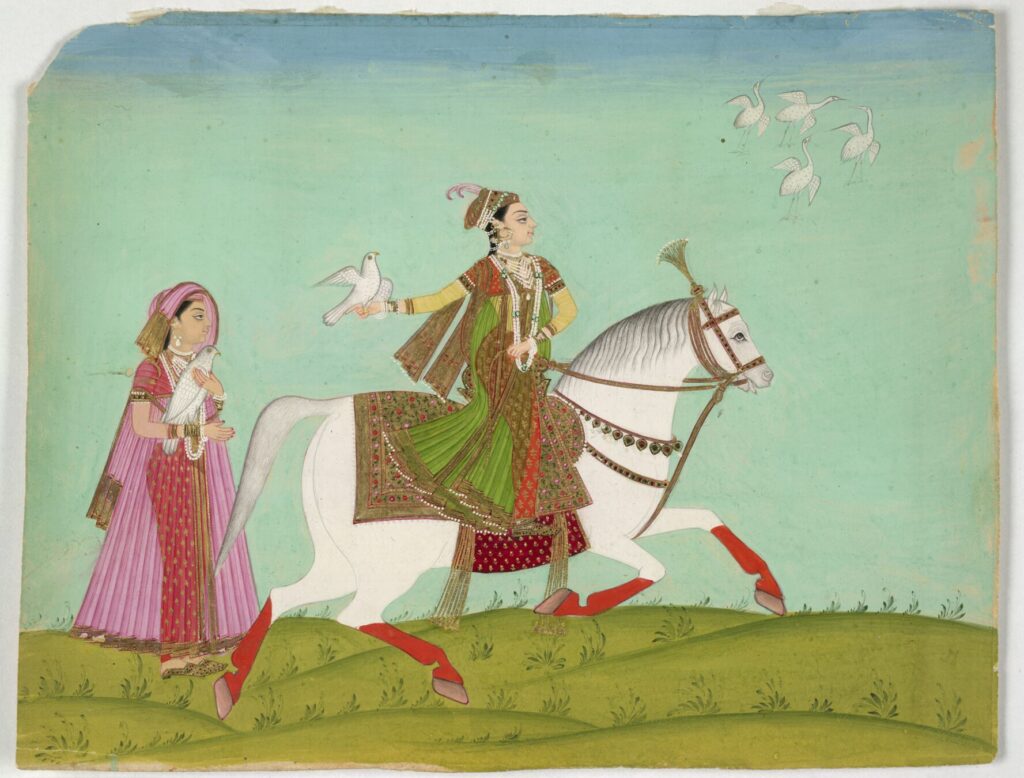
Chand Bibi (c. 1550–1599), also called Chand Sultana, was a regent of the Deccan Sultanates who defended Ahmednagar against Akbar’s Mughal army in the 1595–96 siege. Daughter of the Nizam Shahi sultan of Ahmednagar and widow of Ali Adil Shah I of Bijapur, she served as regent first at Bijapur (1580–84) and later at Ahmednagar, where she led the fort’s defence in person before ceding Berar to the Mughals by treaty. She was killed by her own nobles in 1599.
Chand Bibi defended the Ahmednagar fort against the Mughal army of Akbar in 1595, riding the walls in armour with a drawn sword while Mughal mines collapsed her bastions. She was forty-five, the widowed sister of one sultan and the daughter of another, and she had returned to Ahmednagar only the previous year to act as regent for her infant grand-nephew. The siege lasted four months. It ended with a treaty in which she ceded the province of Berar to Akbar’s empire and saved Ahmednagar. Four years later she was killed inside her own palace by her own nobles, on the rumour that she was negotiating with the Mughals a second time.
In the Deccan she is remembered as Chand Sultana, the most determined woman ruler of the late Nizam Shahi dynasty. In Mughal sources she is the figure who first showed Akbar that the Deccan would take a long time to swallow. In modern Indian history she is the link between the medieval Sultanate world and the rise of Maratha and later women rulers — a queen who fought a recognisably modern siege defence with cavalry, artillery, and diplomatic timing.
This article reads Chand Bibi with a UPSC History lens. It traces her Bijapur upbringing, her marriage to Ali Adil Shah I, her regency at Bijapur, her return to Ahmednagar, the 1595 siege, the cession of Berar, and her assassination in 1599.
Quick Facts
- Born: Around 1550, at Ahmednagar
- Father: Hussain Nizam Shah I, Sultan of Ahmednagar
- Mother: Khunza Humayun
- Brother: Murtaza Nizam Shah I, Sultan of Ahmednagar
- Husband: Ali Adil Shah I, Sultan of Bijapur (m. 1564, d. 1580)
- Brother-in-law: Ibrahim Adil Shah II of Bijapur (her ward as regent)
- Title: Chand Sultana / Chand Khatun
- Return to Ahmednagar: 1591
- Regency: 1595-1599, on behalf of grand-nephew Bahadur Nizam Shah
- Siege of Ahmednagar: December 1595 to March 1596
- Treaty: Cession of Berar to Akbar’s empire, March 1596
- Death: July 1599, killed by her own nobles inside Ahmednagar palace
- Final fall of Ahmednagar: August 1600, to Prince Daniyal’s army
The Deccan World Chand Bibi Was Born Into
Chand Bibi was born around 1550 into the senior household of the Nizam Shahi dynasty of Ahmednagar. Ahmednagar was one of five successor states that had emerged in the late fifteenth century from the breakup of the Bahmani Sultanate of Gulbarga. The other four were Bijapur (Adil Shahi), Golconda (Qutb Shahi), Berar (Imad Shahi), and Bidar (Barid Shahi). For a century these five states had fought each other, raided the Vijayanagara empire to the south, and intermarried at the elite level.
Chand Bibi’s father Hussain Nizam Shah I was one of the architects of the 1565 alliance that defeated Vijayanagara at the Battle of Talikota. Her brother Murtaza Nizam Shah I succeeded their father. Her diplomatic marriage in 1564 to Ali Adil Shah I, the sultan of neighbouring Bijapur, was part of the standard inter-Sultanate marriage policy meant to stabilise the Deccan against the Mughal threat to the north.
She was about fourteen at her marriage. She moved to Bijapur and lived at the Adil Shahi court for the next seventeen years.
Regency at Bijapur, 1580-1584
In April 1580 Ali Adil Shah I was assassinated by a court eunuch at Bijapur. He left no son. The succession passed to a nine-year-old nephew, Ibrahim Adil Shah II. Chand Bibi, by now thirty, was appointed regent.
Her Bijapur regency lasted about four years and was politically turbulent. She faced a coup attempt by Kamil Khan Deccani, a senior noble who tried to seize Bijapur in 1580. She had him imprisoned. She then dealt with a second coup, led by Hamid Khan, by escaping briefly from the Bijapur fort and returning with loyal troops to restore the boy king. She also handled an invasion attempt from Ahmednagar — that is, from her own brother Murtaza — and negotiated a settlement that preserved both states.
By 1584 the Bijapur court had stabilised, Ibrahim Adil Shah II was old enough to begin ruling under guidance, and Chand Bibi was effectively retired from active politics. She continued to live at Bijapur as the senior widow of the dynasty.
Return to Ahmednagar, 1591
In 1591 the Nizam Shahi succession at Ahmednagar collapsed into civil war. Murtaza Nizam Shah I had gone mad, been imprisoned by his son Miran Hussain, and murdered. Miran Hussain himself was killed by court factions. A series of pretenders fought for the throne. The Deccani, Habshi, and Foreign (largely Persian Shia) factions at the Ahmednagar court turned every succession into a small war.
By 1595 the contest had narrowed to a child claimant — Bahadur Nizam Shah, then about four years old, grand-nephew of Chand Bibi through her brother — supported by one faction; and a rival adult pretender supported by another. The faction backing the child called Chand Bibi back from Bijapur to act as regent. She accepted. The Ahmednagar throne, at fifty after Bijapur, was the family inheritance she had grown up around.
It is at this moment that her career intersects with Akbar’s Mughal expansion.
Akbar’s Deccan Campaign and the Siege of Ahmednagar
Akbar’s Mughal Empire had begun probing the Deccan in the early 1590s. After consolidating Sindh and Kandahar, Akbar dispatched his son Prince Murad, with the experienced general Abdur Rahim Khan-i-Khanan, on a campaign against the Deccan Sultanates in 1593-94. The pretext, as in many Mughal campaigns, was internal disorder — the very Ahmednagar succession crisis that had brought Chand Bibi back.
The Mughal army arrived before Ahmednagar in late December 1595. Estimates put it at around 40,000 troops with strong artillery. The Ahmednagar garrison was much smaller — possibly 8,000 to 10,000 inside the fort, with the field army of the Nizam Shahi dispersed across the kingdom.
Chand Bibi commanded the defence personally. Contemporary Persian sources — Ma’asir-i-Rahimi and Tarikh-i-Firishta among them — describe her riding the walls in armour, supervising the rebuilding of breaches at night, deploying counter-mines against Mughal sapping operations, and directing artillery fire from the bastions. The siege lasted roughly four months, into March 1596.
The two best-documented incidents are these.
The breach at the Berari bastion. Mughal sappers detonated a mine that brought down a section of the curtain wall. Mughal infantry surged into the breach. Chand Bibi, with a small reserve, led a counter-attack that drove them back and held the breach long enough for the breach to be improvised back to a defensible state during the night.
The negotiation through Abdur Rahim. Abdur Rahim Khan-i-Khanan, the Mughal commander, was himself a Deccani poet in Persian and a sophisticated diplomat. He opened back-channel negotiations with the regent. The Mughal army was running low on supplies, the monsoon was approaching, and an outright assault on the fort would have been costly. He offered terms.
The treaty signed in March 1596 had three core clauses. Ahmednagar would cede the province of Berar to the Mughals. The Mughals would recognise the child king Bahadur Nizam Shah and lift the siege. Chand Bibi would remain as regent.
Berar was a significant loss — a fertile cotton-growing province in the upper Godavari valley — but it was a price that saved the rest of the Nizam Shahi state. By the standards of late-sixteenth-century Mughal expansion, this was a remarkable diplomatic outcome for the besieged party.
Aftermath: The Difficult Three Years
The treaty of 1596 was not the end of the war. The cession of Berar was contested almost immediately by the Nizam Shahi nobility. A new Deccan alliance — Ahmednagar, Bijapur, and Golconda — fought a campaign against the Mughals in 1597 that ended inconclusively. The Mughals retained Berar; the Deccan retained the rest.
The Ahmednagar court fragmented again. Chand Bibi found herself isolated. The Deccani noble faction blamed her for ceding Berar. The Habshi faction, led by Sidi Yaqut, accused her of preparing to surrender Ahmednagar fort to the Mughals on Abdur Rahim’s promise of a safe pension.
In July 1599 the rumour was used as the pretext for her killing. A faction of Habshi guards entered her quarters at the Ahmednagar palace and murdered her. She was forty-nine.
Ahmednagar fell to the Mughal army of Prince Daniyal in August 1600. Bahadur Nizam Shah was captured. The Nizam Shahi state, in the form Chand Bibi had defended, ended within a year of her death. A reduced Nizam Shahi remnant fought on under Malik Ambar — the great Habshi statesman who had served at Chand Bibi’s court — for another three decades before being finally absorbed by Shah Jahan‘s Mughals in 1636.
Why Chand Bibi Matters for UPSC
For UPSC History, Chand Bibi sits at a precise hinge between medieval and early modern Indian politics.
The Deccan Sultanates
She is the most teachable case study of how the Deccan Sultanates resisted Mughal expansion. The 1596 treaty is the cleanest example of diplomacy buying time when battlefield victory was impossible. The internal factionalism of the Ahmednagar court — Deccani versus Habshi versus Foreign — is the standard frame for Deccani politics in this period.
Akbar’s southern campaigns
She is the human counterweight in the Akbar story. Akbar’s Deccan policy after 1591 is usually told from the Mughal side, with Abdur Rahim and Prince Murad as protagonists. Chand Bibi is the figure who shows what the Mughals were up against and explains why the conquest of the Deccan, finally completed by Aurangzeb a century later, took three more reigns.
Women rulers across the Indian dynasties
She extends the lineage of women rulers backwards from the eighteenth and nineteenth centuries. Read alongside Ahilyabai Holkar and Rani Laxmibai, she shows that the pattern of women taking command in late-dynasty crises is not a peculiarity of the late Maratha or 1857 era. It runs across the Sultanate world too. The earlier southern queen Rani Velu Nachiyar, the Karnataka heroine Kittur Rani Chennamma, the Awadh queen Begum Hazrat Mahal, and twentieth-century leaders like Sucheta Kripalani form a four-hundred-year continuum.
The Question of the “First Woman Defender”
A common UPSC essay question asks for examples of women who held sieges. Chand Bibi is the strongest single sixteenth-century Indian example. Her significance lies in three features that distinguish her case from later sieges.
She commanded the defence in person. She was visible on the walls. Mughal sources, hostile to her cause, still concede this.
She negotiated the treaty in person. The 1596 settlement is signed in her name. She used Abdur Rahim’s poetic and Deccani sympathies as leverage.
She was killed by her own side, not by the besieger. This is the part most often missed. Like many late-Sultanate women rulers, she was eventually destroyed not by the external enemy she had defeated but by the internal faction that found her terms inconvenient.
Architectural and Cultural Memory
The Ahmednagar fort still stands, with the bastions that Chand Bibi defended in 1595-96 partially preserved. The structure is currently administered by the Indian Army and is open to visitors on application. The grave traditionally identified as hers lies within the fort precincts; the attribution is contested and may belong to another Nizam Shahi figure.
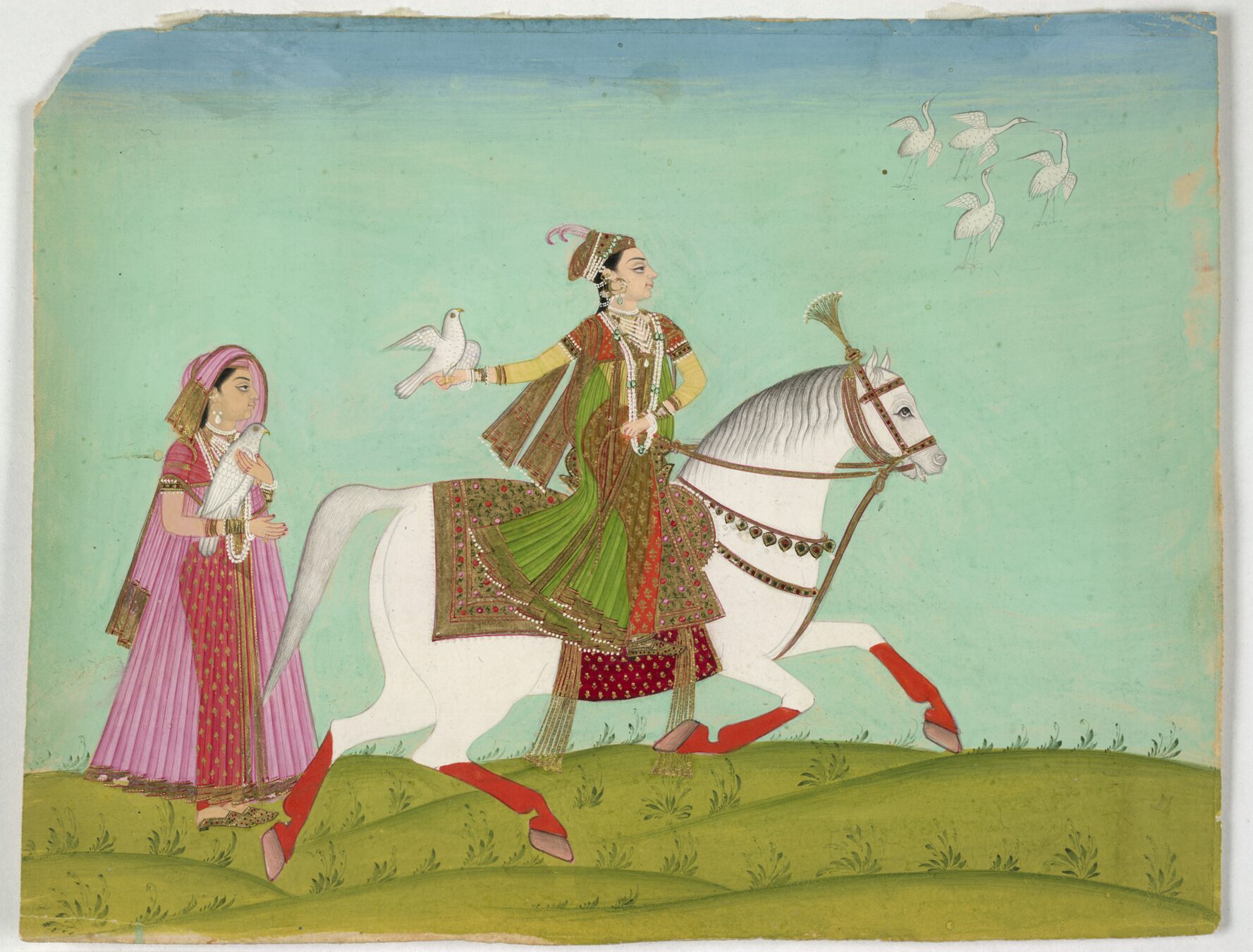
The Adil Shahi tomb complex at Bijapur contains the Bara Kaman, the unfinished mausoleum of her husband Ali Adil Shah I, where she lived for much of her adult life. A nineteenth-century Deccani painting in the Bijapur style, now in several museum collections, shows her hawking with a falcon — the most commonly reproduced image of her, often used as the cover illustration for textbook chapters on the Deccan Sultanates.
In Marathi and Urdu literature she appears as “Chand Sultana,” a figure of administrative competence and tragic loyalty. In Mughal court historiography she is treated with measured respect — the rare adversary of Akbar whose name and conduct are entered in the chronicles without sneer.
Frequently Asked Questions
Was Chand Bibi from Ahmednagar or Bijapur?
She was born in Ahmednagar around 1550, daughter of the Nizam Shahi sultan Hussain Nizam Shah I. She married into the Adil Shahi dynasty of Bijapur in 1564 and lived in Bijapur for most of her adult life. She returned to Ahmednagar in 1591 to serve as regent for her grand-nephew during the Nizam Shahi succession crisis.
Why did Chand Bibi cede Berar to Akbar?
The siege of Ahmednagar in 1595-96 was militarily lost in the long term. Mughal forces outnumbered her garrison roughly four to one and had superior artillery. A continued siege through the summer and monsoon of 1596 risked the loss of the fort itself. Ceding Berar — a province held by the related Imad Shahi line that the Nizam Shahis had recently absorbed — saved Ahmednagar city and the dynasty’s core territory. By the strategic standards of 1596, this was a successful negotiation.
Who killed Chand Bibi?
She was assassinated in July 1599 inside the Ahmednagar palace by a faction of her own nobles, primarily Habshi guards led by Sidi Yaqut. The trigger was a rumour, possibly planted, that she was negotiating a second cession of territory or a personal pension with the Mughals through Abdur Rahim. The killing was a court coup, not a Mughal action.
What does u0022Chand Sultanau0022 mean?
Chand means u0022moonu0022 in Persian and Urdu. Sultana is the feminine of sultan, u0022ruler.u0022 The combined form Chand Sultana is the honorific by which she is known in Deccani historiography, particularly in Marathi and Urdu sources. Chand Bibi, the form more familiar in English-language Indian history, simply means u0022Lady Chand.u0022
Did Chand Bibi actually wear armour during the siege?
Yes, according to multiple contemporary Persian-language sources including the Ma’asir-i-Rahimi and Firishta’s later Tarikh-i-Firishta. The image of the regent in armour on the walls of Ahmednagar is the single most reproduced visual motif of her life and has been confirmed by enough independent textual witnesses to be treated as historical rather than legendary.
What happened to Ahmednagar after Chand Bibi’s death?
Ahmednagar fort fell to Prince Daniyal’s Mughal army in August 1600, a year after her assassination. The child king Bahadur Nizam Shah was captured and imprisoned at Gwalior. A reduced Nizam Shahi state survived in the western Deccan under the regency of the Habshi statesman Malik Ambar, who had served at Chand Bibi’s court, until 1636, when Shah Jahan’s Mughals absorbed the last Nizam Shahi remnant.
Where does Chand Bibi fit in the UPSC Medieval History syllabus?
She belongs in three places: the Deccan Sultanates and their resistance to Mughal expansion; Akbar’s southern campaigns from 1591 onwards; and women rulers in medieval Indian history. She is a standard prelims fact for the date 1595-96 (siege of Ahmednagar) and a standard mains case study for Deccan-Mughal relations.
Is the painting of Chand Bibi hawking a contemporary portrait?
No. The most reproduced image of Chand Bibi — a Deccani painting showing her hawking with a falcon — was produced in the eighteenth or early nineteenth century, well after her lifetime. No verified contemporary portrait of her survives. Visual reconstructions of her appearance are therefore later imaginings rather than historical likenesses.
Tell Google you want more of this.
Add Anantam IAS as a preferred sourceOne tap, and this site shows up more often in your own Top Stories, AI Overviews and AI Mode. Remove it any time.





