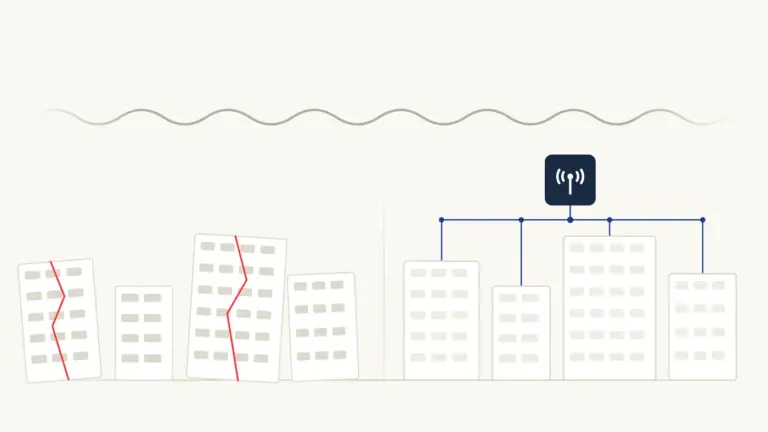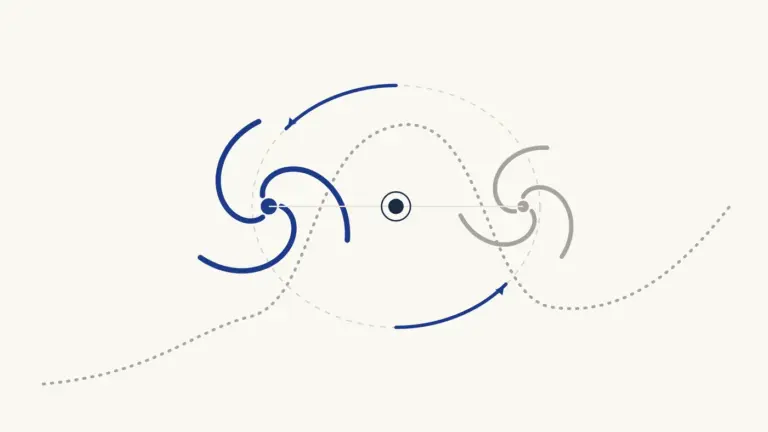
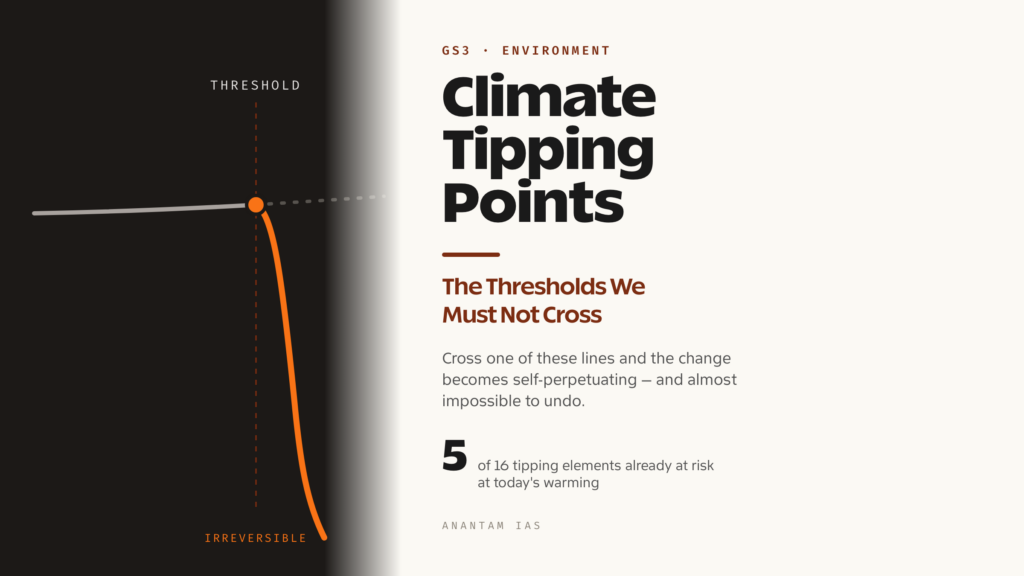
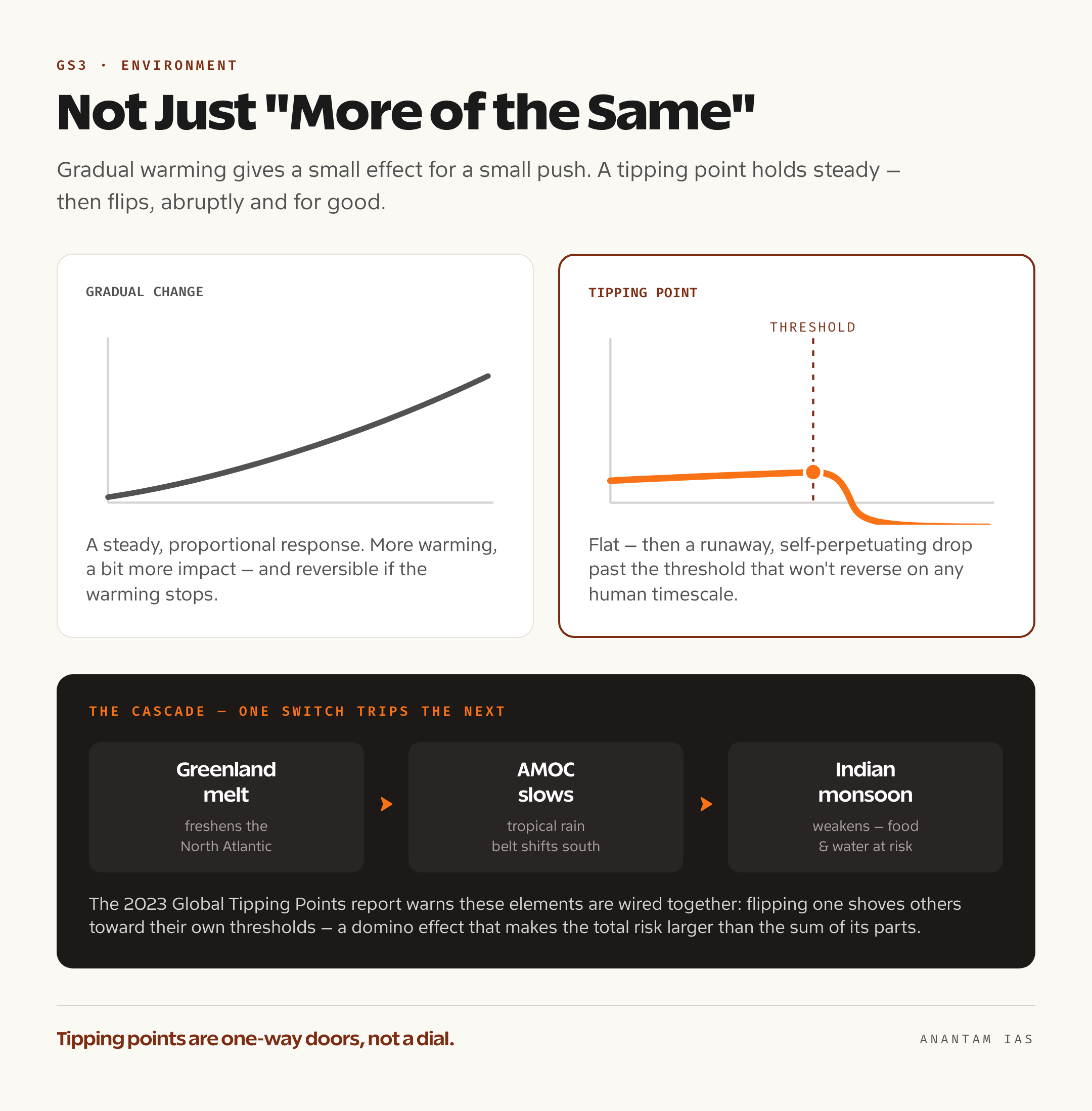
Most of what we expect from climate change is gradual. A little more warming each decade, seas creeping up by millimetres, a slightly fiercer heatwave each summer. The mental picture is a dimmer switch — turn up the heat slowly, and the damage rises slowly with it. Climate tipping points break that picture. They are the parts of the Earth system that don’t respond to warming gradually at all, but hold steady for a long time and then flip — crossing a threshold beyond which large, self-perpetuating and often irreversible change takes over, like a light switch that snaps from on to off and won’t snap back. Push the Greenland ice sheet past its threshold and it keeps melting even if you stop the warming. That is what makes these thresholds the most dangerous idea in climate science, and one of the most testable.
And the reason this has moved from a fringe worry to the centre of the debate is a string of recent science. A landmark 2022 paper in the journal Science, by David Armstrong McKay and colleagues, identified sixteen climate “tipping elements” and warned that five of them could be triggered at the warming the planet has already locked in — roughly 1.1 to 1.5°C above pre-industrial levels. A year later, the COP28 Global Tipping Points report, led by Professor Tim Lenton and drawing on more than 200 researchers, reached the same uncomfortable conclusion and added a chilling word: cascade. For a UPSC aspirant, this is the sharp end of the environment syllabus — it connects climate science, the Himalayas, the monsoon, India’s coasts and disaster management, and it rewards anyone who can explain non-linear change with a clear example and a few precise numbers.
What a Tipping Point Actually Is
Strip away the headlines and a tipping point rests on three ideas that you should be able to state plainly. The first is non-linear change. Most systems respond to a small push with a small effect; a tipping element responds to one extra push with a disproportionate, runaway response. The Earth’s climate has many such systems that stay stable across a wide band of temperatures and then, past a critical threshold, shift abruptly into a completely different state — ice sheet to open water, rainforest to savannah, flowing ocean current to stalled one.
The engine that drives this is the second idea: a self-reinforcing feedback loop. A feedback is a process that feeds back on itself. Take Arctic sea ice. Bright white ice reflects most of the sunlight that hits it; dark open ocean absorbs it. So when ice melts, the exposed water soaks up more heat, which melts more ice, which exposes more water — the warming amplifies itself. The same logic drives the others. As Amazon trees die, the forest recycles less of its own rainfall, the region dries, and more trees die. As permafrost thaws, microbes wake up and respire the carbon locked in the frozen soil, releasing greenhouse gases that warm the planet further and thaw more permafrost. Once the loop is strong enough to keep going on its own, the system has tipped — it no longer needs your push to keep moving.
The third idea is the one that should frighten you most: hysteresis, or irreversibility. Crossing the threshold is far easier than crossing back. To re-freeze a collapsed ice sheet or revive a dead coral reef, you would have to cool the planet well below the temperature at which it tipped — and hold it there for centuries. In practice that means a tipped system is lost on any timescale that matters to a human society. This is why the framing has shifted from “how much warming” to “which thresholds.” A world that warms 2°C and stops is one thing; a world that warms 2°C and trips three irreversible switches on the way is another thing entirely. Tipping points are the reason climate risk is not a smooth, manageable curve but a minefield with hidden lines you cannot see until you have crossed them.
The Major Tipping Elements
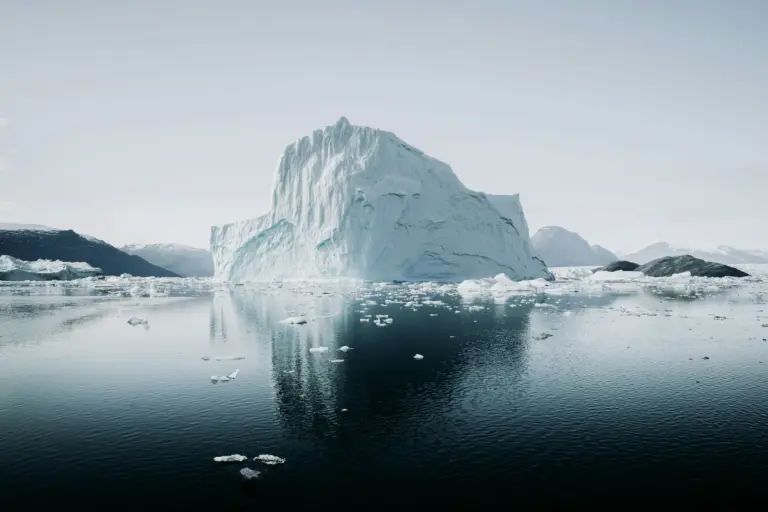
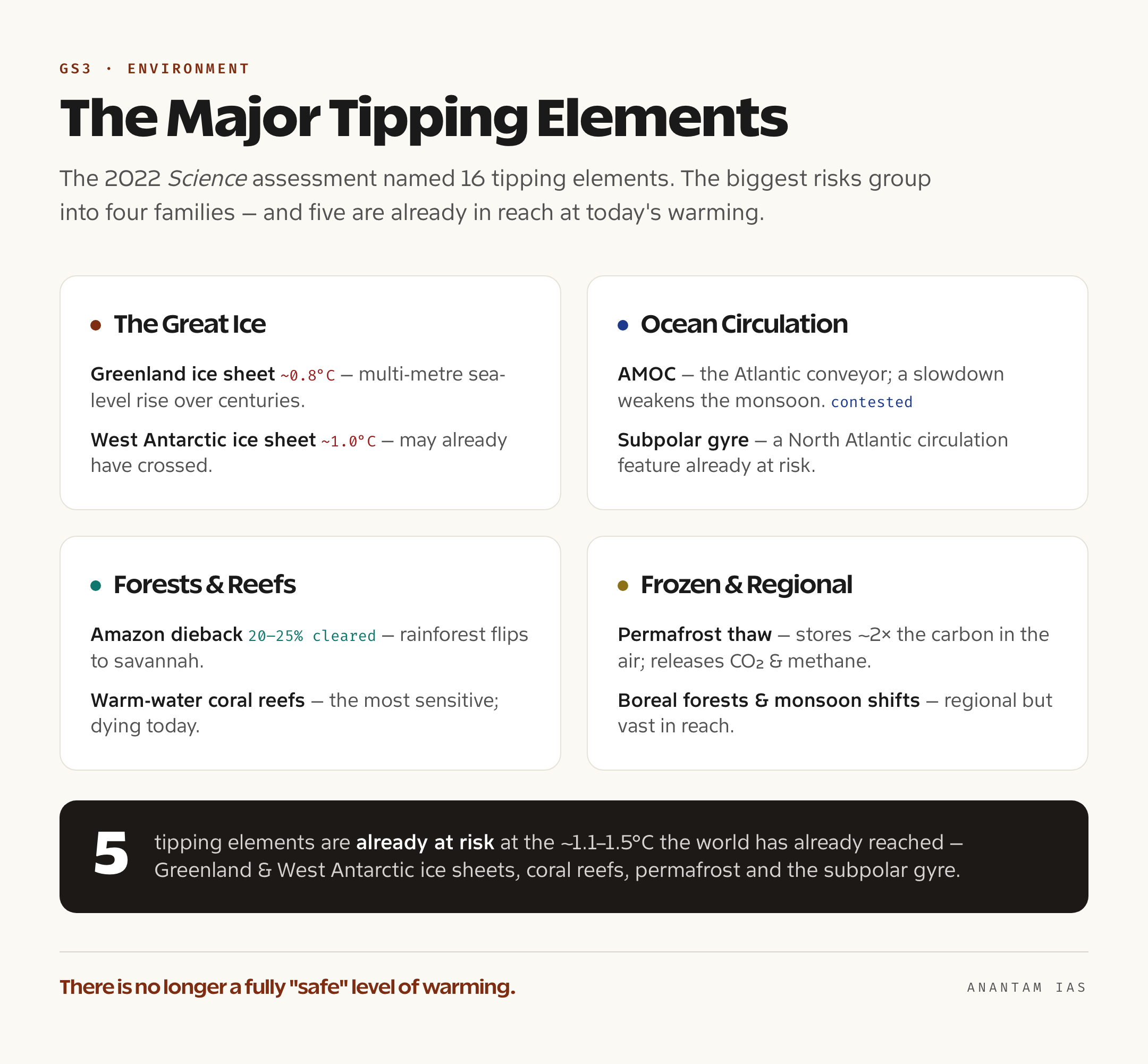
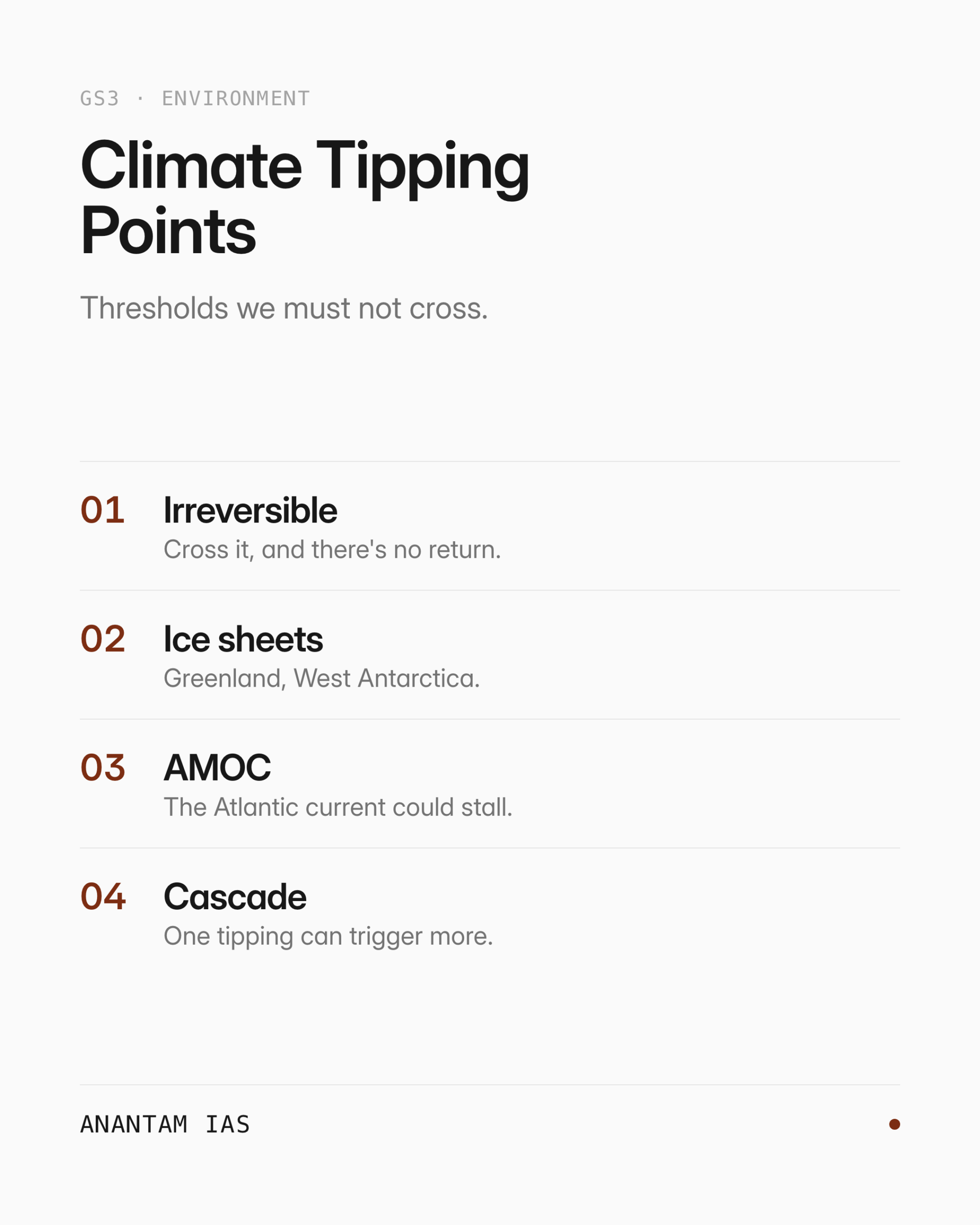
So which parts of the planet are the switches? The 2022 Science assessment names sixteen, but a handful carry most of the risk, and you can group them into four families. The first is the great ice. The Greenland ice sheet and the West Antarctic ice sheet are each enormous reservoirs of frozen freshwater, and each may tip at relatively low warming — the study put possible thresholds near 0.8°C for Greenland and 1.0°C for West Antarctica, both of which the planet has passed. Once committed to collapse, they would not vanish overnight, but their slow, unstoppable melt would raise global sea levels by several metres over centuries, redrawing every coastline on Earth.
The second family is the ocean circulation. The Atlantic Meridional Overturning Circulation, or AMOC, is the vast conveyor belt that carries warm tropical water north and keeps Europe far milder than its latitude deserves — the Gulf Stream is part of it. Meltwater pouring off Greenland is freshening and slowing this current, and a slowdown can become self-reinforcing. The science here is genuinely contested, which is itself worth knowing: a 2024 study using a physics-based early-warning signal concluded the AMOC is “on tipping course,” and in October 2024 forty-four scientists signed an open letter warning the risk has been underestimated, while several 2025 modelling studies argue a full collapse this century remains unlikely. A collapse would not bring a Hollywood ice age, but it would scramble rainfall belts worldwide — and, crucially for South Asia, weaken the monsoon.
The third family is the living forests and reefs. The Amazon rainforest is at risk of “dieback” — drying out and flipping from rainforest to degraded savannah. Roughly 15 per cent of it has already been cleared and more degraded, and scientists such as Carlos Nobre put the danger zone at around 20 to 25 per cent deforestation, beyond which the forest can no longer recycle enough of its own rain to survive. Warm-water coral reefs are the most sensitive of all, already dying off in mass bleaching events at today’s temperatures. The fourth family is the frozen and the regional: permafrost, which stores roughly twice as much carbon as the atmosphere and releases carbon dioxide and methane as it thaws; the boreal forests of the far north; and shifts in the great monsoon systems that water billions of people. Together these elements are not a distant list — five of them, the Global Tipping Points report concluded, are already at risk at the warming we have now.
The Science: Five Switches Already in Reach and the Risk of a Cascade
Here are the numbers that anchor the whole topic. The 2022 Science paper sorted its sixteen elements by the warming at which each becomes plausible. Five of them — the Greenland ice sheet, the West Antarctic ice sheet, warm-water coral reefs, abrupt permafrost thaw, and a circulation feature in the North Atlantic called the subpolar gyre — fall into the danger range at the roughly 1.1 to 1.5°C of warming the world has already reached. Stay inside the Paris Agreement’s 1.5°C and several more become “likely”; push toward 2.6°C and the paper finds thirteen of the sixteen become likely or possible. The blunt message is that there is no fully “safe” level of warming left — even at current temperatures, we are gambling with switches that may already be in reach. Observations even suggest parts of the West Antarctic ice sheet may have crossed their line already.
The 2023 Global Tipping Points report took this further and supplied the word the science had been circling: cascade. Tipping elements are not isolated. They are wired together, so that flipping one can shove others toward their own thresholds — a domino effect in the Earth system. The cleanest example runs straight through India’s weather. If the AMOC weakens, the tropical rain belt shifts south and the Indian monsoon weakens with it. Greenland melt feeds the AMOC slowdown; a dieback of the Amazon dumps carbon that warms the whole planet; thawing permafrost does the same. Each switch makes the next one easier to trip. This is why scientists treat the tipping-point risk as larger than the sum of its parts — the danger is not one catastrophe but a chain of them, each lowering the threshold for the rest.
It is worth being honest about the uncertainty, because examiners reward balance. The exact temperature thresholds carry wide error bars, the timescales range from years for coral to many centuries for the ice sheets, and serious scientists disagree — sharply, in the AMOC case. But the direction of travel is not in dispute. The 2022 and 2023 assessments did not invent new alarm; they tightened the estimates and concluded that the lines are closer than the older, 2008-era science assumed, when only nine elements were on the list and most were thought to need 3°C or more. The responsible reading is not “collapse is certain” but “the cost of overshooting 1.5°C is no longer a smooth, recoverable curve — it is a set of one-way doors.”
Why This Matters for India
No major country has more riding on these thresholds than India, because three of the most consequential tipping systems sit on or around its territory. Start with the Himalayas. The glaciers of the Hindu Kush Himalaya are the frozen water tower that feeds the Ganga, the Yamuna and the Brahmaputra — rivers on which hundreds of millions depend. As they retreat, the near-term risk is more meltwater and more glacial-lake outburst floods, the kind of sudden mountain disaster that devastated Uttarakhand and Sikkim in recent years; the long-term risk is the opposite — shrinking dry-season flows once the ice that feeds the rivers is gone. This is a textbook tipping behaviour: too much water first, then too little.
Then the monsoon. The South-West monsoon is driven partly by the temperature contrast between the warming Indian Ocean and the Himalayan landmass, which is exactly why it is sensitive to the larger tipping system. A weakening AMOC, by pulling the tropical rain belt southward, is one of the clearest pathways by which a far-off ocean current could disrupt the rains that feed Indian agriculture — and a monsoon that swings between failed years and flood years would hit food security, reservoirs and the rural economy harder than almost any other climate shock. You can read more in our explainer on the Indian monsoon and the broader picture in our guide to climate change.
And finally the coasts. The collapse of the Greenland and West Antarctic ice sheets is, in the long run, an Indian coastal-cities story: Mumbai, Kolkata, Chennai and Kochi are among the world’s most exposed urban areas to sea-level rise, and India’s roughly 11,000-kilometre coastline is home to a large share of its people and GDP. Regional projections already point to tens of centimetres of rise around Indian cities by 2050, with Kolkata worsened by land subsidence — and the ice-sheet tipping points are what turn that from a serious problem into a civilisational one over the following centuries. Put together, the Himalayas, the monsoon and the coasts mean India is not a bystander to the tipping-point debate. It is one of the places where the switches, if thrown, would be felt first and worst.
The Response: Staying Near 1.5°C and the Hope of Positive Tipping Points
If the threat is a set of one-way doors, the response is brutally simple to state: keep warming as close to 1.5°C as possible and stop overshooting, because every tenth of a degree changes which switches come within reach. That is the real reason the 1.5°C target is not an arbitrary diplomatic number — it is roughly the line below which most of the worst tipping points stay out of the “likely” zone. The same logic gives an extra urgency to net-zero pledges, to the work of the IPCC, and to the architecture of the Paris Agreement that you can study alongside our notes on the IPCC’s Sixth Assessment Report. Adaptation matters too — flood defences for coastal cities, early-warning systems for glacial-lake floods, climate-resilient agriculture for an erratic monsoon — but adaptation cannot save a tipped system, only buy time around its edges.
Here is the hopeful turn, and the 2023 report made it the heart of its message: tipping points cut both ways. The same self-reinforcing dynamics that make ice-sheet collapse so dangerous can be harnessed in human systems to drive change faster than anyone expects — these are positive tipping points. Once a clean technology gets cheaper than the dirty one it replaces, adoption can snowball. Solar power is the textbook case: global solar capacity in 2023 was already above 1,500 gigawatts, roughly three times what the International Energy Agency had projected for that year back in 2015. Electric vehicles hit a 15 per cent share of new-car sales in 2022, a milestone the IEA had not expected until 2030. Reach those tipping points in enough sectors — power, transport, steel, food — and emissions could fall in a cascade of their own, the mirror image of the dangerous one. The contest that defines the climate century, then, is a race between two kinds of tipping point: the destructive ones in the Earth system and the constructive ones in our economies. Which set of dominoes falls first is, to a meaningful degree, still a choice.
For Your Mains Answer
This is a high-value topic for GS Paper 3, which covers environment, conservation, climate change and disaster management; the India-specific impacts also link to GS Paper 1 physical geography (the monsoon, glaciers, ocean currents). It is tailor-made for the Essay paper on themes of irreversibility, intergenerational equity and the limits of growth. The skill examiners reward is the one this article uses: define non-linear change crisply, anchor it with one or two named tipping elements and exact figures, then bring it home to India.
How to Build the Answer
Open with the concept, not a list — define a tipping point as a threshold beyond which change becomes large, self-perpetuating and often irreversible, and contrast it with gradual warming. Then move in a chain: the three mechanisms (non-linear change, feedback loops, hysteresis), the major tipping elements grouped into ice sheets, ocean circulation, forests and reefs, and permafrost and monsoon, the recent science (five elements at risk at current warming; the cascade risk), the India angle (Himalayas, monsoon, coasts), and finally the response (staying near 1.5°C, plus positive tipping points). Close by judging the balance of risk and agency. That arc — define, mechanise, list, contextualise, evaluate — fits almost any tipping-point question.
Common Mistakes to Avoid
Don’t treat a tipping point as just “fast warming”; the defining features are self-perpetuation and irreversibility, not speed alone. Don’t claim AMOC collapse is certain or imminent — flag it as contested, with strong warnings on one side and stabilising-model studies on the other. Don’t confuse the number of elements (sixteen in the 2022 paper, up from nine in 2008) with the number already at risk (five at current warming). And don’t forget positive tipping points — leaving them out makes the answer one-sided and misses the report’s central, hopeful message.
A Compact Answer Spine
Tipping point = threshold past which change is large, self-perpetuating and often irreversible (non-linearity + feedback + hysteresis) → 2022 Science paper: 16 tipping elements; 5 already at risk at ~1.1-1.5°C (Greenland & West Antarctic ice sheets, coral reefs, permafrost, subpolar gyre) → 2023 Global Tipping Points report: risk of a cascade/domino effect; no safe warming level left → India: Himalayan glaciers (floods then scarcity), monsoon (AMOC-linked weakening), coasts (ice-sheet-driven sea-level rise on Mumbai, Kolkata, Chennai) → response: stay near 1.5°C, adapt, and trigger positive tipping points (solar above 1,500 GW; EVs at 15% in 2022) → verdict: a race between destructive and constructive tipping points.
Diagram or Flowchart Idea
Draw a simple curve that runs flat, then snaps sharply downward at a marked “threshold,” labelled to contrast gradual change with an abrupt tip — beside a small set of linked boxes (Greenland → AMOC → monsoon) with arrows showing the cascade. This two-part visual captures both non-linearity and the domino logic in seconds, and is quick to sketch under time pressure.
A Balanced-Conclusion Line
A line that lands the marks: “Climate tipping points turn warming from a manageable dial into a row of one-way doors — but the same self-reinforcing logic that makes them dangerous can be turned to our advantage in clean technology, making the next decade a race between the dominoes we fear and the ones we can engineer.”
How to Use Data Without Cramming
You need only four or five anchors, not a spreadsheet: sixteen tipping elements (2022 Science paper), five already at risk at today’s warming, the 1.5°C target as the broad safe line, roughly 20-25 per cent deforestation for Amazon dieback, and solar above 1,500 gigawatts as the positive-tipping example. Attribute them plainly — “as the 2023 Global Tipping Points report concluded” — rather than scattering numbers without a source.
Frequently Asked Questions
What is a climate tipping point in simple terms?
It is a threshold in some part of the climate system that, once crossed, causes large, self-perpetuating and often irreversible change — so the system keeps shifting even if the warming that pushed it stops. Unlike gradual warming, where a small push gives a small effect, a tipping element holds steady and then flips abruptly into a new state, like a switch snapping from on to off. The three features that define it are non-linear change, self-reinforcing feedback loops, and hysteresis, meaning it is far harder to reverse than to trigger.
Which climate tipping points are closest to being crossed?
The 2022 Science assessment and the 2023 Global Tipping Points report identify about five that are already at risk at the warming the world has reached, roughly 1.1 to 1.5°C: the Greenland ice sheet, the West Antarctic ice sheet, warm-water coral reefs, abrupt permafrost thaw, and a North Atlantic circulation feature called the subpolar gyre. Coral reefs are the most immediately visible, dying in mass bleaching events today, while the ice sheets would unfold over centuries.
Will the AMOC collapse, and what would it mean for India?
The science is genuinely contested. A 2024 study warned the Atlantic Meridional Overturning Circulation is “on tipping course” and dozens of scientists say the risk is underestimated, while several 2025 modelling studies argue a full collapse this century is unlikely. If it did weaken sharply, it would shift global rainfall belts and pull the tropical rain belt southward — one of the clearest pathways by which a distant ocean current could weaken the Indian monsoon, with serious consequences for agriculture and water.
Are there positive tipping points too?
Yes, and the 2023 report made them central. The same snowballing dynamics that make ice-sheet collapse dangerous can speed up good change in human systems once a clean option becomes cheaper than the dirty one. Solar power’s global capacity passed 1,500 gigawatts in 2023, roughly three times the 2015 projection, and electric vehicles reached a 15 per cent share of new sales in 2022, years ahead of forecasts — examples of positive tipping points that could drive emissions down in a cascade of their own.
Practice Questions
Prelims MCQs
- With reference to climate tipping points, which of the following best describes a “tipping point”?
(a) A point at which warming stops entirely
(b) A threshold beyond which change becomes large, self-perpetuating and often irreversible
(c) The temperature at which the Paris Agreement expires
(d) A reversible swing in seasonal weather
Answer: (b) A tipping point is a threshold past which a system shifts to a new state through self-reinforcing feedbacks, and is very hard to reverse. - The 2022 Science study on climate tipping points identified how many tipping “elements,” and how many are considered at risk at current warming?
(a) 9 elements, 2 at risk
(b) 16 elements, 5 at risk
(c) 12 elements, 8 at risk
(d) 20 elements, 10 at risk
Answer: (b) The McKay et al. paper named 16 tipping elements, up from 9 in 2008, and found about 5 already at risk at the roughly 1.1-1.5°C of warming reached so far. - Which of the following is a self-reinforcing feedback associated with a climate tipping point?
(a) Melting bright sea ice exposes dark ocean that absorbs more heat, melting more ice
(b) Higher rainfall cooling the ocean surface
(c) Forests absorbing carbon dioxide during the day
(d) Volcanic ash reflecting sunlight back to space
Answer: (a) The ice-albedo feedback is a classic tipping mechanism: less reflective ice means more heat absorbed, which melts still more ice. - The AMOC, frequently discussed in the tipping-point debate, refers to which of the following?
(a) A monsoon circulation over the Arabian Sea
(b) An Antarctic meltwater current
(c) The Atlantic Meridional Overturning Circulation, an ocean conveyor that includes the Gulf Stream
(d) A satellite monitoring programme for oceans
Answer: (c) The AMOC carries warm water northward in the Atlantic; meltwater from Greenland can slow it, and its weakening is linked to a weaker Indian monsoon. - The dieback of the Amazon rainforest is estimated to risk a tipping point at roughly what level of cumulative deforestation?
(a) 5 per cent
(b) 20 to 25 per cent
(c) 50 per cent
(d) 70 per cent
Answer: (b) Scientists such as Carlos Nobre put the danger zone near 20-25 per cent deforestation, beyond which the forest can no longer recycle enough rainfall to sustain itself.
Mains Practice Questions
- What is meant by a climate tipping point? Explain, with examples, how non-linear change, feedback loops and irreversibility make tipping points more dangerous than gradual warming. (15 marks, 250 words)
- Identify the major climate tipping elements and discuss why scientists warn of a “cascade” or domino effect among them. (15 marks, 250 words)
- “India is not a bystander to the climate tipping-point debate but one of the places where the switches would be felt first.” Critically examine in light of the Himalayan glaciers, the monsoon and coastal sea-level rise. (15 marks, 250 words)
- Distinguish between negative and positive tipping points. How can the dynamics of positive tipping points be harnessed to accelerate the clean-energy transition? (10 marks, 150 words)
- Evaluate the significance of the 1.5°C target in the context of climate tipping points, and assess whether adaptation alone can address the risks they pose. (15 marks, 250 words)
Tell Google you want more of this.
Add Anantam IAS as a preferred sourceOne tap, and this site shows up more often in your own Top Stories, AI Overviews and AI Mode. Remove it any time.