
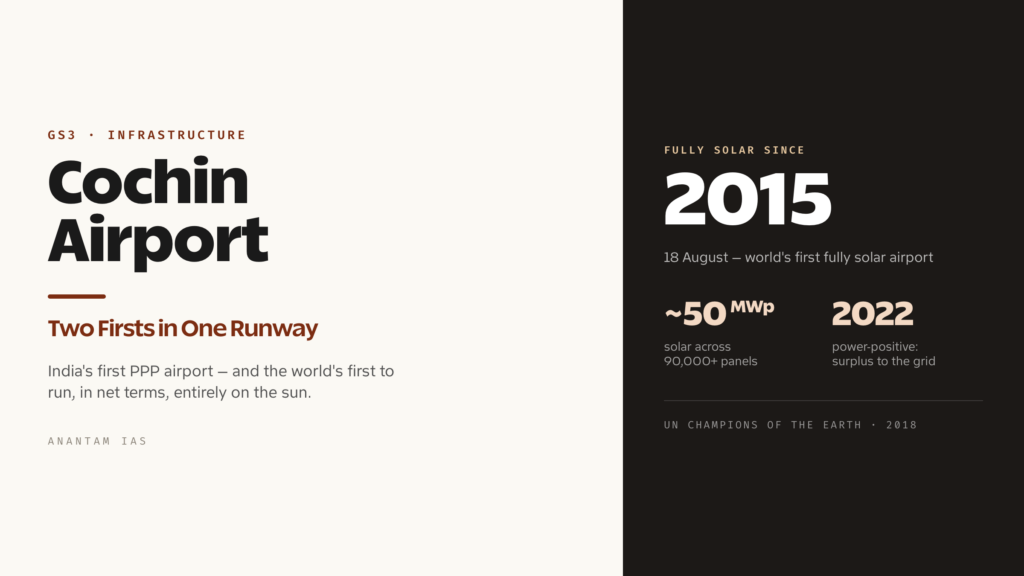
Walk through the terminals at Kochi and you won’t see anything that screams revolution. There are check-in counters, duty-free shelves, the usual queue for security. But the electricity running the X-ray machines, the air-conditioning and the apron lights is doing something no other major airport in the world had done before: it is coming, in net terms, entirely from the sun. Cochin International Airport switched fully to solar power in August 2015, and it has since gone one better — it now generates more clean energy than it consumes and sells the surplus back to the grid.
That alone would make it worth a UPSC candidate’s attention. But the more interesting thing about Cochin airport is what it was before it was green. It is India’s first airport built under a public-private partnership, funded not by the central government but by the Kerala state government, banks, and nearly ten thousand non-resident Indians who bought shares in an airport for their home state. So the airport is really two stories braided together — a financing experiment from the 1990s and an energy experiment from the 2010s — and both have lessons that travel well beyond aviation.
What Cochin International Airport Actually Is
Cochin International Airport Limited, almost always shortened to CIAL, sits at Nedumbassery, about 25 kilometres northeast of Kochi in Kerala’s Ernakulam district. It carries the IATA code COK and opened for commercial flights on 10 June 1999, after being inaugurated a fortnight earlier by President K. R. Narayanan. Today it is among the busiest airports in the country — it handled about 11.14 million passengers in 2024-25, which makes it roughly the eighth-busiest airport in India and one of the top gateways for international travel, especially the heavy traffic between Kerala and the Gulf.
That last point matters, because the airport’s whole reason for existing is the Keralite diaspora. Kerala sends a vast workforce to the Middle East, and for years they had to fly out of Thiruvananthapuram or Chennai. A modern airport at Kochi was, in a real sense, demanded by the people who would use it — and, as we’ll see, partly paid for by them too. The airport now runs three terminals: an international terminal (T3) opened in March 2017, plus the older buildings repurposed for domestic and executive operations after a 2018 reshuffle.
So Cochin is not a small experimental airfield where green ideas are easy to test. It’s a full-scale international hub. That scale is exactly what makes its sustainability record credible rather than symbolic.
How a Diaspora-Funded Airport Got Built
To understand why Cochin matters, you have to go back to 1993, when India had almost no template for building an airport outside the central government’s Airports Authority. The Cochin International Airport Society was registered in July 1993, and the operating company, CIAL, was incorporated in March 1994. The man usually credited with driving it through is V. J. Kurian, an IAS officer who became the airport’s founding managing director and stayed associated with it for decades.
The financing model was the genuinely new part. Instead of waiting for a budget allocation, CIAL raised money as a company. The Government of Kerala took an anchor stake — it still holds roughly a third of the equity, about 32 per cent — while the rest came from banks, financial institutions, airport service providers, and ordinary people. Nearly 10,000 non-resident Indians, spread across more than 30 countries, bought shares in the airport. So the people flying home to Kerala for the holidays were, in many cases, part-owners of the runway they landed on. Because no single private operator controlled it, this was a public-private partnership in the fullest sense — public purpose, private discipline, and a genuinely diffuse shareholder base.
This was India’s first greenfield airport built on the PPP model, and it predates the better-known privatisations of Delhi, Mumbai, Hyderabad and Bangalore by nearly a decade. When the government later opened airport operations to private players — and more recently handed several Airports Authority of India airports to the Adani Group on long leases — it was building on a path that Cochin had already proved could work. The lesson policymakers drew from CIAL was simple but powerful: infrastructure can be commercially viable and professionally run without sitting entirely on the government’s balance sheet.
The Day Cochin Became the World’s First Solar Airport
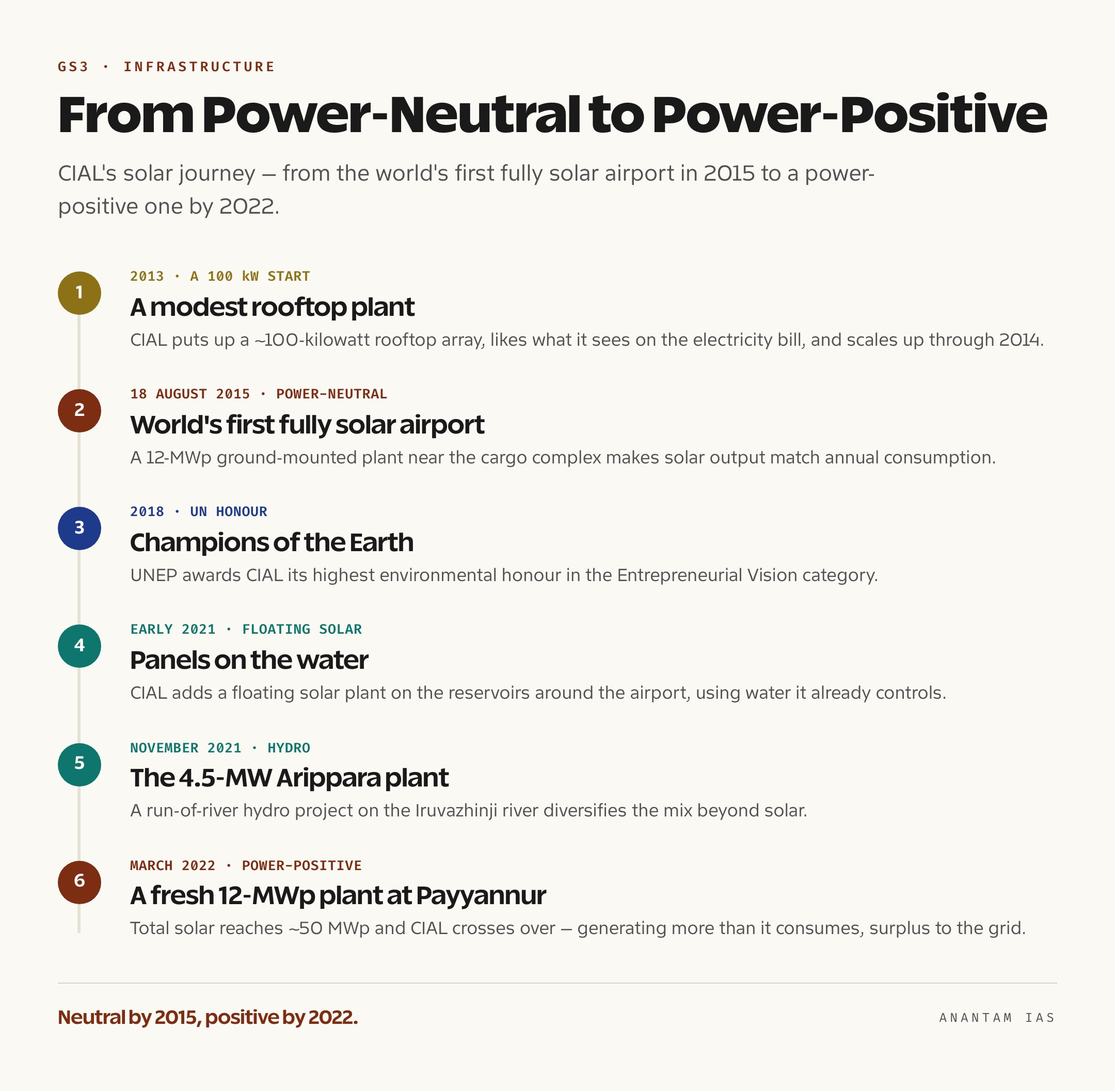
The energy story started small and almost by accident. In 2013, CIAL put up a modest rooftop solar plant of around 100 kilowatts and liked what it saw on the electricity bill. It scaled up through 2014, and then on 18 August 2015 it commissioned a 12-megawatt-peak ground-mounted solar plant near the cargo complex. With that plant running, the airport’s solar output matched its own consumption over the course of a year — and CIAL declared itself the world’s first fully solar-powered airport. The claim drew global attention precisely because nobody expected a mid-sized Indian airport to get there first.
What’s instructive is that the decision wasn’t driven by idealism alone. Electricity is one of an airport’s largest running costs, and Kerala’s grid power was both expensive and, at times, unreliable. Solar offered a hedge: once the panels are paid off, the fuel is free and the price never rises. CIAL treated its solar plant as an investment with a payback period of a handful of years, not as a green gesture. That framing — sustainability as good economics rather than charity — is the single most exportable idea in the whole story.
The world noticed. In 2018, the United Nations Environment Programme gave CIAL its Champions of the Earth award, the UN’s highest environmental honour, in the Entrepreneurial Vision category. The citation singled out exactly the thing CIAL had got right: showing that a large, commercially run facility could go fully renewable and inspire others to follow. For India, which was simultaneously pushing ambitious solar targets through the International Solar Alliance, having a home-grown winner of the UN’s top green prize was no small thing.
From Power-Neutral to Power-Positive
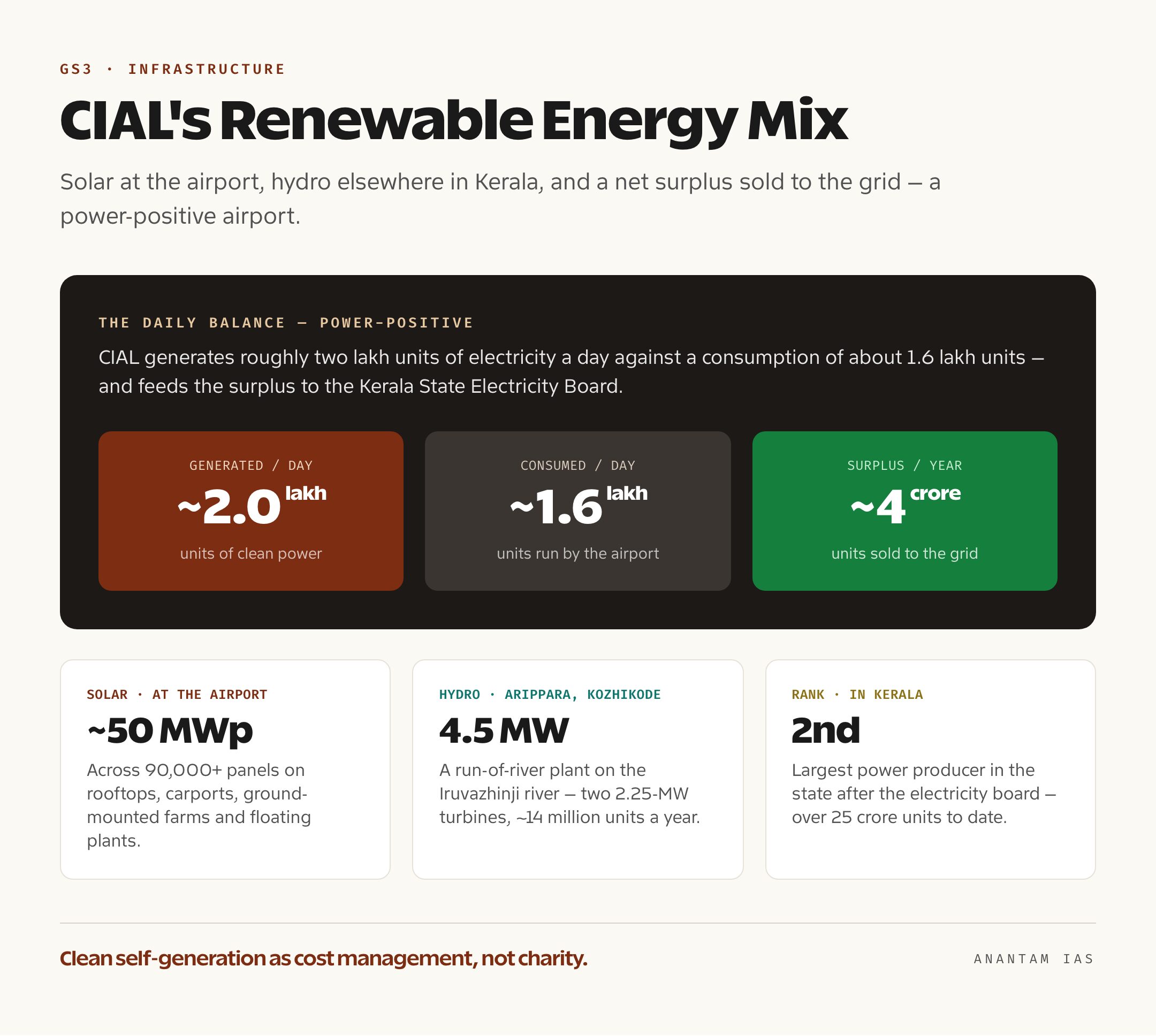
Becoming “fully solar” in 2015 meant being power-neutral — generating, over a year, as much as it used. The more impressive milestone came later. CIAL kept adding capacity, including a floating solar plant on the reservoirs around the airport by early 2021 and a fresh 12-MWp plant at Payyannur commissioned in March 2022. Its total solar capacity now stands at around 50 megawatts-peak, spread across more than 90,000 panels on rooftops, carports, ground-mounted farms and water. With the Payyannur plant running, CIAL crossed over from power-neutral to power-positive: it generates roughly two lakh units of electricity a day against a consumption of about 1.6 lakh units, and feeds the surplus — on the order of four crore units a year — to the Kerala State Electricity Board grid.
Then CIAL did something most airports never would: it moved into hydropower. In November 2021 it commissioned a 4.5-megawatt small hydroelectric plant at Arippara, on the Iruvazhinji river near Kodencheri in Kozhikode district — a run-of-river project with two 2.25-MW turbines, expected to produce about 14 million units a year. Because the airport was already solar-surplus, this hydro output is effectively extra green power sold into the state. Between its solar fleet and the Arippara plant, CIAL has grown into the second-largest power producer in Kerala after the state electricity board itself, and has generated more than 25 crore units of clean electricity over the years. As CIAL’s managing director put it when the hydro plant opened, Kerala has 44 rivers and countless streams — and the model can be repeated.
The cumulative environmental dividend is real. CIAL puts its avoided carbon footprint at roughly 1.6 lakh metric tonnes, with a 25-year offset equivalent to planting lakhs of trees. The point for an exam answer is not the exact tonnage; it is the demonstration that a heavy-energy facility can decarbonise its own operations using land and water it already controls.
Why It Matters and Where the Model Strains
Cochin’s significance for India runs along three tracks at once. As infrastructure financing, it showed that a PPP with diffuse public ownership can build and run a world-class asset. As climate policy, it gave India a flagship example of corporate decarbonisation, directly relevant to the country’s net-zero-by-2070 pledge and its push under the International Solar Alliance. And as a replication template, it has already nudged other airports — and the broader aviation sector now expanding fast under the regional connectivity scheme UDAN — toward rooftop solar and self-generation. Several airports, from Diu to Bhubaneswar, have followed CIAL’s lead in going solar-heavy.
But the honest answer admits where the model strains. Cochin’s solar success leans on something most airports lack: large tracts of flat, sunny land near the runway and reservoirs to float panels on. A congested metro airport hemmed in by a city cannot simply copy it. Solar is also intermittent — the panels do nothing at night or in the monsoon — so “fully solar” really means net-annual balance achieved by trading with the grid, not round-the-clock independence; genuine self-sufficiency would need expensive storage. And the diaspora-funded ownership model is hard to repeat at will, because it depended on a specific, deeply invested community wanting an airport badly enough to buy into one.
So the way forward is to borrow the principle, not photocopy the project. The principle is that airports — and large public facilities generally — should treat clean self-generation as core cost management, use whatever land, rooftop and water they have, and design financing that pulls in patient, broad-based capital. Pair that with grid integration, storage as it gets cheaper, and battery-backed reliability, and Cochin stops being a lucky one-off and becomes a playbook. That is the real test of a model: not whether it won an award, but whether the next ten airports quietly do the same thing without anyone needing to hand them a prize.
For Your Mains Answer
This topic is a versatile case study for GS Paper 3 — it sits squarely in “infrastructure: energy, ports, roads, airports,” “conservation and environmental pollution,” and “investment models” including PPP. It also has a clean GS Paper 2 angle on government policies and PPP governance, and it’s a ready-made example for Essay themes on sustainability, innovation and self-reliance. Treat CIAL as a concrete example you drop into a larger argument, not as a topic to describe for its own sake.
How to Build the Answer
Lead with the dual identity in one line — India’s first PPP airport and the world’s first fully solar airport — because that compression signals command of the topic. Then split your body: one block on the financing model (1994 incorporation, NRI shareholders, Kerala’s stake, the PPP first) and one on the energy model (2015 fully solar, 2022 power-positive, the Arippara hydro). Reserve your final paragraph for critical evaluation — the land and intermittency caveats — so the answer reads as analysis, not eulogy. That object-to-argument arc fits almost any “PPP success story” or “green infrastructure” question.
Common Mistakes to Avoid
Don’t conflate “fully solar” with “off-grid” — CIAL is net-annual solar, balanced through the grid, not islanded. Don’t call it government-owned; it’s a PPP with the Kerala government as a major but minority-to-one-third shareholder. Don’t overstate replicability without naming the land and storage constraints. And don’t drown the answer in figures — two or three anchors (50 MWp, power-positive since 2022, the 2018 UN award) are enough.
A Compact Answer Spine
Two firsts in one airport → PPP origin (CIAL incorporated 1994, ~10,000 NRI shareholders, Kerala holds ~32%, India’s first PPP airport) → solar journey (fully solar August 2015, UN Champions of the Earth 2018, power-positive by 2022 at ~50 MWp) → diversification (4.5 MW Arippara hydro, now Kerala’s second-largest power producer) → significance (financing template, climate flagship, UDAN-era replication) → limits (land, intermittency, storage, hard-to-copy ownership) → borrow the principle, not the project.
Diagram or Flowchart Idea
Draw a simple two-axis box: the horizontal axis as a timeline (1994 incorporation → 1999 operations → 2015 fully solar → 2018 UN award → 2022 power-positive → Arippara hydro), and a small inset pie of the energy mix (solar 50 MWp + 4.5 MW hydro → surplus to grid). A timeline plus a mix diagram earns marks quickly and is fast to sketch.
A Balanced-Conclusion Line
A good closer: CIAL proves that decarbonisation and commercial viability can reinforce rather than fight each other — but its real value lies in the principle it demonstrates, not in a model that every congested airport can copy line for line.
How to Use Data Without Cramming
Memorise a tight cluster and deploy it precisely: “fully solar since August 2015,” “power-positive by 2022 with about 50 MWp,” “UN Champions of the Earth, 2018,” “India’s first PPP airport, ~10,000 NRI shareholders.” Attach each number to a claim rather than listing them — “power-positive by 2022” supports the self-generation argument; “10,000 NRI shareholders” supports the financing-innovation argument. Numbers tied to arguments read as understanding; numbers in a heap read as cramming.
FAQ
Why is Cochin International Airport famous? For two firsts. It is India’s first airport built under a public-private partnership, funded by the Kerala government, banks and nearly 10,000 non-resident Indian shareholders, and operational since 1999. And on 18 August 2015 it became the world’s first fully solar-powered airport — it now generates more clean energy than it uses and is power-positive.
What does “power-positive” mean for CIAL, and when did it happen? Power-positive means the airport generates more electricity over a year than it consumes and exports the surplus. CIAL became power-neutral in 2015 with its 12-MWp plant and crossed into power-positive territory by 2022 after commissioning a fresh 12-MWp plant at Payyannur, taking total solar capacity to around 50 MWp. It now sends roughly four crore units a year to the Kerala grid.
Which UN award did Cochin airport win? In 2018, the United Nations Environment Programme awarded CIAL its Champions of the Earth prize — the UN’s highest environmental honour — in the Entrepreneurial Vision category, recognising its leadership in running a large airport entirely on solar power.
Is Cochin airport only solar-powered now? No — it has diversified. Alongside roughly 50 MWp of solar across rooftops, carports, ground-mounted farms and floating plants, CIAL commissioned a 4.5-MW small hydroelectric plant at Arippara in Kozhikode district in November 2021. Together these make it the second-largest power producer in Kerala after the state electricity board.
Practice Questions
Prelims MCQs
- With reference to Cochin International Airport Limited (CIAL), consider the following: it is often described as India’s first airport built under which model?
(a) Build-Operate-Transfer by a single private firm
(b) Public-private partnership with diffuse ownership including NRI shareholders
(c) Fully Airports Authority of India owned
(d) A foreign-operator concession.
Answer: (b) — CIAL was incorporated in 1994 with the Kerala government, banks and nearly 10,000 NRIs as shareholders, making it India’s first PPP airport. - Cochin International Airport became the world’s first fully solar-powered airport in which year?
(a) 2012
(b) 2013
(c) 2015
(d) 2018.
Answer: (c) — It commissioned a 12-MWp plant on 18 August 2015 and declared itself fully solar-powered. - CIAL received the “Champions of the Earth” award in 2018. This award is instituted by:
(a) World Bank
(b) International Solar Alliance
(c) United Nations Environment Programme
(d) International Civil Aviation Organization.
Answer: (c) — It is the highest environmental honour of the UN Environment Programme (UNEP). - CIAL’s Arippara small hydroelectric project is located on which river in Kerala?
(a) Periyar
(b) Iruvazhinji
(c) Bharathapuzha
(d) Pamba.
Answer: (b) — The 4.5-MW run-of-river plant near Kodencheri, Kozhikode, sits on the Iruvazhinji river. - The UDAN scheme, relevant to India’s airport expansion, is best described as:
(a) A scheme to privatise all major metro airports
(b) A regional connectivity scheme to make air travel affordable and link smaller towns
(c) A subsidy for solar power at airports
(d) A diaspora investment programme for aviation.
Answer: (b) — UDAN (Ude Desh ka Aam Nagrik) is the regional connectivity scheme launched in 2016 to connect underserved and remote airports.
Mains Practice Questions
- “Cochin International Airport is as much a financing innovation as an energy one.” Examine the public-private partnership model behind CIAL and assess its replicability for Indian infrastructure. (15 marks, 250 words)
- Discuss how Cochin International Airport became the world’s first fully solar-powered and later power-positive airport, and evaluate the relevance of this model for India’s net-zero and renewable energy commitments. (15 marks, 250 words)
- “Going fully solar is easier to claim than to sustain.” Critically analyse the constraints — land, intermittency and storage — that limit the replication of CIAL’s solar model at other Indian airports. (10 marks, 150 words)
- Examine the role of public-private partnerships in India’s airport sector since the 1990s, using Cochin as the pioneering example and the recent transfer of Airports Authority of India airports to private operators as a contrast. (15 marks, 250 words)
- How can large public infrastructure facilities treat clean self-generation as core cost management rather than corporate philanthropy? Illustrate with the example of CIAL’s solar and hydro portfolio. (10 marks, 150 words)
Tell Google you want more of this.
Add Anantam IAS as a preferred sourceOne tap, and this site shows up more often in your own Top Stories, AI Overviews and AI Mode. Remove it any time.





