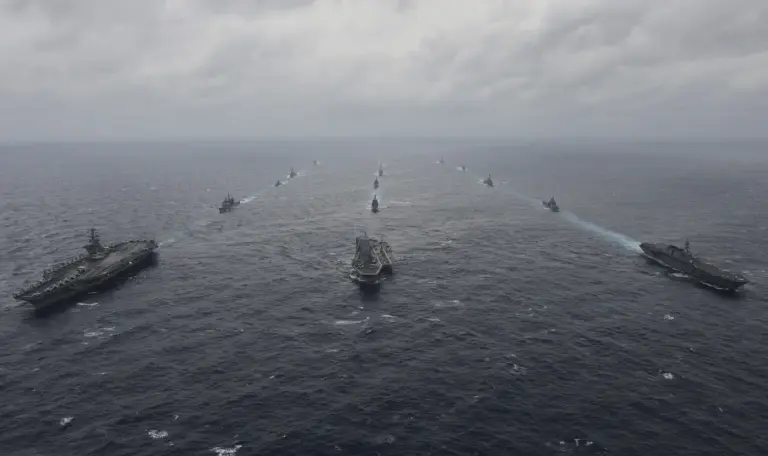
For four days in May 2025, as Indian and Pakistani forces traded fire after the Pahalgam attack, a second war ran alongside the real one — a war fought entirely in people’s heads. Recycled old clips were passed off as live strikes, AI-generated images of burning airbases went viral, and fabricated “official statements” raced across phones faster than any government could deny them. The fog of war had always existed; what was new was that the fog was now manufactured on purpose, at industrial scale, by anyone with a laptop. By the time fact-checkers caught up, the false version had already done its work. That episode is the clearest Indian glimpse yet of what strategists now call cognitive warfare — the deliberate contest to shape how an adversary’s people perceive, reason and decide.
And it is no longer a fringe idea. NATO’s Allied Command Transformation has begun treating human cognition as a contested space in its own right, a place where conflict happens before, during and long after the shooting. The phrase its analysts use is blunt: “the battle for the brain”. For a UPSC aspirant, this is one of those topics that sits at the seam between several syllabus areas at once — internal security, science and technology, and the conduct of modern conflict — and rewards anyone who can explain it with conceptual clarity rather than alarmist noise. Because cognitive warfare is not really about technology. It is about the oldest target there is: the human mind.
What Cognitive Warfare Is — and How It Differs From the Old Battles for the Mind
Start with a careful definition, because the term is often used loosely. Cognitive warfare is the use of information, psychology and technology to manipulate the way a target population thinks, perceives, decides and ultimately behaves — turning human cognition itself into a domain of conflict. The aim is not to destroy an army or even, in the first instance, to convince anyone of a particular fact. It is subtler and more corrosive: to degrade a society’s capacity to reason clearly, to trust shared institutions, and to act with confidence. As one NATO-linked study put it, the brain has become the battlefield of the twenty-first century, with future conflicts likely to be fought “amongst the people” digitally first and physically afterward.
The temptation is to treat this as just a new name for propaganda, and that mistake is worth correcting carefully, because the distinction is exactly where the marks are. Propaganda and classic psychological operations try to change what people think — to plant a specific belief or sap a specific morale. Information warfare, the broader cousin, contests the information environment itself, controlling and corrupting the flow of facts. Cognitive warfare reaches one layer deeper. It targets how people think — the reasoning machinery, the biases, the emotional reflexes that sit underneath any particular belief. The French officer François du Cluzel, an early theorist of the idea, drew the line precisely: psychological warfare changes what an audience thinks, but cognitive warfare aims to shape how it reasons, and so how it behaves. Damage the mental apparatus, and you do not need to win any single argument; the target’s whole ability to tell signal from noise has been blunted.
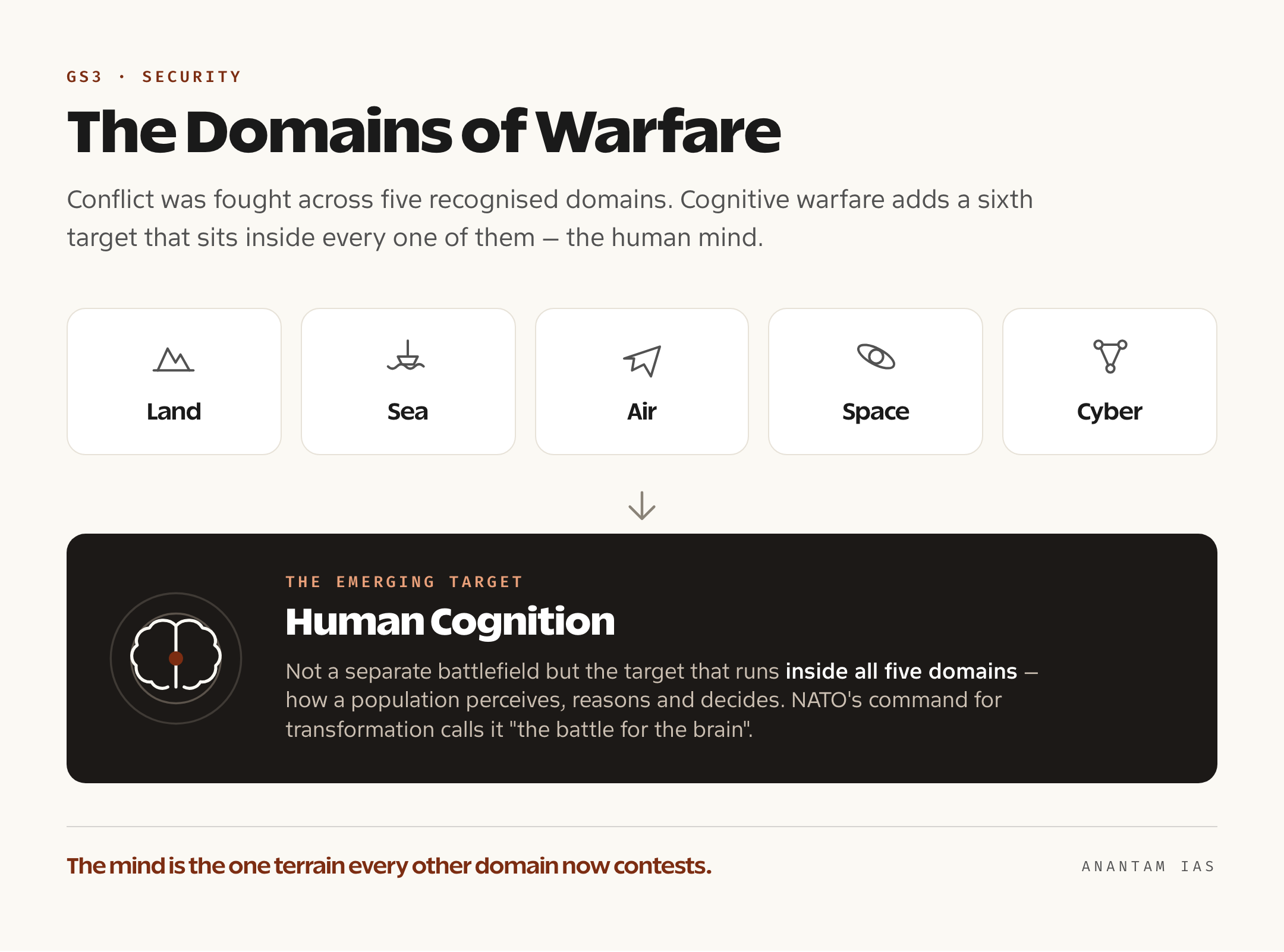
Three features make this a genuinely new kind of contest rather than old wine in a new bottle. First, it is continuous and operates in peacetime, not just during declared conflict — a slow, patient effort to widen a rival society’s fault lines years before any crisis. Second, it fuses tools the old propagandists never had: the data exhaust of billions of people, the targeting precision of digital advertising, behavioural and brain science, and AI that can generate persuasive content at infinite scale. Third, it works on the architecture of cognition — the predictable biases every human shares, like our tendency to believe what confirms our existing views or to remember the vivid over the true. This is why some analysts speak of a “cognitive domain” alongside the five recognised domains of warfare — land, sea, air, space and cyber — though the more careful framing, and the one a UPSC answer should prefer, is that cognition is the emerging target across all of them rather than a settled sixth domain. The International Committee of the Red Cross, writing in early 2026, warned plainly that the human brain should not be allowed to become a battlefield at all.
The Toolkit: How the Mind Is Targeted at Scale
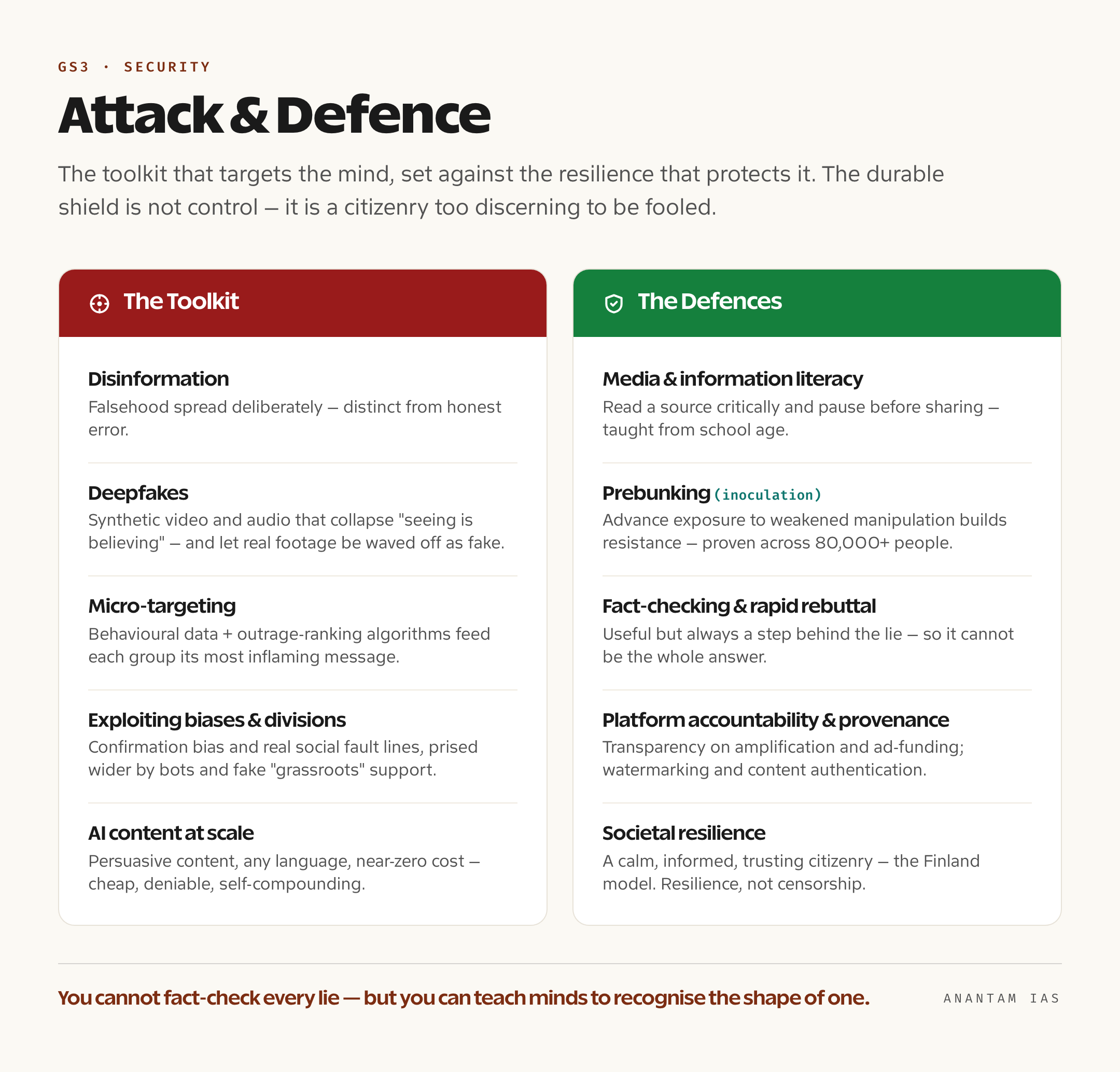
The methods of cognitive warfare are not exotic; they are the everyday mechanics of the modern internet, turned to hostile ends. The most familiar is disinformation — falsehood spread deliberately, distinct from misinformation, which is false content shared by people who simply do not know better. On top of that sits the deepfake: synthetic audio, image and video, increasingly indistinguishable from the real thing, which collapses our last instinct that “seeing is believing”. When a fabricated video of a leader can circulate in seconds, the damage is twofold — the lie itself, and the slower poison that follows, where genuine footage can now be dismissed as fake. That second effect, the so-called liar’s dividend, is the real prize.
Layered onto this is the machinery of platform amplification and micro-targeting, which is where the surveillance-driven business model of the modern internet becomes a weapon. Because platforms harvest enormous behavioural data and rank content by what provokes the strongest reaction, an attacker can profile audiences down to their anxieties and feed each group precisely the message most likely to inflame it. Security analysts describe a recognisable playbook: inject divisive narratives into debates that are already heated, ride the algorithms that reward outrage, fabricate the appearance of grassroots support through bot networks and fake accounts, and steadily delegitimise the very institutions — courts, election bodies, the press — that a population relies on to settle disputes. The strategy does not invent the cracks in a society; it finds the real ones and prises them wider, exploiting cognitive biases such as confirmation bias and the availability heuristic to make each false frame feel like common sense.
What ties the kit together, and what makes it dangerous, is the economics. Generative AI has made persuasive content almost free to produce in any language and at any volume, so a single small team can now flood an information space that once needed a state broadcaster. The whole enterprise is cheap, deniable and asymmetric — a few people can rattle a nation of a billion, and attribution is hard enough that the aggressor can always shrug. Worse, it compounds: every successful operation deepens the polarisation that makes the next operation easier and cheaper. That ratchet — divisions weaponised to manufacture more division — is why this matters far beyond any single fake video, and it is the natural place to pause and picture the landscape.
Why It Matters: A New Front That Blurs War and Peace
The deepest danger of cognitive warfare is not any single lie but what it does to the connective tissue of a society. Liberal democracies, and large diverse democracies most of all, run on a quiet assumption — that citizens broadly share a set of facts, trust the referees who certify them, and can argue about values on that common ground. Cognitive operations attack precisely that shared floor. The target is not a building or a battalion but social cohesion itself: the trust between citizens, and the trust between citizens and their institutions. Erode that, and a country can be weakened without a shot fired, simply by making its people unable to agree on what is real.
It also dissolves the tidy line between war and peace that international law and military doctrine were built around. There is no declaration, no front line, no clear first shot — just a continuous, low-cost campaign that runs through ordinary peacetime debate and only spikes during a crisis. That ambiguity is a feature, not a bug, for the attacker: it makes a proportionate response almost impossible to design, because retaliating against a tweet or a meme is both legally murky and politically fraught. This is why cognitive warfare is usually discussed under the wider umbrella of hybrid and grey-zone conflict — the deliberate blending of military, economic, cyber and informational pressure kept carefully below the threshold that would trigger an open, conventional reply.
There is a defensive trap here that aspirants should note, because it is where the ethics of the subject bite. The instinct of a threatened state may be to fight back by controlling information — censoring, surveilling, building its own propaganda. But an open society that defends itself by becoming closed has, in a sense, already conceded the war: it has degraded the very freedoms and pluralism the attacker wanted to destroy. The harder and better answer, which the strongest defences pursue, is resilience rather than control — making the population itself a poor target, so that the lies simply do not land. That reframing, from policing speech to strengthening minds, is the single most important judgement in the whole debate.
The Defences: From Fact-Checking to a Resilient Society
A serious defence works on several levels at once, and the order matters. At the base is media and information literacy — teaching people, ideally from school age, how to read a source critically, spot a manipulation technique, and pause before sharing. The most striking recent evidence is for “prebunking”, or inoculation: a 2025 meta-analysis spanning more than eighty thousand participants found that briefly exposing people in advance to a weakened form of a manipulation tactic builds measurable resistance to the real thing later, much as a vaccine primes the immune system. Prebunking is powerful precisely because it scales — you cannot fact-check every lie after it spreads, but you can teach the population to recognise the shape of a lie before it arrives.
Behind that front line sit the reactive tools, useful but limited. Fact-checking and rapid rebuttal matter, yet they are forever a step behind, because a falsehood travels far before the correction is written. So defence also has to reach the platforms where the content lives: accountability for the algorithms that amplify outrage, transparency about who is paying for political messaging, faster takedown of coordinated inauthentic behaviour, and provenance technology — digital watermarking and content authentication — so that genuine media can be verified and synthetic media flagged at the source. None of these is a silver bullet, and each carries its own free-speech tension, which is exactly why the policy debate is so hard.
The countries usually held up as models make the deeper point that resilience is societal, not merely technical. Finland threads media literacy through its entire school curriculum and treats it as a national-security asset; the Nordic and Baltic states, hardened by years of pressure on their borders, have built rapid-response and “psychological defence” capacities; the European Union frames the whole challenge as one of “cognitive security”. The common thread is that the real defence is a citizenry that is hard to fool — informed, calm, used to disagreement, and confident in its institutions. The technology helps, but the durable shield is a population whose habits of mind cannot be cheaply hijacked.
The India Angle: A Vast, Plural, Fast-Digitising Information Space
India is, in many ways, the world’s most exposed cognitive battlefield, and an answer that explains why will always read better than one that simply asserts it. The scale is the first reason: with well over 900 million internet users, most of them on cheap data and a smartphone, India is among the largest and fastest-growing information spaces on earth, much of it flowing through encrypted, hard-to-monitor messaging. The diversity is the second: a deeply multilingual, multi-religious, federal society offers a wide menu of existing fault lines — communal, regional, linguistic, caste — that a hostile operation can probe and inflame, with content tailored to each language and community. And the third reason is the speed of the on-ramp: hundreds of millions of citizens have come online in barely a decade, often without the gradual build-up of critical media habits that older internet societies acquired over a generation.
The May 2025 crisis with Pakistan was the live demonstration. As the Indian defence think-tank MP-IDSA and others have analysed, the speed at which AI-generated deepfakes and false narratives spread made it genuinely hard, even for informed observers, to verify what was happening in real time, and the lag in official rebuttal let fabricated stories briefly dominate the conversation. The episode exposed a cognitive vulnerability that no missile defence can patch. India’s institutional response so far runs through the Press Information Bureau’s Fact Check Unit, which debunks false claims about government policy, alongside a broader push on digital and media literacy and on tools to detect synthetic media — necessary steps, but, on the evidence of 2025, not yet fast or deep enough against an AI-accelerated threat.
The way forward that most analysts converge on is a whole-of-society one, and it maps neatly onto themes the UPSC values. India needs to treat information resilience as a pillar of national security alongside the physical kind: invest in mass media literacy as public infrastructure, build genuinely rapid and credible official communication so that truth can keep pace with rumour, hold platforms accountable for amplification and provenance, and consider a dedicated, professional capacity to detect and counter hostile narratives. The hard balance, and the one worth flagging in any answer, is doing all this without sliding into censorship or surveillance that would corrode the open, pluralistic democracy the strategy exists to protect. India’s strongest defence is not a tighter grip on information but a citizenry too discerning to be easily played.
For Your Mains Answer
This is a high-value, cross-cutting topic for GS Paper 3, especially the internal-security syllabus — the role of media and social-networking sites in internal-security challenges, the basics of cyber security, and the broader category of non-traditional and hybrid threats. It also lends itself to GS Paper 2 (governance, the functioning of institutions, the health of democracy), to GS Paper 4 (the ethics of state responses, the tension between security and liberty), and to the Essay paper on themes of truth, technology and democracy. The skill examiners reward is conceptual precision: define cognitive warfare correctly, distinguish it cleanly from information and psychological warfare, and always land the India-specific reasoning.
How to Build the Answer
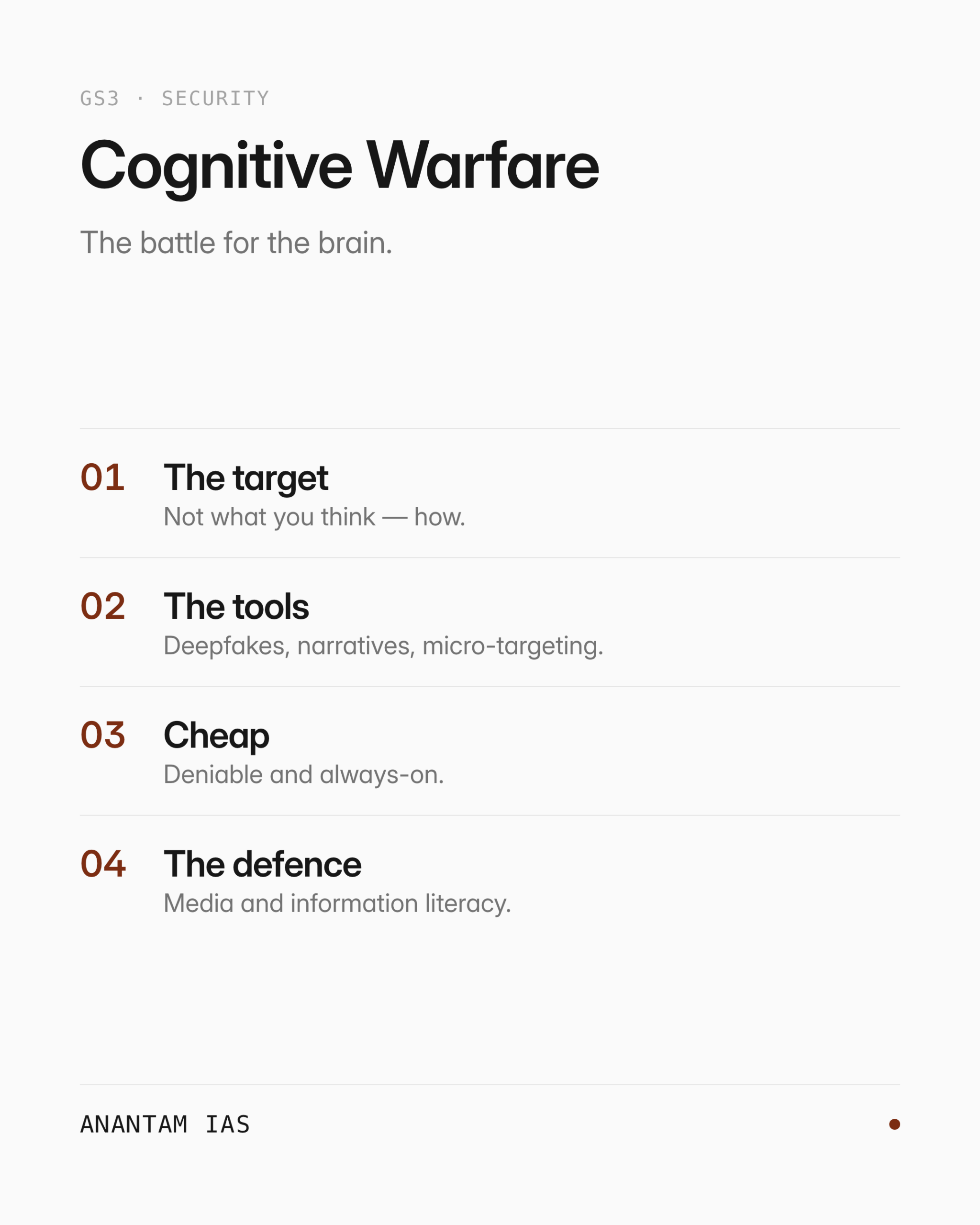
Move in a clear chain. Define cognitive warfare as the contest to shape how a population thinks and reasons, not merely what it believes. Distinguish it from propaganda and information warfare (the how versus the what). Lay out the toolkit — disinformation, deepfakes, micro-targeting, bias exploitation, AI-generated content at scale. Explain why it matters — it attacks social cohesion and trust, blurs war and peace, and is cheap, deniable and asymmetric. Then the defences — media literacy and prebunking first, fact-checking and platform accountability second, societal resilience as the goal. Close on India: why a vast, plural, fast-digitising society is uniquely exposed, the May 2025 lesson, and a balanced way forward that avoids the censorship trap.
Common Mistakes to Avoid
Don’t equate cognitive warfare with ordinary propaganda — the examiner wants the “targets how you reason, not just what you think” distinction. Don’t over-claim a settled “sixth domain”; frame cognition as the emerging target across the recognised domains. Don’t treat it as purely a technology problem solved by detection tools — the durable fix is a resilient citizenry. And don’t propose censorship or surveillance as the answer without flagging that an open society defended by closing itself has already lost something essential.
A Compact Answer Spine
Cognitive warfare = manipulating how a population perceives, reasons and decides → deeper than propaganda (the how, not the what), continuous and in peacetime, fuses data + neuroscience + AI → toolkit: disinformation, deepfakes (and the “liar’s dividend”), micro-targeting, exploiting biases and social divisions, AI content at scale → why it matters: attacks cohesion and institutional trust, blurs war/peace, cheap, deniable, self-compounding → defences: media literacy and prebunking (inoculation), fact-checking, platform accountability and content provenance, societal resilience over control → India: 900 mn+ users, multilingual fault lines, rapid digitisation, the May 2025 deepfake surge, PIB fact-check + digital-literacy push → way forward: resilience as national security, without the censorship trap.
Diagram or Flowchart Idea
Draw a simple two-panel visual. On the left, the five domains (land, sea, air, space, cyber) with an arrow pointing inward to a head/brain labelled “cognition — the emerging target”. On the right, a two-column attack-versus-defence table: disinformation / deepfakes / micro-targeting / bias-exploitation against media literacy / prebunking / fact-checking / platform accountability / resilience. The contrast communicates the whole answer at a glance.
A Balanced-Conclusion Line
A line that lands the marks: “Cognitive warfare turns an open society’s greatest strengths — its freedom, its plurality, its connectivity — into attack surfaces; the answer for a democracy like India is not to close the mind through control, but to harden it through literacy, trust and resilience, so the lies simply find no purchase.”
How to Use Data Without Cramming
You need only a few anchors, not a data dump: the framing phrase “the battle for the brain”, the five recognised domains with cognition as the emerging target, India’s 900-million-plus internet users, the May 2025 India-Pakistan deepfake episode as the live case, and the prebunking meta-analysis of over eighty thousand participants as evidence that inoculation works. Attribute plainly — “as NATO’s command for transformation frames it”, “as the defence think-tank MP-IDSA noted of the 2025 crisis” — rather than scattering claims.
Frequently Asked Questions
What is cognitive warfare in simple terms?
Cognitive warfare is the deliberate effort to manipulate how a target population thinks, perceives and decides — to shape the reasoning process itself, not just to plant a single belief. It uses disinformation, deepfakes, social-media manipulation and AI-generated content to degrade a society’s ability to tell truth from falsehood and to erode trust between citizens and their institutions. Analysts call it “the battle for the brain”, because the human mind is both the target and the terrain.
How is cognitive warfare different from information warfare or propaganda?
Propaganda and psychological operations try to change what people think — a specific belief or morale. Information warfare contests the wider information environment, controlling and corrupting the flow of facts. Cognitive warfare goes one layer deeper, targeting how people reason — the biases, emotions and mental reflexes beneath any belief. Damage that machinery and you needn’t win any single argument; the target’s ability to reason clearly is itself impaired.
Why is India especially vulnerable to cognitive warfare?
Because of scale, diversity and speed. India has well over 900 million internet users, mostly on smartphones and encrypted messaging; a deeply multilingual, multi-religious, federal society offers many existing fault lines to exploit; and hundreds of millions came online in barely a decade, often without ingrained critical-media habits. The May 2025 crisis with Pakistan, when AI deepfakes and false narratives spread faster than they could be rebutted, was a stark live demonstration of that exposure.
How can a society defend against cognitive warfare?
The strongest defence is resilience, not control. That means mass media and information literacy and “prebunking” — inoculating people in advance against manipulation techniques so falsehoods don’t land; backed by fact-checking and rapid rebuttal, platform accountability and content-provenance tools, and credible, fast official communication. Models like Finland show the durable shield is a discerning citizenry. The trap to avoid is defending an open society by censoring or surveilling it, which surrenders the very freedoms under attack.
Practice Questions
Prelims MCQs
- With reference to “cognitive warfare”, which of the following best describes its distinctive aim?
(a) Destroying an adversary’s physical military assets through precision strikes
(b) Manipulating how a target population perceives, reasons and decides, rather than only what it believes
(c) Disrupting an enemy’s banking and financial networks
(d) Jamming an adversary’s radar and communication systems
Answer: (b) Cognitive warfare targets the reasoning process itself — the “how” of thinking — which distinguishes it from propaganda that targets the “what”. - The term the “liar’s dividend”, relevant to deepfakes, refers to which of the following?
(a) The profit earned by selling fabricated content online
(b) The ability to dismiss genuine, authentic footage as fake once people know convincing fakes exist
(c) A tax levied on social-media platforms hosting false content
(d) The reward algorithms give to the most-shared posts
Answer: (b) Once deepfakes are common, real evidence can be waved away as fabricated — a second-order harm beyond the original lie. - Consider the following statements about cognitive warfare:
- It typically operates only after a formal declaration of war.
- It deliberately blurs the line between war and peace and is often discussed under hybrid or grey-zone conflict.
- It commonly exploits cognitive biases such as confirmation bias.
Which of the statements are correct?
(a) 1 and 2 only
(b) 2 and 3 only
(c) 1 and 3 only
(d) 1, 2 and 3
Answer: (b) Cognitive warfare is continuous and runs through peacetime, so statement 1 is wrong; it blurs war and peace and exploits biases, so 2 and 3 are correct. - “Prebunking”, a defence against cognitive warfare, is best described as:
(a) Removing false content after it has gone viral
(b) Inoculating people in advance by exposing them to weakened forms of manipulation techniques
(c) Banning all anonymous accounts on social media
(d) Prosecuting those who create deepfakes
Answer: (b) Prebunking, or inoculation, builds advance resistance to manipulation, much as a vaccine primes the body before exposure. - Which institution in India is primarily tasked with debunking false claims about government policies and programmes?
(a) The Election Commission’s Media Cell
(b) The Press Information Bureau’s Fact Check Unit
(c) The Telecom Regulatory Authority of India
(d) The National Investigation Agency
Answer: (b) The PIB Fact Check Unit issues clarifications and rebuttals of misinformation relating to government policy through official channels.
Mains Practice Questions
- “Cognitive warfare turns the human mind into a domain of conflict.” Examine how cognitive warfare differs from traditional information and psychological warfare, and discuss why it poses a distinct challenge to open societies. (15 marks, 250 words)
- Disinformation, deepfakes and micro-targeting have made the contest for human cognition cheap, deniable and continuous. Analyse the toolkit of cognitive warfare and explain why it is described as an asymmetric threat. (15 marks, 250 words)
- “The defence against cognitive warfare lies in resilience, not control.” Critically evaluate this statement with reference to media literacy, prebunking and the risks of state censorship. (15 marks, 250 words)
- India’s vast, multilingual and rapidly digitising information space makes it especially vulnerable to cognitive operations. Discuss this vulnerability and suggest a whole-of-society approach to building cognitive resilience. (15 marks, 250 words)
- Cognitive warfare blurs the line between war and peace and operates in the grey zone. Discuss the implications of this for India’s internal-security framework and for the ethics of a democratic state’s response. (10 marks, 150 words)
Tell Google you want more of this.
Add Anantam IAS as a preferred sourceOne tap, and this site shows up more often in your own Top Stories, AI Overviews and AI Mode. Remove it any time.