
A surprising share of the UPSC science and technology paper turns on a small set of communicable diseases, the pathogens that cause them, the vectors that carry them, and the national programmes that try to bring them under control. The questions are usually small in scope but unforgiving in detail. Was the pathogen a virus, a bacterium, or a protozoan? Was the vector an Anopheles mosquito or an Aedes mosquito? Did India sign up to eliminate the disease by 2030, or was the target redrawn?
The reason this matters is not just exam tactics. India still carries a disproportionate share of the global burden of tuberculosis, kala-azar, lymphatic filariasis, and several other diseases that the rest of the world has largely beaten. The country’s public health capacity, its surveillance infrastructure, and its drug procurement systems are built around the structure of these diseases. Understanding the comparison is the foundation for understanding the policy.
Quick Facts on Major Communicable Diseases
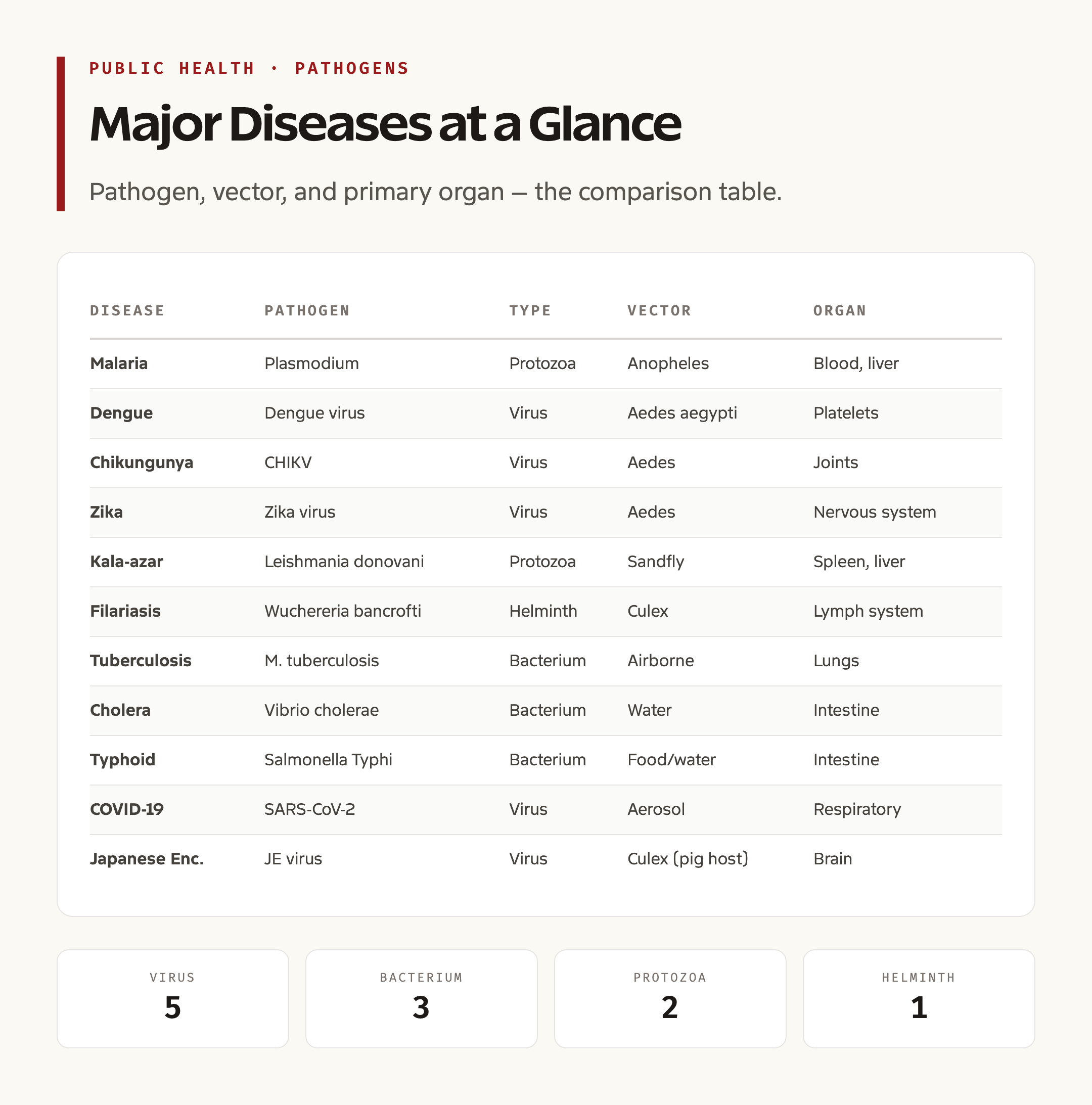
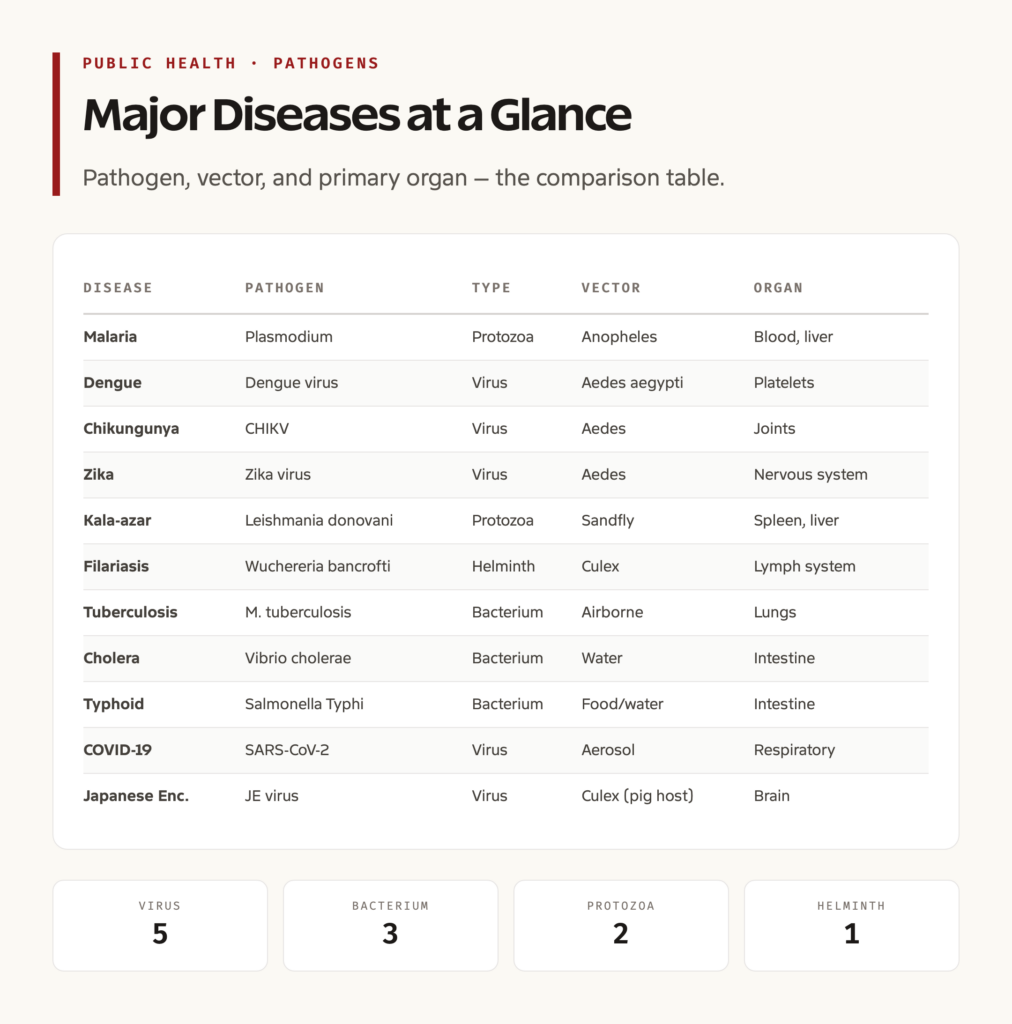
The Indian disease burden is dominated by a handful of pathogens. Mycobacterium tuberculosis remains the single largest cause of infectious disease mortality. Plasmodium parasites cause hundreds of thousands of cases of malaria a year, although the trend has been falling. Aedes-borne viral fevers, including dengue, chikungunya, and Zika, have become urban epidemics in monsoon and post-monsoon months. Bacterial diseases of poor sanitation, including cholera and typhoid, persist in pockets despite decades of public health investment.
Each of these diseases has a different pathogen type, a different mode of transmission, a different organ system as the primary target, and a different national programme behind its control. The table later in this article lays out the comparison.
What a Communicable Disease Actually Is
A communicable disease is one that is caused by a specific infectious agent and transmitted directly or indirectly from an infected source to a susceptible host. The chain has three links. The first is the agent, which can be a virus, a bacterium, a protozoan, a fungus, or a multicellular parasite such as a worm. The second is the route of transmission, which can be airborne, waterborne, foodborne, vector-borne, or direct contact. The third is the susceptible host, whose immune status, nutritional state, and access to vaccination determine whether infection becomes disease.
Public health programmes break the chain at one or more of these three links. Vaccination shrinks the pool of susceptible hosts. Vector control disrupts transmission. Antimicrobials and sanitation reduce the agent’s ability to thrive. The mix that works depends on the specific disease, which is why the comparison matters.
Background and Historical Context
India’s tryst with communicable disease control began under colonial public health, which focused narrowly on plague, cholera, and smallpox because these were the diseases that disrupted commerce and threatened European populations. Tuberculosis, malaria, and tropical diseases that burdened Indians received much less systematic attention.
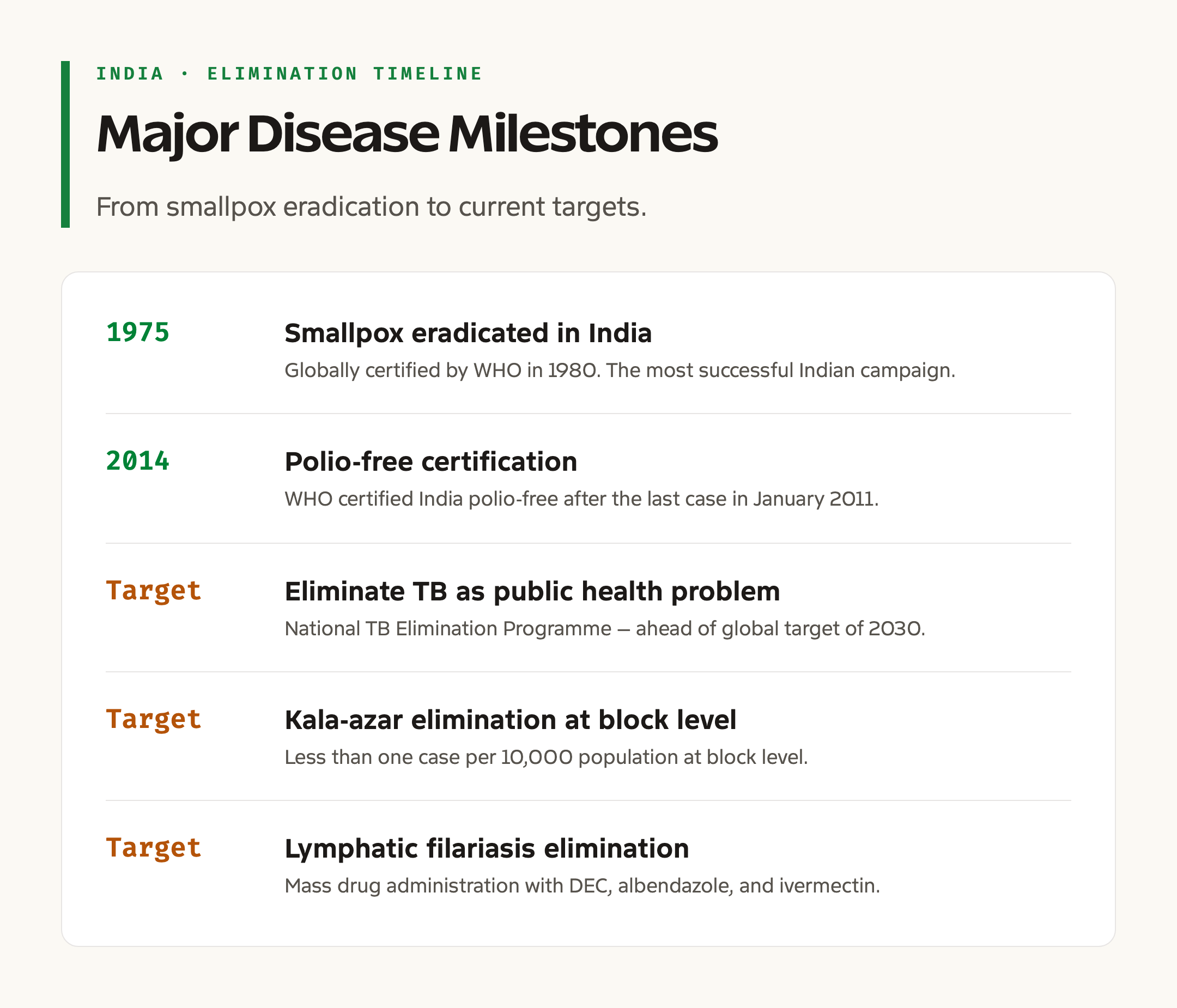
The post-Independence period saw the launch of dedicated national programmes, beginning with the National Malaria Control Programme in 1953, which became the National Malaria Eradication Programme in 1958, and which by the 1970s had walked back to a control rather than eradication framing as the parasite developed resistance and the vector adapted. The smallpox eradication campaign, completed in India by 1975 and globally certified by the World Health Organization in 1980, remains the most successful Indian public health campaign in absolute terms.
Through the 1980s and 1990s, the architecture of vertical, disease-specific programmes was built up. The Revised National Tuberculosis Control Programme launched in the 1990s and became the National Tuberculosis Elimination Programme in 2020 with a target of eliminating tuberculosis as a public health problem by 2025. The Kala-Azar Elimination Programme has driven cases down dramatically. The National Vector Borne Disease Control Programme integrates malaria, dengue, chikungunya, lymphatic filariasis, and Japanese encephalitis. The country’s evolving institutional capacity in this space connects directly to broader biotechnology policy and to the national biotechnology development strategy.
Major Diseases Compared
The following matrix captures the diseases most relevant to UPSC preparation. It is organized by pathogen type and includes the primary vector or transmission route, the main organ system affected, and the controlling national programme.
| Disease | Causative Agent | Pathogen Type | Vector or Transmission | Key Organ Affected | National Programme |
|---|---|---|---|---|---|
| Malaria | Plasmodium species | Protozoa | Female Anopheles mosquito | Blood, liver | NVBDCP |
| Dengue | Dengue virus, Flavivirus | Virus | Aedes aegypti mosquito | Blood vessels, platelets | NVBDCP |
| Chikungunya | Chikungunya virus, Alphavirus | Virus | Aedes mosquito | Joints, muscles | NVBDCP |
| Zika | Zika virus, Flavivirus | Virus | Aedes mosquito, sexual, vertical | Nervous system | NVBDCP |
| Kala-azar | Leishmania donovani | Protozoa | Phlebotomus sandfly | Spleen, liver | Kala-Azar Elimination Programme |
| Lymphatic filariasis | Wuchereria bancrofti | Helminth, worm | Culex mosquito | Lymphatic system | NVBDCP, MDA campaigns |
| Tuberculosis | Mycobacterium tuberculosis | Bacterium | Airborne droplets | Lungs, can spread | NTEP |
| Cholera | Vibrio cholerae | Bacterium | Contaminated water | Intestine | IDSP, water and sanitation |
| Typhoid | Salmonella Typhi | Bacterium | Contaminated food and water | Intestine, bloodstream | IDSP, vaccination |
| COVID-19 | SARS-CoV-2 | Virus, Coronavirus | Airborne droplets and aerosols | Respiratory system | NCDC, surveillance |
| Japanese encephalitis | JE virus | Virus | Culex mosquito | Brain | NVBDCP, vaccination |
Three additional points are worth noting. Malaria has both an asexual phase in the human and a sexual phase in the mosquito, which is why the female Anopheles is the vector. Tuberculosis is acid-fast on Ziehl-Neelsen staining, a feature that comes up in prelims-style questions. Dengue is famous for the second-infection severity problem, where a person infected with one serotype is at increased risk of severe dengue if subsequently infected with a different serotype.
Why the Comparison Matters
For a public health planner, the comparison drives the choice of intervention. A bacterial disease responds to antibiotics. A viral disease usually does not, although a few have antivirals and many now have vaccines. A protozoal disease has its own drug class. A worm needs anthelmintics. Vector-borne diseases need vector control alongside treatment. Waterborne diseases need clean water and sanitation. The programme architecture follows the biology.
For a UPSC aspirant, the comparison is the spine on which a hundred small facts hang. Once the table is internalized, questions about which mosquito carries which fever, which organ a particular pathogen attacks, or which programme is the relevant institutional vehicle become much easier to answer. The same comparison feeds into questions on India’s health system and on the policy choices around vaccine procurement and distribution.
Detailed Analysis of Selected Diseases
Tuberculosis is caused by Mycobacterium tuberculosis, a slow-growing aerobic bacillus that primarily attacks the lungs but can affect almost any organ. Transmission is airborne, through droplets from the cough or sneeze of a person with active pulmonary disease. Diagnosis has shifted from sputum microscopy to molecular tests like CBNAAT, also known as GeneXpert, which can detect drug resistance in hours. Treatment is a multi-drug regimen of typically four months for drug-sensitive disease under the new shorter regimen, longer for drug-resistant cases.
Malaria is caused by Plasmodium parasites, of which Plasmodium falciparum and Plasmodium vivax are most common in India. The parasite has a complex life cycle with stages in the liver, stages in red blood cells, and a sexual stage in the mosquito. Treatment depends on the species. Falciparum malaria in most parts of India is now treated with artemisinin-based combination therapy.
Dengue is a viral illness with four serotypes. Infection by one serotype confers lasting immunity to that serotype but only partial, short-lived cross-immunity to the others. A second infection with a different serotype carries an elevated risk of severe dengue, the haemorrhagic form, through a phenomenon called antibody-dependent enhancement. There is no specific antiviral. Management is supportive, with attention to fluid balance and platelet trends.
Kala-azar, also called visceral leishmaniasis, is caused by Leishmania donovani and transmitted by the Phlebotomus sandfly. Bihar has historically carried the bulk of India’s case load. The Kala-Azar Elimination Programme has driven cases down sharply, and India has been working towards the elimination threshold of less than one case per ten thousand population at the block level.
Lymphatic filariasis is caused by the worm Wuchereria bancrofti, transmitted by the Culex mosquito. Adult worms live in the lymphatic system and over years can cause the disfiguring swelling known as elephantiasis. Mass drug administration with diethylcarbamazine, albendazole, and ivermectin has been the workhorse of the elimination programme.
Comparative Concepts: Endemic, Epidemic, Pandemic
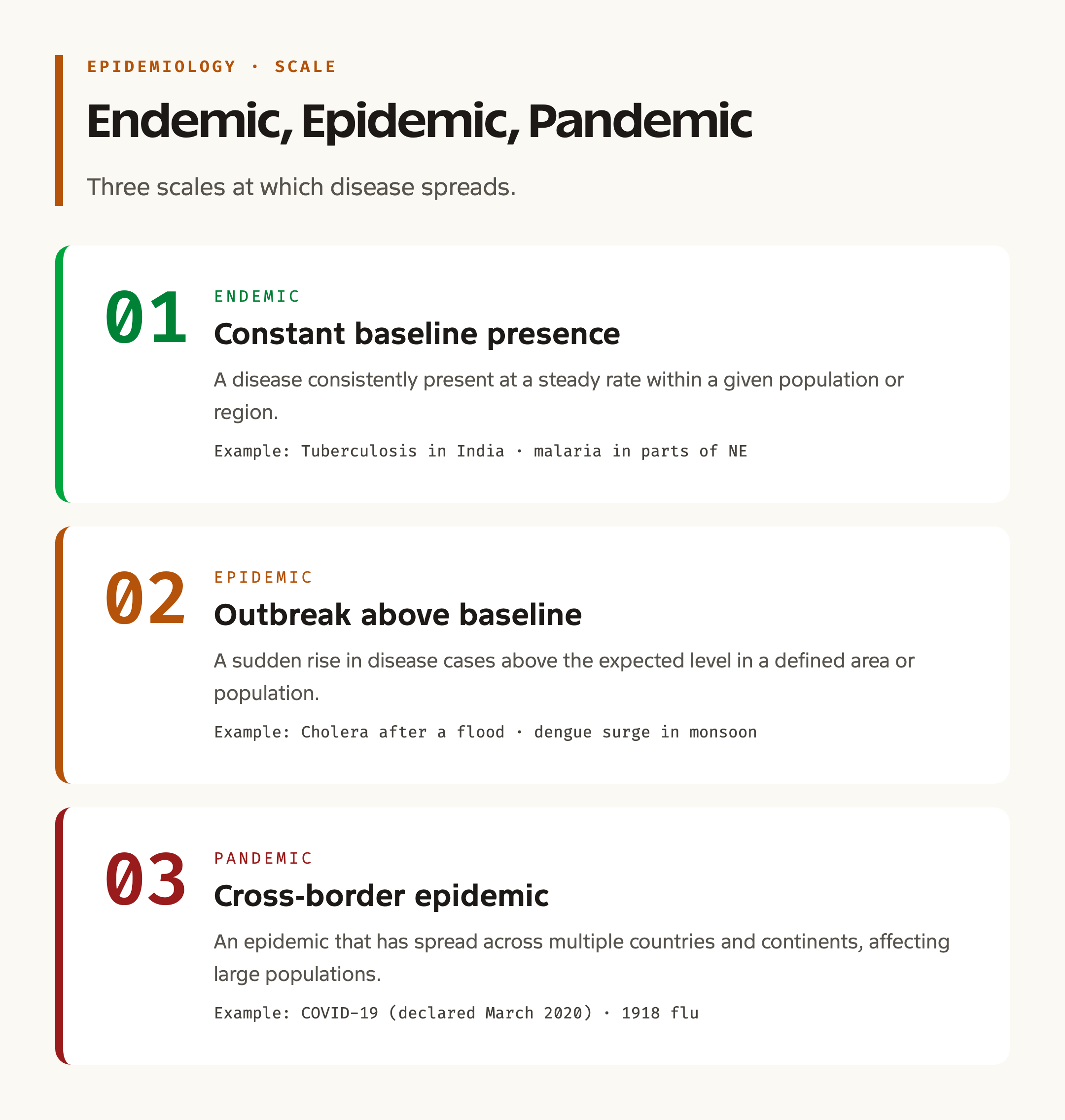
Three terms appear frequently and are routinely confused. An endemic disease is one that is consistently present at a baseline rate in a population. Tuberculosis in India is endemic. A new outbreak above the expected baseline is an epidemic. Cholera in a city after a flood is an epidemic. A pandemic is an epidemic that crosses international boundaries and affects a large number of people across several continents. COVID-19, declared a pandemic by the World Health Organization in March 2020, is the recent reference point.
Two related terms are useful. An outbreak is a sudden rise in cases above the expected baseline, often used for smaller events. A cluster is a set of cases close in time and place, possibly the start of an outbreak. The vocabulary matters for surveillance reporting.
Challenges in Disease Control in India
The challenges fall into a few buckets. The first is detection. Many cases of tuberculosis, kala-azar, and even malaria go undiagnosed or are diagnosed late, which fuels onward transmission. Strengthening primary health surveillance and lab capability is the standard first move.
The second is drug resistance. Multi-drug resistant tuberculosis is a serious problem. Antimalarial resistance has emerged in pockets. Antibiotic resistance in cholera and typhoid is a growing concern, especially with the spread of extensively drug-resistant typhoid in some neighbouring countries.
The third is vector ecology. Aedes aegypti has adapted superbly to urban India, breeding in clean stagnant water in containers, tyres, and rooftop tanks. Anopheles species have shifted their behaviour in response to long-running insecticide use. Climate change is shifting the geographic range of several vectors.
The fourth is the social determinants. Diseases of poverty respond to nutrition, sanitation, housing, and access to care, not only to drugs and vaccines. Sustained reduction in disease burden requires investment in the underlying conditions.
Prelims Pointers
- Malaria is caused by Plasmodium and transmitted by the female Anopheles mosquito. The sexual cycle of the parasite is in the mosquito.
- Dengue, chikungunya, and Zika are all transmitted by Aedes mosquitoes, primarily Aedes aegypti.
- Filariasis is caused by the worm Wuchereria bancrofti and transmitted by the Culex mosquito.
- Kala-azar is caused by Leishmania donovani and transmitted by the Phlebotomus sandfly.
- Tuberculosis is caused by Mycobacterium tuberculosis, an acid-fast bacillus.
- Cholera is caused by Vibrio cholerae and is waterborne.
- Typhoid is caused by Salmonella Typhi and is foodborne and waterborne.
- Japanese encephalitis is transmitted by the Culex mosquito and has the pig as an amplifying host.
- COVID-19 is caused by SARS-CoV-2, a coronavirus, transmitted by airborne droplets and aerosols.
- The relevant umbrella programme for vector-borne diseases is the National Vector Borne Disease Control Programme.
Mains Practice Questions
- Examine the structure of the disease burden in India and discuss how the design of national vertical disease control programmes responds to the biology of each pathogen. Use specific examples.
- Critically evaluate India’s progress towards elimination of tuberculosis, kala-azar, and lymphatic filariasis. What lessons can be drawn from the smallpox eradication campaign?
- Discuss the role of vector ecology, drug resistance, and climate change in shaping the future of communicable disease control in India.
Way Forward
The path forward for Indian communicable disease control rests on a few priorities. First, integrated disease surveillance has to become genuinely integrated, with electronic reporting from primary health centres flowing in real time to district and national dashboards. The Integrated Disease Surveillance Programme has been moving in this direction but execution varies sharply between states.
Second, diagnostic capability at the primary care level needs to expand. Molecular tests like CBNAAT, rapid diagnostic tests for malaria and dengue, and antigen tests for typhoid have to be available at the point of care. Treatment cannot wait for sample transport to a distant lab.
Third, vector control has to move beyond fogging campaigns to source reduction, environmental management, and community engagement. The Aedes mosquito breeds in domestic water containers. Reducing breeding sites is more durable than killing adult mosquitoes after the fact.
Fourth, the social determinants matter. Clean water, safe sanitation, decent housing, and adequate nutrition remove the conditions that allow these diseases to thrive. Over the long arc, India’s success against communicable disease will rest on improvements in these underlying systems as much as on programme-specific interventions.
Frequently Asked Questions
Which mosquito carries malaria?
Malaria is transmitted by the female Anopheles mosquito. Only the female feeds on blood, which is why she is the vector. The male feeds on plant juices.
Which mosquito carries dengue?
Dengue is transmitted primarily by Aedes aegypti, with Aedes albopictus as a secondary vector. The same mosquito also transmits chikungunya, Zika, and yellow fever.
What is the difference between a virus, a bacterium, and a protozoan?
A virus is an obligate intracellular parasite that requires a host cell to replicate. A bacterium is a single-celled organism that can usually replicate independently. A protozoan is a single-celled eukaryote, more complex than a bacterium, often with a defined life cycle in one or more hosts.
Why is dengue more dangerous on the second infection?
Dengue has four serotypes. Infection by one serotype produces antibodies that give long-term protection against that serotype but only partial protection against the others. On a second infection by a different serotype, the existing antibodies can in some cases enhance viral entry into cells, a phenomenon called antibody-dependent enhancement, raising the risk of severe dengue.
What is the difference between an epidemic and a pandemic?
An epidemic is an outbreak that affects a particular population or region above the expected baseline. A pandemic is an epidemic that has spread across multiple countries and continents, affecting a large number of people.
What is the National Tuberculosis Elimination Programme?
The National Tuberculosis Elimination Programme, NTEP, is the rebranded successor to the Revised National Tuberculosis Control Programme. It targets the elimination of tuberculosis as a public health problem in India by 2025, ahead of the global target of 2030.
Which disease has India already eradicated?
India achieved smallpox eradication by 1975 as part of the global eradication campaign. India has also been certified polio-free by the World Health Organization in 2014, although global eradication of polio is still pending.
Why is kala-azar concentrated in certain Indian states?
Kala-azar transmission depends on the Phlebotomus sandfly, which thrives in specific ecological conditions, including mud-walled houses, organic debris, and a particular humidity range. Bihar, Jharkhand, parts of West Bengal, and Uttar Pradesh have historically carried most of India’s case load.
What is mass drug administration?
Mass drug administration is the practice of giving the same medication to entire eligible populations in a defined area, regardless of individual infection status, to break disease transmission. It is used in lymphatic filariasis elimination and in some intestinal worm campaigns.
How does climate change affect communicable disease in India?
Climate change shifts the geographic range and seasonal dynamics of vectors. Aedes and Anopheles mosquitoes are sensitive to temperature, rainfall, and humidity. Warming and changes in precipitation can extend the transmission season, push vectors into new areas, and alter the relative dominance of different species.
Tell Google you want more of this.
Add Anantam IAS as a preferred sourceOne tap, and this site shows up more often in your own Top Stories, AI Overviews and AI Mode. Remove it any time.





