

The question of who owns the output of an AI system was once academic. It is now central to how the next decade of the global creative economy will be organized. When a generative model writes a news article, paints an image, or composes a tune, three sets of interests collide. The human creators whose work was used to train the model want compensation. The AI developer wants legal certainty about training rights. The user who issues the prompt and edits the output wants copyright in the result. None of the existing copyright statutes was written with this triangle in mind.
In December 2025, the Department for Promotion of Industry and Internal Trade released a working paper that proposed something new for India. A Hybrid Licensing Model. A statutory licence for AI training data, paired with mandatory royalty payments through a new collective body called the Copyright Royalties Collective for AI Training. The proposal explicitly rejects the United States approach, where AI training is largely defended on a broad fair-use doctrine. It also goes further than the European Union’s text-and-data-mining exception. The shift, if it becomes law, would make India the first major economy to convert AI training rights into a licence-and-pay system.
This article walks through the architecture, the litigation that triggered it, and where India sits in a global comparison. It is now one of the most active intersections of intellectual property rights, technology policy, and constitutional law in the GS-III syllabus.
Quick Facts on Copyright and AI
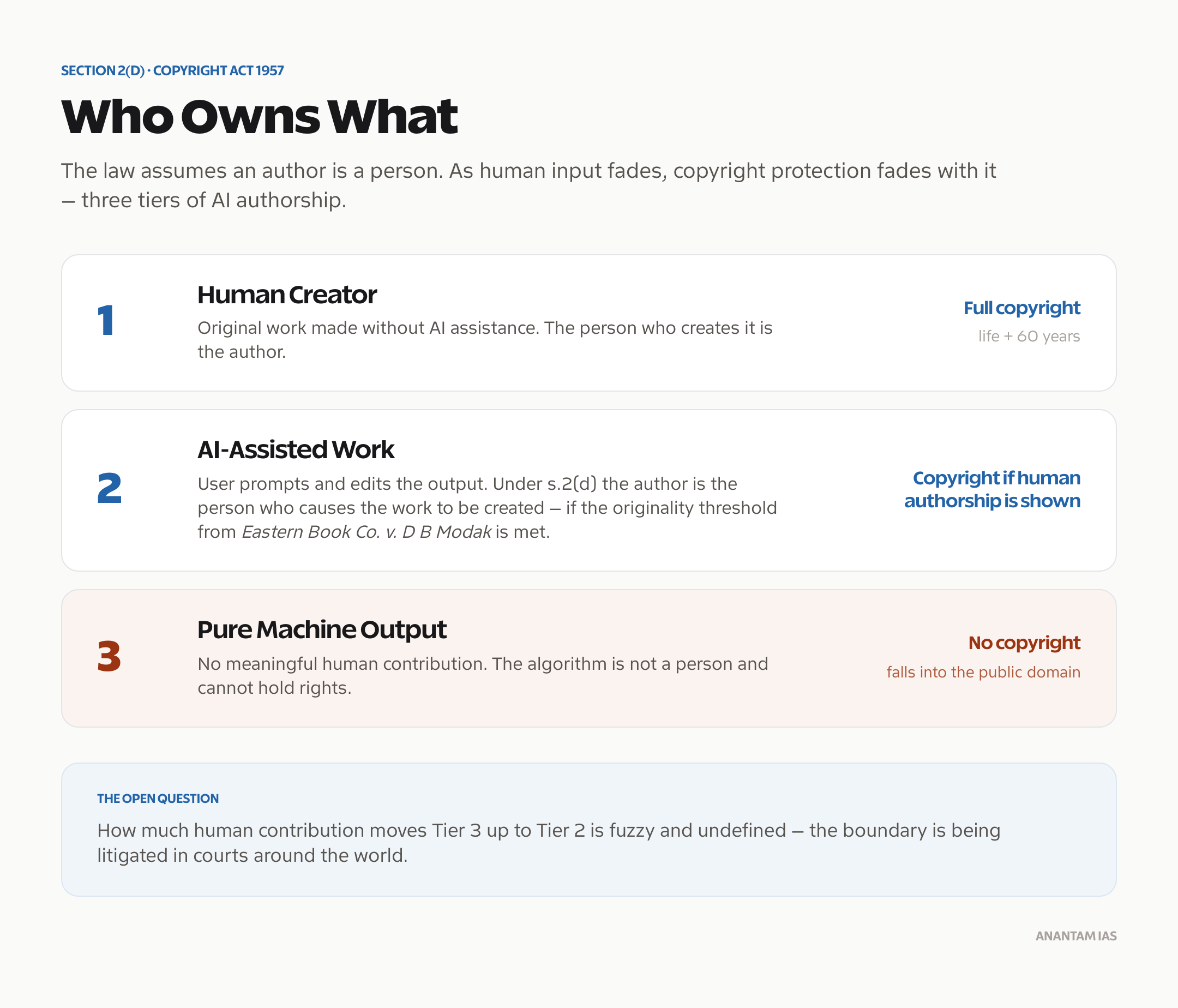
The Copyright Act of 1957 is the principal statute. Section 2(d) defines an author. The categories are familiar. The author of a literary, dramatic, musical, or artistic work is the person who creates it. The author of a cinematograph film is the producer. The author of a sound recording is the producer. The author of a computer-generated work is the person who causes the work to be created.
The last clause is the one that bears most directly on AI. In its current reading, the law assumes that the person who causes the work to be created is the human user issuing the prompt or running the model, not the algorithm itself. The algorithm is not a person and cannot hold rights. Whether the human contribution is enough to attract copyright depends on the originality test, which is itself the subject of considerable litigation.
The training-data question is separate. Training a foundation model involves making copies of copyrighted works at scale to feed into a learning algorithm. Whether that use is permitted by India’s fair-dealing exception under section 52, or whether it constitutes infringement, has not been settled by any Indian court.
What the 2025 DPIIT Proposal Actually Is
The DPIIT working paper of December 2025 takes a position. It treats large-scale ingestion of copyrighted material for AI training as a use that requires a licence. Rather than leaving AI developers to negotiate millions of bilateral licences with publishers, news agencies, music labels, and individual authors, the paper proposes a single statutory licence administered through a new body called the Copyright Royalties Collective for AI Training, abbreviated CRCAT.
Under the proposal, AI companies that train models on Indian copyrighted material would obtain a One Nation, One Licence, One Payment authorization. They would pay a calibrated royalty into CRCAT, which would distribute proceeds to rights holders based on usage data. Content creators would not be able to opt out individually. The trade-off is that they are guaranteed payment.
The model rejects both the American fair-use defence, which would allow training without payment, and the European opt-out model under the Digital Single Market Directive, which lets rights holders block their work from being mined. The Indian middle position is licence-and-pay, with no opt-out and no free use.
Background and Historical Context
The Copyright Act was enacted in 1957, four decades before the public internet and seven decades before generative AI. It has been amended multiple times to keep pace with technology, including significant changes in 2012 to bring the statute in line with the WIPO Copyright Treaty and the WIPO Performances and Phonograms Treaty. None of those amendments anticipated machine learning.
The fair-dealing exception under section 52 covers research, criticism, review, news reporting, private use, and educational use. The list is closed. Indian courts have read the exception narrowly compared with the open-ended American fair-use standard. Text and data mining for commercial purposes does not appear in section 52, leaving AI training in a legal grey zone in India.
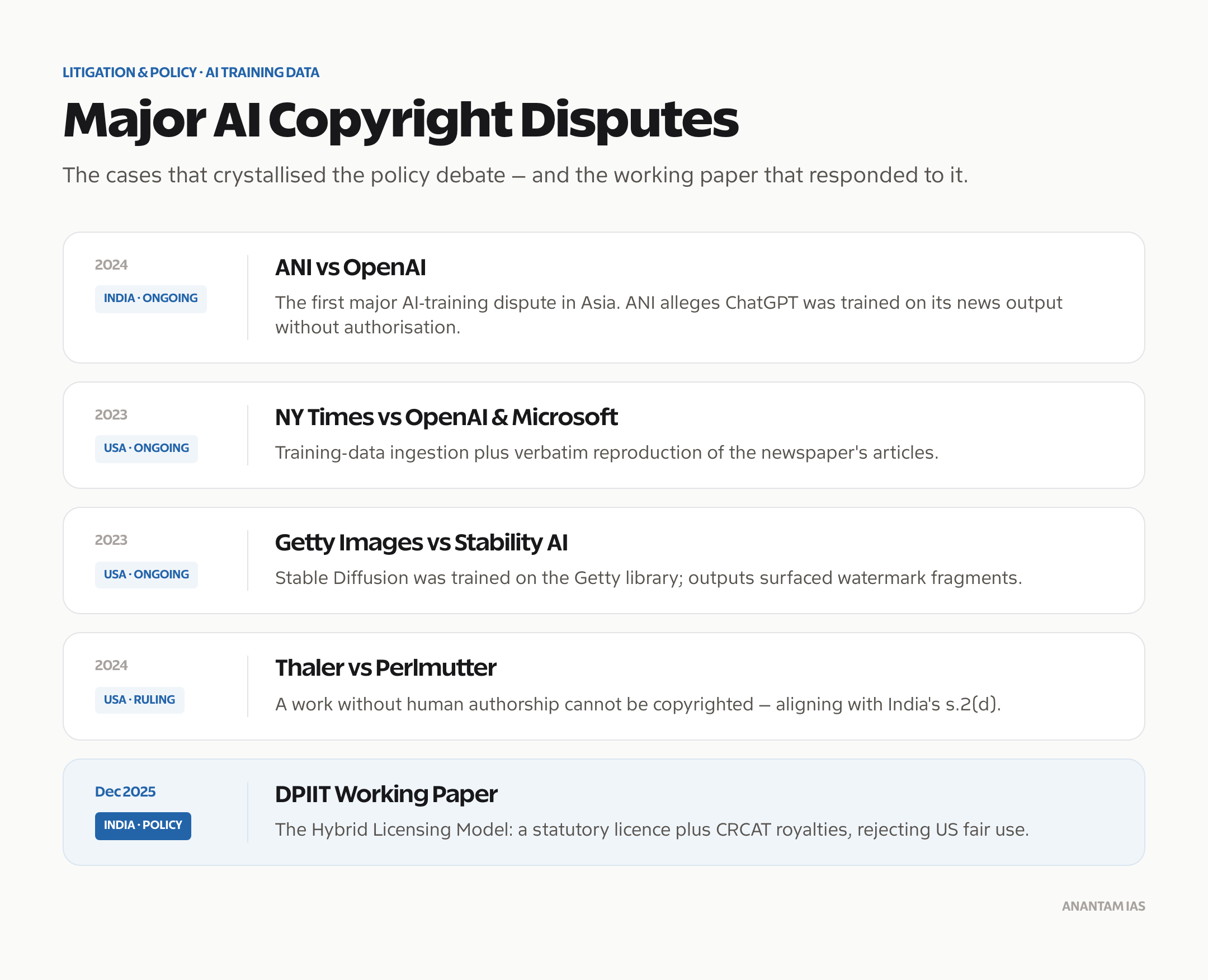
The pressure on this grey zone built through 2023 and 2024. ChatGPT, Gemini, Claude, and other foundation models had clearly been trained on Indian content scraped from news sites, government databases, social media, and book digitizations. Indian newspapers and news agencies began complaining publicly. The first formal litigation came in late 2024 when Asian News International sued OpenAI for using its news content as training data without authorization.
The DPIIT working paper of December 2025 is the policy response. It signals that India will not wait for years of litigation to settle the question and will instead legislate a clear framework. If converted into a Copyright Amendment Bill in 2026, the framework would change Indian copyright law for the first time since 2012.
Key Features of the Hybrid Licensing Model
The proposed model has four moving parts. The first is the statutory licence itself. AI developers would not need to negotiate individual licences with rights holders. The licence would attach automatically once the developer registers with CRCAT and begins paying royalties.
The second is CRCAT, the Copyright Royalties Collective for AI Training. It would be modelled on existing collective management organizations that license music for radio and television, but with a much wider remit covering text, images, audio, video, and code. Distribution to rights holders would be based on usage analytics provided by AI developers.
The third is the no-opt-out rule. Rights holders cannot refuse to have their work used for training, but they are guaranteed compensation. The trade-off is that AI developers get legal certainty, and rights holders get a revenue stream they cannot achieve through individual enforcement.
The fourth is the royalty rate, which the working paper does not fix. Earlier drafts have suggested a tiered structure based on the developer’s annual revenue and the nature of the model. The actual rates would be set by a tariff-board mechanism, similar to how music broadcast royalties are set today.
Why It Matters
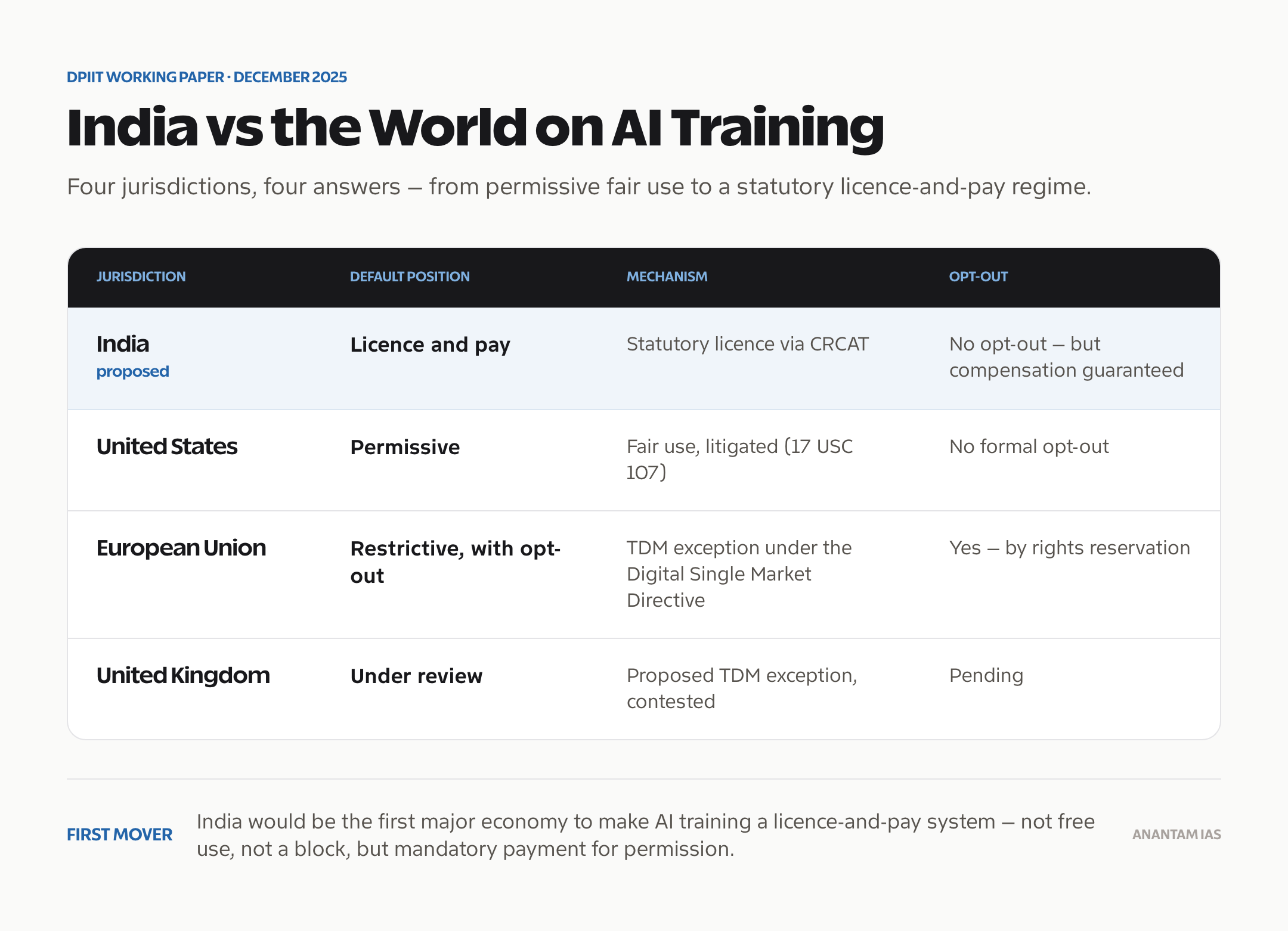
The model matters because it sets a global precedent. If India enacts statutory licensing for AI training, it becomes the first major jurisdiction to monetize the training process as a matter of statute. The European Union has an opt-out regime. The United States operates on litigated fair use. Japan permits training-data use without payment under specific circumstances. The Indian model is different from all three.
For Indian rights holders, the model promises revenue that individual enforcement could never produce. A small publisher cannot effectively sue a global AI company. A collective licence, distributed through a statutory body, can produce a meaningful payment stream even for small contributors.
For AI developers, the model offers legal certainty in a market that is otherwise growing rapidly. India’s data corpus is large, multilingual, and largely free of the litigation drag of the US market. A licence-and-pay regime makes Indian content predictable to use.
For Indian users and the broader AI ecosystem, the implications are mixed. Royalty costs would be passed on, in some form, to subscribers and enterprise customers. The trade-off is a more orderly relationship between AI companies and the creative economy, which could in turn enable richer Indian-language models trained on properly licensed content.
Detailed Analysis: The ANI versus OpenAI Case
The case that crystallized the policy debate is Asian News International versus OpenAI, filed in 2024 in Indian courts. ANI, one of India’s largest news agencies, alleged that OpenAI had ingested its copyrighted news output to train ChatGPT without authorization, and that ChatGPT continued to reproduce ANI-style outputs in response to user queries.
OpenAI’s defence has rested on three lines. First, that training-data ingestion is a non-expressive use that should not constitute infringement. Second, that to the extent any use is made, it falls within section 52 fair dealing as research or analysis. Third, that the actual outputs of ChatGPT are sufficiently transformed from any single source that no specific infringement can be shown.
ANI has argued that section 52 is closed and does not cover commercial text and data mining, that OpenAI’s commercial scale defeats any research framing, and that the model’s outputs in some cases reproduce identifiable ANI text. The case is among the first major AI-training disputes in Asia and has been watched globally for the precedent it might set.
The litigation is ongoing in 2025 and 2026. If India enacts the DPIIT Hybrid Licensing Model first, the statute may overtake the litigation. If the courts rule first, the judgment will set the baseline against which the statute is later drafted.
Comparative Snapshot: India, US, UK, EU on AI Training
The four major approaches sit on a spectrum from permissive to restrictive.
| Jurisdiction | Default Position | Mechanism | Opt-Out Available |
|---|---|---|---|
| United States | Permissive | Fair use, litigated | Not formal |
| European Union | Restrictive with opt-out | TDM exception under DSM Directive | Yes, by reservation |
| United Kingdom | Under review | Proposed TDM exception, contested | Pending |
| India (proposed) | Licence and pay | Statutory licence via CRCAT | No, but compensation guaranteed |
India’s position, if enacted, is unique. It does not let AI developers train for free. It does not let rights holders block training. It mandates payment in exchange for permission, with collective administration handling the matching of money to creators.
Challenges and Open Questions
The first challenge is the international interaction. AI models are trained globally. A model trained in California on Indian content sold to an Indian customer raises hard questions about which jurisdiction’s law applies. The DPIIT proposal would need to address extraterritorial reach if it is to bite on global developers.
The second challenge is rate-setting. CRCAT royalties would need to be set high enough to be meaningful to rights holders but low enough not to throttle AI development in India. The history of music royalty regulation suggests this is genuinely difficult and produces years of disputed appeals.
The third challenge is data attribution. To distribute royalties accurately, CRCAT would need usage data from AI developers showing which works were used and how often. AI developers may resist this disclosure on commercial-confidentiality grounds. Without disclosure, distribution defaults to broad-bucket allocation, which underpays larger contributors and overpays small ones.
The fourth challenge is constitutional. A no-opt-out compulsory licence touches the property right of authors under the Copyright Act, which is read alongside Article 300A. The proposal will need to demonstrate that the public interest justification meets the proportionality test.
The fifth challenge is downstream output. Even if training is licensed, the question of whether AI-generated outputs themselves qualify for copyright remains open. The leading view, drawn from section 2(d) and from the originality test in Eastern Book Company, is that human authorship is required and pure machine outputs are uncopyrightable. The boundary is fuzzy.
Prelims Pointers
- The Copyright Act of 1957 is the principal statute governing copyright in India.
- Section 2(d) of the Copyright Act defines an author as a person, which excludes machines and algorithms.
- The fair-dealing exception under section 52 covers a closed list that includes research, criticism, review, news reporting, and private use.
- The DPIIT working paper of December 2025 proposed a Hybrid Licensing Model with a statutory licence and royalty payments via the Copyright Royalties Collective for AI Training, CRCAT.
- ANI versus OpenAI is the leading Indian litigation on AI training data, filed in 2024.
- The European Union allows text and data mining under the Digital Single Market Directive with a rights-holder opt-out.
- The United States operates on a fair-use defence rather than a statutory training licence.
- Japan permits training-data use without payment under specific statutory carve-outs.
- The Eastern Book Company versus D B Modak case set the originality test as the modicum of creativity standard.
- Computer-generated works are recognized in section 2(d), with authorship attributed to the person who causes the work to be created.
Mains Practice Questions
- Examine the implications of the DPIIT’s proposed Hybrid Licensing Model for AI training data. Compare it with the fair-use approach in the United States and the text-and-data-mining exception in the European Union, and discuss which model best fits India’s creative economy.
- Critically evaluate the legal framework governing AI-generated works under Indian copyright law. Discuss the role of section 2(d) of the Copyright Act, the originality test, and the implications of the ANI versus OpenAI litigation for the future of AI in India.
- The Copyright Act of 1957 was drafted in a pre-internet era. Discuss the major reforms needed to bring Indian copyright law in line with the realities of generative artificial intelligence, including training-data licensing, output attribution, and protection of creator livelihoods.
Way Forward
A coherent next phase has five components. First, conversion of the DPIIT working paper into a Copyright Amendment Bill in 2026, with detailed provisions on CRCAT’s structure, governance, and audit obligations. Second, a tariff-board mechanism with rights-holder, AI-developer, and consumer-side representation, modelled on the existing Copyright Board. Third, a clarifying provision on AI-generated outputs that explicitly fixes the originality threshold and authorship attribution rules, reducing downstream litigation. Fourth, a transitional safe harbour for AI developers who register with CRCAT during the rollout period, balanced against retroactive royalty obligations for past training. Fifth, alignment with the broader national IPR policy framework, including coordination with the Copyright Office and the Indian Patent Office on overlapping AI-and-IP questions. The window to set a global standard on AI training rights is narrow. India has the policy depth, the data corpus, and the litigation pressure to act first. The question is whether the political economy of rights holders, AI developers, and government revenue calculations align in time.
Frequently Asked Questions
Can an AI system hold a copyright in India?
No. Section 2(d) of the Copyright Act defines an author as a person. The law does not recognize a machine or algorithm as a legal entity capable of holding rights. The author of a computer-generated work is the person who causes the work to be created, which in current readings means the human user issuing the prompt or running the model.
What is the Hybrid Licensing Model proposed by DPIIT?
The Hybrid Licensing Model is a proposal in the December 2025 DPIIT working paper. It would create a statutory licence for AI training data, administered through a new body called the Copyright Royalties Collective for AI Training, CRCAT. AI companies would pay royalties for the right to train on Indian copyrighted content. Rights holders cannot opt out but are guaranteed compensation.
What is the ANI versus OpenAI case?
It is a litigation filed by Asian News International against OpenAI in Indian courts in 2024, alleging that ChatGPT was trained on ANI’s copyrighted news content without authorization and that the model’s outputs reproduce identifiable ANI material. The case is among the first major AI-training disputes in Asia and is being watched globally as a precedent.
How is fair dealing in India different from fair use in the United States?
Fair dealing under section 52 of the Indian Copyright Act covers a closed list of permitted uses, including research, criticism, review, news reporting, private use, and educational use. The American fair-use standard is open-ended and applies a four-factor balancing test. Fair dealing is therefore narrower and does not currently cover commercial text and data mining for AI training.
Will Indian creators have to allow their work to be used for AI training?
If the DPIIT Hybrid Licensing Model is enacted, yes. Rights holders would not be able to opt out, but they would be compensated through the Copyright Royalties Collective for AI Training. The trade-off is guaranteed payment in exchange for unblocked use.
How does the European Union approach AI training data?
The European Union allows text and data mining under the Digital Single Market Directive with a rights-holder opt-out. Rights holders who reserve their rights, typically through machine-readable signals, can block the use of their work. Those who do not reserve are deemed to have consented.
What is CRCAT?
CRCAT is the proposed Copyright Royalties Collective for AI Training, a new statutory body that would license AI training rights collectively, collect royalties from AI developers, and distribute proceeds to rights holders. It would be modelled on existing collective management organizations that license music for radio and television, but with a wider remit covering text, images, audio, video, and code.
Can a person who issues a prompt to ChatGPT claim copyright in the output?
Possibly. The current reading of section 2(d) attributes authorship of a computer-generated work to the person who causes the work to be created, which in most cases is the human user. Whether the output meets the originality threshold under Eastern Book Company versus D B Modak is a separate question and depends on the specific creative contribution of the user.
Why is text and data mining for AI training treated differently from research?
Research under section 52 is read in Indian case law as non-commercial inquiry by a defined person or institution. Text and data mining for AI training is large-scale, commercial, and conducted by entities whose end product competes with the original works. Indian courts have so far been reluctant to fold commercial AI training into the research exception.
When will India have a final law on AI and copyright?
The DPIIT working paper of December 2025 is the latest formal proposal. Conversion into a Copyright Amendment Bill, parliamentary debate, and final enactment would normally take twelve to twenty-four months. The ANI versus OpenAI litigation may produce judicial guidance in parallel. A combined statutory and judicial picture should emerge over the course of 2026 and 2027.
Tell Google you want more of this.
Add Anantam IAS as a preferred sourceOne tap, and this site shows up more often in your own Top Stories, AI Overviews and AI Mode. Remove it any time.






