Disclosure: this guide contains Amazon affiliate links. As an Amazon Associate, Anantam IAS earns from qualifying purchases — at no extra cost to you.
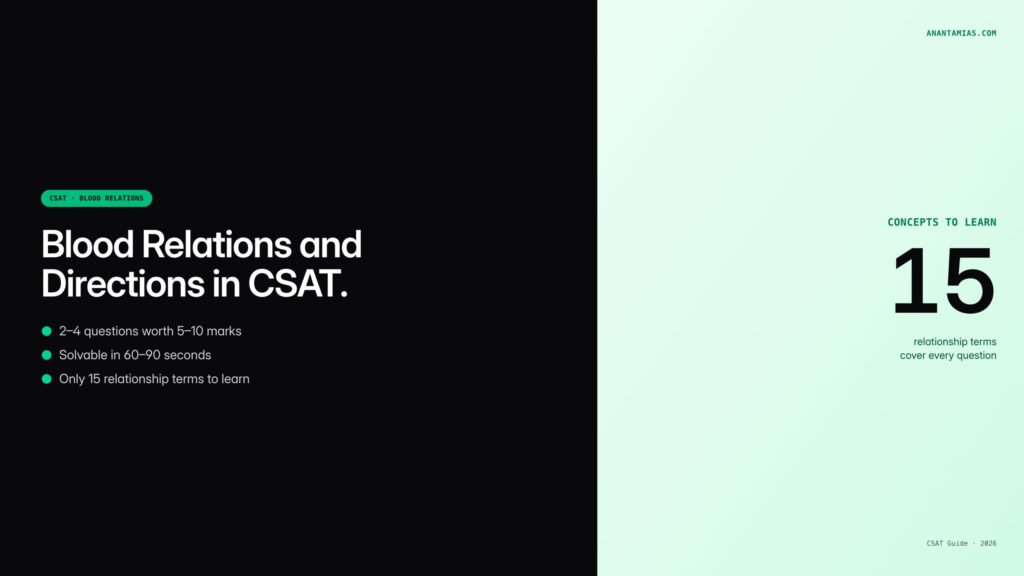
Blood relations and direction sense questions appear in CSAT almost every year, contributing 2 to 4 questions worth 5 to 10 marks. These questions are high-yield: solvable in 60 to 90 seconds once you master a few basic techniques. This guide covers the standard relationship terms, the family-tree method, and direction sense rules.
Why These Questions Are Scoring
- Concepts are finite: 15 relationship terms, 8 directions.
- No outside knowledge required.
- Solvable with diagrams, minimal arithmetic.
- Consistent format year after year.
Standard Family Relationship Vocabulary
| Relation | Meaning | Relation | Meaning |
|---|---|---|---|
| Paternal uncle | Father’s brother | Maternal uncle | Mother’s brother |
| Paternal aunt | Father’s sister | Maternal aunt | Mother’s sister |
| Nephew | Brother/sister’s son | Niece | Brother/sister’s daughter |
| Brother-in-law | Sister’s husband / spouse’s brother | Sister-in-law | Brother’s wife / spouse’s sister |
| Cousin | Uncle/aunt’s child | Son-in-law | Daughter’s husband |
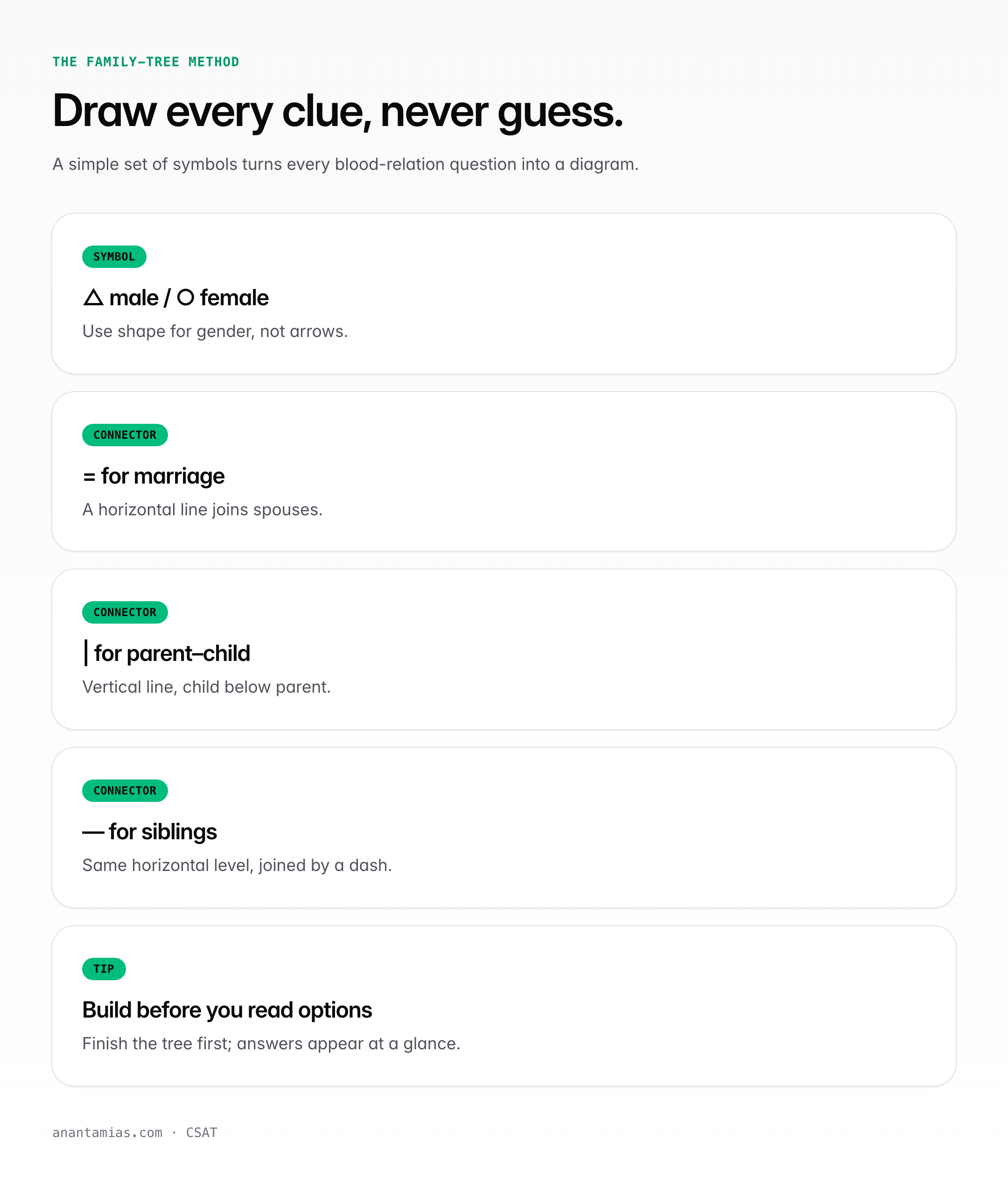
The Family Tree Method
Represent every relationship visually:
- Use △ for male, ○ for female.
- Connect marriage with = (horizontal line).
- Connect parent-child with | (vertical line).
- Siblings sit at the same horizontal level connected by —.
Worked Example 1
A is B’s brother. B is C’s mother. C is D’s sister. How is A related to D?
Solution: B has two children — C and D. A is B’s brother, so A is the maternal uncle of C and D. Answer: Maternal uncle.
Worked Example 2
Pointing to a photograph, a man said, ‘She is the daughter of the only son of my grandfather.’ How is the girl related to the man?
Solution: Grandfather’s only son = the man’s father. Father’s daughter = the man’s sister. Answer: Sister.
Worked Example 3
P is Q’s wife. R is the son of Q. S is R’s sister. T is S’s mother. How is T related to P?
Solution: Q and P are married. R and S are their children. S’s mother is Q’s wife, which is P. T is the same person as P.
Tricky Phrasing to Watch For
- ‘Only son of my father’ = the speaker himself.
- ‘Only daughter of my mother’ = the speaker herself (if female).
- ‘My father’s only brother’ = the speaker’s paternal uncle.
- ‘Wife of the only son of…’ requires two-level deduction.
Direction Sense Fundamentals
Always draw a compass at the top of your rough space:
- North ↑, South ↓, East →, West ←.
- Northeast = between N and E (upper right).
- Southwest = between S and W (lower left).
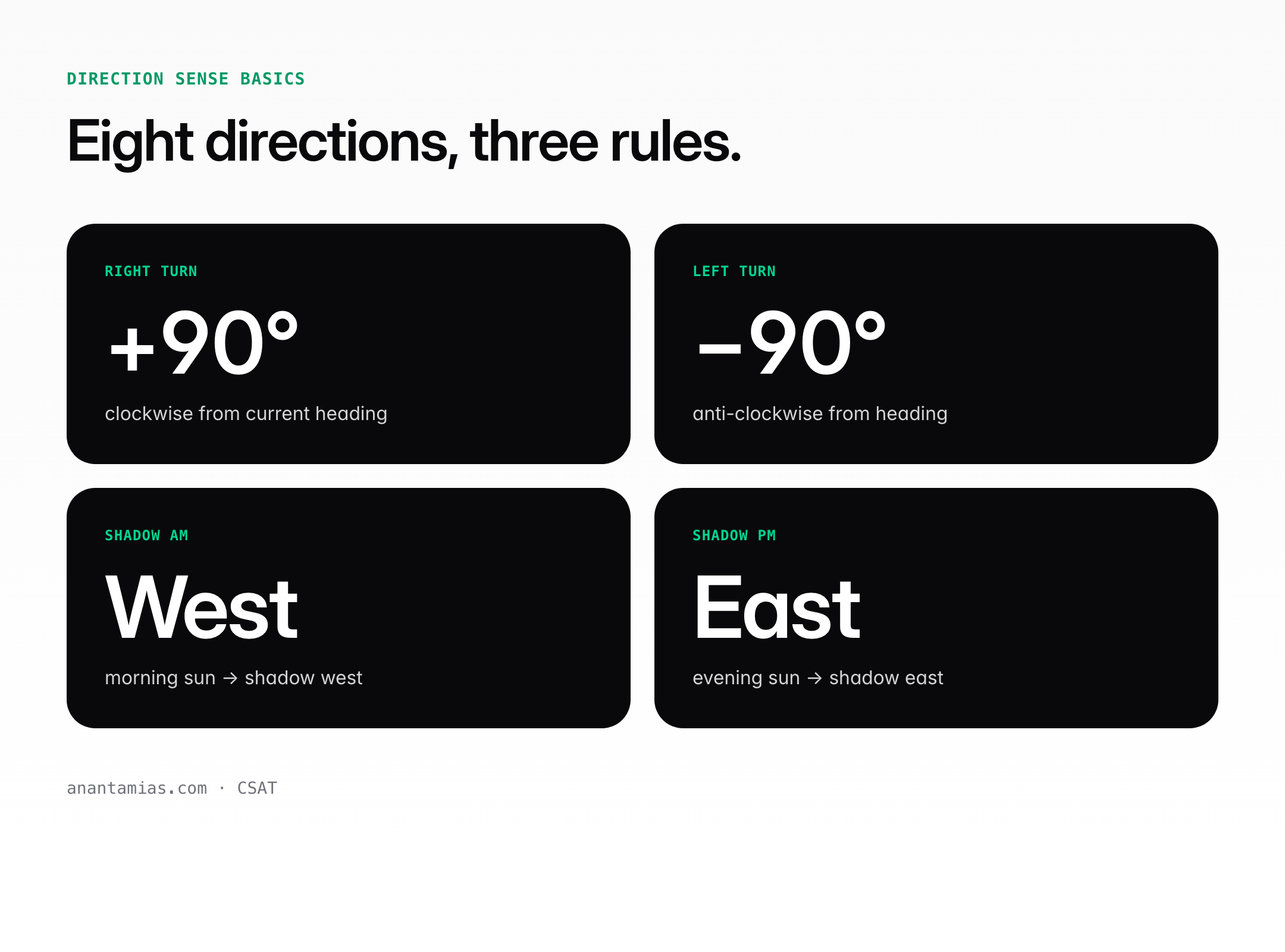
- A right turn when facing North = East.
- A left turn when facing North = West.
Direction Sense Example
A man walks 5 km North, then turns right and walks 3 km, then turns right again and walks 5 km. How far is he from the starting point and in which direction?
Solution: 5 km N, then 3 km E (right turn from N = E), then 5 km S (right turn from E = S). Net displacement = 0 N/S, 3 km E. He is 3 km east of the starting point.
Clock-Based Direction Questions
UPSC sometimes frames directions using clock angles: ’45° clockwise from North’ = Northeast. ’90° anticlockwise from East’ = North. Memorize:
| Angle from North (clockwise) | Direction |
|---|---|
| 0° | North |
| 45° | Northeast |
| 90° | East |
| 135° | Southeast |
| 180° | South |
| 225° | Southwest |
| 270° | West |
| 315° | Northwest |
Shadow-Based Direction
At sunrise, the sun is in the east. A man’s shadow falls to the west. At sunset, the sun is in the west; shadows fall east. At noon, shadows are short and point north (in the Northern Hemisphere).
Common Mistakes
- Assuming gender when not stated.
- Confusing ‘father-in-law’ with ‘paternal uncle.’
- Missing ‘only’ qualifier (only son, only daughter).
- Not drawing a compass for direction questions.
- Miscalculating displacement when paths overlap.
Practice Strategy

A Modern Approach to Verbal & Non-Verbal Reasoning — R.S. Aggarwal
- 932 pages across verbal and non-verbal reasoning
- Pattern-based practice for the reasoning half of CSAT
- Solutions worked out rather than just answer keys
- Solve 5 blood relation and 5 direction questions daily for 2 weeks.
- Build muscle memory for family-tree diagrams.
- Time yourself: target 60 seconds per blood relation, 45 seconds per direction.
- Review previous year CSAT questions on these topics — highly repeatable.
Key Takeaway
Blood relations and direction sense are CSAT’s easiest marks if you commit to the diagram method. Never solve these questions in your head — always draw. The 10 seconds spent drawing save 60 seconds of confusion.
Frequently Asked Questions
How many blood relation questions come in CSAT?
Typically 1 to 2 blood relation questions and 1 to 2 direction sense questions every year, totaling 5 to 10 marks. These are among the most predictable question types.
What is the fastest way to solve blood relation questions?
Draw a family tree with standard symbols (△ male, ○ female, = married, | parent-child). Process the statement sentence by sentence. This eliminates 90% of confusion.
How do I handle coded blood relations?
If ‘A + B’ means ‘A is the father of B,’ simply substitute the code as you read. Maintain the family tree throughout. UPSC rarely asks coded blood relations, but banking exams do.
Why do I keep making errors in direction sense?
Usually because you skip drawing the compass. Always draw N-E-S-W at the top. For every movement, update your position on paper. In-head calculation fails for anything more than 2 turns.
Are 3-D direction questions asked?
Rarely in CSAT. Occasionally a shadow-direction question appears, which uses east-sunrise, west-sunset, and noon-shadow-north conventions. Memorize these.
Tell Google you want more of this.
Add Anantam IAS as a preferred sourceOne tap, and this site shows up more often in your own Top Stories, AI Overviews and AI Mode. Remove it any time.