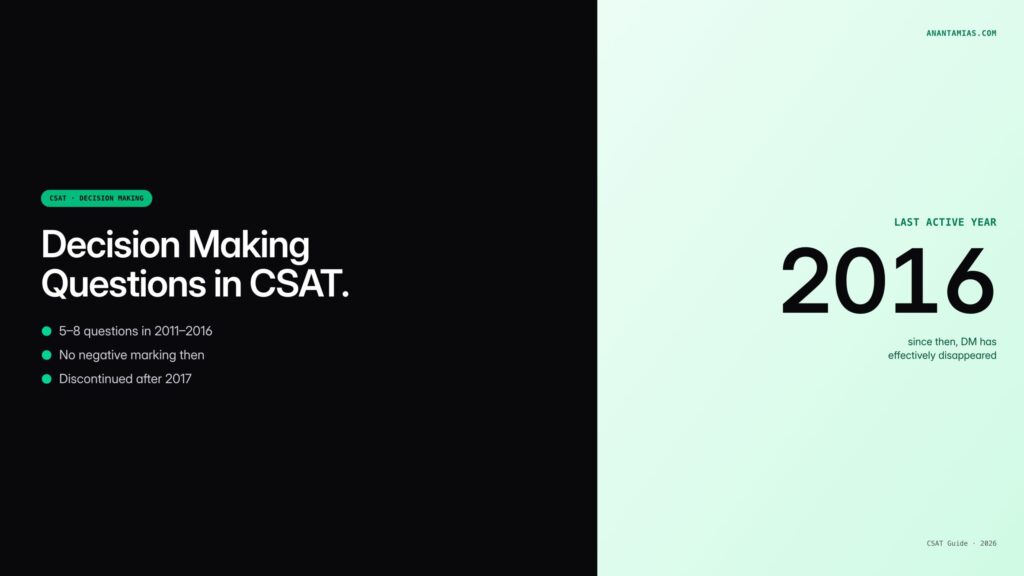
Decision making questions were once a regular feature of CSAT, carrying 5 to 8 questions per paper from 2011 to 2016. Unique to CSAT, these questions had no negative marking and tested administrative judgment in hypothetical scenarios. Since 2017, decision making has been largely discontinued, but understanding the format is useful for interview preparation and for candidates preparing from older papers.
What Are Decision Making Questions?
A decision making question presents a scenario where the candidate is placed in an administrative role — typically a District Magistrate, SDM, or departmental officer. The candidate must choose the ‘best’ course of action from four or five given options. UPSC explicitly stated that there was no single right answer — all options carried partial credit except the least appropriate, which carried zero.
Standard Scenario Types
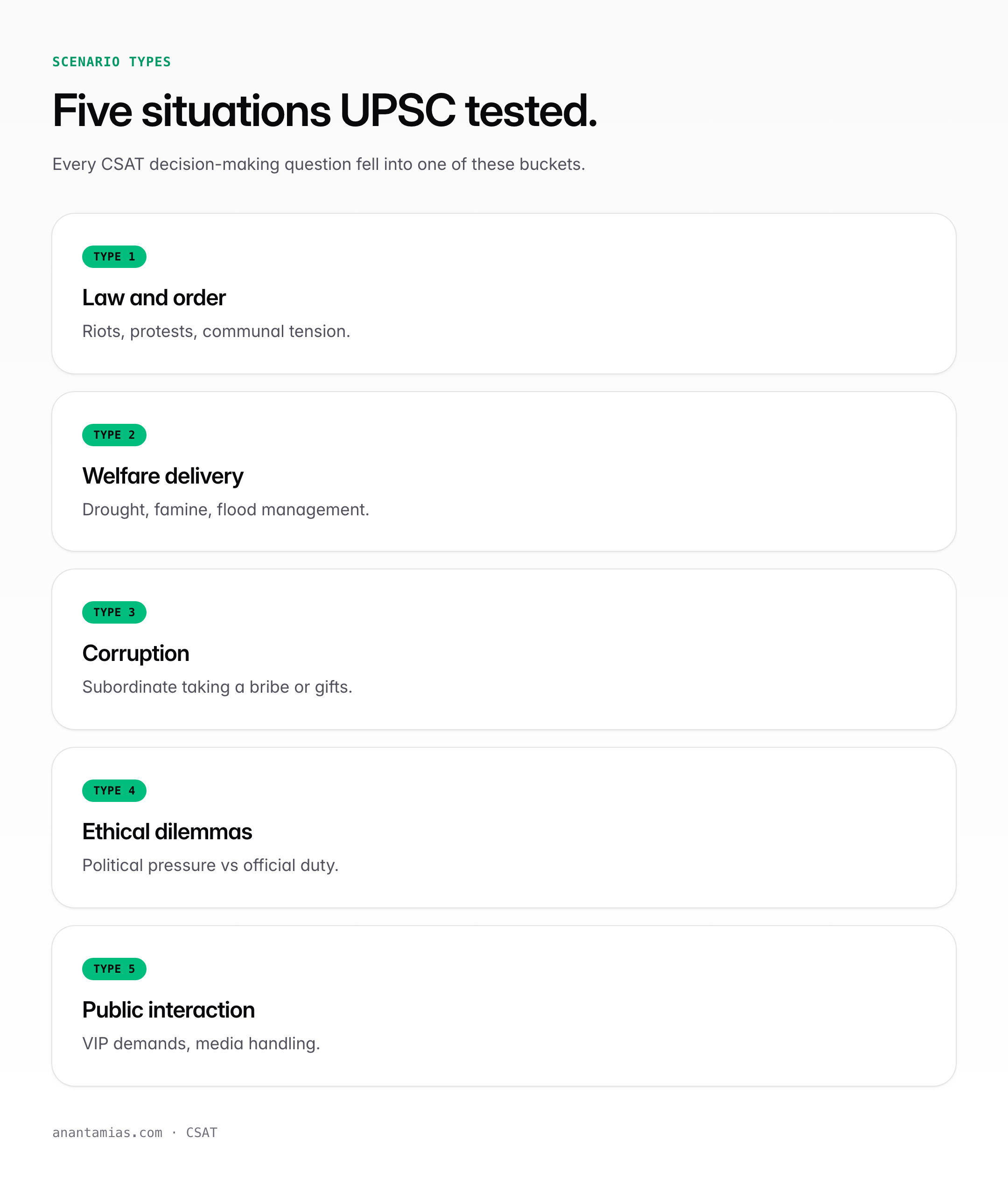
- Law and order: Riot, protest, or communal situation.
- Welfare delivery: Drought relief, famine, flood management.
- Corruption: Subordinate accepting bribes.
- Ethical dilemmas: Political pressure, personal vs official duty.
- Public interaction: VIP demands, media handling.
The Ideal Decision Making Framework
UPSC valued decisions that balanced four pillars:
- Legality: Is the action within the rulebook?
- Feasibility: Can it be implemented now?
- Effectiveness: Does it solve the problem?
- Ethics: Is it fair, transparent, and compassionate?
Sample Decision Making Question (CSAT 2014)
You are the Tehsildar. A group of villagers, displaced by a flash flood, have gathered at the block office demanding food and shelter. You are alone, without subordinate staff. What is your most appropriate response?
- (a) Inform the District Collector and wait for instructions.
- (b) Arrange immediate food and shelter from local resources and then inform higher authorities.
- (c) Tell the villagers to wait till tomorrow.
- (d) Send the villagers to the nearest police station.
Best answer: (b). Immediate action on humanitarian grounds is essential. Informing superiors after providing relief balances legality with compassion. (a) is slow; (c) is insensitive; (d) shifts the problem.
Principles That Guided UPSC’s ‘Best Answer’
- Prioritize the public over paperwork.
- Act within legal authority but show initiative.
- Compassion over rigidity.
- Transparency — inform superiors after acting.
- Avoid passing the buck.
Why Decision Making Was Discontinued
UPSC faced growing criticism that decision making was subjective, rewarding ‘politically correct’ answers over analytical skill. From 2017, the section was effectively removed, with occasional standalone ethical scenarios replacing full question sets. By 2022, decision making had vanished entirely from CSAT.
Is Decision Making Still Tested Anywhere?
- Not in CSAT (post-2022).
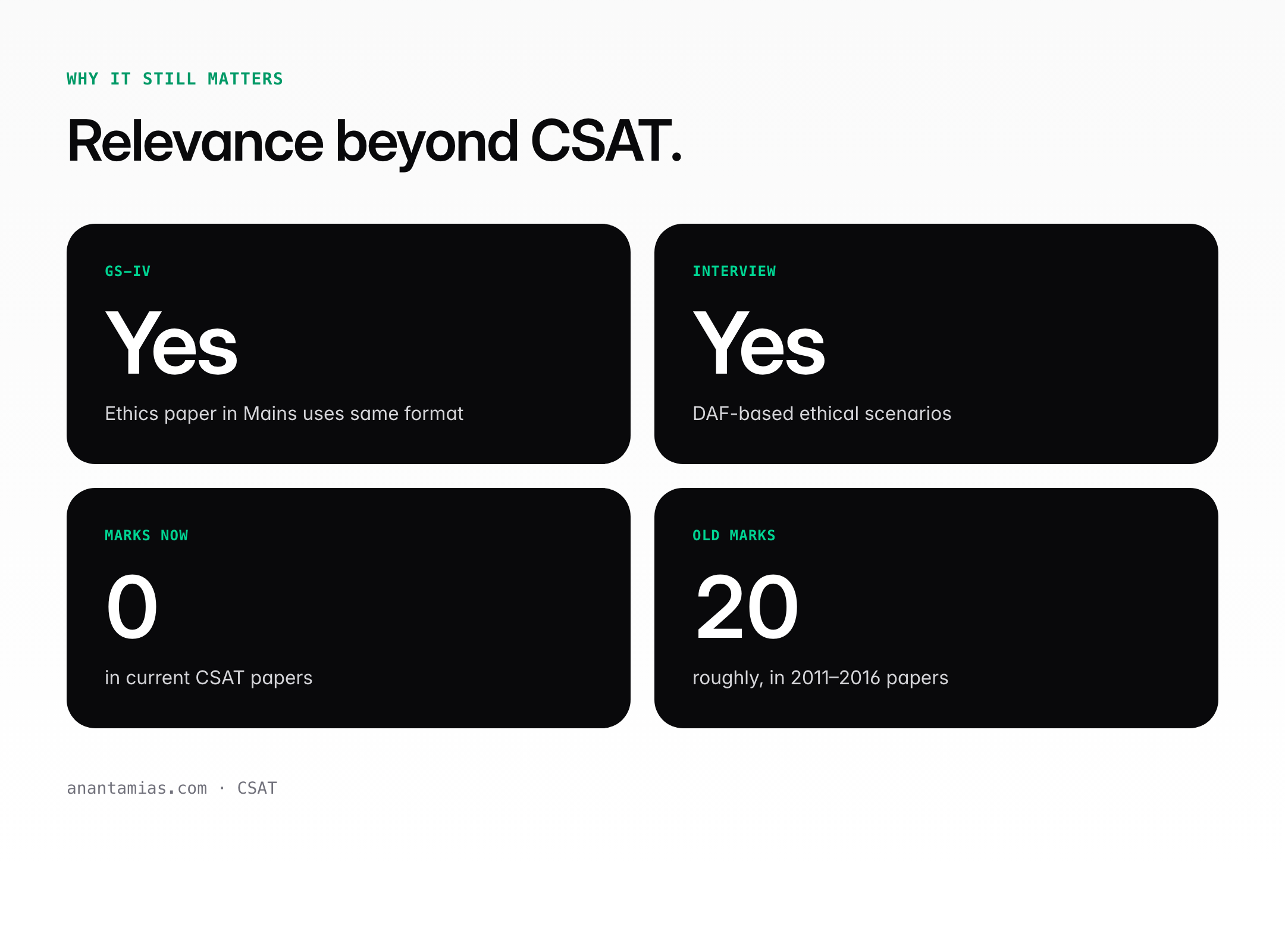
- Yes in Ethics, Integrity & Aptitude (GS Paper IV of Mains).
- Yes in the UPSC Personality Test (interview).
- Yes in case-study-style Mains GS-IV questions (125 marks).
Types of Decision Making Tested in GS-IV
| Scenario Type | Typical Case Study |
|---|---|
| Conflict of interest | Friend/relative involved in govt contract |
| Whistleblowing | Senior committing fraud |
| Resource allocation | Limited vaccines, multiple claimants |
| Transparency | Revealing sensitive info to media |
| Personal vs professional | Family emergency during duty crisis |
How to Practice Decision Making
- Read decision making sections of CSAT 2011 to 2016 papers.
- For each scenario, write your answer in 2 to 3 sentences.
- Compare with ideal answers from ClearIAS or Insights.
- Use the 4-pillar framework (legality, feasibility, effectiveness, ethics).
Useful Phrases in Decision Making Responses
- ‘I would first assess the immediate risk before taking action.’
- ‘While following due process, I would also ensure humanitarian concerns are addressed.’
- ‘Informing senior officers without delay is essential, but immediate relief cannot wait.’
- ‘Legal provisions must be respected, but compassion informs the manner of execution.’
Common Mistakes
- Picking the ‘safest’ answer that avoids all risk (often passive).
- Choosing the ‘most dramatic’ action without legality.
- Ignoring the institutional hierarchy.
- Forgetting to act — deliberation alone is not a decision.
Key Takeaway
Though decision making is no longer tested in CSAT, its logic powers GS-IV case studies and interviews. Master the 4-pillar framework and you will benefit across Mains and Personality Test. Do not overinvest in decision making for CSAT itself — it will not appear.
Frequently Asked Questions
Is decision making still asked in CSAT?
No. Decision making has been effectively discontinued in CSAT since 2017 and completely absent since 2022. Your preparation focus should be on RC, reasoning, and quant.
Where is decision making now tested?
In GS Paper IV (Ethics, Integrity and Aptitude) in Mains as case studies worth 125 marks, and in the UPSC Personality Test (interview) as situational questions.
Did decision making have negative marking?
No. When decision making was part of CSAT, all options carried partial marks except the worst, which carried zero. There was no negative marking, which made it a ‘free points’ section for most candidates.
How do I approach a decision making question?
Use the 4-pillar framework: Is it legal? Is it feasible? Is it effective? Is it ethical? The best answer balances all four. Avoid both extreme inaction and extreme heroism.
Should I study decision making from old CSAT papers?
Yes, if you are preparing for GS-IV Mains or interviews. The situational logic is identical. For CSAT itself, skip these sections — they will not appear in 2025 or 2026.
Tell Google you want more of this.
Add Anantam IAS as a preferred sourceOne tap, and this site shows up more often in your own Top Stories, AI Overviews and AI Mode. Remove it any time.