Disclosure: this guide contains Amazon affiliate links. As an Amazon Associate, Anantam IAS earns from qualifying purchases — at no extra cost to you.
CSAT previous year papers from 2011 to 2025 are the single most important resource for cracking Paper II of UPSC Prelims. Fifteen years of papers, 1,200+ questions, and a single qualifying threshold of 33% — these are the only mocks that actually count. Every other test series is a guess at what UPSC will do; only the official PYQs tell you what UPSC has actually done.
This page gives you the complete official archive: every CSAT Paper II from 2011 through 2025, downloadable from upsc.gov.in, plus a year-by-year analysis of difficulty, topic weightage, and what the paper has been quietly drifting towards. Save the table, work through the papers in order, and you’ll see the pattern long before you write your own attempt.
If you treat CSAT as just qualifying and leave it for the last two months, 2023 will repeat itself. Roughly 72% of attempters did not clear CSAT that year. Most of them had no problem with GS1. Plan accordingly.
Download CSAT Previous Year Papers (2011-2026)
All papers below are direct links to the official UPSC archive. Where UPSC has retired older PDFs from its public-facing folder, the link points to the official Civil Services Preliminary archive page, where the relevant year’s bundle is still listed.
| Year | Official PDF | Notes |
|---|---|---|
| 2026 | Download Paper II | Conducted 24 May 2026. Moderate-to-tough. Reading Comprehension 28 of 80. |
| 2025 | Download Paper II | Conducted 26 May 2025. Quant-heavy. RC complex. |
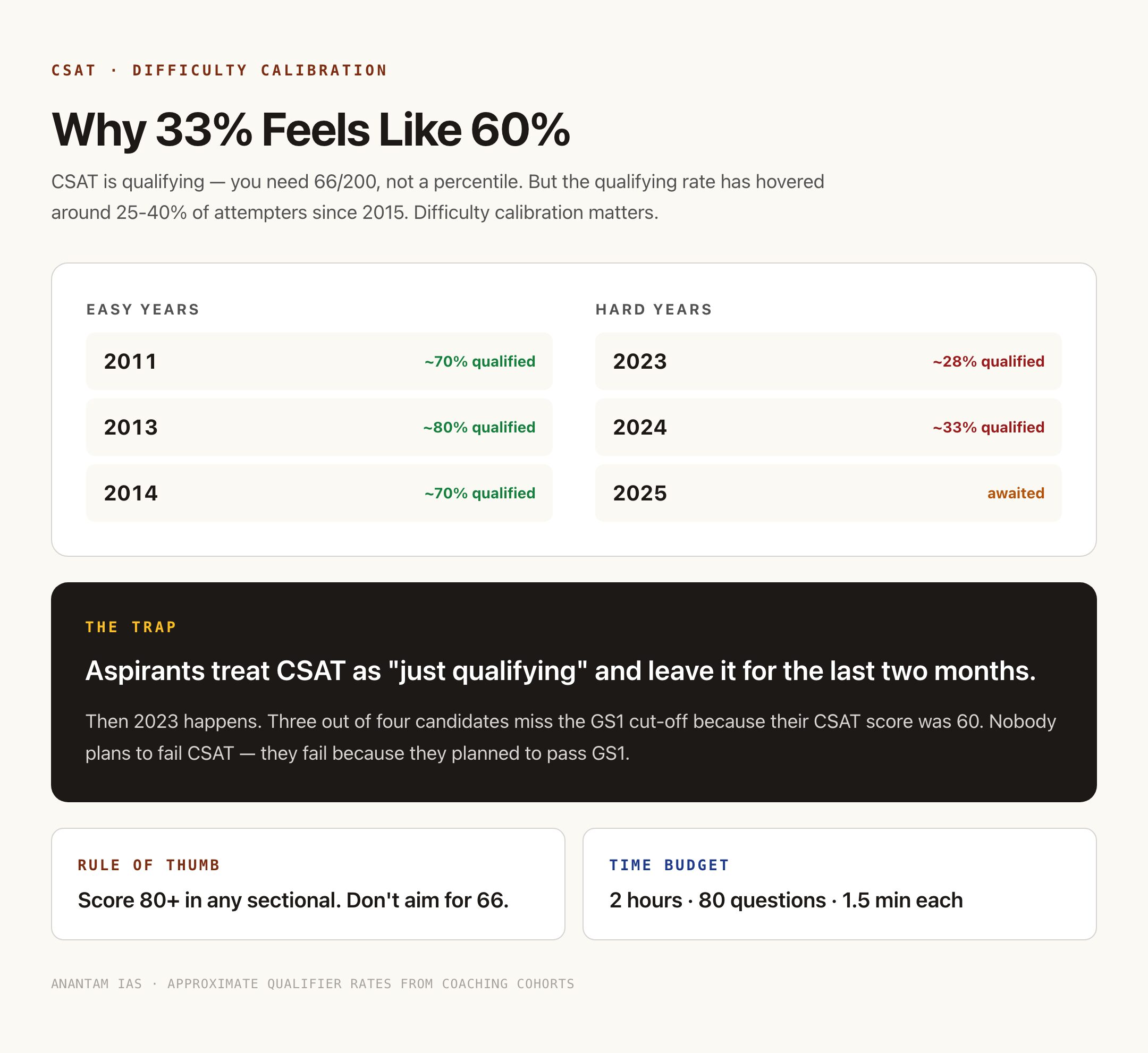
| 2024 | Download Paper II | Conducted 16 June 2024. Hard. ~33% qualifier rate. |
| 2023 | Download Paper II | Conducted 28 May 2023. Hardest paper since 2015. ~28% qualified. |
| 2022 | Download Paper II | Conducted 5 June 2022. Moderate-hard. Quant 24+ questions. |
| 2021 | Download Paper II | Conducted 10 October 2021. Pandemic-delayed. Balanced paper. |
| 2020 | Download Paper II | Conducted 4 October 2020. Moderate. Maths-heavy. |
| 2019 | Download Paper II | Conducted 2 June 2019. Quant 30+ questions, RC tougher than usual. |
| 2018 | Download Paper II | Conducted 3 June 2018. Heavy data interpretation. |
| 2017 | Download Paper II | Conducted 18 June 2017. RC-heavy with longer passages. |
| 2016 | Download Paper II | Conducted 7 August 2016. Easier than 2015. |
| 2015 | Download Paper II | Conducted 23 August 2015. Last paper before “qualifying-only” rule kicked in fully. |
| 2014 | Download Paper II | Conducted 24 August 2014. English RC controversy. ~70% qualified. |
| 2013 | Download Paper II | Conducted 26 May 2013. Easy paper. ~80% qualified. |
| 2012 | Download Paper II | Conducted 20 May 2012. Mostly RC + LR. |
| 2011 | Download Paper II | First CSAT paper. Conducted 12 June 2011. Decision Making section was alive. |
How to use this table: download all 15 PDFs into one folder. Rename each as CSAT_YYYY.pdf. Do not attempt them in chronological order — start with 2019, 2022, 2023, 2024 (the modern difficulty band), and only then go backward.
Why CSAT Previous Year Papers Matter More Than Mocks
Every coaching test series is a forecast. UPSC PYQs are the answer key to that forecast. When a coaching mock asks you a question UPSC hasn’t asked in 15 years, you have to ask whether the mock is preparing you for UPSC or for itself.
- UPSC tells you exactly what it tests. Question types recur with 80%+ similarity even when the surface details change.
- Difficulty calibration. You learn what a 33% qualifying paper actually looks like — which is very different from what a coaching ‘70% scorer’ looks like.
- Realistic time pressure. Two hours, eighty questions, no calculator. That’s the real constraint. Mocks loosen this. PYQs don’t.
- Diagnostic clarity. The pattern of your wrong answers across five PYQs tells you whether your problem is RC speed, quant fundamentals, reasoning gaps, or panic management. Mocks rarely give you that signal cleanly.
- Free. Every paper is on upsc.gov.in. No subscription, no test-series fee, no ads.
Topic-Wise Weightage: 2011-2026
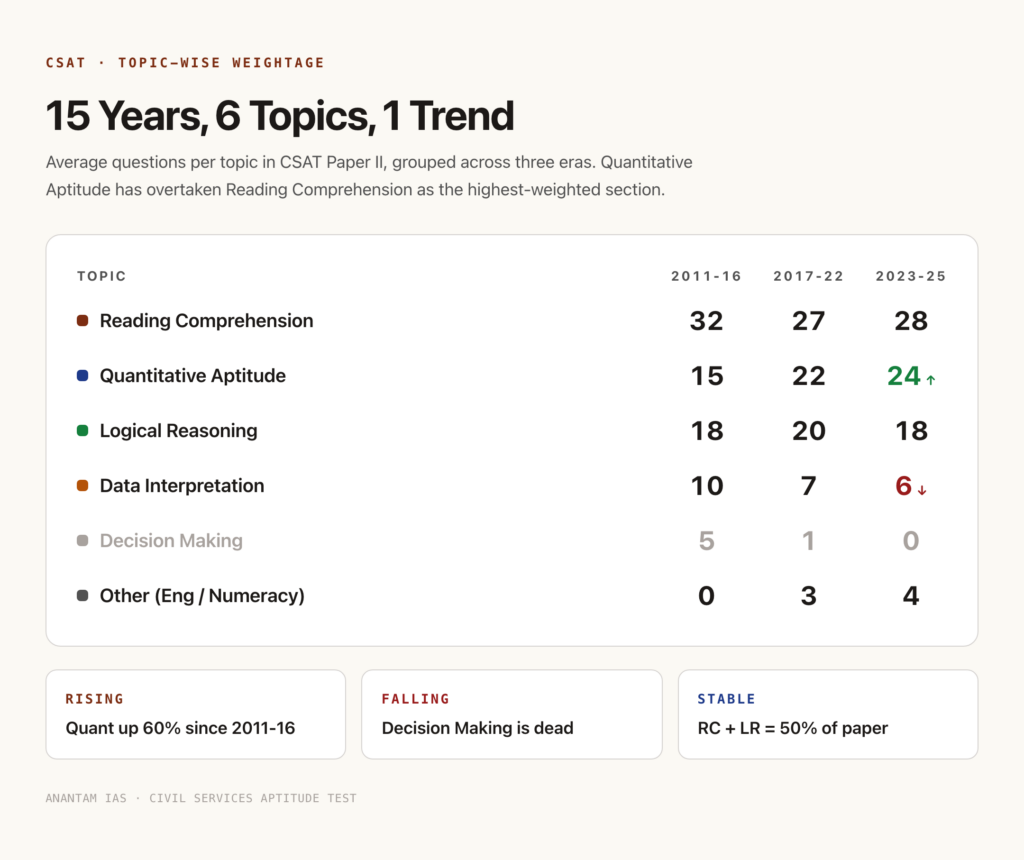
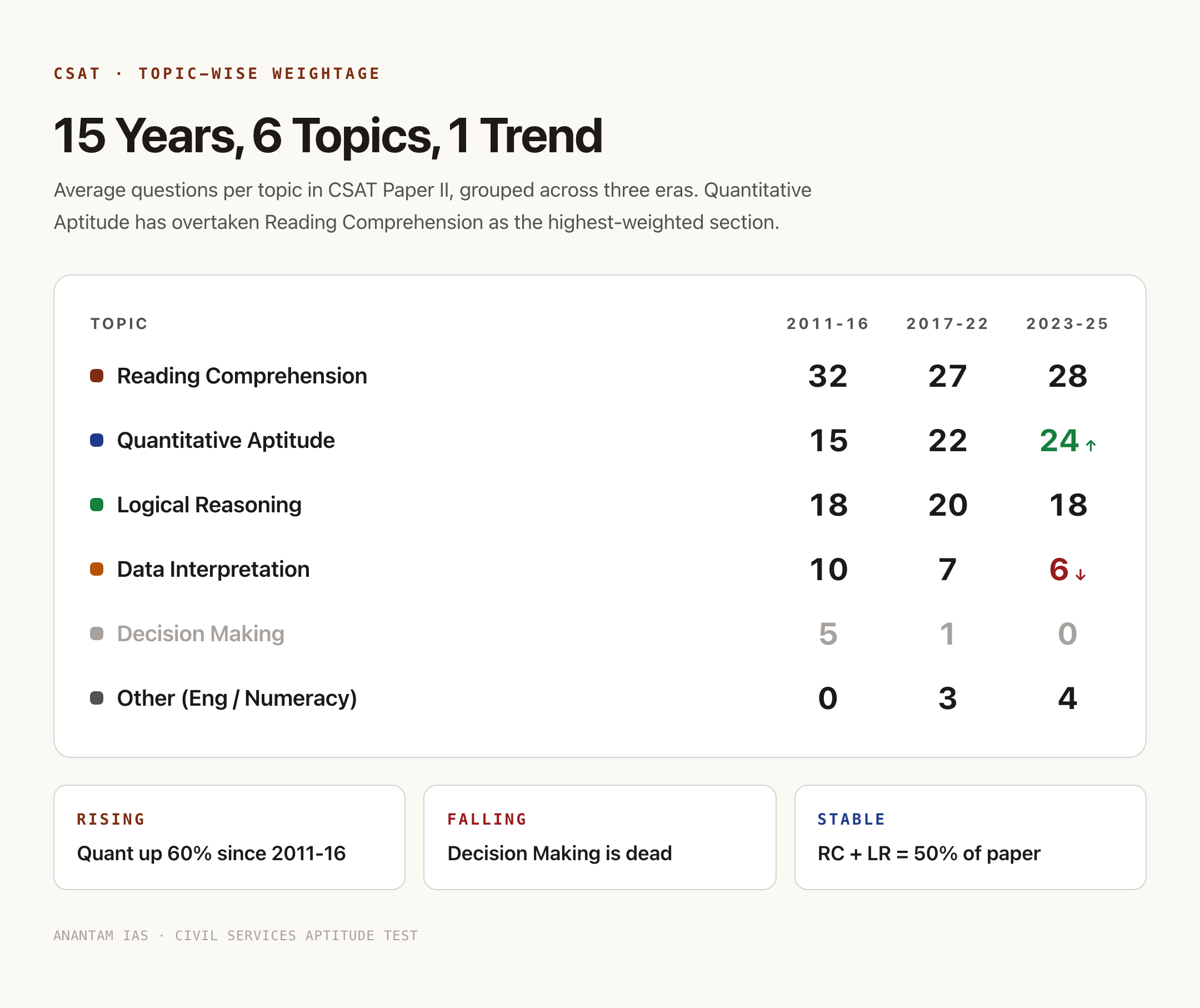
Across 16 years, six topics carry 95% of CSAT’s weight. The relative share has shifted noticeably since 2017.
| Topic | 2011-2016 Avg | 2017-2022 Avg | 2023-2025 Avg |
|---|---|---|---|
| Reading Comprehension | 32 | 27 | 28 |
| Logical Reasoning | 18 | 20 | 18 |
| Quantitative Aptitude | 15 | 22 | 24 |
| Data Interpretation | 10 | 7 | 6 |
| Decision Making | 5 | 1 | 0 |
| Other (English, basic numeracy) | 0 | 3 | 4 |
What changed
- Quantitative Aptitude rose from 15 questions per paper (2011-16 average) to 24 (2023-25). The biggest single shift in CSAT’s history.
- Decision Making is effectively dead. Last meaningful presence in 2014.
- Reading Comprehension has stayed at ~28 questions but the passages got longer and the inference chains harder.
- Data Interpretation is shrinking — only 6 questions in the 2023-25 average. Don’t over-prepare it.
Year-by-Year Difficulty: Easy Years vs Hard Years
CSAT looks like one paper from a syllabus document. In practice, it has had two distinct eras: the easy years (2011-2014) when the paper was new and qualifier rates touched 70-80%, and the recalibrated era (2015 onwards) where the paper became a real screening filter.
The 2023 inflection
The 2023 CSAT paper — conducted on 28 May 2023 — became a defining moment. Approximately 72% of attempters failed to clear the 33% qualifying threshold. RAU’s IAS, Vajiram, ForumIAS, and ShankarIAS all reported their cohorts taking a 30-40 mark hit compared to their pre-exam mocks. The takeaway is uncomfortable: CSAT is no longer a formality.
Which years still reflect current difficulty
- Use for calibration: 2019, 2022, 2023, 2024, 2025. These are the closest predictors of what’s coming.
- Use for confidence and pattern: 2017, 2018, 2020, 2021. Solid representative papers.
- Use cautiously: 2015, 2016. Still useful, but the pacing has tightened since then.
- Skip for serious mocks: 2011, 2012, 2013, 2014. Solve them once for completeness, then archive.
How to Use 16 Years of Papers in 90 Days

UPSC CSAT Topic-wise Previous Year Papers — Disha
- 304 pages, 31 topics, every CSAT paper since 1995 sorted by topic
- Solutions worked out, not just keys
- The fastest way to see which topics UPSC repeats
Days 1-30: Diagnose
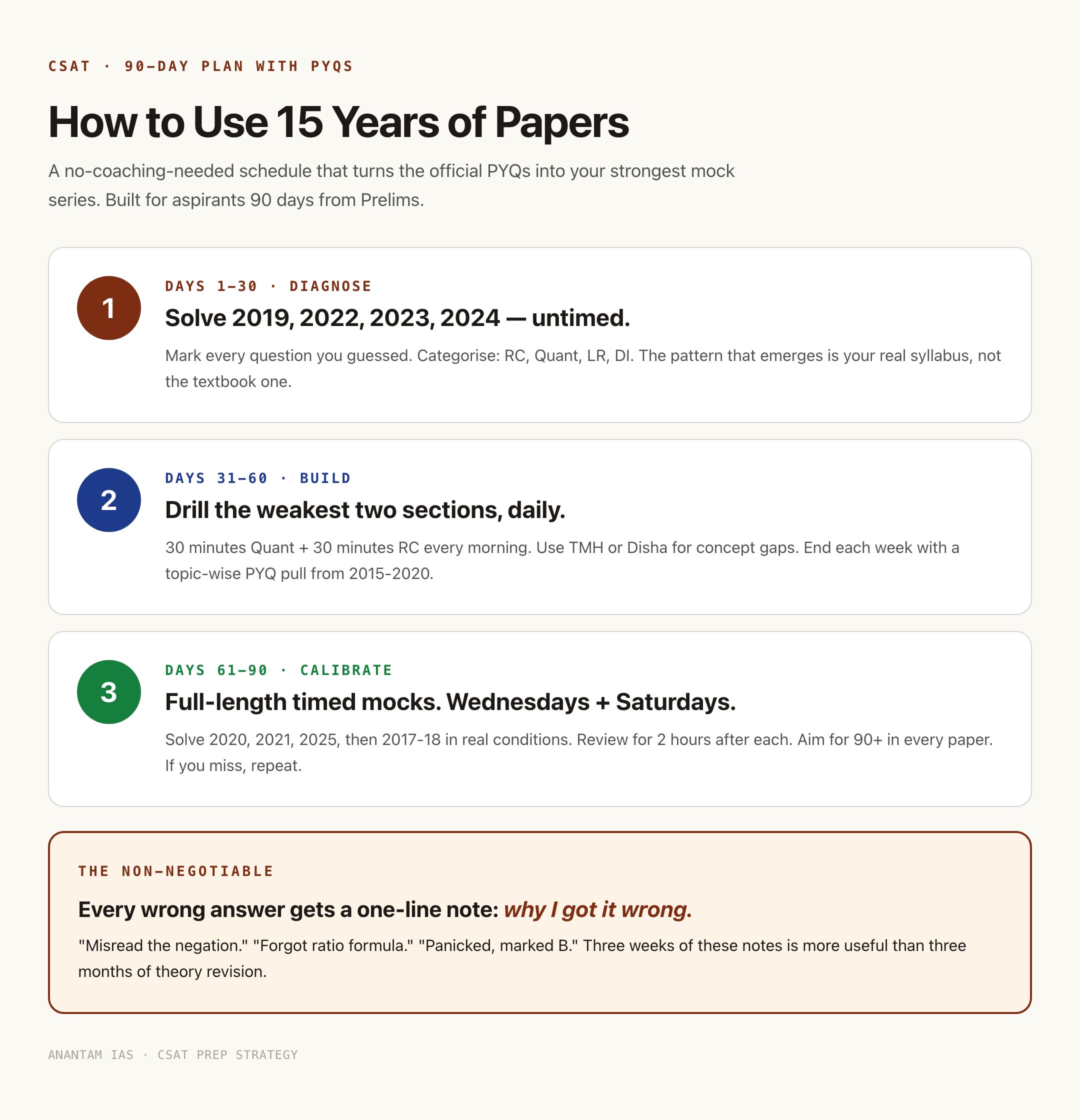
Solve 2019, 2022, 2023, and 2024 untimed. Don’t aim for a score. Mark every question you guessed and every question you got right by elimination rather than by knowing the answer. Group your wrong answers by topic. The pattern that emerges is your real syllabus, not the textbook one.
Days 31-60: Build
Drill your two weakest sections every morning, 60 minutes total. If your weak link is Quant + RC, that’s 30 minutes of TMH or Disha problem-sets plus 30 minutes of two RC passages from a recent CSAT paper. End each week with a topic-wise pull from the 2015-2020 papers — solve only RC questions one week, only Quant questions the next.
Days 61-90: Calibrate
Full-length timed papers, twice a week. Solve 2020 and 2021 in the first week. Solve 2017 and 2018 in the second. Then re-attempt 2023 (the hard one). After every attempt, do a 2-hour review: every wrong answer gets a one-line note about why you got it wrong. That note is the most valuable artefact in your prep.
Five Mistakes Aspirants Make With CSAT PYQs
- Treating CSAT as a topper interview problem. Reading topper blogs that say ‘I cleared CSAT without preparation’ and assuming the same. Most of those toppers attempted in pre-2017 papers. Today’s CSAT requires deliberate practice.
- Solving in chronological order. Start with 2011 means starting with the easiest paper. You’ll feel falsely confident. Start with 2023 instead.
- Skipping the review. Solving a paper takes 2 hours. Reviewing it well takes 3. The aspirants who clear CSAT spend more time reviewing than solving.
- Aiming for 66. 33% qualifying means 66/200 — but UPSC’s normalisation, OMR errors, and your own panic can shave 8-10 marks easily. Aim for 90+ in mocks.
- Ignoring English RC if you’re a Hindi-medium aspirant. CSAT RC is bilingual but the English passages are often easier than the Hindi translations. Solve in whichever language reads cleaner that day, not by ideology.
Section-Wise Strategy Using the Papers
Reading Comprehension
Two skills: active reading (one read, full grasp, no re-reads) and logical inference (the answer is implied, not stated). PYQ method: pick 5 RC passages from any single year. Time yourself at 7 minutes per passage. After every wrong answer, write the exact line number that supports the correct option. Three weeks of this fixes most RC issues.
Quantitative Aptitude
CSAT quant is class 10 mathematics. Percentages, ratios, time-and-work, time-speed-distance, simple/compound interest, mensuration, basic algebra, basic probability. PYQ method: solve all quant questions from 2018-2024 in one pass, topic-wise. You’ll see the same six question templates recycled. Master those templates, drop the rest.
Logical Reasoning
Syllogisms, blood relations, sitting arrangements, coding-decoding, statement-conclusion. PYQ method: solve 2017-2024 LR questions in one sitting. Watch for the negation traps and the ‘cannot be determined’ option, which UPSC abuses heavily.
Data Interpretation
Shrinking section. Don’t over-prepare it. Solve the DI sets from 2014-2020 — that’s enough drill. Most modern DI is just percentages on a table or pie-chart.
CSAT PYQ Download Checklist
Once you’ve downloaded all 15 papers, organise them like this:
CSAT_2025.pdfthroughCSAT_2011.pdfin a single folder.- Solution key from any reliable coaching: cross-check with at least two sources before finalising your scoring.
- A spreadsheet with columns: Year, Date Attempted, Score, RC, Quant, LR, DI, Notes. Update after every attempt.
- A ‘mistakes log’ document — one line per wrong answer, organised by topic. This is your real revision material in the final week.
UPSC Relevance and Final Word
CSAT is qualifying. That word does most of the damage. It tells you the paper doesn’t matter, so you don’t prepare for it, so it disqualifies you. Treating CSAT as a real exam — not a formality — is the single biggest mindset upgrade most aspirants need.
Solve every official paper. Review every wrong answer. Time yourself honestly. Do this for 90 days, and you’ll walk into the next CSAT paper with the only thing that actually matters in that hall: calm familiarity with what UPSC is going to ask.
For a full Prelims roadmap, see UPSC Prelims Strategy, UPSC Syllabus 2026, UPSC CSAT (overview), and UPSC Prelims PYQ (GS1).
Frequently Asked Questions about CSAT Previous Year Papers
Where can I download UPSC CSAT previous year papers from 2011 to 2025?
All papers are available on the official UPSC website at upsc.gov.in under Examinations > Previous Question Papers > Civil Services (Preliminary). The table on this page links directly to UPSC’s PDFs for 2020-2025 and to the official archive page for 2011-2019.
Are CSAT previous year papers enough to clear Paper II?
For most aspirants, yes — if you solve all 15 papers, review every wrong answer, and drill your weakest section. Coaching mocks help with realistic pressure but PYQs are the only material that reflects what UPSC actually tests.
How many CSAT previous year papers should I solve?
All 16 (2011-2026), but not equally. Solve 2020-2026 twice — once timed, once reviewed. Solve 2015-2019 once timed. Solve 2011-2014 once for pattern recognition. Skip duplicate practice on the easy 2011-2013 papers.
Do CSAT questions repeat in UPSC?
Exact questions almost never repeat. Question types and framing styles recur with 80%+ similarity, especially in Quant (percentage, ratio, time-work) and Reasoning (syllogism, blood relations, arrangement). That’s the value of solving PYQs.
How many times should I solve each CSAT paper?
Twice is enough for most papers. First pass as a timed mock, second pass as an untimed review after 30 days. A third pass is useful only for papers where you scored below 70 the second time.
Do the 2011 and 2013 papers still reflect current CSAT difficulty?
No. They reflect the easier early-CSAT era when 70-80% of attempters cleared the qualifier. Use 2011-2014 only for confidence-building and pattern recognition. For real difficulty calibration, rely on 2019 onwards, especially 2023-2025.
What is a safe target score in CSAT mocks?
Aim for 90+ in mocks. The qualifying mark is 66 (33% of 200), but exam-day panic, OMR errors, and tougher-than-mock papers routinely shave 8-15 marks off your mock score. A 90 in mocks usually translates to ~75 in the actual paper.
Is CSAT really qualifying or does it affect ranking?
Strictly qualifying. CSAT marks do not contribute to your Prelims merit list or final ranking. But you must score the qualifying 66 to have your GS1 paper evaluated. Roughly 25-40% of attempters fail this each year, which makes CSAT the second-biggest filter in the entire exam.
Should I take CSAT-only test series?
Only if your weak section needs heavy drill (typical for arts/commerce graduates with weak quant). Otherwise, official PYQs plus one general test series with 5-6 CSAT mocks is sufficient. Don’t subscribe to a CSAT-specific series unless you’ve already solved at least 10 PYQs.
Is the Hindi version of CSAT easier than the English version?
Often the opposite — English passages are usually written more cleanly than the Hindi translations. UPSC translates RC passages from English, and the translated Hindi version can feel awkward. Hindi-medium aspirants should attempt RC in whichever language reads more cleanly that day.
Tell Google you want more of this.
Add Anantam IAS as a preferred sourceOne tap, and this site shows up more often in your own Top Stories, AI Overviews and AI Mode. Remove it any time.