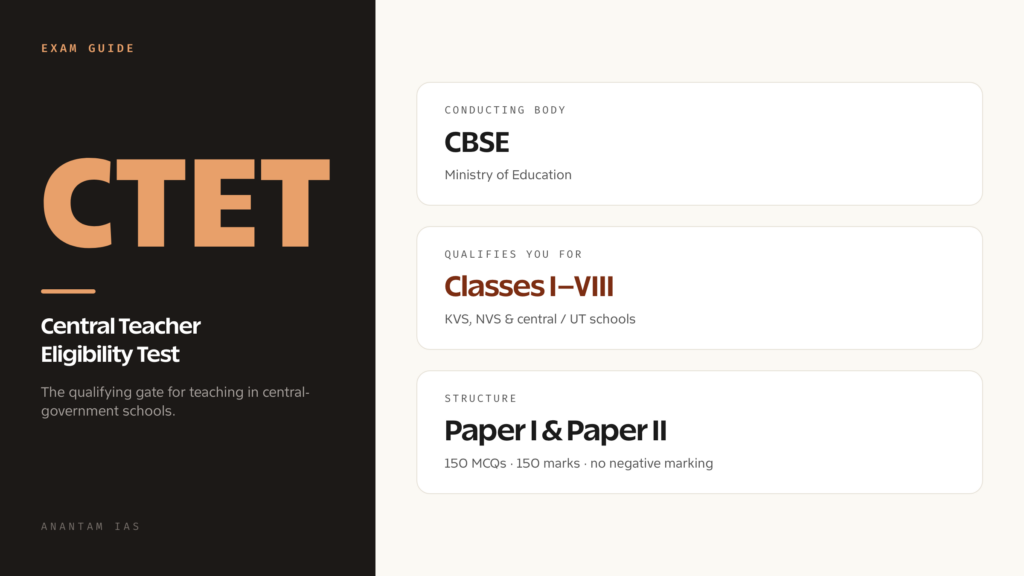
If you want to teach in a central-government school, the CTET is the gate you have to pass through first. The Central Teacher Eligibility Test is the national-level qualifying exam that certifies whether you meet the minimum benchmark to be a teacher for classes I to VIII, and it’s the single most common starting point for anyone planning a school-teaching career in the public system.
CTET isn’t a recruitment exam in itself — clearing it doesn’t hand you a posting. It’s an eligibility test. Once you qualify, you can apply for teacher vacancies in central schools like Kendriya Vidyalayas and Navodaya Vidyalayas, and your certificate is also accepted as a benchmark by many state governments and private schools. This guide walks through both papers, who can apply, what the syllabus contains, and how to prepare so you clear it on the first attempt.
What Is CTET?
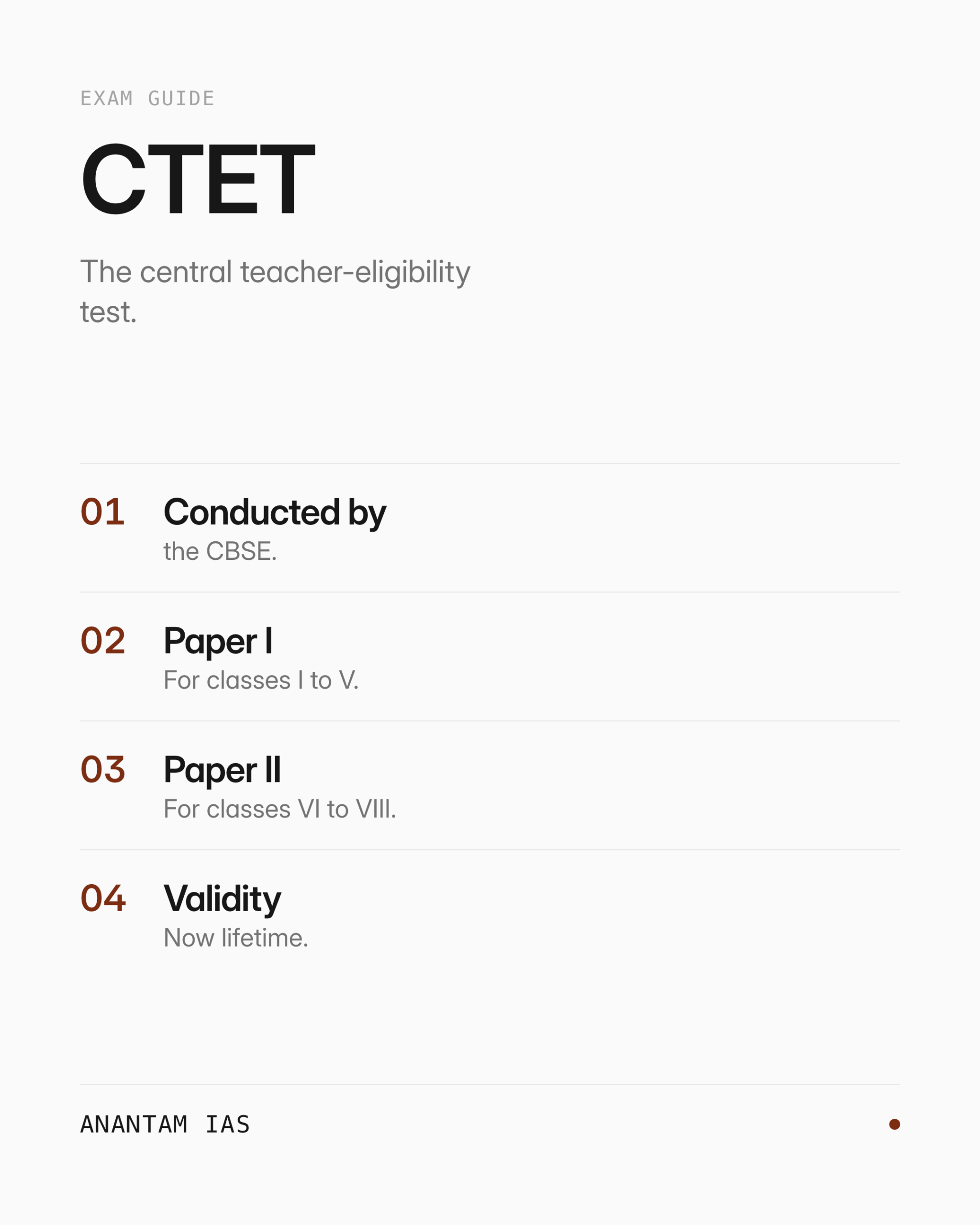
CTET stands for the Central Teacher Eligibility Test. It’s conducted by the Central Board of Secondary Education (CBSE) on behalf of the Ministry of Education, and it tests whether a candidate has the conceptual grounding and teaching aptitude expected of a school teacher at the elementary level. The test exists because the Right to Education Act, 2009 made a Teacher Eligibility Test a mandatory qualification for teacher appointments — the National Council for Teacher Education (NCTE) lays down the norms, and CTET is the central-level version of that test.
Qualifying CTET makes you eligible for teaching posts in schools run by the central government and Union Territory administrations — Kendriya Vidyalaya Sangathan (KVS), Navodaya Vidyalaya Samiti (NVS), schools under the Ministry of Education, and central-government-controlled schools in the UTs. Beyond that, a CTET certificate carries weight far wider than its official remit: many state governments accept it, and a large number of private and unaided schools use it as a hiring filter even though they aren’t legally bound to.
Key Facts
- Conducting authority: Central Board of Secondary Education (CBSE), under the Ministry of Education
- Posts it qualifies you for: Teacher (Classes I-V via Paper I; Classes VI-VIII via Paper II) in KVS, NVS, and central/UT schools
- Frequency: Conducted twice a year in most cycles (a July/September session and a December/January session)
- Scale of competition: Among India’s largest exams by volume — registrations routinely run into the lakhs each cycle, with well over a million candidates appearing in a typical year
CTET Exam Pattern
CTET has two papers, and which one you take depends on the class level you want to teach. You can take either, or both in the same cycle if you’re aiming to keep your options open across primary and upper-primary roles.
- Paper I is for candidates who intend to teach classes I to V (the primary level).
- Paper II is for candidates who intend to teach classes VI to VIII (the upper-primary level).
- A candidate who wants eligibility for both levels simply registers for and sits both papers, which are scheduled in separate sittings (typically Paper II in the morning and Paper I in the afternoon).
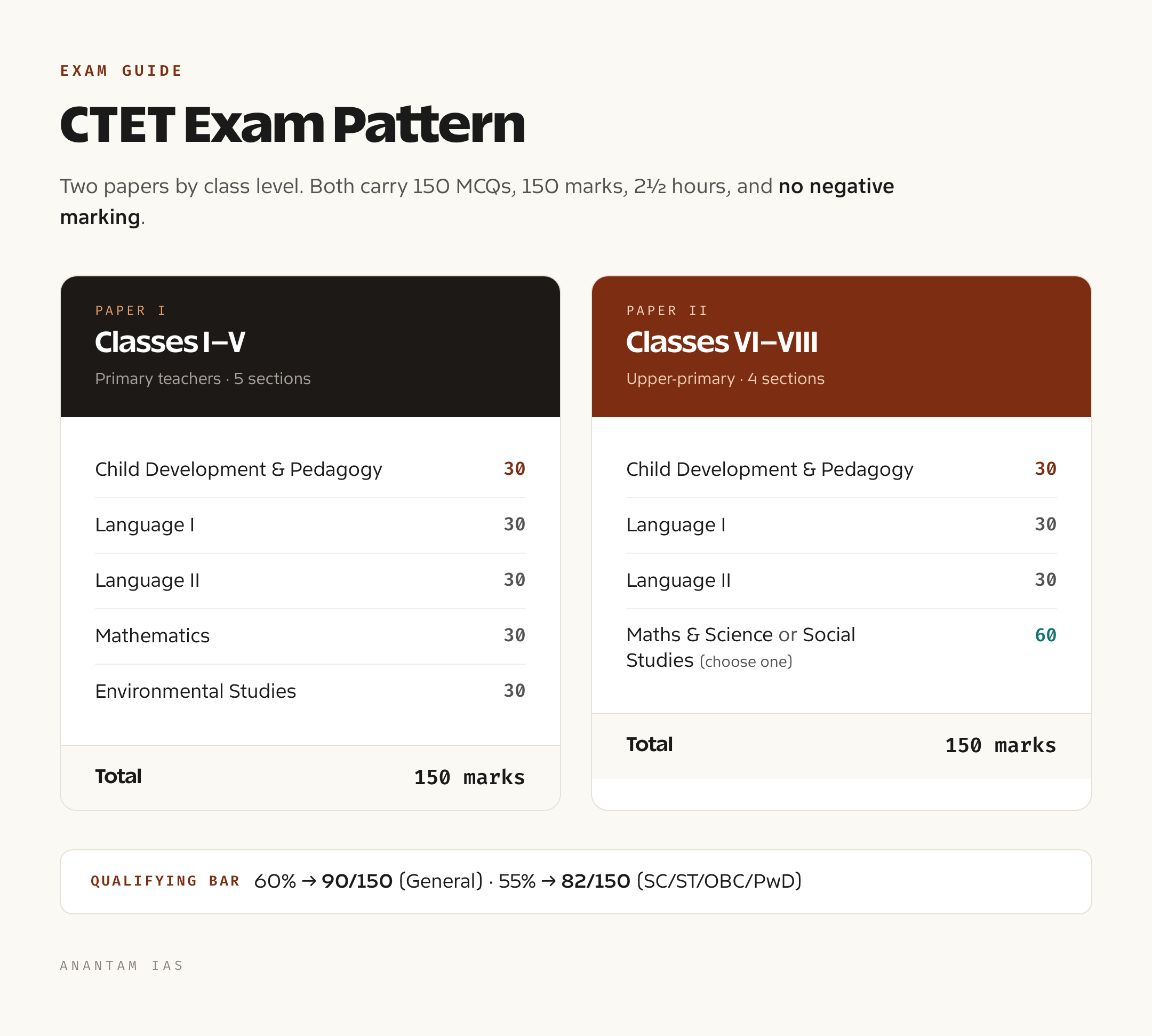
Both papers follow the same broad shape: 150 multiple-choice questions, 150 marks, two and a half hours, one mark per correct answer, and — importantly — no negative marking. So there’s no penalty for guessing, and you should attempt every question. The exam is offline and OMR-based.
Paper I — Classes I to V
Paper I has five sections of 30 questions each, all compulsory, with no internal choice:
| Section | Questions | Marks |
|---|---|---|
| Child Development & Pedagogy | 30 | 30 |
| Language I (medium of instruction) | 30 | 30 |
| Language II | 30 | 30 |
| Mathematics | 30 | 30 |
| Environmental Studies (EVS) | 30 | 30 |
| Total | 150 | 150 |
The Mathematics and EVS here are pitched at primary-school content and its teaching methods — not advanced material, but tested through a pedagogical lens.
Paper II — Classes VI to VIII
Paper II has four sections. Three are fixed; the fourth is a stream you choose based on what you want to teach:
| Section | Questions | Marks |
|---|---|---|
| Child Development & Pedagogy | 30 | 30 |
| Language I (medium of instruction) | 30 | 30 |
| Language II | 30 | 30 |
| Mathematics & Science OR Social Studies/Social Science | 60 | 60 |
| Total | 150 | 150 |
That final 60-mark block is the fork in the road. A maths-or-science teacher picks the Mathematics & Science stream; a history-geography-civics teacher picks the Social Studies/Social Science stream. Choose the one that matches your subject and your strength — it’s 40% of the paper.
How It Compares to UPSC
Unlike a recruitment exam such as the UPSC Civil Services Examination, CTET has no interview or personality test and no descriptive Mains stage. It’s a single objective paper per level, purely a pass-or-fail eligibility benchmark. The whole contest is decided in one 150-mark MCQ sitting — which makes accuracy on the high-weight pedagogy sections decisive.
CTET Eligibility
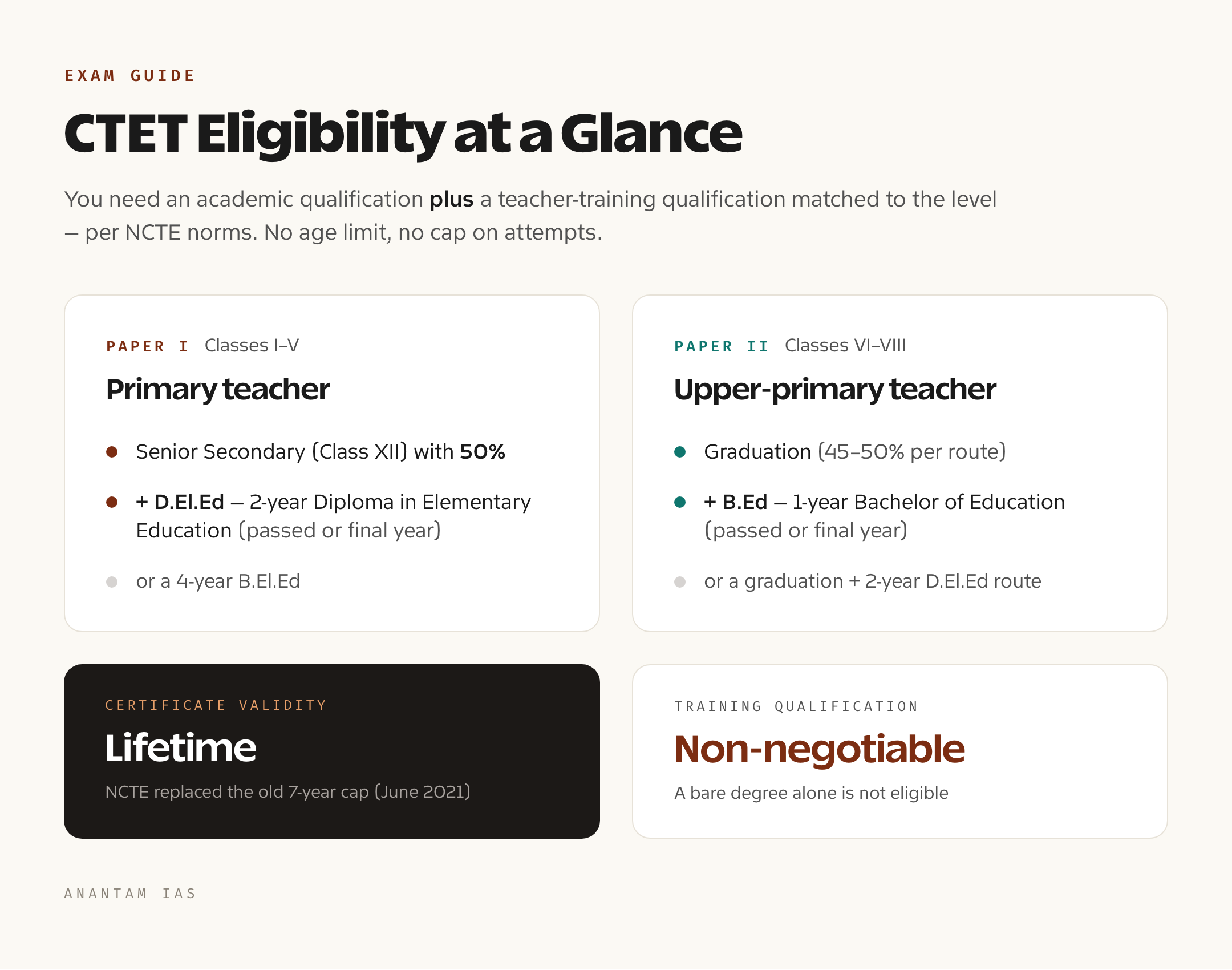
Eligibility for CTET hinges on one principle: you need both an academic qualification and a teacher-training qualification appropriate to the level you’re targeting, in line with NCTE norms. There’s no upper age limit and no cap on the number of attempts — you can sit CTET as many times as you like, in as many cycles as you like, and there’s no restriction on improving an earlier score.
For Paper I (Classes I-V), you broadly need one of these:
- Senior Secondary (Class XII) with at least 50% marks, plus a passed or final-year 2-year Diploma in Elementary Education (D.El.Ed)
- Senior Secondary with at least 45% marks, plus a D.El.Ed (final year), as per the NCTE Regulations in force
- Senior Secondary with at least 50% marks, plus a 4-year Bachelor of Elementary Education (B.El.Ed)
For Paper II (Classes VI-VIII), you broadly need one of these:
- Graduation, plus a passed or final-year 2-year D.El.Ed
- Graduation with at least 50% marks, plus a 1-year Bachelor of Education (B.Ed)
- Graduation with at least 45% marks, plus a B.Ed in accordance with the NCTE Regulations
- Senior Secondary with at least 50% marks, plus a 4-year B.El.Ed or integrated B.A./B.Sc.Ed degree
The percentage relaxations of 5% for reserved categories (SC/ST/OBC/PwD) generally follow each state government’s and the appropriate authority’s rules, so check the current notification for the exact relaxation that applies to you. The recurring point is that the teacher-training qualification — a D.El.Ed for the primary level or a B.Ed for the upper-primary level — is non-negotiable. A bare degree without a recognised training qualification does not make you eligible.
CTET Syllabus
The syllabus is built around child development, language proficiency, and subject content seen through a teaching lens. There’s no separate “Prelims and Mains” split here — each paper has one composite syllabus matching its sections.
Paper I Syllabus
- Child Development & Pedagogy (30 marks): the concept of development and its relationship with learning; principles of child development; influence of heredity and environment; socialisation; Piaget, Kohlberg, and Vygotsky and their constructs; child-centred and progressive education; intelligence and its critiques; learning and pedagogy; inclusive education and children with special needs.
- Language I (30 marks): reading comprehension, plus the pedagogy of language development — learning and acquisition, principles of language teaching, the role of grammar, language skills, and evaluation.
- Language II (30 marks): comprehension of unseen passages, with a stronger focus on the pedagogy and methods of language teaching.
- Mathematics (30 marks): number system, geometry, shapes, measurement, data handling, patterns — at the primary level — together with the pedagogical issues of teaching maths.
- Environmental Studies (30 marks): family and friends, food, shelter, water, travel, things we make and do, and the pedagogy of EVS.
Paper II Syllabus
- Child Development & Pedagogy (30 marks): the same developmental and pedagogical foundation as Paper I, oriented to the 11-14 age group.
- Language I and Language II (30 marks each): comprehension and the pedagogy of language development, identical in structure to Paper I.
- Mathematics & Science (60 marks): algebra, geometry, mensuration, and data handling for maths; food, materials, the living world, and natural phenomena for science; plus the pedagogy of each.
- Social Studies/Social Science (60 marks): History, Geography, Social and Political Life (civics), and the pedagogy of social-science teaching.
Where the Marks Really Sit
Notice that Child Development & Pedagogy and the pedagogy embedded in every section together dominate the paper. Across either paper, pedagogy-flavoured questions account for a much larger share than the raw subject content — which is exactly why preparation has to be weighted toward teaching theory, not just brushing up school subjects.
CTET Preparation Strategy
CTET rewards a focused, theory-aware approach more than brute-force content revision. Here’s a sequence that works.
Make Pedagogy Your Anchor
Child Development & Pedagogy is the highest-weight and most-scoring portion of the exam, and the pedagogy threaded through every section compounds that. Build a solid base in developmental psychology — the constructs of Jean Piaget (cognitive stages), Lev Vygotsky (the zone of proximal development and social constructivism), and Lawrence Kohlberg (moral development) come up repeatedly. These are conceptual, predictable, and high-return; master them early.
Lean on NCERT for Content
For the subject sections — Maths, EVS, Science, Social Studies — the NCERT textbooks from the relevant classes are the single best source. They map directly onto what CTET tests and how the questions are framed. Read them not just for facts but for how a concept is introduced and taught, because that’s the angle the paper takes.
Sort Out Your Languages Early
Pick your Language I and Language II deliberately — Language I is usually your medium of instruction and your strongest language. A big share of the language marks is pedagogy of language, not grammar drills, so study the methods of language teaching alongside comprehension practice.
Work Through Previous Years’ Papers
CTET reuses question patterns heavily across cycles. Going through past papers tells you the depth expected, the recurring theorist-and-concept questions, and the balance between content and pedagogy. Treat PYQ analysis as a core activity, not an afterthought.
Take Timed Mock Tests
With 150 questions in 150 minutes and no negative marking, the skill being tested is steady accuracy under a clock. Regular full-length mocks build the pacing you need, and since there’s no penalty for wrong answers, train yourself to attempt every single question.
Revise in Layers
Keep short notes on pedagogy theorists, key EVS/Science facts, and language-teaching principles, and cycle through them in the final weeks. The qualifying bar is fixed, so the goal isn’t a top rank — it’s clearing 60% cleanly and reliably.
Certificate, Validity & Career
Here’s the part that has changed for the better. The CTET qualifying certificate is now valid for lifetime. Earlier, it carried only a seven-year validity, which forced qualified candidates to re-take the exam if they hadn’t secured a posting in time. That cap was removed: NCTE, through its letter dated 9 June 2021, substituted the seven-year rule with lifetime validity for the TET qualifying certificate, and CBSE applied it to CTET — including retrospectively for older certificates. So once you clear CTET, you never have to clear it again.
The qualifying bar is 60% overall, which works out to 90 out of 150 marks for general-category candidates. Reserved categories (SC/ST/OBC/PwD) typically get a relaxation to around 55%, or 82 marks, subject to the rules notified by the appropriate government. Clearing the cut-off is pass-or-fail — there’s no rank, no merit list within CTET itself.
On the career side, a CTET certificate is the gateway to applying for KVS and NVS teacher recruitments and to school-teaching roles across central and UT schools, with many state and private schools treating it as a preferred credential. It pairs naturally with recruitment notifications: CTET makes you eligible, and the actual hiring exam or interview decides the posting. For anyone serious about a teaching career in the public system, qualifying CTET is the foundational, one-time step that unlocks every door downstream.
Frequently Asked Questions
Is the CTET certificate valid for lifetime now?
Yes. The CTET qualifying certificate now carries lifetime validity for all categories. NCTE replaced the earlier seven-year validity rule with lifetime validity through its June 2021 notification, and CBSE applied it to CTET, including for certificates issued before the change. Once you qualify, you don’t need to sit the exam again.
What are the qualifying marks for CTET?
A candidate must score at least 60% to qualify, which is 90 out of 150 marks for general-category candidates. SC, ST, OBC, and PwD candidates typically qualify at around 55%, or 82 marks, as per the relaxation notified by the appropriate government. The bar is the same for both Paper I and Paper II.
What’s the difference between CTET Paper I and Paper II?
Paper I qualifies you to teach classes I to V (primary level) and includes Mathematics and Environmental Studies. Paper II qualifies you to teach classes VI to VIII (upper-primary level) and replaces those with a 60-mark stream where you choose either Mathematics & Science or Social Studies/Social Science. If you want eligibility for both levels, you sit both papers.
Can I take CTET without a B.Ed or D.El.Ed?
No. CTET eligibility requires a recognised teacher-training qualification — a D.El.Ed for the primary level or a B.Ed for the upper-primary level — alongside the relevant academic qualification, in line with NCTE norms. A graduation or Class XII pass on its own, without a training qualification, does not make you eligible to appear.
Tell Google you want more of this.
Add Anantam IAS as a preferred sourceOne tap, and this site shows up more often in your own Top Stories, AI Overviews and AI Mode. Remove it any time.