Why in News?
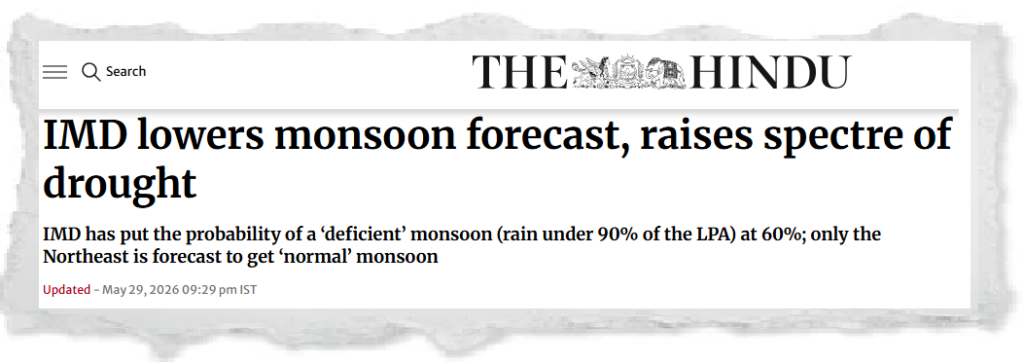
The India Meteorological Department (IMD) has revised its 2026 southwest monsoon forecast downward from 92% of the Long Period Average (LPA) to 90% of LPA, placing the season firmly in the “below-normal” category. The IMD has also indicated a 60% probability of a deficient monsoon, raising concerns about drought-like conditions, agricultural stress, water shortages, inflation, and rural economic slowdown.
The forecast comes amid the expected development of El Niño conditions, which are historically associated with weaker Indian monsoons.
UPSC Relevance
Prelims: El Niño, Indian Ocean Dipole (IOD), Madden-Julian Oscillation (MJO), Long Period Average (LPA), southwest monsoon.
Mains:
GS I – Indian climate, monsoon system, droughts;
GS III – Agriculture, food security, disaster management, water resources, climate change.
Background: Why the Monsoon Matters for India
The southwest monsoon, extending from June to September, is the backbone of India’s climate and economy. Nearly 70% of India’s annual rainfall is received during this period.
Despite the growth of irrigation infrastructure, a significant portion of Indian agriculture remains dependent on rainfall. The monsoon therefore directly influences agricultural production, groundwater recharge, reservoir storage, hydropower generation, rural incomes, and food prices.
A weak monsoon often triggers cascading effects across multiple sectors of the economy.
What Has the IMD Forecast Said?
The IMD has revised its seasonal rainfall projection to 90% of the Long Period Average (LPA), compared to its earlier April estimate of 92%. The department has also attached a 60% probability to a deficient monsoon season, meaning rainfall could fall below 90% of the benchmark average.
The forecast indicates that most regions of India, including Central India, Northwest India, the Southern Peninsula, and the monsoon core zone, may receive below-normal rainfall. Only Northeast India is expected to receive normal monsoon precipitation.
The IMD has further suggested that June rainfall itself is likely to remain below average, increasing concerns about delayed sowing and prolonged dry spells during the initial agricultural season.
Delay in Monsoon Onset over Kerala
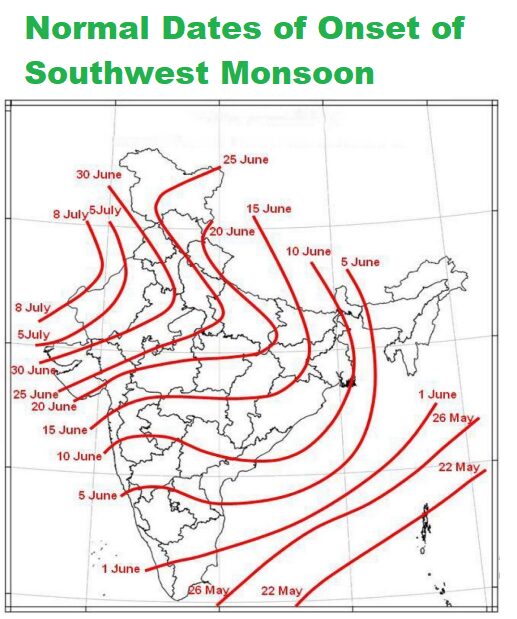
The southwest monsoon usually enters India through Kerala and marks the beginning of the rainy season.
The IMD had initially forecast the onset around May 26, but later acknowledged that the monsoon was unlikely to arrive within the projected window and may now reach Kerala during the first week of June.
Meteorologists attributed the delay to weaker monsoon winds over the Arabian Sea, the westward drift of atmospheric circulations, and the continued influence of mid-latitude western disturbances that temporarily disrupted the northward advance of monsoon currents.
While a delay of a few days is not unusual, prolonged delays combined with weak rainfall often create stress for agriculture and water resources.
What is Long Period Average (LPA)?
The Long Period Average refers to the average rainfall recorded over a long reference period and serves as a benchmark for monsoon forecasts.
The current LPA used by the IMD is based on rainfall data from 1971–2020.
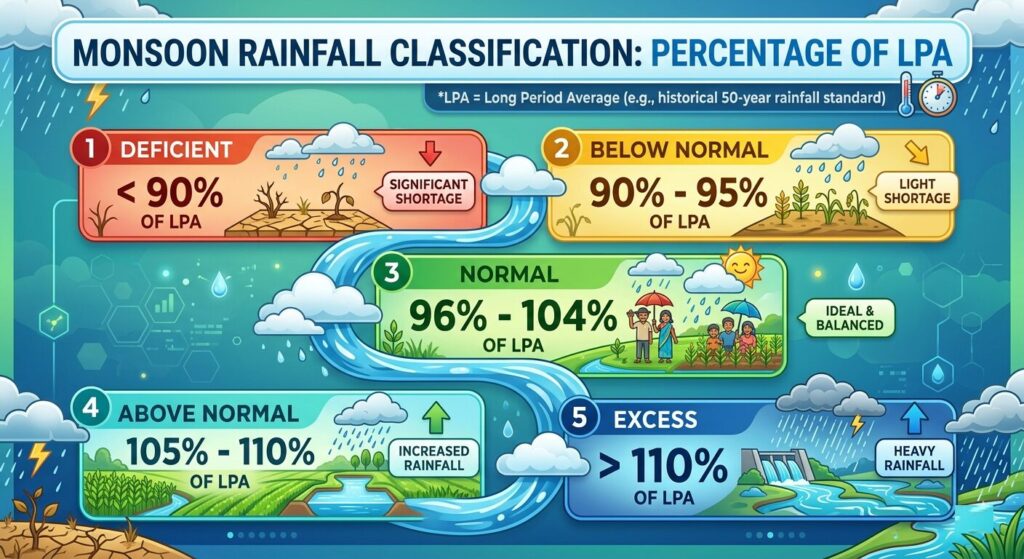
Based on the percentage of LPA received, monsoon rainfall is classified into different categories:
- Deficient: Less than 90% of LPA
- Below Normal: 90%–95% of LPA
- Normal: 96%–104% of LPA
- Above Normal: 105%–110% of LPA
- Excess: More than 110% of LPA
A forecast of 90% of LPA places the monsoon at the boundary between deficient and below-normal categories.
El Niño: The Biggest Concern
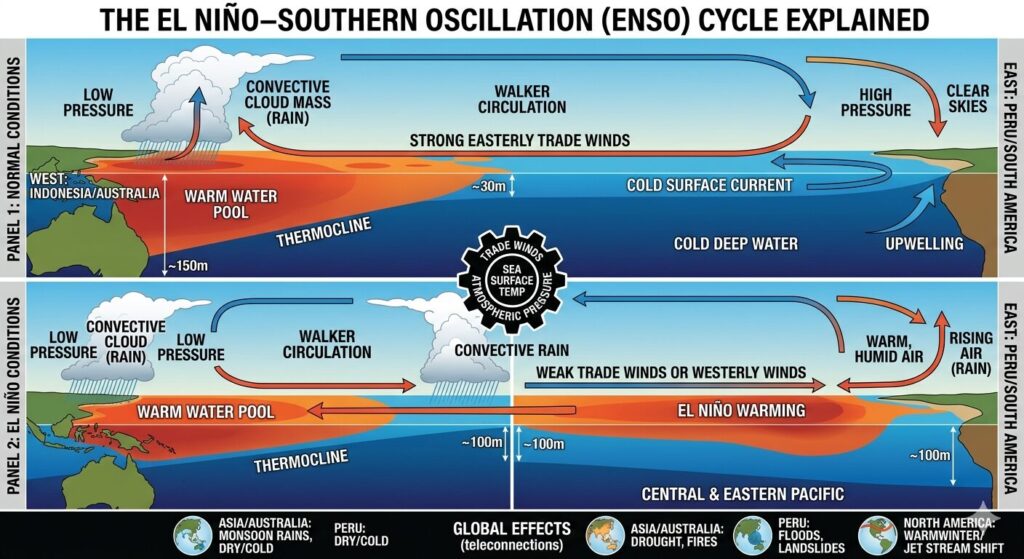
The IMD estimates a very high probability of El Niño conditions developing during the monsoon season. El Niño refers to the abnormal warming of sea surface temperatures in the central and eastern Pacific Ocean.
This warming weakens the Walker Circulation and alters global atmospheric circulation patterns. For India, El Niño often reduces monsoon rainfall by weakening moisture-bearing winds over the subcontinent.
Historically, several major drought years such as 2002, 2009, 2014, and 2015 have been associated with El Niño events.
However, the relationship is not absolute. Other climatic factors can either worsen or partially offset El Niño’s impact.
Role of Indian Ocean Dipole (IOD)
The Indian Ocean Dipole (IOD) refers to irregular changes in sea surface temperatures between the western and eastern Indian Ocean.
A positive IOD generally strengthens the Indian monsoon by enhancing moisture transport toward the Indian subcontinent. In several past years, positive IOD conditions have partly compensated for the adverse effects of El Niño.
At present, no strong positive IOD signal has emerged. This has added to concerns regarding monsoon performance during the season.
Madden-Julian Oscillation (MJO)
The Madden-Julian Oscillation is an eastward-moving atmospheric disturbance characterised by clouds, rainfall, winds and pressure anomalies that travel around the equatorial region roughly every 30–60 days.
A favourable phase of the MJO can strengthen rainfall activity over India and improve monsoon performance even during otherwise weak years.
Meteorologists therefore continue to closely monitor MJO behaviour because intraseasonal weather systems can significantly influence the final seasonal outcome.
Why Deficient Rainfall Does Not Always Mean Drought
A common misconception is that lower total rainfall automatically translates into drought.
The distribution of rainfall is often more important than the seasonal total itself.
Agriculture can withstand a moderate reduction in total rainfall if rains are evenly distributed. However, prolonged dry spells during critical crop-growth stages can cause severe agricultural losses even when seasonal rainfall appears adequate.
Therefore, delayed onset, uneven distribution, and repeated dry spells are often more damaging than a simple reduction in seasonal averages.
Possible Impact on Agriculture
Stress on Kharif crops
The kharif season begins with the arrival of the southwest monsoon. Crops such as rice, maize, pulses, cotton, soybean, and groundnut depend heavily on monsoon rainfall during sowing and early growth stages.
A delayed onset or prolonged dry spells may reduce sowing acreage and lower crop productivity.
Impact on rain-fed farming regions
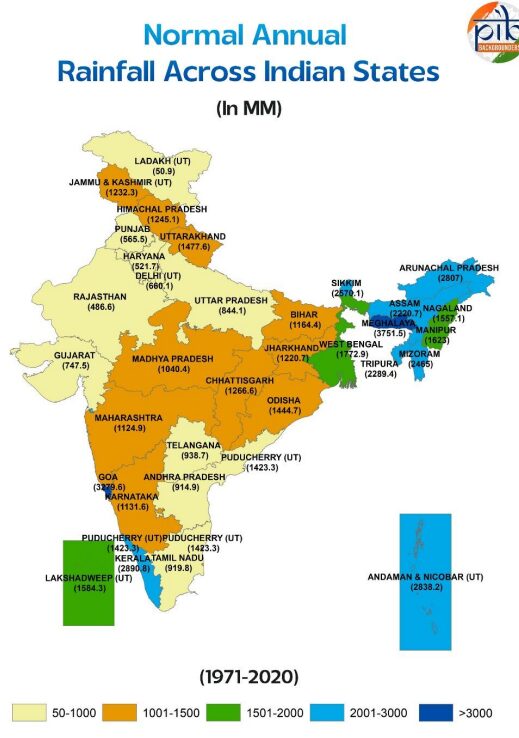
Large parts of central and peninsular India continue to depend on rainfall rather than irrigation. Farmers in these regions are particularly vulnerable to monsoon fluctuations.
Lower rainfall can increase crop failure risks and reduce farm incomes.
Reduced groundwater recharge
Weak rainfall affects not only current crops but also future agricultural seasons.
Insufficient recharge of groundwater and reservoirs can reduce irrigation availability for both kharif and rabi crops, creating longer-term water stress.
Economic Implications
India’s economy remains significantly influenced by monsoon performance despite rapid industrialisation and urbanisation.
A weak monsoon can lead to:
- Lower agricultural output and rural incomes.
- Reduced demand in rural markets.
- Increased food inflation due to supply shortages.
- Pressure on water resources and electricity generation.
- Greater fiscal burden through drought relief and agricultural support measures.
Several economists have warned that a deficient monsoon could complicate inflation management and affect broader economic growth prospects.
Climate Change and Increasing Monsoon Uncertainty
Climate change is making monsoon behaviour increasingly unpredictable.
Recent decades have witnessed:
- More frequent extreme rainfall events,
- Longer dry spells,
- Erratic onset and withdrawal patterns,
- Rising temperatures,
- Increased heatwave intensity.
This suggests that future climate risks may arise not only from deficient rainfall but also from greater variability in rainfall distribution.
The challenge is therefore shifting from merely forecasting total rainfall to managing climate uncertainty and improving resilience.
Way Forward
Strengthening climate-resilient agriculture
Promotion of drought-resistant crop varieties, climate-smart farming techniques, and diversified cropping systems can reduce agricultural vulnerability.
Expanding irrigation coverage
Greater investment in micro-irrigation, watershed development, and rainwater harvesting can reduce dependence on monsoon variability.
Improving weather advisories
Timely district-level weather forecasts and agro-advisories can help farmers make informed sowing and irrigation decisions.
Enhancing groundwater management
Efficient groundwater recharge programmes and sustainable extraction practices are essential to strengthen long-term water security.
Building drought preparedness
Governments should strengthen contingency planning, crop insurance coverage, and early-warning systems to reduce the impact of deficient rainfall years.
Conclusion
The IMD’s downward revision of the 2026 monsoon forecast has revived concerns about drought-like conditions, agricultural stress, and inflationary pressures. While a deficient monsoon is not yet certain, the combination of a delayed onset, high probability of El Niño, and below-normal rainfall projections has increased risks for the economy and rural livelihoods.
The ultimate outcome will depend on the interaction of multiple climatic factors such as El Niño, the Indian Ocean Dipole, and the Madden-Julian Oscillation. As climate variability increases, India’s long-term resilience will depend not only on accurate forecasting but also on stronger water management, climate-adaptive agriculture, and disaster preparedness.
Practice Questions
Prelims Question 1 (Inference-based)
Consider the following statements with reference to the 2026 southwest monsoon forecast:
I. The IMD has revised the monsoon forecast downward and indicated a high probability of deficient rainfall.
II. Agricultural stress depends not only on the total amount of rainfall received but also on its temporal distribution during the cropping season.
III. Climatic phenomena such as El Niño, the Indian Ocean Dipole, and the Madden-Julian Oscillation can collectively influence monsoon performance.
Which of the following relationships among the above statements is/are correct?
- Statement II explains why a season with near-normal rainfall can still create agricultural distress.
- Statement III suggests that monsoon outcomes cannot be determined solely by the presence of El Niño.
- Statement I contradicts Statement III because a deficient monsoon forecast rules out the influence of other climatic factors.
(a) 1 and 2 only
(b) 2 and 3 only
(c) 1 only
(d) 1, 2 and 3
Answer: (a)
Explanation: Rainfall distribution is often more important than total rainfall for agriculture, making Statement II a valid explanation. Statement III correctly indicates that multiple climatic drivers influence the monsoon. Statement 3 is incorrect because El Niño is only one among several influencing factors.
Prelims Question 2
Consider the following statements:
- El Niño is associated with warming of sea surface temperatures in the central and eastern Pacific Ocean.
- A positive Indian Ocean Dipole generally strengthens monsoon conditions over India.
- The Madden-Julian Oscillation is a seasonal reversal of winds between land and sea.
- Long Period Average (LPA) serves as a benchmark for classifying monsoon rainfall performance.
Which of the statements given above are correct?
(a) 1, 2 and 4 only
(b) 1 and 3 only
(c) 2, 3 and 4 only
(d) 1, 2, 3 and 4
Answer: (a)
Explanation: Statement 3 is incorrect because the Madden-Julian Oscillation is an eastward-moving atmospheric disturbance involving rainfall and cloud activity near the equator. It is not a seasonal wind reversal.
Mains Questions
- Discuss the role of El Niño, the Indian Ocean Dipole (IOD), and the Madden-Julian Oscillation (MJO) in influencing the Indian southwest monsoon.
- Examine the economic and agricultural implications of a deficient monsoon in India. How can climate-resilient policies reduce vulnerability to monsoon variability?