Opens in a new tab
Join Anantam IAS Channel on Telegram

Daily Digest · Saturday

4 October 2025 Current Affairs for UPSC

3 current affairs published on Saturday, 4 October 2025

4 October 2025 Current Affairs for UPSC — every Why-in-News article AnantamIAS published on Saturday, 4 October 2025, broken down with Why in News?, the exact GS paper it feeds, sub-topic mapping, MCQ-ready facts and a UPSC-style practice question. 3 articles in total, covering Polity, Economy, Environment, S&T, IR, Geography, History, Society and Internal Security — the same Why-in-News + GS-paper-mapping + practice-question format the Compass uses across every daily digest on the site.

Daily current affairs for UPSC is where new material enters your prep stream. Read this 4 October 2025 digest end-to-end in 25–35 minutes, attempt the practice question at the foot of each article (it's MCQ for some, 10/15-marker for others), then bookmark the entries that fall inside your active revision window. Everything stays cross-linked: tap any subject pill to jump to that subject's hub, or use the table of contents above to skip straight to a specific story.

Use this page three ways. Read sequentially for a one-sitting scan of everything that mattered on 4 October 2025. Download the 4 October 2025 PDF below for offline study or print revision. Or use the October 2025 Current Affairs compilation to see this day in the month's full context. For the previous day's reading, see 3 October 2025 Current Affairs; the next day's is 5 October 2025 Current Affairs.

Why we publish daily current affairs separately from the monthly compilation: daily is learning, monthly is revision. Use the daily page to add fresh material to your notes the day it breaks; come back to the October 2025 compilation 60 days before Prelims when the noise has settled and only the lasting takeaway is worth re-reading.

Stubble Burning

Open article →Download PDF

image 7

WhatsApp Image 2025 10 04 at 10.55.02 c564dccd

Why in news:

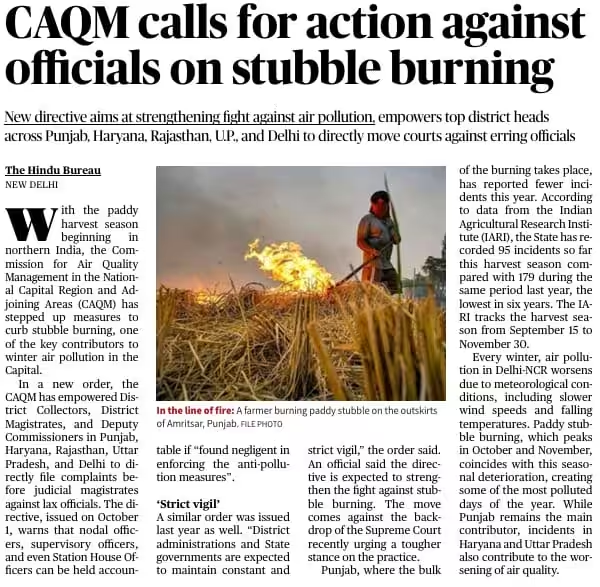
Commission for Air Quality Management (CAQM) has issued a new directive to curb stubble burning, which is one of the biggest contributors to air pollution in Delhi-NCR during winters. District Collectors, District Magistrates, and Deputy Commissioners in Punjab, Haryana, Rajasthan, Uttar Pradesh, and Delhi have been empowered to directly file complaints in court against officials who fail to control stubble burning.

UPSC Relevance:

Environmental pollution and degradation

UPSC PYQ

Q. What are the major factors responsible for making the rice-wheat system a success? In spite of this success, how has this system become bane in India? (2020)

What is stubble burning?

  • Northern India, especially the states of Punjab and Haryana have two growing seasons: one from May to September and another from November to April.
  • Many farmers rotate between crops, planting rice in May and wheat in November.
  • In order to quickly prepare their fields for the wheat crop, many farmers simply burn leftover plant debris (stubble) after harvesting rice.
  • This practice is known as paddy stubble burning.
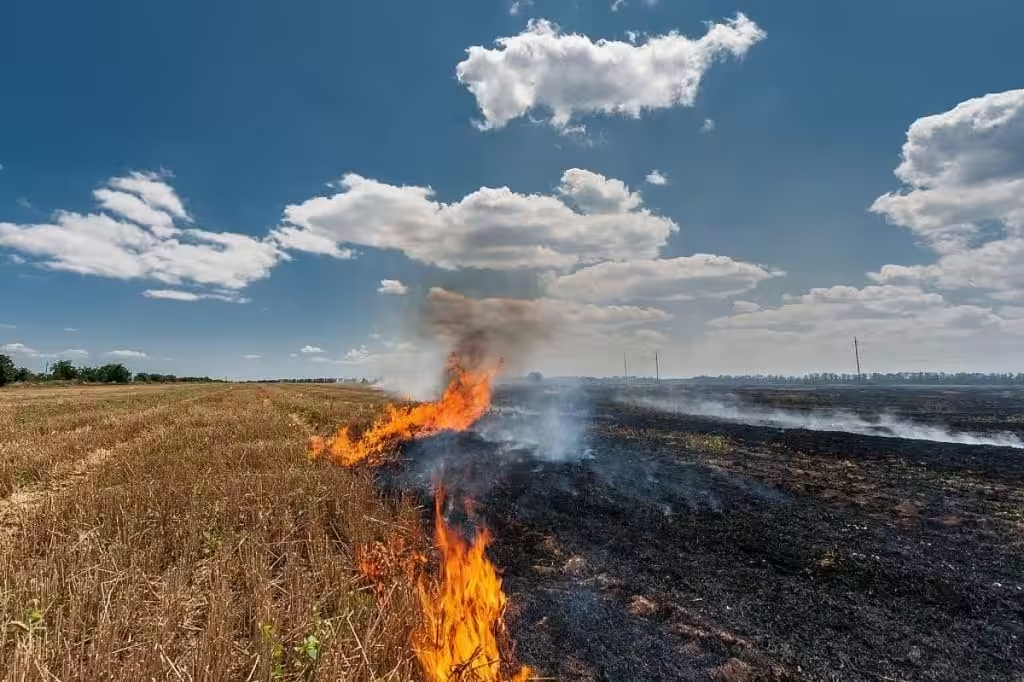
image 7 1
  • Crop residue burning in Punjab, Haryana and western Uttar Pradesh has been known, but nowadays it’s spreading more frequently in other parts of country. According to an official report, more than 500 million tonnes of parali (crop residues) is produced annually in the country, cereal crops (rice, wheat, maize and millets) account for 70 per cent of the total crop residue.
  • On December 10, 2015, the National Green Tribunal (NGT) had banned crop residue burning in the states of Rajasthan, Uttar Pradesh, Haryana and Punjab.
  • Burning crop residue is a crime under Section 188 of the IPC and under the Air and Pollution Control Act of 1981.

Among the various crops cultivated, the main contributors of crop residual are rice (43%), wheat (21%), sugarcane (19%), and oil seed crops (5%) and the majority crop residues are burnt.
image 7 2

Why stubble burning is practised?

  • Very short window between crops (Paddy → Wheat): Due to government law, Punjab farmers must plant paddy late (after 10 June) to save groundwater. Harvest happens around mid-October. Wheat must be sown within 15–20 days after that. Farmers have no time for manual or machine-based residue removal and therefore burning becomes the fastest option.
  • High cost of residue management: Small and marginal farmers can’t afford machines like Happy Seeder, Super Straw Management System (SMS). Labor shortages for farm activities like manual harvesting has encouraged the use of mechanized combine harvesters that leave behind crop residue.
  • Mechanized harvesting: Harvesters leave 7–10 inch stubble, impossible to plough easily and therefore burning becomes the cheapest and fastest solution.
  • Government MSP policy has made farmers stuck in this wheat–paddy cycle, which causes residue every year.
  • Lack of incentives & infrastructure: Very limited availability of biomass processing plants or ex-situ uses.

Green Revolution and Stubble Burning: Before the 1980s, farmers used to till the remaining debris back into the soil after harvesting the crops manually. The origin of stubble burning can be traced to the advent of the Green Revolution and mechanised harvesting, which utilised the combined harvesting technique. The Green Revolution increased greatly rice and wheat production, which simultaneously increased stubble post harvest. However, the popular combined harvesting technique was not efficacious, as machines left behind one-foot-tall stalks. This prompted stubble burning as a low-cost and speedy solution available to farmers due to the limited time period of 20-25 days between harvesting one crop and sowing another.”

What are the issues arising out of stubble burning?

  • Air Pollution and Emission of Greenhouse Gases
    •  Burning rice straw is expected to release 70% of the carbon in the straw as CO2, 7% as CO, and 0.66% as CH4. However, 2.09% of the nitrogen in the straw is released as N2O directly in the atmosphere which leads to global warming.
  • Nutritional Deficiencies
    • Approximately 90% of the nitrogen, 50% of the sulphur, 25% of the phosphorus, and 20% of the potassium from crop leftovers are released into the atmosphere as gases and particulates when the residue is burned, along with other valuable nutrients
  • Loss of Soil Fertility
    • The majority of farmers believe that burning is a quick, simple, and affordable procedure as it destroys all undesirable plants, shrubs, and husks. Some people think that fire could replenish the soil’s nutrients. However, the soil becomes less productive when husks are burned on the ground as it destroys the nutrients.
  • Smoke and Soot Particles
    • The smoke released due to husk burning, pollutes the air and produces a haze of pollutants that induces a “toxic atmosphere” in Delhi.
  • Harm on Health
    • Burning residue can lead to health risks such as bronchial asthma, asthma, acute respiratory infections (ARI), and eye irritation. Due to the increase in smog, 84.5% of the people had heart difficulties, 76.8% suffered from eye irritation, 44.8% reported nose discomfort, 45.5% complained about throat irritation, wheezing issues increased by 18.0%, while cough issues increased by 41.6%.

What are the other technological alternatives to stubble burning?

Farmers can manage crop residues effectively by employing agricultural machines like:
● Happy Seeder(used for sowing of the crop in standing stubble)
● Zero till seed drill (used for land preparations directly sowing of seeds in the
previous crop stubble)
● Baler (used for the collection of straw and making bales of the paddy stubble)
● Rotavator (used for land preparation and incorporation of crop stubble in the soil)
● Paddy Straw Chopper (cutting of paddy stubble for easily mixing with the soil)
● Reaper Binder (used for harvesting paddy stubble and making into bundles)

Diversified Uses of Crop Residue:

  • Decomposing stubble in the farm field and turning it into useful manure.
  • Use in Power Generation, production of cellulosic ethanol in PPP mode.
  • Use of Crop Residue for paper/board/panel and packing material.
  • Promotion of collection of crop residue for feed bricks making and its transport to
    fodder deficient areas.

Summary:

AspectKey Points
What is it?Burning leftover paddy/wheat stubble to quickly clear fields before next crop.
Why Practiced?• Very short 15–20 day crop window (Paddy→Wheat)
• High cost of machines, labour shortage
• Mechanized harvesters leave 7–10 inch residue
• MSP-driven rice–wheat cycle
• No incentives / weak biomass infrastructure
• Green Revolution + combine harvester legacy
Changing trends?Earlier limited to Punjab–Haryana–W.UP, now spreading across India due to mechanisation
Legal Status?• NGT banned in 2015
• IPC Sec 188 + Air Act 1981 = punishable offence
Major contributors?Rice (43%), wheat (21%), sugarcane (19%), oilseeds (5%)
Environmental Issues?• Massive air pollution + smog in NCR
• Emits CO₂, CO, CH₄, N₂O → GHG emissions
• Smoke + soot → toxic haze
Impact on Soil?• Loss of N (90%), S (50%), P (25%), K (20%) nutrients
• Kills soil microbes + organic carbon → long-term fertility loss
Impact on health?• Asthma, bronchitis, ARI, eye irritation
• High spike in smog-linked hospital cases
Technological alternatives?• Zero-Till Drill, Rotavator, Straw Chopper
• Baler, Reaper Binder
Non-Tech alternatives?• In-situ decomposition → manure
• Biomass power / ethanol (PPP)
• Paper, packaging, fodder briquettes

Clean energy and Climate finance

Open article →Download PDF

WhatsApp Image 2025 10 04 at 10.59.08 b954b0a3

Why in news:

India is making rapid strides in renewable energy, its progress is heavily constrained by lack of climate finance. The government and private sector must expand financing mechanisms like green bonds, carbon markets, and institutional investments to ensure India meets its 2030 climate targets.

UPSC Relevance:

Climate change, Climate Finance, Carbon Market, Renewable energy etc.

UPSC PYQ:

Q.1 In the context of India’s preparation for Climate-Smart Agriculture, consider the following statements: (2021)

  1. The ‘Climate-Smart Village’ approach in India is a part of a project led by the Climate Change, Agriculture and Food Security (CCAFS), an international research programme.
  2. The project of CCAFS is carried out under Consultative Group on International Agricultural Research (CGIAR) headquartered in France.
  3. The International Crops Research Institute for the Semi-Arid Tropics (ICRISAT) in India is one of the CGIAR’s research centres.

Which of the statements given above are correct?

(a) 1 and 2 only

(b) 2 and 3 only

(c) 1 and 3 only

(d) 1, 2 and 3

Q.1 Describe the major outcomes of the 26th session of the Conference of the Parties (COP) to the United Nations Framework Convention on Climate Change (UNFCCC). What are the commitments made by India in this conference? (2021)

Q.2 ‘Climate Change’ is a global problem. How will India be affected by climate change? How Himalayan and coastal states of India be affected by climate change? (2017)

Major highlights of the editorial:

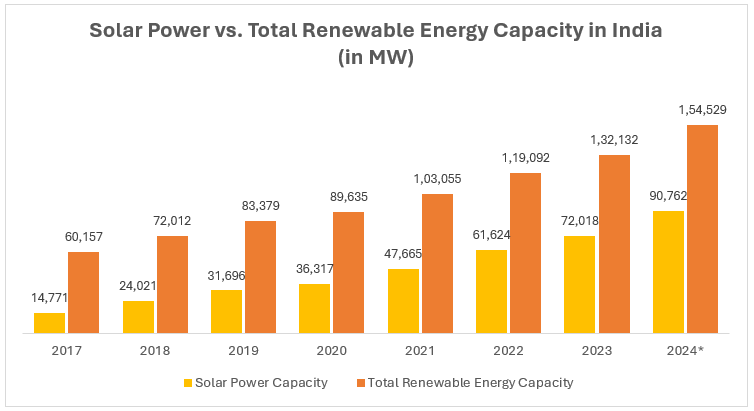
India’s clean energy transition is gaining momentum. In 2024, India added 24.5 gigawatts (GW) of solar energy capacity, making it the third largest contributor globally after China and the United States, making it a key player in the global shift towards renewables.

India has officially surpassed Japan to become the world’s third-largest solar power producer. According to the International Renewable Energy Agency (IRENA), India generated an impressive 1,08,494 GWh of solar energy, leaving Japan behind at 96,459 GWh.

image 7 3

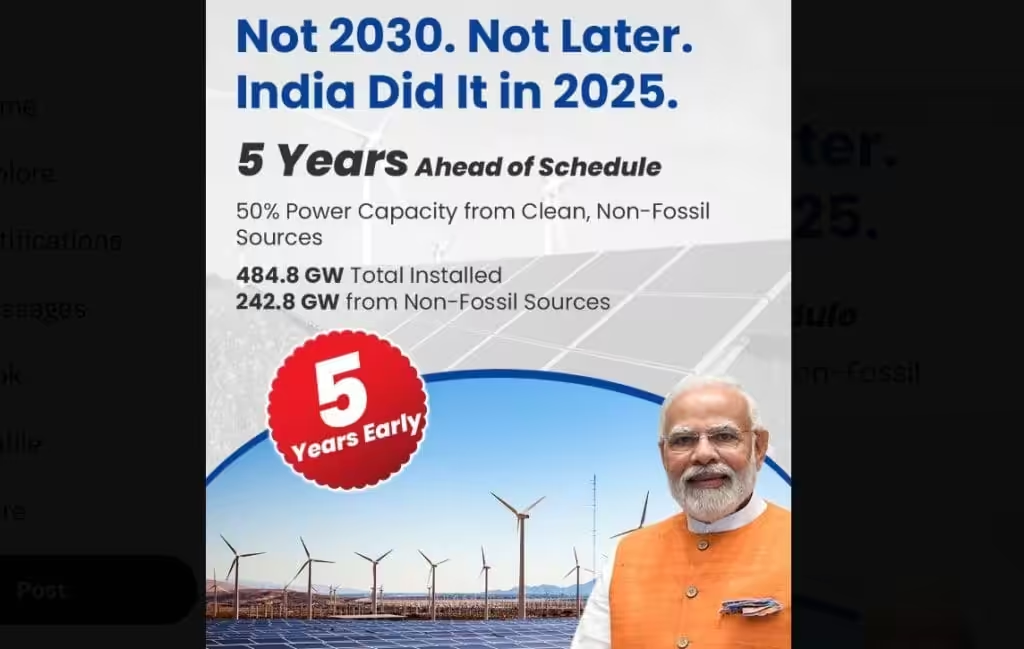
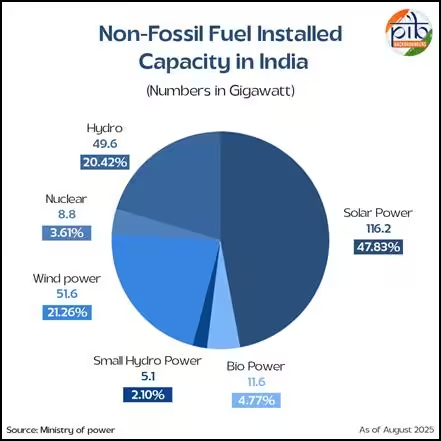
India has achieved its target of meeting 50 per cent of total installed energy capacity through renewable sources well ahead of the 2030 deadline.

image 7

Reason Behind this success:

  • PM Surya Ghar: Muft Bijli Yojana
  • PM-KUSUM (Pradhan Mantri Kisan Urja Suraksha Evam Utthaan Mahabhiyaan)
  • Solar Parks Scheme
  • PM JANMAN: Empowering PVTG Communities through Solar Electrification
  • Floating Solar Projects: The Omkareshwar Floating Solar Park in Madhya Pradesh is one of Asia’s largest floating solar parks, with a planned capacity of 600 MW.
  • Agrivoltaics: Agrivoltaics use solar panels and allow farming underneath, increasing land use and farmer income.

image 9

India stands 4th globally in Renewable Energy Installed Capacity, 4th in Wind Power capacity and 3rd in Solar Power capacity (as per IRENA RE Statistics 2025).

image 10

The Paris Agreement was adopted under United Nations Framework Convention on Climate Change (UNFCCC) in 2015. Under its Paris Agreement Nationally Determined Contributions (NDCs), India committed to reducing carbon intensity of the economy by 45% by 2030, over 2005 levels and the target of achieving 50% of cumulative electric power installed capacity from non-fossil fuel-based energy resources by 2030is now being met ahead of schedule.

Achievements:

  • Global leadership: Founding role in the International Solar Alliance (ISA).
  • Large-scale solar and wind growth: India is at the forefront of renewable expansion.
  • Employment generation: Renewables provided more than 1 million jobs (2023), plus 80,000 jobs in off-grid solar (2021).

Critical Gap – Climate Finance

  • Without large-scale finance, India will struggle to meet its climate targets.
  • Despite progress, the biggest challenge is finance to sustain and scale renewable growth.
  • Estimates suggest $1.5 trillion by 2030 will be needed; some projections even higher ($2.5 trillion).

Key Insights from the Report:

Green Bond Market:

  • India issued $55.9 billion in sustainability-linked bonds since 2021, but it’s still short of the needed scale.
  • Private finance covers 84% of total green investment, but public sector involvement is limited.

Scaling Clean Energy:

  • Investment needed in battery storage, hydrogen fuel, smart grids, decentralised energy, and green transport.
  • Mid-sized clean energy infrastructure (esp. Tier II & III cities) faces risks due to weak governance and delivery mechanisms.

Policy & Institutional Support:

  • Unlocking domestic pools like pension funds, sovereign wealth funds, insurance companies can expand financing.
  • Regulatory reforms, risk mitigation, and long-term project financing are required.

Carbon Markets:

  • India’s Carbon Credit Trading Scheme could mobilize finance if implemented transparently.
  • Potential to fund adaptation, innovation, and loss & damage measures.

Dairy Sector

Open article →Download PDF

image 11

Context:

The dairy sector in India grown by 70% in the last 11 years and is now the fastest growing sector in the world. In this growth, the dairy cooperatives and white revolution 2.0 have played prominent role.

UPSC Relevance:

Indian economy; agriculture and allied sectors.

PYQ:

Q) Livestock rearing has a big potential for providing non-farm employment and income in rural areas. Discuss suggesting suitable measures to promote this sector in India. 

India’s status in dairy sector:

  • 25% to world’s total milk output is from India, ranking first in production of milk globally.
  • 5% of the country’s GDP comes from dairy sector.
  • 8 crore families are provided livelihood by dairy industry.
  • More than 70% participation in the dairy sector is by women.

Objectives of White Revolution 2.0

  • Increase milk procurement by dairy cooperative societies: Aim is to increase the procurement by 50% over the next five years increasing the milk procurement to 1,000 lakh kilograms per day by 2029.
  • Strengthen women Farmer: To make women self-reliant and empowered in rural areas through employment, and fight against malnutrition etc.
  • Strengthen Dairy Infrastructure: The targets of White Revolution 2.0 have been subsumed under the Central Sector Scheme National Programme for Dairy Development (NPDD) 2.0. 
  • Financial assistance under NPDD is provided for setting up of village level milk procurement system, milk chilling facilities for quality milk procurement to strengthen dairy infrastructure
  • Boost Dairy Exports: Through indigenous production of testing equipment, bulk milk collection and dairy infrastructure.
  • Financial Inclusion:  Announcement of nationwide expansion of the ‘Cooperation among Cooperatives’ Initiative, was also done which has been successfully piloted in Gujarat. 
  • The programme will provide interest-free cash credit to dairy farmers through RuPay-Kisan Credit Cards and distribute micro-ATMs to dairy cooperative societies, bringing banking services to farmers’ doorsteps.

Importance of Cooperatives in Dairy Sector:

  • Promoting Economic Empowerment of Farmers: Cooperative societies like Amul and Nandini have provided equitable wealth distribution, reducing economic inequality among farmers.
  • Market Access: Cooperatives facilitate market access for small farmers, enhancing their collective bargaining power and enabling them to reach consumers more effectively.
  • Supporting Women’s Empowerment: By increasing women’s representation in the dairy sector, cooperatives contribute to their economic independence. 35% of participants in dairy cooperatives are women.
  • Facilitating Financial Inclusion: Cooperative banks offer low-interest loans, improving access to credit for farmers and members.
  • Crisis resilience and risk mitigation: Cooperatives offer crisis resilience and risk mitigation by providing a support network during economic downturns and reducing vulnerability to market fluctuations.

Challenges Faced by India’s Dairy Cooperatives:

  • Successful cooperative models are primarily found in Maharashtra, Gujarat, and parts of Kerala. Other regions have struggled to replicate this success. Some of the key reasons for this are as follows
  • Financing: Huge constraints are faced by cooperatives in alluring investments since cooperatives rely upon member contributions or loan capital, unlike firms/corporations that primarily rely on equity capital. 
  • Hurdles in creating milk grid: Domestic milk production units are scattered and partitioned by uneven terrain, constraining the development of a grand superstructure for a milk grid. The procurement price received by rural producers is further eroded by inefficiencies and diseconomies of scale. The cost of transportation and processing too is higher
  • Challenges faced by dairy farmers: low milk prices, high feed costs, unstable markets, inadequate veterinary services, equipment for milking, cow dung management, and tracking and storing of records. 
  • Farmers who have tracts of irrigated land possessed greater comparative advantages, to the many disadvantages of the landless. 
  • Consumer preference and market dynamics: Changing consumer needs, increased regulation, competition in the market, and volatile weather are some other challenges faced by milk cooperatives.

Way ahead:

Following initiatives could make India’s dairy cooperatives more efficient and competitive

  • Technological Integration: 
    • Milk cooperatives should integrate with information and communication technologies (ICT) for smoother operations. 
    • Establish cyber stores at key locations and create customer databases to segment the market and improve sales targeting.
    • Introduce a web-based business-to-business system for rural cooperatives, enabling easier transactions with dealers and stockists. 
  • Efficient Milk Processing:
    • Focus on Quality & Safety: Ensure quality milk procurement while maintaining high food safety and quality standards. 
    • Cold Chain Infrastructure: Develop a robust cold chain infrastructure to maintain milk quality and ensure smooth transportation. 
    • Brand Building & Promotion: Improve brand recognition through online promotion strategies, interactive websites, and creative marketing, such as food preparation guides or quizzes to capture consumer interest. 
  • Boosting Exports 
    • Competitiveness: Build confidence in domestic dairy brands by improving their competitiveness against international brands. 
    • Business Approach: Farmers should manage dairy cooperatives with a business mindset, focusing on profitability and sustainability. 
    • Exclusion from FTAs: Advocate for the exclusion of dairy from free trade agreements (FTAs) to protect domestic producers from international competition.