UPSC CSE 2026 Essay Paper Discussion

Daily Digest · Tuesday

9 June 2026 Current Affairs for UPSC

4 current affairs published on Tuesday, 9 June 2026

9 June 2026 Current Affairs for UPSC — every Why-in-News article AnantamIAS published on Tuesday, 9 June 2026, broken down with Why in News?, the exact GS paper it feeds, sub-topic mapping, MCQ-ready facts and a UPSC-style practice question. 4 articles in total, covering Polity, Economy, Environment, S&T, IR, Geography, History, Society and Internal Security — the same Why-in-News + GS-paper-mapping + practice-question format the Compass uses across every daily digest on the site.

Daily current affairs for UPSC is where new material enters your prep stream. Read this 9 June 2026 digest end-to-end in 25–35 minutes, attempt the practice question at the foot of each article (it's MCQ for some, 10/15-marker for others), then bookmark the entries that fall inside your active revision window. Everything stays cross-linked: tap any subject pill to jump to that subject's hub, or use the table of contents above to skip straight to a specific story.

Use this page three ways. Read sequentially for a one-sitting scan of everything that mattered on 9 June 2026. Download the 9 June 2026 PDF below for offline study or print revision. Or use the June 2026 Current Affairs compilation to see this day in the month's full context. For the previous day's reading, see 8 June 2026 Current Affairs; the next day's is 10 June 2026 Current Affairs.

Why we publish daily current affairs separately from the monthly compilation: daily is learning, monthly is revision. Use the daily page to add fresh material to your notes the day it breaks; come back to the June 2026 compilation 60 days before Prelims when the noise has settled and only the lasting takeaway is worth re-reading.

What is Lost and Gained in NFHS-6?

Open article →Download PDF

Why in News?

The Union Ministry of Health and Family Welfare recently released the National Family Health Survey-6 (NFHS-6), 2023-24. The survey was conducted by the Ministry with the International Institute for Population Sciences (IIPS), Mumbai, as the nodal agency and covered nearly 6.79 lakh households across 715 districts.

NFHS-6 has sparked debate because the preliminary fact sheet lists 101 indicators, compared with 131 in NFHS-5, and several important indicators are absent.

UPSC Relevance: GS-2 Social Justice: Health, Governance, Women and Child Development

Prelims: National Family Health Survey-6: Key data & indicators 

What is NFHS?

  • The National Family Health Survey is a large-scale, multi-round household survey that provides data on fertility, family planning, maternal and child health, nutrition, anaemia, mortality, women’s empowerment and other health indicators. 
  • Importance of NFHS: NFHS is a key survey for policy and programme purposes, as it provides:
    • National, State and district-level estimates
    • Comparable data across survey rounds
    • Evidence for schemes such as Poshan Abhiyaan, Ayushman Bharat, Janani Suraksha Yojana, Mission Parivar Vikas and Anaemia Mukt Bharat
    • Data for SDG monitoring, especially SDG 2, SDG 3, SDG 5 and SDG 6. 

Key Gains recorded in NFHS-6: 

  • Progress in Maternal and Child Health: Pregnant women receiving antenatal care rose to 95.9%. Institutional deliveries increased from 88.6% to 90.6%, while births attended by skilled health personnel rose from 89.4% to 91.3%. This reflects the impact of schemes such as:
    • Janani Suraksha Yojana
    • Janani Shishu Suraksha Karyakram
    • Pradhan Mantri Surakshit Matritva Abhiyan
    • SUMAN
    • PM Matru Vandana Yojana 
  • Improvement in Child Nutrition: Stunting among children under five declined from 35.5% to 29.3%, severe wasting declined from 7.7% to 5.2%, and underweight prevalence saw a marginal decline from 32.1% to 31.8%. Children aged 6-8 months receiving solid or semi-solid food with breastmilk increased from 45.9% to 59.5%.
  • Immunisation: Full vaccination coverage among children aged 12-23 months increased from 83.8% to 87.1%. 95.6% of children received most vaccinations through public health facilities.
  • Health Insurance and Financial Protection: Household-level health insurance or financing scheme coverage increased from 41.0% to 60.2%. The government has linked this improvement to Ayushman Bharat-PMJAY and other health protection initiatives.
  • Women’s Digital and Financial Inclusion: Women who had ever used the internet nearly doubled from 33.3% to 64.3%. Women having a bank or savings account increased from 78.6% to 89.0%, while women owning a mobile phone rose from 53.9% to 63.6%. This connects NFHS-6 with:
    • Digital India
    • Jan Dhan-Aadhaar-Mobile architecture
    • Direct Benefit Transfers
    • Women-led development
    • Financial inclusion

What is Lost in NFHS-6?

The main concern is not that NFHS-6 shows poor performance, but that the preliminary fact sheet reports fewer indicators than NFHS-5. A comparison cited by media reports shows 43 indicators dropped and 13 added, leading to a net reduction from 131 to 101 indicators.

Major Indicators Missing from the NFHS-6 Fact Sheet: 

Key indicators such as anaemia, mortality, sex ratio at birth, sanitation, and clean cooking fuel have been removed from the survey. 
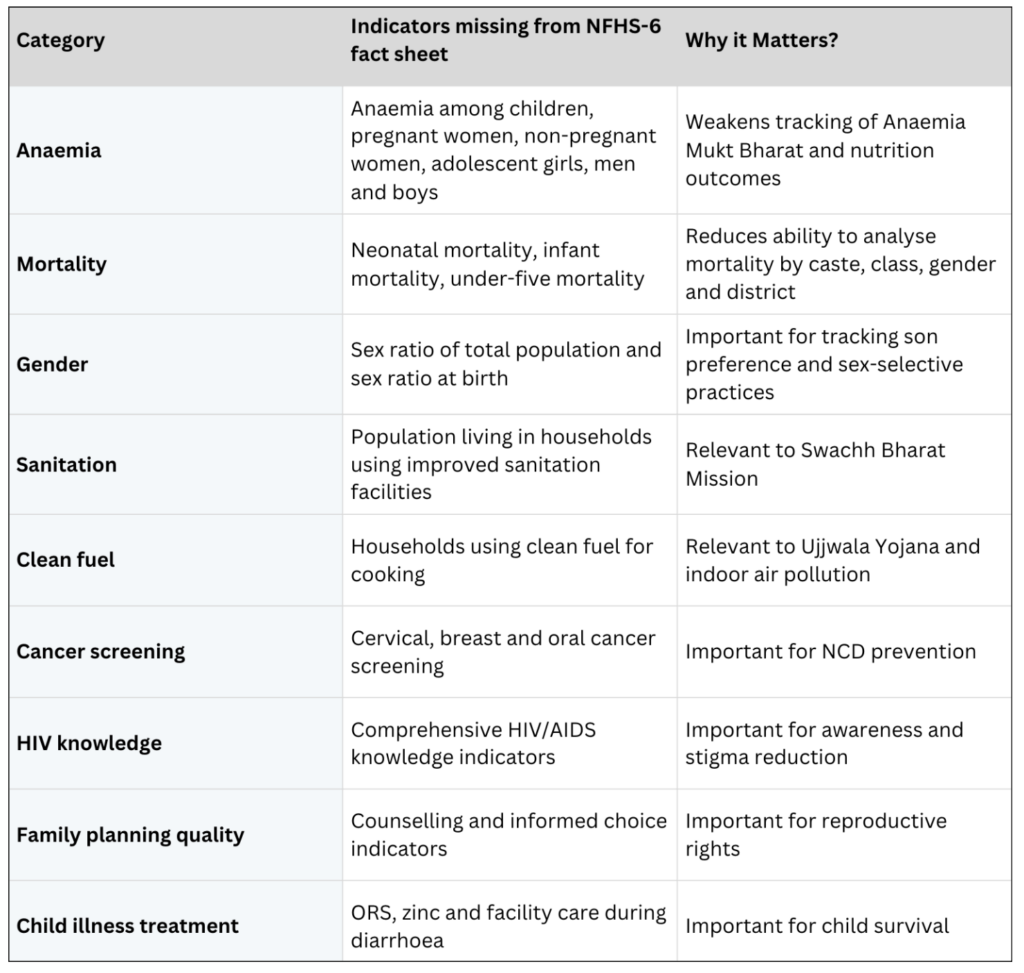
Why was Anaemia dropped?

  • Anaemia is the most debated omission. NFHS-5 had shown worsening anaemia: anaemia among children aged 6-59 months increased to 67.1%, among women aged 15-49 to 57%, and among pregnant women to 52.2%.
  • The official/technical justification is linked to methodology. NFHS used a finger-prick capillary blood sample. Anaemia prevalence is now expected to be reported through a separate Diet and Biomarker Survey by the National Institute of Nutrition, using venous blood samples.
  • The concern is not only methodological. If anaemia is measured through a new survey using a different method, comparison with NFHS-4 and NFHS-5 may become difficult. This creates a break in the time series, making it harder to assess whether Anaemia Mukt Bharat is improving outcomes.

New Additions in NFHS-6:

  • Newer Policy-Relevant Themes: NFHS-6 has added or emphasised indicators related to:
    • Direct Benefit Transfers
    • Self-help group membership
    • Digital literacy
    • Financial transactions
    • Household bank/post office account ownership
    • Population aged 60 years and above
    • Birth-dose Hepatitis-B vaccination

These additions reflect India’s changing policy landscape: ageing, digital governance, women’s financial inclusion and health system digitisation.

  • Digital Welfare Indicators: Inclusion of digital literacy and DBT-related indicators is important because India’s welfare delivery increasingly depends on digital access. However, digital access should not be reduced to internet use alone. It must also include the ability to use digital payments, access government portals, detect fraud and exercise consent.
  • Expanded Biomarker Focus: NFHS-6 includes greater attention to non-communicable disease indicators such as blood sugar and obesity. High blood sugar increased among both women and men, even as high blood pressure declined.

NFHS-6 presents a mixed picture. India has gained evidence of progress in maternal care, child nutrition, immunisation, financial protection and women’s digital inclusion. But it has lost visibility on several foundational public health and social indicators in the preliminary fact sheet. 

The gains of NFHS-6 will be fully meaningful only if the missing indicators are transparently explained, released through reliable alternative sources, and made comparable across time. 
The Trust Deficit in India-Bangladesh Ties

Open article →Download PDF

Why in News?

Once described as a model of neighbourhood diplomacy, India-Bangladesh relations are passing through a phase of political distrust. The change of regime in Bangladesh after the 2024 political upheaval, the interim rule under Muhammad Yunus, and the return of the Bangladesh Nationalist Party under Prime Minister Tarique Rahman have not yet produced the expected reset in ties.

The relationship is strained not because channels of communication have collapsed, but because both sides perceive the other as withholding meaningful political and material reassurance.

UPSC Relevance: GS-2 International Relations: Bilateral Relations; GS-3 Internal Security: Border Management

Mains: India-Bangladesh Bilateral Relations

During the Sheikh Hasina period, India-Bangladesh ties saw significant progress in connectivity, security cooperation, power trade, border management and economic engagement. Bangladesh acted against several anti-India insurgent networks operating from its territory, while India expanded lines of credit, power supply, transit and market access.

However, the 2024 political upheaval in Bangladesh altered this comfort zone. The interim government under Muhammad Yunus adopted a more critical tone towards India, while India was cautious in dealing with the post-Hasina political order. The BNP’s return to power under Tarique Rahman raised hopes of a pragmatic reset, but the first few months have shown that structural mistrust remains deep.

Why has the Trust Deficit Persisted?

1. India’s cautious approach towards the BNP government:

  • India has engaged the new Bangladesh government diplomatically, including through high-level visits and participation in the swearing-in ceremony. 
  • From Dhaka’s perspective, diplomatic outreach has not been matched by policy concessions. Bangladesh expected India to reverse some measures taken during the interim government’s tenure, especially in trade, transit and visas.

2. Trade and transit restrictions: 

  • India withdrew the transhipment facility that had allowed Bangladeshi exports to third countries through Indian land routes. India also imposed port restrictions on some Bangladeshi imports, including readymade garments and processed food items. These decisions are seen in Bangladesh as punitive and as a signal that India is not yet ready to normalise economic relations.
  • For India, however, such measures have been justified in terms of logistics, reciprocity, domestic industry concerns and border management.

3. Visa restrictions and people-to-people disruption:

  • The India-Bangladesh relationship has historically been sustained by dense people-to-people links. Medical travel, student movement, family visits, trade travel and tourism have all created social stakes in stability. Hence, visa restrictions add to the trust deficit. 

4. Illegal migration and domestic politics in India: 

  • The issue of illegal migration from Bangladesh is politically sensitive in Indian States such as West Bengal, Assam and Tripura. 
  • Bangladesh, however, sees aggressive rhetoric on illegal immigration as a diplomatic irritant and an insult to its national dignity.
  • Bangladesh has alleged attempts to force people into its territory, while India has maintained that repatriation must be dealt with through existing bilateral mechanisms. This shows how a border-management issue can quickly become a larger diplomatic flashpoint.

5. Sheikh Hasina’s presence in India:

  • The continued presence of the former Prime Minister in India remains a sensitive issue. The interim government had taken a hardline position on this matter. The BNP has tried to soften the tone by indicating that Hasina’s presence need not permanently hold the relationship hostage.

6. The Ganga Water Treaty and water insecurity: 

  • The 1996 Ganga Water Sharing Treaty is due for renewal in December 2026. This is one of the most important issues in bilateral relations because Bangladesh is a lower riparian country and depends heavily on predictable dry-season flows of the Ganga/Padma system.
  • Any delay in renewal may affect irrigation, agriculture, navigation, fisheries, salinity management and public opinion in Bangladesh. Projects such as the Ganges-Kobadak irrigation system in western Bangladesh are linked to the reliability of Ganga/Padma water flows.

7. China factor in Bangladesh’s foreign policy

  • Bangladesh’s affiliation towards China is partly structural and partly tactical. China is a major investor in infrastructure, defence supplies and connectivity projects.
  • For India, this raises strategic concerns because Bangladesh sits at the heart of the Bay of Bengal and India’s eastern neighbourhood. A stronger Chinese presence in Bangladesh could affect India’s maritime security, connectivity ambitions and Northeast strategy.

Why Bangladesh Matters to India?

  • Security of the Northeast: Bangladesh is crucial for India’s internal security because of its proximity to Assam, Tripura, Meghalaya and Mizoram. Past cooperation helped India reduce insurgent sanctuaries and improve border security. Any deterioration in ties can affect security in the Northeast.
  • Connectivity and Act East Policy: Bangladesh provides India with the most practical land and river connectivity route to the Northeast and Southeast Asia. Projects involving road, rail, inland waterways and ports are central to India’s Act East Policy and BIMSTEC vision.
  • Trade and regional integration: Bangladesh is one of India’s most important neighbours in terms of trade, market access and supply chains. Disruption in trade and transit affects not only bilateral commerce but also India’s regional integration with Nepal, Bhutan and the Bay of Bengal region.
  • Maritime security in the Bay of Bengal: Bangladesh is a key Bay of Bengal littoral state. Its strategic alignment affects India’s maritime interests, blue economy, energy security and response to China’s growing Indian Ocean presence.
  • Climate and river cooperation: India and Bangladesh share several transboundary rivers. Floods, cyclones, riverbank erosion, salinity intrusion and water scarcity require cooperative river-basin management rather than narrow seasonal bargaining.

India’s Concerns: 

  • The possible revival of anti-India Islamist or extremist networks.
  • The political rise of Jamaat-e-Islami and other groups with historically anti-India positions.
  • Safety of religious minorities in Bangladesh.
  • Illegal migration and border crime.
  • Smuggling, trafficking and fake currency networks.
  • Growing Chinese strategic influence.
  • Uncertainty about the BNP’s long-term position towards India.
  • Domestic pressure from the Indian border States.

Way Forward: 

  • Restore people-centric diplomacy: India should prioritise full restoration of medical, student, business and family visas. This would generate goodwill among ordinary Bangladeshis and reduce anti-India narratives.
  • Review trade and transit restrictions: India can consider a phased restoration of transhipment and land-port facilities, subject to safeguards. A technical mechanism can address logistics and reciprocity issues without politicising trade.
  • Fast-track Ganga Treaty negotiations: The Ganga Water Treaty renewal should be treated as a strategic confidence-building measure. The future agreement should include climate variability, dry-season stress, data sharing, sediment management and basin-level ecological concerns.
  • Institutionalise border-management mechanisms: India and Bangladesh should use BSF-BGB and Home Ministry-level mechanisms to handle migration and repatriation disputes. Public accusations should be avoided unless diplomatic mechanisms fail.
  • Engage all democratic actors in Bangladesh: India should avoid being seen as aligned with only one political party. A stable long-term policy requires engagement with the BNP, civil society, youth groups, business associations and regional actors.

A stable, sovereign and economically resilient Bangladesh is not a concession by India; it is a strategic necessity for India’s own neighbourhood policy. 

Zojila Tunnel Project 

Open article →Download PDF

Why in News?

The Zojila Tunnel Project achieved the final breakthrough when the excavation faces from the Kashmir and Ladakh sides met beneath the Zojila Pass. 

The project is expected to be fully commissioned around 2028 and will provide all-weather connectivity between the Kashmir Valley and Ladakh.

UPSC Relevance: GS-1 Geography: Locations; GS-3 Economy: Infrastructure

Prelims: Zojila Tunnel Project 

About Zojila Tunnel: 

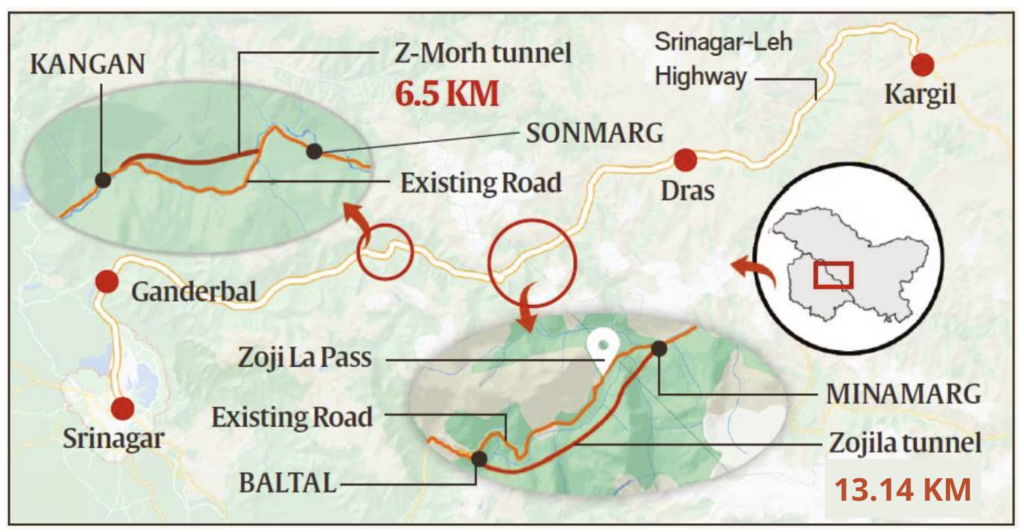
  • The Zojila Tunnel is an under-construction all-weather high-altitude road tunnel beneath the Zojila Pass on the Srinagar-Leh National Highway. 
  • Key Features
    • Length: 13.14-13.15 km
    • Altitude: 11,578 feet (≈3,500 m)
    • Location: Between Baltal (Kashmir) and Minamarg/Meenamarg (Ladakh)
    • Cost: Approximately ₹6,500-6,800 crore
    • Implementing Agency: National Highways and Infrastructure Development Corporation Limited
    • Geological Zone: Seismic Zone IV
    • Construction Technique: New Austrian Tunnelling Method (NATM)

The strategic Zojila Pass connects the Kashmir Valley (specifically Srinagar) to its west with the Ladakh region (specifically Leh, via the Dras and Suru valleys) to its northeast.

Why was the Tunnel Needed?

Seasonal Isolation of Ladakh:

  • Historically, the Zojila Pass has been one of the most difficult mountain passes in India.
    • Heavy snowfall and avalanches regularly block the pass.
    • The route traditionally remained inaccessible for nearly 160-180 days annually.
    • Even after improved snow-clearing operations, closures continue depending on weather conditions.
  • Such disruptions isolate Ladakh from the Kashmir Valley and the rest of India for extended periods.

Lifeline for Defence Logistics: 

  • The Srinagar-Leh highway passing through Zojila is the primary supply route for troops deployed in Ladakh, including those stationed in the Siachen Glacier region and along the Line of Actual Control (LAC) with China. The tunnel will ensure the uninterrupted movement of troops, Heavy military equipment, fuel, ammunition, and emergency reinforcements throughout the year.

Lessons from Kargil and Galwan:

  • The Kargil War (1999) highlighted the vulnerability of supply routes passing through the Zojila region. Pakistani intrusions targeted heights overlooking the highway to disrupt Indian logistics.
  • The Galwan Clash (2020) reinforced the need for rapid troop mobilisation and reliable connectivity in high-altitude border regions.

As a result, border infrastructure development became a major strategic priority.

Connectivity Benefits: 

  • Reduction in Travel Time: The tunnel will dramatically improve transportation efficiency.
    • Present Situation: Time across the Zojila Stretch is around 90 minutes to 3 hours, depending on conditions. 
    • After Completion: About 15-20 minutes
  • Integration with Z-Morh Tunnel: The recently operational Z-Morh Tunnel and the Zojila Tunnel together will create seamless year-round connectivity on the Srinagar-Leh corridor.
  • Tourism Growth: The tunnel is expected to boost tourism in Ladakh and Kargil. Promote winter tourism. It will also improve access to Baltal, the base camp for the annual Amarnath Yatra.
  • Regional Development: Year-round connectivity can reduce transportation costs, improve agricultural market access, facilitate movement of goods and services and encourage private investment.

Part of a Larger Border Infrastructure Strategy: 

The Zojila Tunnel is not an isolated project. According to government data:

  • 31 border road tunnels are under construction in Jammu & Kashmir and Ladakh. These include 20 tunnels in Jammu & Kashmir and 11 in Ladakh.
  • They form part of a broader set of 73 border infrastructure projects aimed at strengthening connectivity and strategic preparedness along India’s northern frontiers.

The initiative reflects India’s shift towards developing robust infrastructure in border regions to support both security and socio-economic objectives. 

India expanded its Nuclear Arsenal in 2025: SIPRI

Open article →Download PDF

Why in News?

India is estimated to have modestly expanded its nuclear arsenal in 2025 and continued developing new nuclear delivery systems, according to the Stockholm International Peace Research Institute (SIPRI) Yearbook 2026.

International Campaign to Abolish Nuclear Weapons (ICAN) reported a significant rise in global nuclear weapons expenditure in 2025, highlighting concerns about a renewed global nuclear arms race.

UPSC Relevance: GS-2 International Relations: Reports and Indices; GS-3: Defence Technology

Prelims: SIPRI Yearbook 2026: Key Highlights 

Key Findings of SIPRI Yearbook 2026:

1. India’s Nuclear Arsenal:

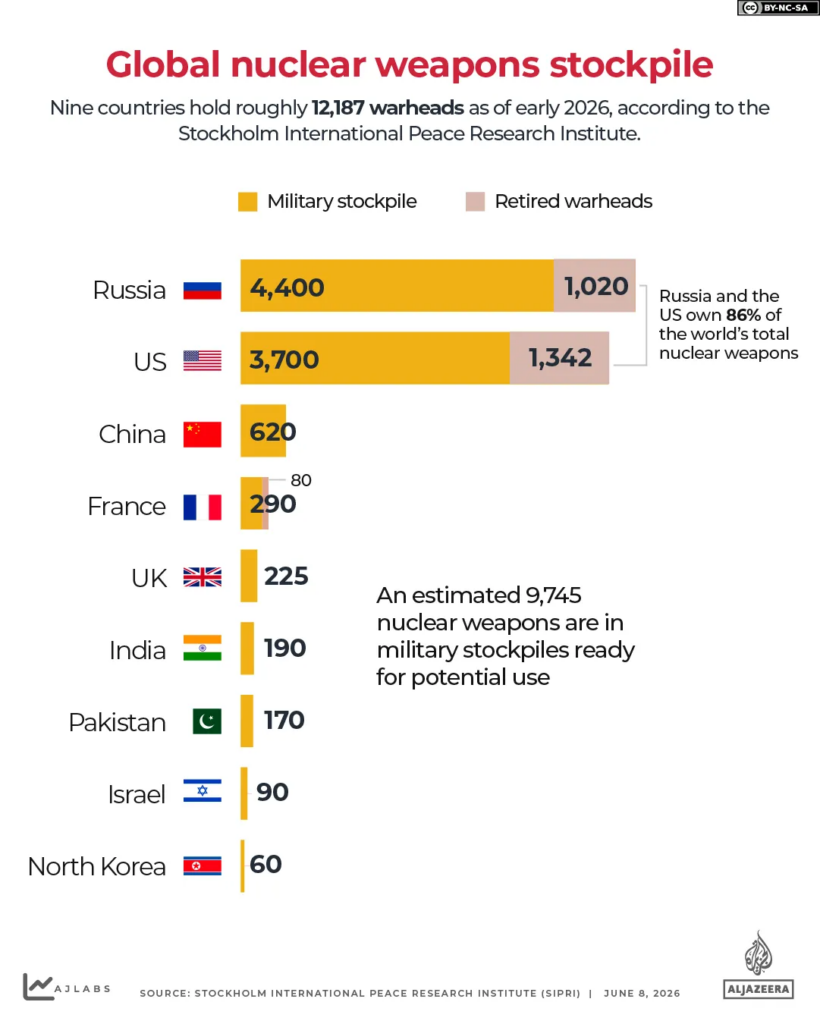
  • India possessed approximately 190 nuclear warheads in early 2026. The stockpile increased from around 180 warheads in 2025.
  • India continued to develop new long-range nuclear delivery systems. The modernisation programme increasingly focuses on longer-range capabilities capable of reaching targets across China.

Comparison: 

  • Pakistan is estimated to possess around 170 nuclear warheads.
  • China remains the fastest-growing nuclear power with an estimated 620 nuclear warheads.

2. Global Nuclear Landscape:

  • Nuclear-Armed States: Nine countries currently possess nuclear weapons:
    • United States
    • Russia
    • United Kingdom
    • France
    • China
    • India
    • Pakistan
    • North Korea
    • Israel
  • Together, they possessed approximately 12,187 nuclear warheads in early 2026. Around 9,745 warheads were in military stockpiles and potentially operational. Although total numbers continue to decline due to the dismantlement of retired warheads by the United States and Russia, operationally available nuclear weapons are increasing.

3. Military Expenditure: India’s Position

  • India retained its position as the world’s fifth-largest military spender in 2025. SIPRI estimated India’s military expenditure at $92.1 billion, an increase of 8.9% over the previous year. 
  • The country ranked behind only the United States ($954 billion), China ($336 billion), Russia and Germany in defence spending. 

Nuclear Spending: 

According to ICAN estimates for 2025:

  • According to ICAN’s latest assessment, India spent an estimated $2.5 billion on its nuclear weapons programme in 2025.
  • The United States remained by far the largest spender, investing $69.2 billion in nuclear weapons last year, more than all other nuclear-armed countries combined.
  • China emerged as the second-largest spender after the United States, allocating an estimated $13.5 billion towards its nuclear arsenal in 2025, more than five times India’s expenditure. 

India’s Nuclear Doctrine: 

India’s nuclear policy is built upon the principle of credible minimum deterrence.

  • No First Use (NFU): India pledges not to use nuclear weapons first but reserves the right to retaliate massively if attacked with nuclear weapons.
  • Credible Minimum Deterrence: India seeks only the minimum nuclear capability required to deter adversaries rather than pursuing numerical parity.
  • Civilian Political Control: Nuclear weapons remain under civilian oversight through the Nuclear Command Authority.
  • Assured Retaliation: India aims to maintain a survivable second-strike capability.

India’s Nuclear Triad: 

A mature nuclear deterrent requires delivery capabilities from land, air and sea.

  • Land-Based Systems
    • Agni series ballistic missiles
    • Agni-V and emerging longer-range systems
  • Air-Based Systems: Modified fighter aircraft capable of delivering nuclear weapons
  • Sea-Based Systems:
    • Nuclear-powered ballistic missile submarines (SSBNs)
    • K-series submarine-launched ballistic missiles

The sea-based component significantly enhances survivability and second-strike capability.

The expiry of New START-related limits and the failure of the 2026 Nuclear Non-Proliferation Treaty Review Conference to produce a final outcome document indicate growing stress in the global nuclear arms control regime. SIPRI warns that the absence of strategic dialogue and rising opacity may increase nuclear risks. 

About Stockholm International Peace Research Institute: 

  • SIPRI is an independent international institute dedicated to research into conflict, armaments, arms control and disarmament. 
  • Established in 1966, it publishes reports on global arms transfers, tracking trends in arms imports and exports to provide data-driven insights for policy-making in global security and military affairs.