Why in News?
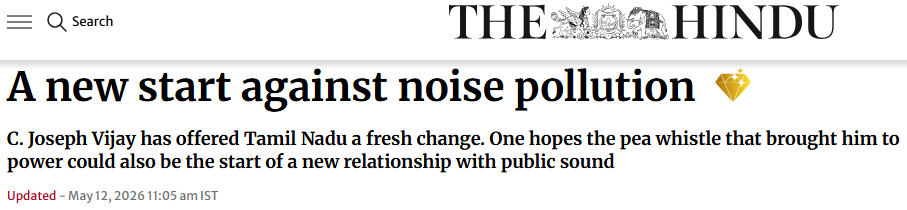
Noise pollution has emerged as a major public concern in Tamil Nadu following the widespread use of pea whistles during the Indian Premier League (IPL) matches of the Chennai Super Kings and the post-election celebrations of Tamilaga Vettri Kazhagam led by Joseph Vijay. The debate has revived attention on India’s weak enforcement of noise pollution norms, growing urban sound levels, and the broader public health implications of excessive noise exposure.
UPSC Relevance
GS-III: Environmental Pollution and Environmental Governance, Public Health and Urbanisation, Role of CPCB, State Pollution Control Boards, and local governance, Sustainable cities and quality of life under SDG-11, Rights-based discourse involving Article 21 (Right to Life and peaceful environment).
Noise Pollution: An Overlooked Environmental Crisis
While air and water pollution dominate environmental debates, noise pollution remains one of the least regulated and most socially tolerated forms of environmental degradation in India. Rapid urbanisation, political rallies, festivals, traffic congestion, construction activity, loudspeakers, and industrialisation have intensified ambient noise levels across Indian cities.
Unlike visible pollution, noise leaves no physical residue, yet its health impacts are profound and long-lasting.
The recent discussions in Tamil Nadu underline how cultural and political celebrations often normalise harmful sound levels despite clear legal restrictions and scientific evidence regarding their health effects.
What is Noise Pollution?
Noise pollution refers to unwanted or excessive sound that disrupts normal activities and adversely affects human and ecological health.
The World Health Organization (WHO) identifies prolonged exposure above 85 decibels (dB) as harmful to hearing and overall health.
Research indicates that pea whistles and similar devices can generate sound levels between 104 and 116 dB at the source — well above safe exposure thresholds.
Major Sources of Noise Pollution in India
Urban and Transport Sources
- Road traffic and honking.
- Railways and airports.
- Construction activities.
- Industrial machinery.
Social and Cultural Sources
- Religious processions and festivals.
- Political rallies and election campaigns.
- Marriage ceremonies and public events.
- Sports celebrations and amplified music systems.
Occupational Sources
- Factories and industrial units.
- Mining and construction sectors.
- Informal sector workplaces with limited safety regulation.
Health Impacts of Excessive Noise
Hearing Impairment
Noise-induced hearing loss is one of the most common occupational health disorders globally. Studies in India indicate significant hearing impairment among industrial and construction workers exposed to prolonged high-decibel environments.
India is estimated to have over six crore people with some degree of hearing impairment.
Physiological Effects
Continuous exposure to loud noise can:
- Elevate stress hormones such as cortisol.
- Increase risks of hypertension and cardiovascular diseases.
- Disturb sleep cycles and circadian rhythms.
- Trigger headaches and fatigue.
Cognitive and Psychological Effects
Children exposed to chronic noise near highways, airports, or industrial zones may experience:
- Reduced concentration and learning capacity.
- Memory and cognitive impairment.
- Increased anxiety and stress.
Impact on Wildlife
Noise pollution affects:
- Bird communication and migration.
- Marine ecosystems through underwater acoustic disturbances.
- Breeding and feeding behaviour of wildlife.
Noise Pollution in India: Current Status
National Ambient Noise Monitoring Network (NANMN)
India monitors ambient sound levels through the National Ambient Noise Monitoring Network under the Central Pollution Control Board (CPCB).
However:
- The network has limited coverage.
- Monitoring stations are concentrated in major metros.
- Many Tier-II and Tier-III cities remain unmonitored.
Data from CPCB indicate that a majority of monitoring stations exceed prescribed noise standards during both day and night.
Prescribed Noise Standards in India
Under the Noise Pollution (Regulation and Control) Rules, 2000:
| Area Category | Day Limit | Night Limit |
| Industrial | 75 dB | 70 dB |
| Commercial | 65 dB | 55 dB |
| Residential | 55 dB | 45 dB |
| Silence Zone | 50 dB | 40 dB |
Silence zones include areas around:
- Hospitals.
- Educational institutions.
- Courts.
- Religious places.
Legal and Institutional Framework
Constitutional Provisions
Article 21
The Supreme Court has interpreted the Right to Life to include:
- Right to sleep.
- Right to health.
- Right to a peaceful environment.
Article 48A
Directs the State to protect and improve the environment.
Article 51A(g)
Makes environmental protection a Fundamental Duty of citizens.
Noise Pollution (Regulation and Control) Rules, 2000
The Rules:
- Prescribe permissible noise limits.
- Restrict loudspeaker use during nighttime.
- Empower State governments and police authorities to regulate noise-generating activities.
Exceptions
States may permit loudspeaker use between 10 PM and midnight for up to 15 days annually during cultural or religious occasions.
Judicial Interventions
The Supreme Court and High Courts have repeatedly emphasised that:
- Religious freedom does not include unrestricted use of loudspeakers.
- Public health must prevail over excessive noise.
Important judgments include:
- In Re: Noise Pollution vs Unknown (2005).
- Restrictions on firecrackers and loudspeaker use.
Why Enforcement Remains Weak
Political Hesitation
Political parties are often reluctant to regulate:
- Election celebrations.
- Religious events.
- Public gatherings.
Fear of backlash frequently overrides enforcement concerns.
Low Public Awareness
Noise pollution is socially normalised and rarely viewed as a serious environmental threat.
Weak Monitoring Infrastructure
Insufficient monitoring stations and manpower reduce enforcement capacity.
Poor Urban Planning
Indian cities often lack:
- Acoustic zoning.
- Noise barriers.
- Proper construction regulations.
Broader Governance Challenges
Urban Informality
In densely populated urban settlements:
- Construction often continues at night.
- Loudspeaker permissions are poorly regulated.
- Occupational safety standards remain weak.
Public Health Burden
India’s healthcare system does not adequately integrate:
- Occupational hearing loss screening.
- Mental health impacts of noise.
- Urban acoustic planning.
International Experience
European Union
The European Environment Agency identifies noise as the second-largest environmental cause of health burden after air pollution.
Several European countries implement:
- Noise mapping.
- Urban sound barriers.
- Strict traffic regulation.
- Quiet zones in cities.
WHO Guidelines
WHO recommends:
- Lower urban traffic noise.
- Strong occupational sound standards.
- Integration of noise into public health policy.
The Way Forward
Strengthen Monitoring Infrastructure
India should:
- Expand NANMN coverage beyond metros.
- Introduce real-time public noise dashboards.
- Use AI and IoT-based acoustic sensors.
Strict Enforcement of Existing Rules
Authorities must:
- Penalise repeated violations.
- Monitor political and religious events uniformly.
- Ensure silence zones are protected.
Urban Acoustic Planning
Urban planning should integrate:
- Soundproofing standards.
- Green buffers and noise barriers.
- Better zoning regulations.
Public Awareness Campaigns
Noise pollution must be treated as:
- A public health issue.
- An environmental justice concern.
- A governance challenge.
Occupational Safety Measures
Mandatory hearing protection and periodic screening should be enforced in:
- Construction sites.
- Industrial workplaces.
- Transport hubs.
Political Leadership and Civic Responsibility
Political parties, celebrities, and public leaders can help normalise:
- Low-noise celebrations.
- Responsible public events.
- Respect for community well-being.
Conclusion
Noise pollution represents a silent public health emergency that India has long ignored. The debate emerging from Tamil Nadu highlights a deeper governance challenge — balancing celebration, culture, politics, and public health in rapidly urbanising societies.
India’s environmental discourse can no longer treat noise as a secondary issue. Protecting citizens’ right to sleep, study, work, and live in peace is integral to the constitutional promise of dignity and quality of life. Effective regulation, public awareness, and political will are essential if India is to move toward healthier and more liveable cities.
Practice Questions
1. With reference to Noise Pollution (Regulation and Control) Rules, 2000, consider the following statements:
- State governments may permit loudspeaker use during nighttime on specified occasions.
- Silence zones include areas around hospitals and educational institutions.
- The Rules are implemented exclusively by the Central Pollution Control Board.
How many of the above statements are correct?
(a) Only one
(b) Only two
(c) All three
(d) None
Answer: (b)
2. Which of the following health impacts are associated with prolonged exposure to excessive noise?
- Hypertension
- Hearing impairment
- Sleep disturbance
- Cognitive stress in children
Select the correct answer using the code below:
(a) 1 and 2 only
(b) 2 and 3 only
(c) 1, 2 and 4 only
(d) 1, 2, 3 and 4
Answer: (d)
Mains
1. Noise pollution is an under-recognised environmental and public health challenge in India. Discuss the causes, impacts, and limitations of the existing regulatory framework.
2. Examine the role of urbanisation, political culture, and weak enforcement in aggravating noise pollution in India. Suggest measures for sustainable urban acoustic governance.
Tell Google you want more of this.
Add Anantam IAS as a preferred sourceOne tap, and this site shows up more often in your own Top Stories, AI Overviews and AI Mode. Remove it any time.