Why in News?
On 5 November, Cosmoserve Space opened its Base 1 facility in Hyderabad to develop and test robots for active debris removal and in-orbit servicing.
- Base 1 has laboratories for orbital rendezvous and capture, microgravity simulation platforms and satellite integration clean rooms.
- The Department of Space reported that Mission EMBRACE tested soft robotic petals in space in July 2026.
- The minister described debris-free space by 2030 as a policy vision. The announcement reported no recovery or disposal of an existing debris object.
- A defunct satellite can share an orbital region with working satellites long after its mission ends.
- Tracking can warn an operator about a close approach. Removing an object requires a spacecraft capable of changing that object’s orbit.
UPSC Relevance
Prelims Relevance
- Orbital debris includes defunct satellites and spent rocket stages.
- Rendezvous involves bringing two spacecraft close with compatible motion.
- An uncooperative target cannot help a servicing vehicle navigate or capture it.
- A capture mechanism secures the object. Disposal changes its orbital fate.
Mains Relevance
GS Paper 3
- Distinguish collision avoidance, prevention of new debris and removal of existing debris.
- Evaluate what a ground test facility can establish about readiness for a flight mission.
Background and Context
What Can the Hyderabad Facility Test?
A removal mission must bring hardware, navigation software and flight control together. Base 1 gives engineers a place to test how those parts interact.
- The rendezvous laboratory addresses the approach to a moving target. A capture laboratory addresses the later problem of making contact and holding the target without damaging either object.
- A microgravity simulation lets teams study how hardware behaves under selected conditions on Earth. A ground trial can expose a fault before flight, while leaving other conditions to be tested in orbit.
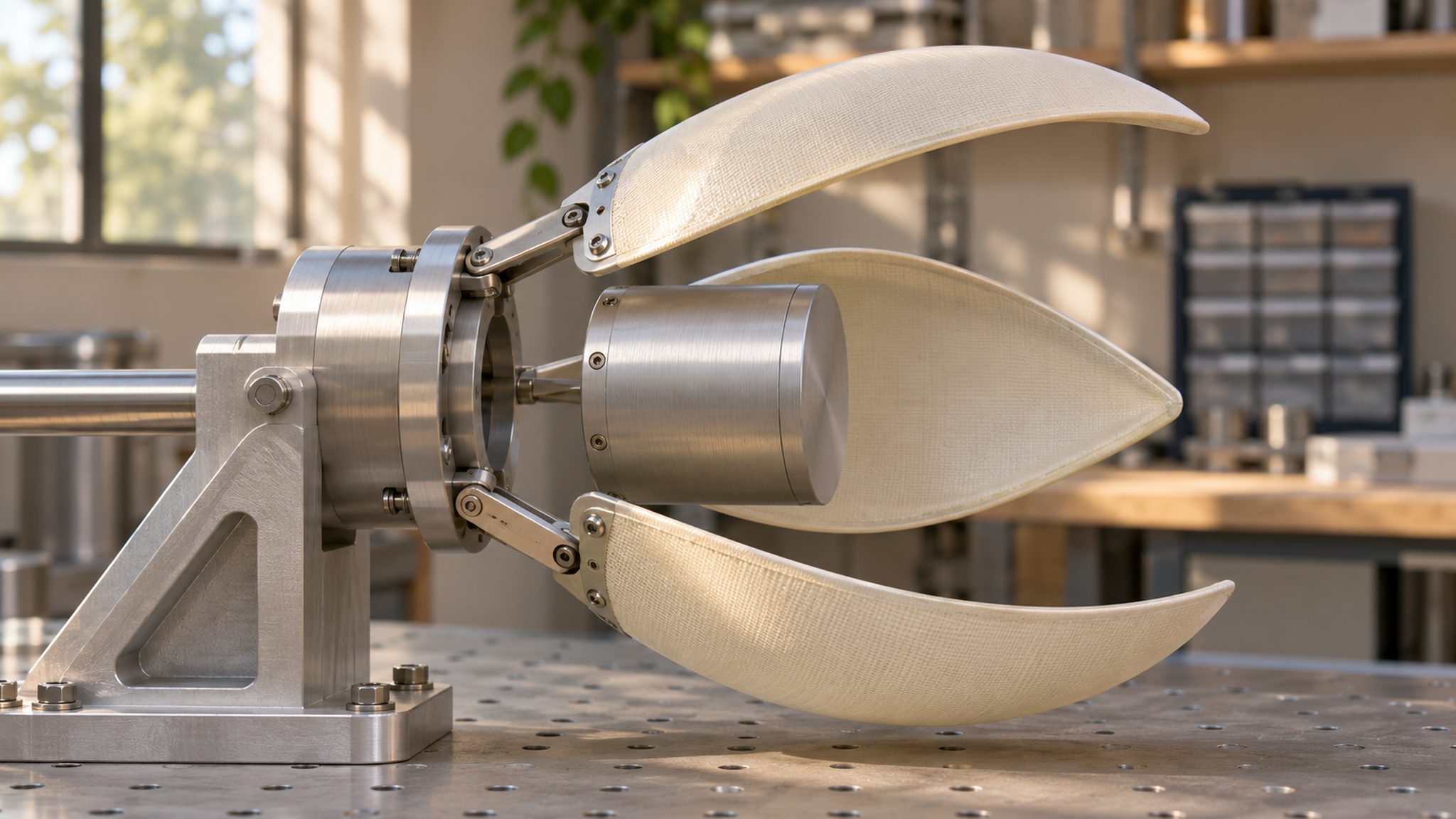
- The July EMBRACE test took soft robotic petals into space. That demonstrated a step in developing a capture device. The official account does not report the capture of a freely orbiting, defunct satellite.
- The same close-approach skills also support in-orbit servicing. A servicing vehicle might reach an operating satellite to extend its useful life, whereas a debris-removal vehicle seeks to take a defunct object out of harm’s way.
Why Must a Chaser Match the Target's Motion?
Imagine two objects passing the same point on different paths. Even at their closest approach they can be moving rapidly relative to one another.
- Tracking estimates where the debris will be. An orbit catalogue helps a mission planner find the target, but reaching that predicted location alone could produce a brief flyby or a collision.
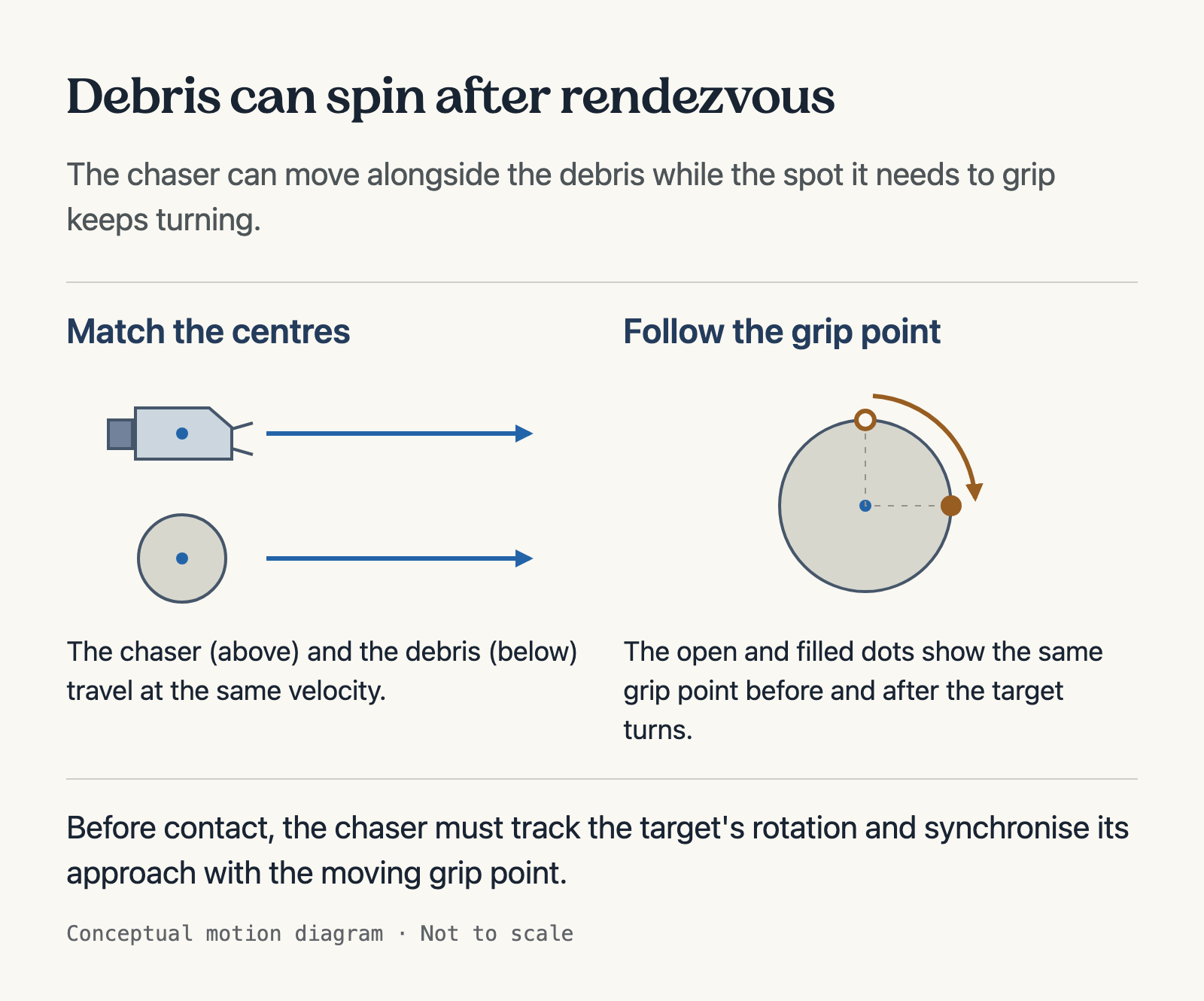
- During rendezvous, the chaser changes its trajectory so that it can stay near the target. Its sensors measure the separation and how quickly that separation changes as the two objects move.
- A defunct satellite may tumble. Even when its centre moves alongside the chaser, a point on its surface can sweep past the capture mechanism, much as the rim of a turning wheel does.
- For capture, the chaser must account for both the approach speed and the rotation of the intended contact point. If those motions are poorly matched, contact can knock fragments loose.
- Once joined, the spacecraft must control the combined body. The attached mass changes how the system responds to thrust. A secure grip gives the chaser a way to move the debris with it.
When Does Capture Become Disposal?
A captured object can still occupy the same busy orbit. Its eventual path determines whether the operation has reduced the hazard.
- For an object in low Earth orbit, one disposal option is to lower its orbit for atmospheric re-entry. The mission must plan the descent as well as the encounter that precedes it.
- Active removal deals with debris already present. Designing a new satellite to leave its operational orbit at the end of its life reduces the chance that a future chaser will have to collect it.
- A functioning satellite may make a collision-avoidance manoeuvre after a warning. That can protect the satellite during one encounter while leaving the debris available to cross another spacecraft’s path later.
- Read the 2030 vision against these separate outcomes. Demonstrating a capture component, disposing of one selected object and reducing the risk across an entire orbital region each require different evidence.
Way Forward
Measure Each Flight Milestone
- Report which relative motions a test reproduced, which target it used and what happened after contact.
- Include a safe retreat if the chaser loses track of the target during the final approach.
- Pair a removal plan with measures that limit new debris. See the wider space governance debate and the scope of the Outer Space Treaty.
Conclusion
- For an exam question, follow the target through the encounter. Tracking predicts its path, rendezvous controls relative motion, capture secures it and disposal changes where it will travel.
- The Hyderabad laboratories support the development of these capabilities. A claim of debris removal requires evidence of the target’s fate after the capture attempt.
UPSC Practice Questions
Prelims MCQ 1
With reference to active debris removal, consider the following statements:
- A tracking catalogue alone can change the orbit of a defunct satellite.
- A chaser may need to account for the target’s rotation before capture.
- Securing a target does not by itself remove it from its orbit.
How many of the above statements are correct?
(a) Only one (b) Only two (c) All three (d) None
Answer: (b) Only two
Explanation:
Statements two and three are correct. Tracking estimates motion. A chaser must physically intervene to change a debris object’s orbit.
Prelims MCQ 2
Which observation most directly demonstrates a successful rendezvous before capture?
(a) Both objects pass through the same altitude (b) A ground sensor identifies the target (c) The chaser maintains a controlled position close to the target (d) Both objects cross the same point at high relative speed
Answer: (c) The chaser maintains a controlled position close to the target
Explanation:
Controlled relative position enables the final approach. Equal altitudes and crossing paths can still leave the vehicles moving rapidly relative to each other.
UPSC Mains Questions
- Why is tracking orbital debris insufficient for its safe removal? Explain the role of relative motion in capture.
- How should a national space programme balance preventing new debris with removing existing objects?
Sources: PIB, Department of Space and European Space Agency, Active debris removal.
Frequently Asked Questions
What is active debris removal?
It is a mission to intervene physically in the trajectory of an existing debris object. One approach uses a chaser to capture the object and take it towards safe disposal.
Why is a tumbling target difficult to capture?
The target’s surface rotates relative to the chaser. Even if their centres move together, the intended contact point may move fast enough to make a grip unsafe.
What did Mission EMBRACE test?
The Department of Space reports that the mission tested soft robotic petals in space in July 2026. The ministry describes a component test and gives no account of an existing debris object being removed.
How does collision avoidance differ from active removal?
A working satellite changes its own path to avoid a predicted encounter. Active removal changes the path of the debris itself so it can leave the orbital region at risk.
Tell Google you want more of this.
Add Anantam IAS as a preferred sourceOne tap, and this site shows up more often in your own Top Stories, AI Overviews and AI Mode. Remove it any time.