Why in News?
- India commissioned the indigenous stealth frigate INS Taragiri (F41) on 3 April 2026.
- It is part of Project 17A (Nilgiri-class) warships.
- Built by Mazagon Dock Shipbuilders Limited (MDL) with ~75% indigenous content.
- Equipped with advanced weapons including BrahMos missiles.
UPSC Relevance:
GS-III: Science & Technology, Indigenous Capability, Internal Security and GS-II: International Relations
What is INS Taragiri?
- A guided-missile stealth frigate of the Indian Navy
- Part of Nilgiri-class (Project 17A)
- Designed for multi-role operations:
- Surface warfare, Anti-air warfare, Anti-submarine warfare
Key Features
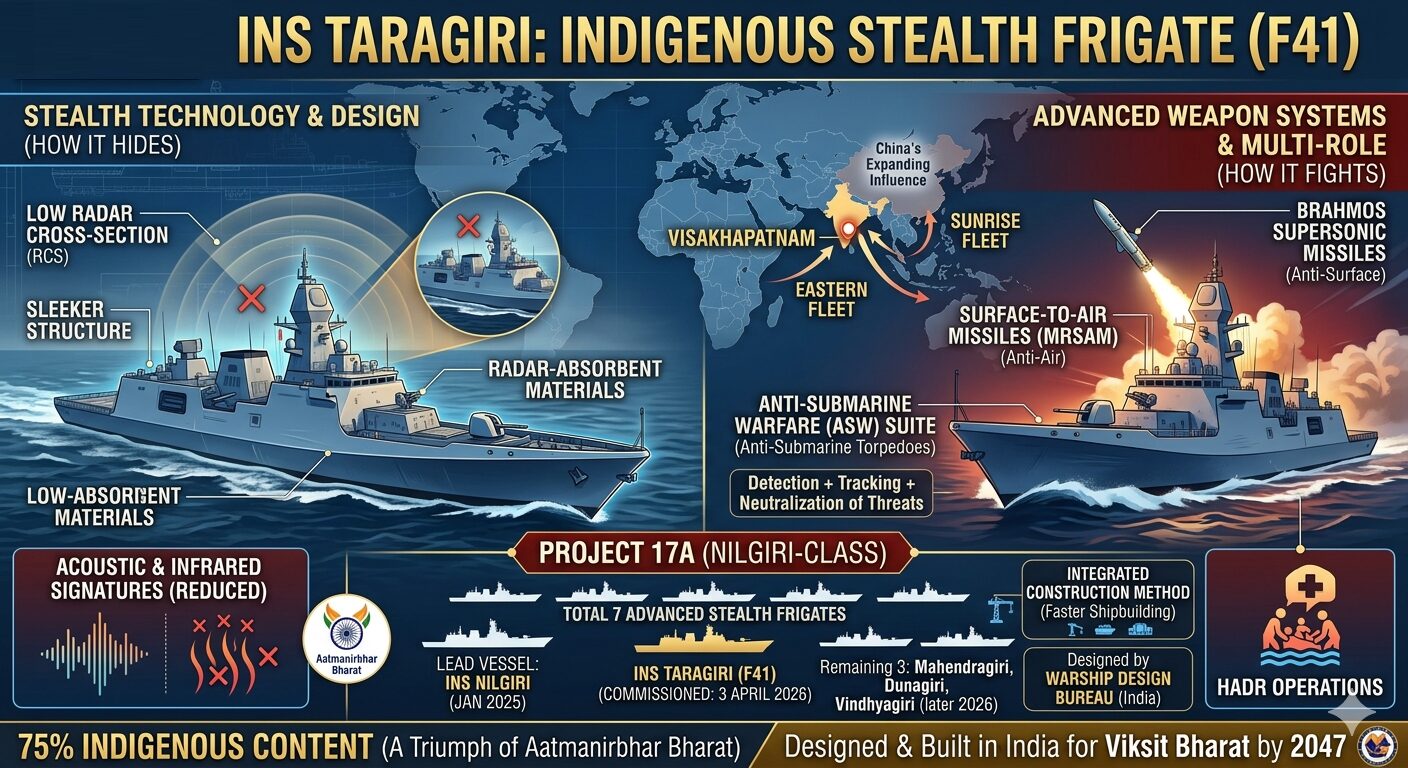
1. Stealth Technology
- Reduced radar cross-section → difficult to detect
- Low acoustic & infrared signatures
A stealth frigate is a warship designed to avoid detection (radar, sonar, IR) while carrying advanced weapons.
2. Advanced Weapon Systems
- BrahMos supersonic cruise missiles
- Surface-to-air missiles (MRSAM)
- Anti-submarine torpedoes
3. Sensors & Systems
- Modern radar (MF-STAR)
- Sonar systems
- Combat Management System
Enables: Detection + tracking + neutralization of threats
4. Indigenous Capability
- ~75% indigenous components
- Designed by Warship Design Bureau (India)
Reflects: Aatmanirbhar Bharat in defence
What is Project 17A?
- Project 17A is a programme of the Indian Navy to build a total of seven advanced stealth frigates. The ships are an upgraded version of the earlier Shivalik-class frigates (Project 17). Four are being built by MDL in Mumbai and three by Garden Reach Shipbuilders and Engineers (GRSE) in Kolkata. The lead vessel, INS Nilgiri, was commissioned in January 2025. The remaining three ships—Mahendragiri, Dunagiri, and Vindhyagiri—are expected to be commissioned later in 2026
Key innovations:
- Integrated construction method → faster shipbuilding
- Better:
- Stealth
- Automation
- Survivability
Strategic Significance
- A Leap in Stealth Technology: Its advanced design features a ‘sleeker structure’ and a significantly reduced Radar Cross-Section (RCS), making it very difficult for enemy radars to detect. This ‘low radar visibility’ allows it to approach targets undetected and enhances its survivability in contested maritime environments. It is considered a “generational leap” over earlier frigate designs.
- Formidable Firepower and Multi-Role Capability: As a true ‘multi-role’ vessel, it is equipped to handle a wide array of missions. The integration of the supersonic BrahMos missile, MRSAMs, and an advanced anti-submarine warfare (ASW) suite gives it a formidable edge in anti-surface, anti-air, and anti-submarine warfare. Beyond combat, it is also designed for humanitarian assistance and disaster relief (HADR) operations.
- A Triumph of ‘Aatmanirbhar Bharat’ in Defence: The ship is a shining example of India’s growing self-reliance in defence manufacturing. With over 75% indigenous content, it showcases the maturity of the domestic defence industrial ecosystem. The project involved over 200 Micro, Small, and Medium Enterprises (MSMEs), supporting thousands of jobs. It is the embodiment of the ‘Make in India‘ spirit.
- Strengthening the Eastern Fleet and the ‘Sunrise Fleet’: Commissioned into the Eastern Fleet, which is based in Visakhapatnam and is often called the ‘Sunrise Fleet’, INS Taragiri will significantly bolster India’s naval presence along its eastern seaboard. This is crucial given China’s expanding influence in the Bay of Bengal and Southeast Asia.
Challenges / Concerns
- High cost of indigenous warships
- Dependence on some foreign components
- Need for faster production timelines
Conclusion:
The commissioning of INS Taragiri is not merely the addition of a warship but a demonstration of India’s growing technological prowess and strategic resolve. It strengthens the Navy’s ability to protect national interests, secure global trade, and project power in the Indian Ocean Region. As India works towards a ‘Viksit Bharat’ by 2047, the modernisation and indigenisation of its naval fleet are fundamental pillars for ensuring its security and prosperity
Practice MCQs:
Consider the following statements regarding INS Taragiri:
- It is a nuclear-powered submarine.
- It is part of Project 17A frigates.
- It is equipped with BrahMos missiles.
Which of the statements given above is/are correct?
A) 1 only
B) 2 and 3 only
C) 1 and 3 only
D) 1, 2 and 3
Answer: B
Which of the following features is/are associated with stealth warships?
- Reduced radar cross-section
- Low acoustic signature
- High visibility to enemy radar
Select the correct answer:
A) 1 and 2 only
B) 2 and 3 only
C) 1 and 3 only
D) 1, 2 and 3
Answer: A
Tell Google you want more of this.
Add Anantam IAS as a preferred sourceOne tap, and this site shows up more often in your own Top Stories, AI Overviews and AI Mode. Remove it any time.