Why in News?
On 30 September 2026, PIB reported CHIME’s standalone detection of distant hydrogen emission, with Raman Research Institute participation, advancing a method for studying cosmic expansion.
- The signal comes from when the universe was about five billion years old; this is cosmic age, not a five-billion-year lookback time.
- CHIME identified the faint hydrogen signal using its own data, without requiring another telescope’s galaxy survey for this detection.
- The result strengthens hydrogen intensity mapping; it does not directly detect dark energy or settle competing explanations of accelerated expansion.
- Neutral hydrogen provides a tracer of matter beyond individually identified bright galaxies, helping researchers study cosmic structure statistically.
- Signal extraction is central: a plausible sky map becomes scientific evidence only after contamination and instrument effects are tested.
UPSC Relevance
Prelims Relevance
- CHIME: a radio interferometer in Canada.
- Neutral atomic hydrogen and its 21-centimetre radio emission.
- Cosmological redshift: wavelength increases as the universe expands.
- Intensity mapping: aggregate emission rather than separately catalogued galaxies.
- Raman Research Institute: Indian participation in the collaboration.
Mains Relevance
GS Paper 3
- How new observational tools test cosmological models.
- Research infrastructure, international collaboration and reliable data analysis.
Essay
- Scientific progress often depends on learning to distinguish a weak signal from a convincing error.
Background and Context
What the CHIME telescope measures
CHIME collects radio signals across broad areas of sky; its measurement is the combined brightness of hydrogen rather than a photograph of individual atoms.
- CHIME stands for Canadian Hydrogen Intensity Mapping Experiment. Its fixed, curved reflectors resemble long troughs, with receivers along their focal lines; they do not rotate to follow a selected object across the sky.
- As Earth rotates, different sky regions pass overhead. Combining receiver signals makes this an interferometer, allowing astronomers to distinguish directions while repeatedly surveying the same accessible sky with a stationary physical structure.
- Neutral atomic hydrogen has an electron bound to a proton. Its characteristic radio emission has a rest wavelength of 21 centimetres; expansion stretches that radiation before it reaches the telescope on Earth.
- Intensity mapping records aggregate emission within sky and frequency cells. It retains information about large-scale structure without requiring every contributing galaxy to be separately identified, measured and entered into an optical survey catalogue.
- Indian participation through Raman Research Institute connects instrument interpretation with international research. The wider question of access to specialised equipment is discussed in shared public research infrastructure, although I-STEM does not operate CHIME.

From hydrogen emission to a three-dimensional map
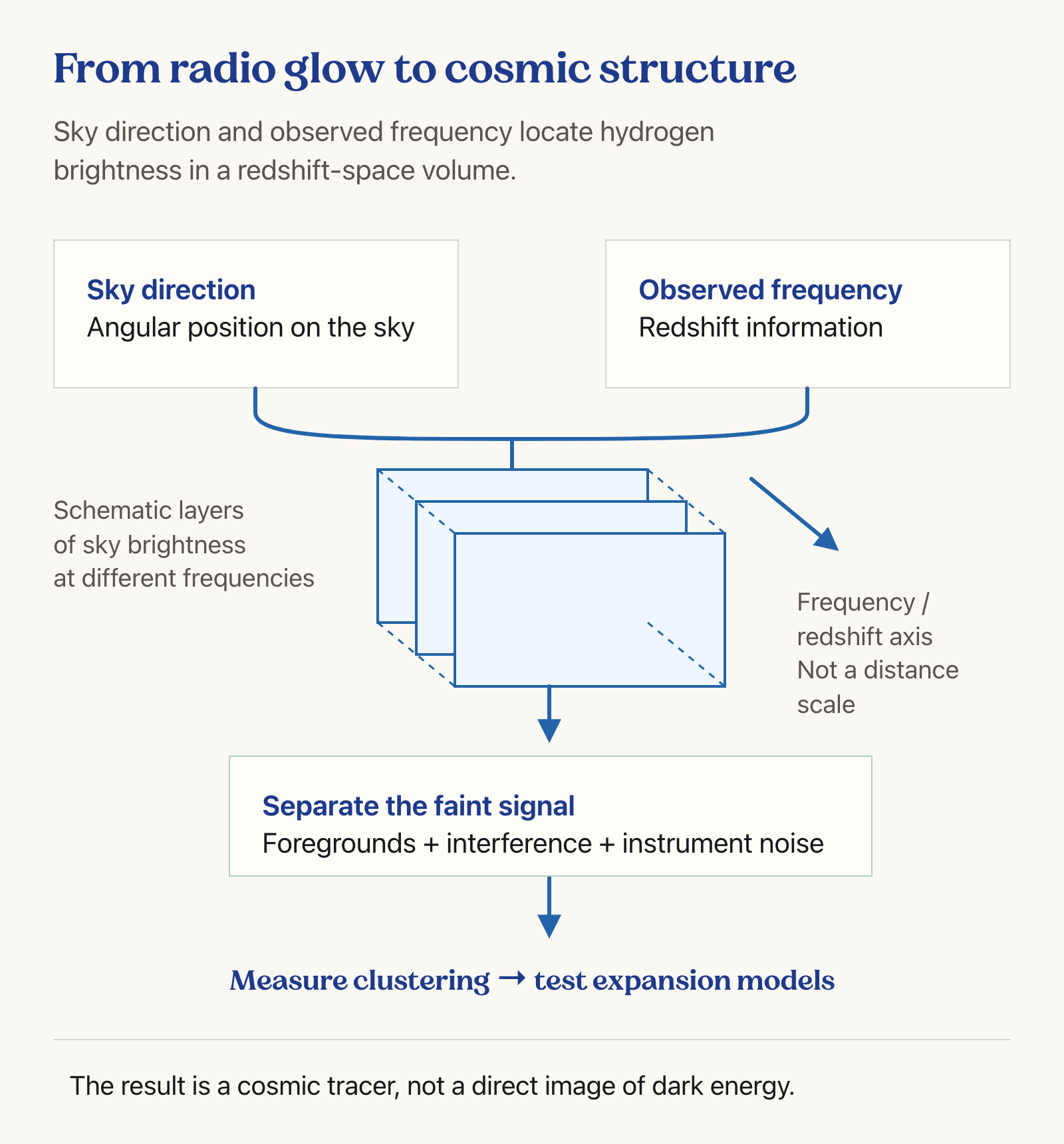
Sky direction supplies angular position, while the observed frequency supplies redshift information: together they organise hydrogen emission into a three-dimensional view.
- Angular position tells researchers where a signal appears on the sky. On its own, this is a projected view: radiation arriving from the same direction can originate at different depths along that sightline.
- Observed frequency adds the missing separation. Comparing it with hydrogen’s known emitted frequency gives redshift; for cosmological emission, a lower observed frequency corresponds to greater stretching during the radiation’s journey through expanding space.
- Frequency slices separate emission by redshift. Combining these slices with angular maps produces a volume of brightness fluctuations; converting redshift into physical distance requires a cosmological model, rather than simple direct ranging.
- Clustering describes how emission varies across this volume. Its statistical patterns trace underlying matter structure, giving researchers a way to compare predictions about the universe with observations gathered through a different measurement technique.
- Expansion tests compare clustering patterns across redshifts. Characteristic scales, including baryon acoustic oscillations, can act as cosmological rulers; detecting hydrogen emission is a step toward these measurements, not proof that every ruler is measured.
Why foreground removal determines the claim
A telescope detects everything entering its receivers; the scientific task is to establish which part of that mixture belongs to distant hydrogen.
- Foreground emission from nearer astronomical sources can overwhelm the desired signal. Human radio transmissions and the instrument’s own response add further contamination, so a strong recorded signal is not automatically a strong cosmological detection.
- Calibration characterises receiver behaviour before researchers interpret sky brightness. Differences across time, direction or frequency can otherwise resemble celestial structure; cleaning must also be checked for accidentally removing the weak hydrogen component being sought.
- Cross-correlation previously compared CHIME data with independent galaxy surveys to recover shared structure. The new standalone result establishes detection using CHIME observations themselves, while independent comparisons remain valuable checks on the interpretation of those measurements.
- Dark energy names the unknown explanation associated with accelerated expansion. Hydrogen supplies observable matter structure for testing cosmological models; its detection neither photographs dark energy nor identifies a new particle responsible for cosmic acceleration.
- Cosmic mapping asks how matter is distributed across large volumes. By contrast, black-hole jet heating concerns energy transfer around galaxies; studying gas in both cases does not make the physical questions interchangeable.
Way Forward
Improve the measurement before widening the claim
- Test foreground cleaning against simulated signal recovery and independent observations to distinguish real structure from analysis artefacts.
- Expand the analysed observations while checking instrument stability; more data are useful only when measurement errors remain controlled.
- Report detection, parameter constraints and theoretical interpretation separately so scientific communication does not turn a new observational capability into a settled explanation.
Conclusion
- CHIME hydrogen mapping links an atomic radio signal to cosmic structure through sky position, observed frequency and statistical analysis. The standalone detection strengthens that observational chain without directly revealing the physical nature of dark energy.
- The durable distinction is between what is measured and what is inferred: hydrogen brightness is observed, while expansion history is investigated through calibrated maps and cosmological models that must survive further tests.
UPSC Practice Questions
Prelims MCQ 1
With reference to hydrogen intensity mapping, consider the following statements:
- It can measure combined radio emission without individually identifying every contributing galaxy.
- Cosmological expansion stretches the wavelength of hydrogen emission.
- Detecting hydrogen emission directly identifies the physical nature of dark energy.
How many of the above statements are correct?
(a) Only one (b) Only two (c) All three (d) None
Answer: (b) Only two
Explanation:
The first two statements are correct. Hydrogen maps help test expansion models; they do not directly identify dark energy.
Prelims MCQ 2
Why is frequency information useful alongside angular position in hydrogen intensity mapping?
(a) It eliminates all instrument noise automatically. (b) It identifies the chemical composition of every galaxy. (c) It supplies redshift information that separates emission along the line of sight. (d) It proves that foreground emission is absent.
Answer: (c) It supplies redshift information that separates emission along the line of sight.
Explanation:
The known emitted hydrogen frequency and its observed value give redshift information. Foreground removal and calibration are still required.
UPSC Mains Questions
- Explain how hydrogen intensity mapping can contribute to studies of cosmic expansion. What observational challenges limit the interpretation?
- Distinguish scientific detection from theoretical explanation, using CHIME’s standalone hydrogen detection as an example.
Sources: PIB, Ministry of Science and Technology and National Research Council Canada.
Frequently Asked Questions
What is CHIME?
CHIME is the Canadian Hydrogen Intensity Mapping Experiment, a fixed radio telescope in Canada. It combines signals from its receivers to survey the sky as Earth rotates and study astronomical radio emission.
How does hydrogen intensity mapping work?
It measures combined hydrogen radio brightness across sky directions and observed frequencies. Frequency provides redshift information, allowing researchers to study structure in three dimensions without separately identifying every contributing galaxy.
Did CHIME discover dark energy?
No. The reported achievement is a standalone detection of distant hydrogen emission. Hydrogen maps can support tests of cosmic expansion and dark-energy models, but they do not directly establish what dark energy is.
Does five billion years refer to the signal’s travel time?
No. The report refers to the age of the universe when the emission originated. Cosmic age at emission and lookback time describe different intervals and should not be used interchangeably.
Why must researchers remove foregrounds?
Closer astronomical radio sources can be much brighter than distant hydrogen. Researchers must distinguish that contamination, terrestrial interference and instrument effects from the weak signal before interpreting a map as cosmological evidence.
Tell Google you want more of this.
Add Anantam IAS as a preferred sourceOne tap, and this site shows up more often in your own Top Stories, AI Overviews and AI Mode. Remove it any time.