Context:
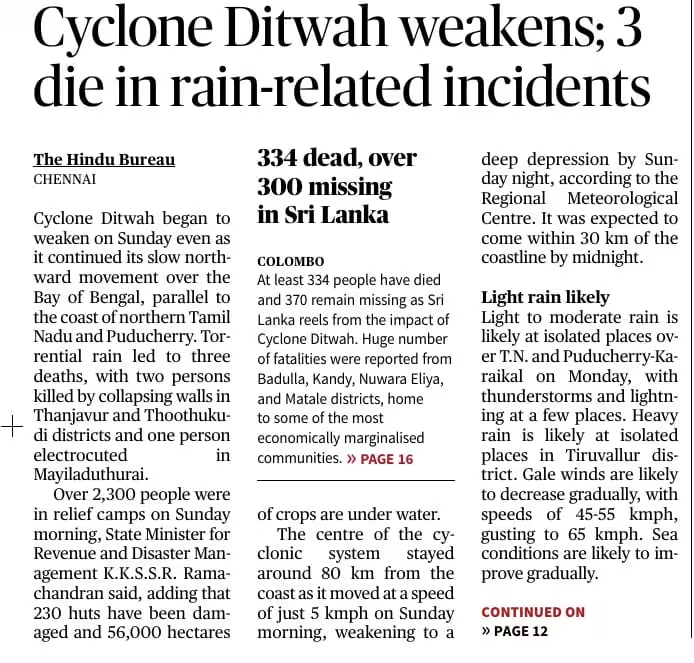
Cyclone Ditwah weakened on Sunday while moving northward over the Bay of Bengal, parallel to Tamil Nadu and Puducherry coasts.
UPSC Relevance:
Geography
UPSC PYQ:
1. Consider the following statements:
- Jet streams occur in the Northern Hemisphere only.
- Only some cyclones develop an eye.
- The temperature inside the eye of a cyclone is nearly 10°C lesser than that of the surroundings.
Which of the statements given above is/are correct?
(a) 1 only
(b) 2 and 3 only
(c) 2 only
(d) 1 and 3 only
Q: Tropical cyclones are largely confined to South China Sea, Bay of Bengal and Gulf of Mexico. Why?
About Cyclone:
Cyclones are rapid inward air circulation around a low-pressure area. The air circulates in an anticlockwise direction in the Northern hemisphere and clockwise in the Southern hemisphere.
- The word Cyclone is derived from the Greek word Cyclos meaning the coils of a snake. It was coined by Henry Peddington because the tropical storms in the Bay of Bengal and the Arabian Sea appear like coiled serpents of the sea.
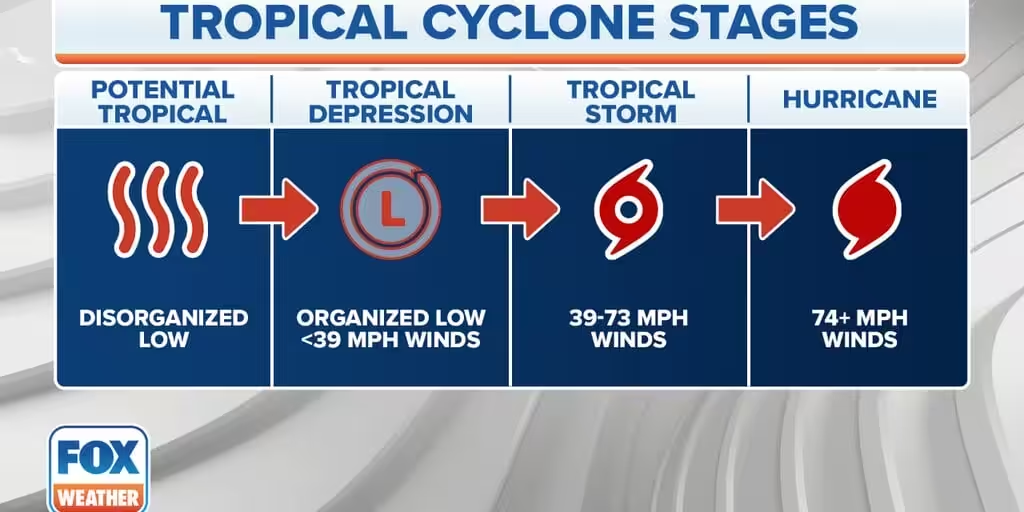
| Type of Disturbances | Wind Speed in Km/h | Wind Speed in Knots |
|---|---|---|
| Low Pressure | Less than 31 | Less than 17 |
| Depression | 31-49 | 17-27 |
| Deep Depression | 49-61 | 27-33 |
| Cyclonic Storm | 61-88 | 33-47 |
| Severe Cyclonic Storm | 88-117 | 47-63 |
| Super Cyclone | More than 221 | More than 120 |
Several favorable environmental conditions:
- Low values (less than about 23 mph / 37 km/h) of vertical wind shear between the surface and the upper troposphere. Vertical wind shear is the change in wind speed with height.
- Warm ocean waters (at least 80°F / 27°C) throughout a depth of about 150 ft. (46 m).
- An atmosphere which cools fast enough with height such that it is potentially unstable to moist convection.
- Relatively moist air near the mid-level of the troposphere (16,000 ft. / 4,900 m).
- Generally, a minimum distance of at least 300 miles (480 km) from the equator.
- A pre-existing near-surface disturbance.
Stages of Formation:
Formation and Initial Development Stage
- Cyclone formation depends on the transfer of water vapour and heat from the warm ocean to the atmosphere.
- Strong evaporation from the sea surface adds moisture and heat to the overlying air.
- Warm, moist air rises due to convection, forming large cumulus clouds.
- As the rising air cools, condensation occurs, releasing latent heat, which further fuels the system.
- This continuous heat release deepens the low-pressure zone, leading to the early structure of a developing cyclonic storm.
Mature Stage
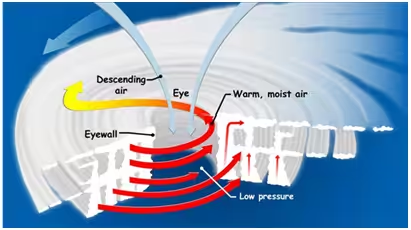
- As the tropical storm intensifies, air rises violently in deep convective thunderstorms.
- At the tropopause level, the rising air spreads outward horizontally.
- This outward spreading of air creates a positive pressure (high pressure) at upper levels.
- The upper-level high pressure forces air to descend in the centre → Subsidence.
- Descending air warms by compression, forming the warm Eye (low-pressure centre).
- A mature cyclone displays a concentric pattern of giant, turbulent cumulonimbus cloud bands spiralling around the eye.
- Wind speeds are at their highest, and the cyclone reaches its maximum intensity.
Modification and Decay Stage
- A tropical cyclone begins to weaken when its main energy source — warm, moist air — is reduced or cut off.
- This happens when:
- The cyclone makes landfall, where moisture availability is low, or
- It travels over cold ocean waters, where evaporation is minimal.
- As a result:
- The central low pressure rises,
- The internal heat decreases,
- The wind speeds gradually reduce.
- Eventually, the cyclone dissipates into a low-pressure area or depression.
Cyclone Ditwah:
- Sri Lanka Impact — Very High Casualties:
- 334 dead, 370 missing due to heavy rain, landslides, and floods.
- Most affected districts:
- Badulla, Kandy, Nuwara Eliya, Matale
- These are hilly districts → vulnerable to landslides.
Tell Google you want more of this.
Add Anantam IAS as a preferred sourceOne tap, and this site shows up more often in your own Top Stories, AI Overviews and AI Mode. Remove it any time.