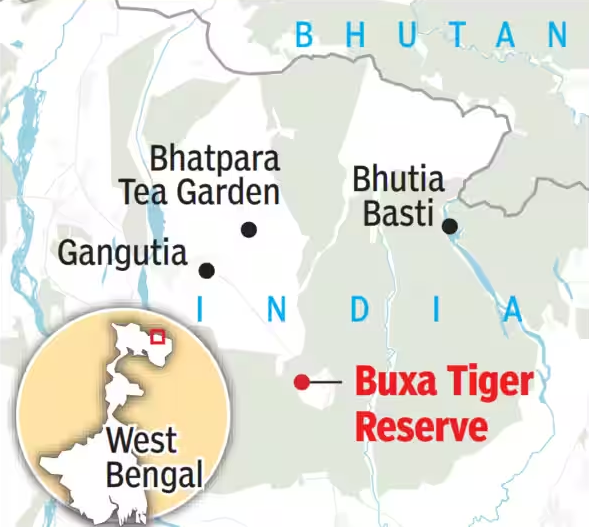
A Royal Bengal Tiger has been photographed inside the D’Ering Memorial Wildlife Sanctuary (DEMWS) near Pasighat in Arunachal Pradesh. The sighting was confirmed in early May 2026 through camera trap images captured during a survey conducted by the state forest department with technical support from the Ashoka Trust for Research in Ecology and the Environment (ATREE). It is the first verified tiger evidence inside DEMWS in nearly two decades. The last confirmed evidence dated back to 2005, with only unverified sightings reported until 2007 to 2008.
For a sanctuary that occupies a thin riparian strip between the Brahmaputra (locally the Siang and Lohit) and the Assam-Arunachal border, the return of a tiger is more than a feel-good story. It says something concrete about ecosystem recovery, prey base health, and the slow knitting back together of the Northeast tiger corridor that runs from Kaziranga across Dibru-Saikhowa into Arunachal’s foothill grasslands. The same camera trap survey also documented the Critically Endangered Chinese pangolin and the rare Endangered hispid hare, both of which are extremely difficult to detect without dedicated effort.
UPSC aspirants should treat this as a layered story. It connects with the National Tiger Conservation Authority’s all-India tiger estimation work, with the Northeast biodiversity hotspot, with the policy debate around grassland ecosystems versus dense forest cover, and with the role of independent research institutions like ATREE in conservation science.
Quick Facts
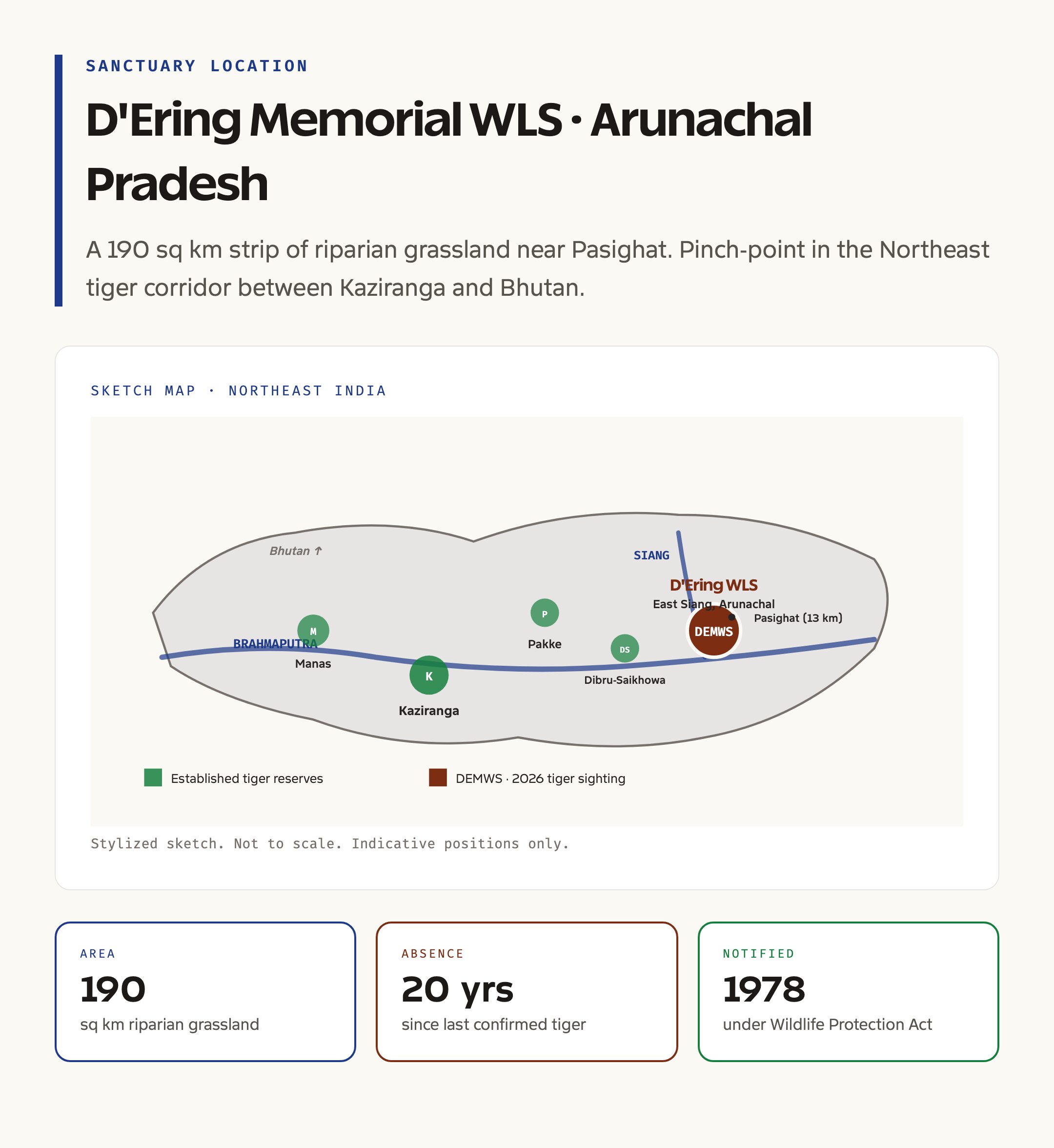
- Sanctuary: D’Ering Memorial Wildlife Sanctuary (DEMWS)
- Location: East Siang district, Arunachal Pradesh, 13 km from Pasighat
- Area: Approximately 190 sq km
- Ecosystem: Riparian grassland and wetland complex along the Siang and Lohit rivers
- Established: Notified as a wildlife sanctuary in 1978
- Sighting confirmed: Early May 2026, through camera trap survey
- Survey partner: Ashoka Trust for Research in Ecology and the Environment (ATREE)
- Previous confirmed tiger evidence: 2005, last documented inside DEMWS
- Other recent finds in same survey: Chinese pangolin (Critically Endangered), hispid hare (Endangered)
- Adjacent landscape: Kobu Chapori proposed reserve forest in Assam, where adult tiger pugmarks were reported in January 2026
What Just Happened
Wildlife officials of the Arunachal Pradesh forest department, working alongside an ATREE-led research team, confirmed the presence of a Royal Bengal Tiger inside this wildlife sanctuary based on camera trap photographs from a survey conducted over the late dry season. The Arunachal Times and India Today NE first reported the finding on May 8, 2026, with corroborating reports from EastMojo and the Arunachal Observer.
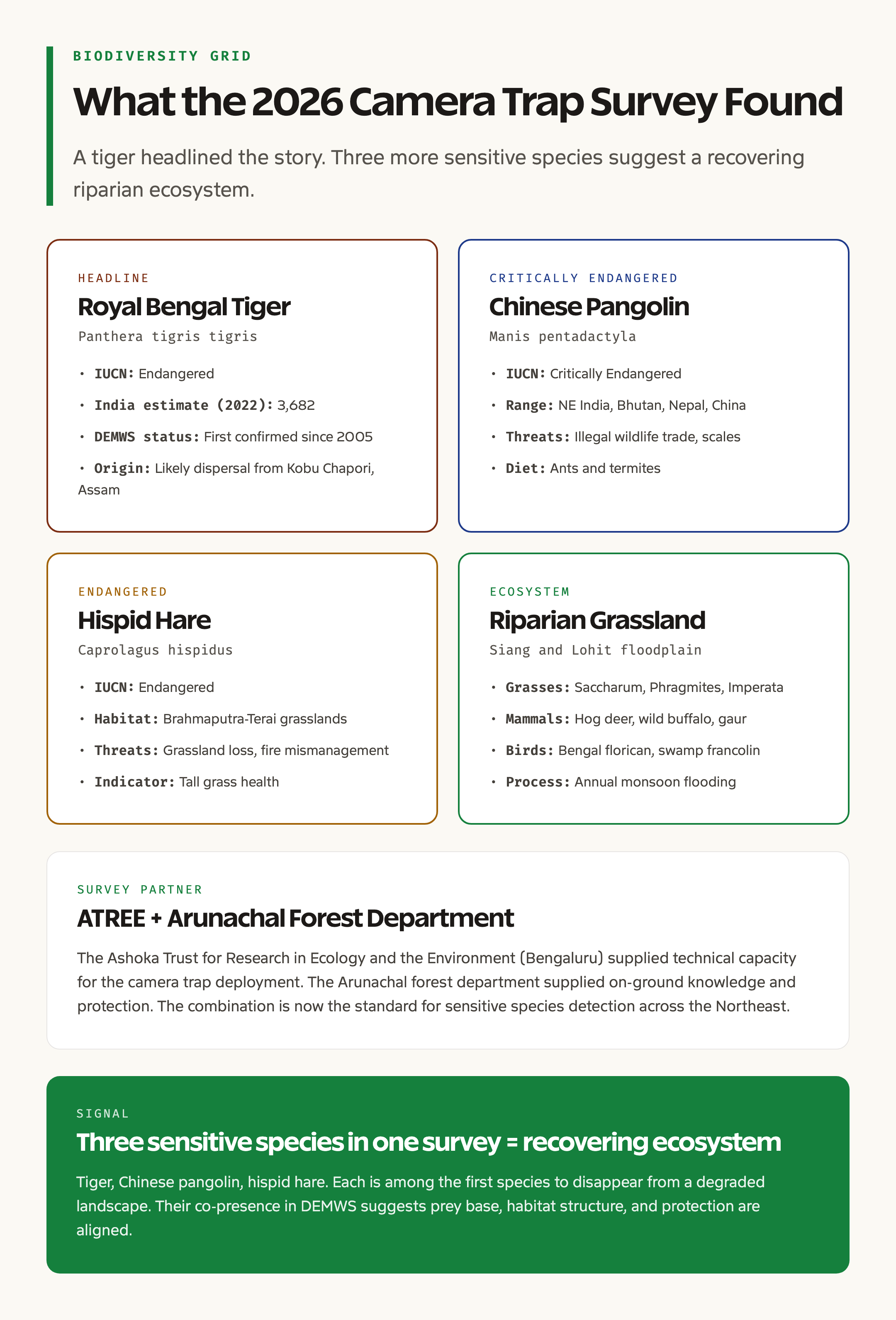
The same camera trap survey, set up to study small carnivore and mesomammal distribution in the sanctuary’s riparian grasslands, produced two more notable detections. Chinese pangolin (Manis pentadactyla), classified as Critically Endangered by the IUCN, was photographed in the sanctuary’s interior. Hispid hare (Caprolagus hispidus), classified as Endangered and endemic to the Brahmaputra-Terai floodplain belt, was also documented. Both species are notoriously difficult to detect with traditional sign surveys.
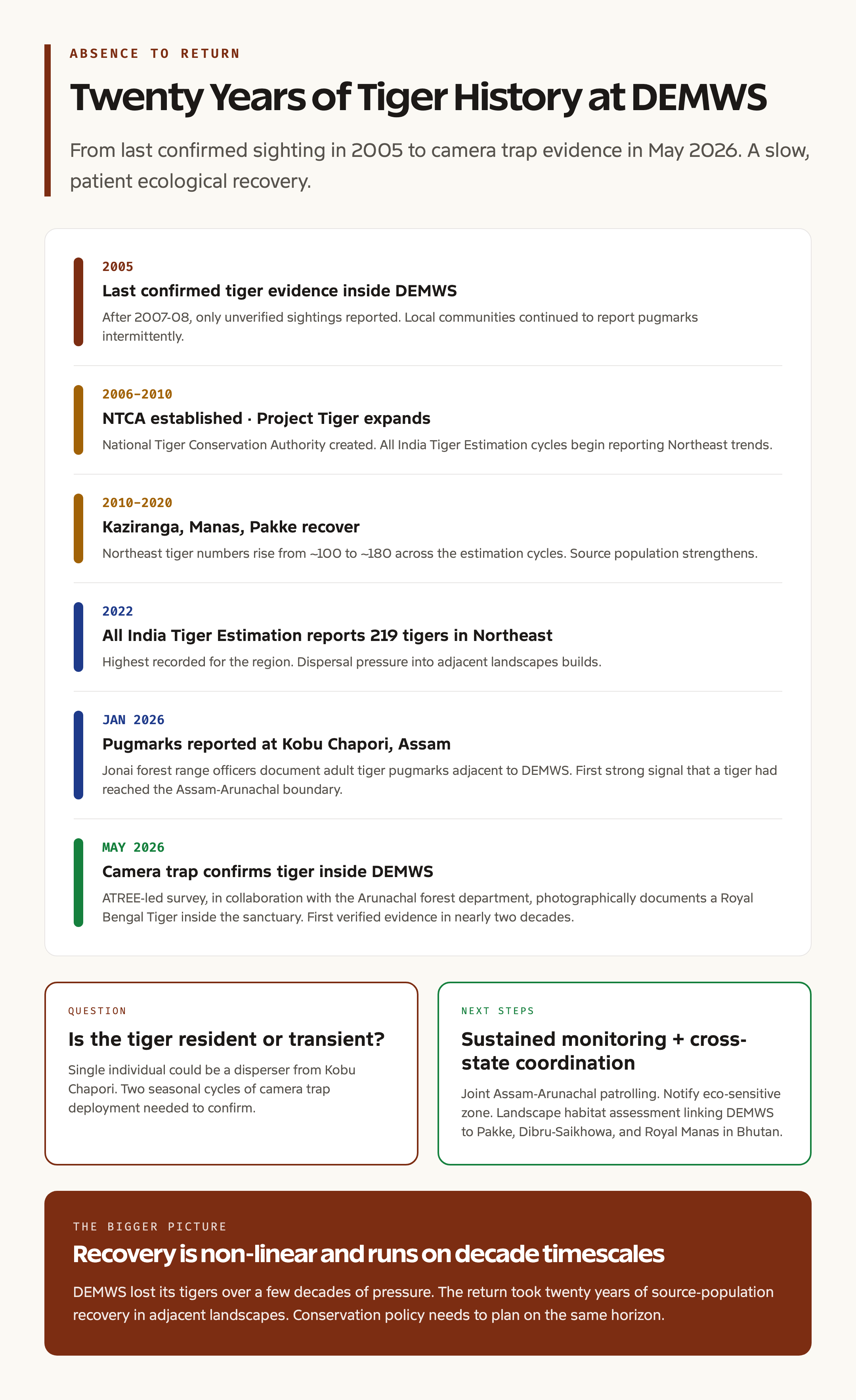
Forest officials have been careful in their public statements. The single tiger documented could be a transient individual from the adjacent Kobu Chapori area in Assam, where adult tiger pugmarks were reported in January 2026 by Jonai forest range officers. Whether it represents a resident population, a recurring visitor, or a single dispersal event will need follow-up camera trap deployment over the next monsoon and winter cycle.
Background and Historical Context
DEMWS is named after Daying Ering, an Adi statesman from Arunachal Pradesh who served in the Lok Sabha and later as Lieutenant Governor of Mizoram. The sanctuary was notified in 1978 to protect a stretch of riverine grassland and seasonally inundated wetland on the Siang and Lohit rivers. It sits at an elevation range of roughly 100 to 150 meters above sea level, placing it firmly in the floodplain transition zone.
The historical tiger presence in this landscape is well-documented. Until the 1990s, tigers ranged across the contiguous Kaziranga, Dibru-Saikhowa, and D’Ering riparian belt. Hunting pressure, retaliatory killings after livestock predation, and a combination of habitat fragmentation and seasonal flooding shifts pushed tigers out of the smaller protected areas. Kaziranga retained its core population. DEMWS lost its tigers by the mid-2000s.
The recovery story has multiple threads. National Tiger Conservation Authority data through the All India Tiger Estimation cycles has shown a steady increase in Northeast tiger numbers from around 100 in 2006 to 219 in the 2022 round. Most of that recovery has been concentrated in Kaziranga, Manas, and Pakke. The dispersal of younger tigers from these source populations into adjacent landscapes is the mechanism that the DEMWS sighting likely represents.
Camera trap technology has been the second thread. The cost and reliability of motion-triggered cameras has dropped sharply. ATREE and other institutions have built dense camera grids across the Northeast, picking up presence data that older sign-based surveys would have missed.
Key Provisions and Features of DEMWS Conservation
The sanctuary is managed under the Wildlife Protection Act, 1972, as amended. Its protection regime has three operational features.
- Riparian grassland management: The sanctuary’s grassland mosaic, dominated by tall grass species like Saccharum, Phragmites, and Imperata, is maintained through controlled burning and grazing exclusion. These grasslands are habitat for the hispid hare, hog deer, and pygmy hog (although the pygmy hog is currently not confirmed in DEMWS).
- Flood management: Annual monsoon flooding of the Siang and Lohit is part of the ecosystem rather than a threat. Sanctuary management has resisted flood control structures that would harm the riparian dynamic.
- Buffer integration: The sanctuary’s boundary touches Assam’s Kobu Chapori proposed reserve forest. Cross-state coordination on patrolling, anti-poaching, and habitat management has been weak historically but is being strengthened under the NTCA’s landscape approach.
The sanctuary has been on the radar of state and central conservation authorities for upgradation. Proposals to include it as part of an expanded protected area network in Arunachal have been discussed for over a decade.
Why It Matters
The D’Ering Memorial Wildlife Sanctuary tiger sighting matters on three dimensions.
On the ecological side, it confirms that prey base, water security, and habitat structure at DEMWS are sufficient to support a top predator. Tigers do not move into landscapes that cannot sustain them for at least a season. The detection of hispid hare and Chinese pangolin in the same survey strengthens the picture. These species are sensitive to disturbance and would be among the first to disappear from a degrading landscape.
On the policy side, the sighting supports the case for treating the Northeast riparian belt as a single conservation landscape rather than as administratively separate sanctuaries. The NTCA’s landscape approach, articulated in the National Tiger Recovery Programme, calls for managing source-sink dynamics across protected areas. The DEMWS sighting is exactly the kind of evidence the NTCA needs to push for coordinated funding across state boundaries.
On the institutional side, it validates the role of research partners like ATREE. Independent technical capacity, combined with state forest department on-ground knowledge, is the model that has worked for elephant census, snow leopard surveys, and now tiger detection. UPSC questions on the public-private-academic partnership model in conservation can draw on exactly this kind of example.
Detailed Analysis: The Northeast Tiger Corridor
The Northeast tiger corridor sits at the heart of India’s tiger species story and is one of the four major tiger landscapes recognized by the NTCA. It connects with the broader network of tiger reserves in India. It runs from the Brahmaputra floodplain across Assam into Arunachal Pradesh’s foothills and feeds into Bhutan’s Royal Manas National Park and onward into the Tibetan-facing slopes. The corridor includes Kaziranga, Manas, Nameri, Orang, Dibru-Saikhowa, Pakke, and now potentially DEMWS as a recovery node.
The corridor’s value rests on three structural features. It is the only Indian tiger landscape that connects to Bhutan and feeds genetic flow into a transboundary population. It includes seasonal floodplain habitat that supports unusually high prey densities (rhino, swamp deer, hog deer, wild buffalo, sambar, gaur). And it is the only Indian landscape where the Indian and Indochinese tiger gene pools have historically met.
The recovery in this corridor has not been uniform. Kaziranga’s tiger density per 100 sq km is among the highest in the world. Manas and Pakke have recovered slower. DEMWS, Dibru-Saikhowa, and several proposed reserve forests in Assam and Arunachal are still in the early stages.
What complicates the picture is climate-driven flood pattern change. The Brahmaputra system is seeing larger and faster monsoon flood events, which can briefly turn even safe high-ground refugia into inaccessible patches. Riparian sanctuaries like DEMWS may need to plan for shifting prey distribution and intermittent connectivity.
Comparative Perspective
How does the DEMWS tiger story compare with other ecological recovery moments in Indian conservation?
| Recovery Story | Location | Species Returning | Approximate Timeline |
|---|---|---|---|
| Western Ghats tiger dispersal | Kerala, Karnataka, Tamil Nadu | Tiger to new sub-landscapes | Ongoing since 2018 |
| Greater one-horned rhino in Manas | Assam | Rhino, after near-extinction in 2005 | Recovered to 50+ by 2024 |
| Eastern swamp deer in Manas | Assam | Reintroduced from Kaziranga | 2014 onward |
| Snow leopard detections in Sikkim and Arunachal | Eastern Himalayas | Documented presence | 2020s |
| DEMWS tiger | Arunachal Pradesh | Tiger after 20-year gap | 2026 |
Each of these stories follows a similar pattern. Long absence, conservation pressure ratchets up in the surrounding landscape, source population recovers, dispersing individuals reach the previously empty area, camera trap or genetic evidence confirms return. Each then faces the harder second question, which is whether a recurring detection becomes a resident population, and then a breeding population.
Challenges Ahead
Three challenges sit immediately ahead. Confirming whether the DEMWS tiger is transient or resident requires sustained camera trap effort over at least two seasons. The forest department and ATREE will need funding and personnel for this.
Cross-state coordination with Assam over the Kobu Chapori area needs formal structure. The current ad-hoc information sharing is not enough. A joint patrolling protocol between Arunachal and Assam forest departments, with NTCA financial backing, should be the immediate next step.
Tourism and commercial development pressure on Pasighat town, only 13 km from DEMWS, is rising. The sanctuary’s effective insulation from human disturbance has been one of its conservation strengths. Without a clearly notified eco-sensitive zone, that insulation will erode.
Beyond these immediate items, the deeper challenge is grassland ecosystem protection. India’s protected area framework was designed primarily around forests. Grasslands, riparian belts, and seasonally inundated habitats have been undervalued in policy. DEMWS, the Banni grasslands in Gujarat, and the terai grasslands in Uttar Pradesh and Uttarakhand all face this same blind spot.
Prelims Pointers
- D’Ering Memorial Wildlife Sanctuary is in East Siang district, Arunachal Pradesh, near Pasighat.
- Sanctuary area: approximately 190 sq km.
- Sanctuary notified in 1978.
- Named after Daying Ering, an Adi statesman who served in the Lok Sabha and as Lieutenant Governor of Mizoram.
- Ecosystem: riparian grassland and wetland on the Siang and Lohit rivers.
- Last confirmed tiger evidence before 2026: 2005.
- 2026 sighting: confirmed through camera trap survey by Arunachal forest department with ATREE.
- ATREE is the Ashoka Trust for Research in Ecology and the Environment, headquartered in Bengaluru.
- Royal Bengal Tiger scientific name: Panthera tigris tigris.
- Chinese pangolin: IUCN Critically Endangered, scientific name Manis pentadactyla.
- Hispid hare: IUCN Endangered, scientific name Caprolagus hispidus.
- Adjacent area in Assam where pugmarks were reported in January 2026: Kobu Chapori proposed reserve forest, Jonai forest range.
- All India Tiger Estimation 2022 reported 219 tigers in the Northeast Hills and Brahmaputra Flood Plains landscape.
Mains Questions
- The reappearance of the Royal Bengal Tiger in D’Ering Memorial Wildlife Sanctuary after two decades reflects both the success and the unfinished business of India’s tiger recovery. Discuss. (GS Paper 3, Environment and Ecology, 250 words)
- Examine the role of independent research institutions in Indian wildlife conservation. Use the ATREE-DEMWS camera trap survey as an illustrative case. (GS Paper 2, Civil Society and Conservation, 150 words)
- Riparian grasslands have been undervalued in India’s protected area framework. Discuss the policy and ecological case for stronger grassland protection. (GS Paper 3, 250 words)
- The Northeast tiger corridor connects across state and international boundaries. Discuss the federal and diplomatic dimensions of managing this landscape. (GS Paper 2, Federalism and International Relations, 250 words)
Way Forward
The DEMWS tiger sighting deserves a structured follow-through. The forest department should expand the camera trap grid across the entire sanctuary and the adjoining Kobu Chapori area for two full seasonal cycles to establish residency status. The NTCA should fund a landscape-level habitat assessment connecting DEMWS with Dibru-Saikhowa, Pakke, and the Bhutan-side Royal Manas, identifying connectivity bottlenecks and barriers.
Arunachal and Assam should formalize a joint management protocol for the cross-boundary tiger landscape, including data sharing, anti-poaching coordination, and prey base management. The eco-sensitive zone for DEMWS should be notified at the earliest opportunity to limit commercial pressure from Pasighat.
For the broader policy picture, the central government should reconsider the protected area classification system to give riparian grasslands the same legal weight and funding priority as dense forest tiger reserves. The DEMWS story is a small reminder that India’s biodiversity is not a static map. It is a recovering, redistributing system, and policy needs to keep up.
Frequently Asked Questions
Where is D’Ering Memorial Wildlife Sanctuary located?
D’Ering Memorial Wildlife Sanctuary is in East Siang district of Arunachal Pradesh, approximately 13 km from the town of Pasighat. It covers about 190 sq km of riparian grassland and wetland along the Siang and Lohit rivers.
Why is the 2026 tiger sighting significant?
The May 2026 sighting is the first verified evidence of a Royal Bengal Tiger inside DEMWS in nearly two decades. The last confirmed evidence was from 2005. The return suggests that prey base, habitat, and connectivity in the Northeast tiger corridor have improved enough to support dispersal into previously empty sanctuaries.
How was the tiger documented?
The sighting was confirmed through camera trap photographs captured during a survey conducted by the Arunachal Pradesh forest department with technical support from the Ashoka Trust for Research in Ecology and the Environment (ATREE).
What is ATREE?
ATREE is the Ashoka Trust for Research in Ecology and the Environment, an independent research institution headquartered in Bengaluru that works on ecology, biodiversity, and environmental policy. It partners with forest departments and the NTCA on field-based research.
What other species were found in the same survey?
The survey also documented the Chinese pangolin (Manis pentadactyla), classified as Critically Endangered by the IUCN, and the hispid hare (Caprolagus hispidus), classified as Endangered. Both species are difficult to detect without dedicated camera trap effort.
Is the tiger a resident or a transient?
It is too early to tell. The single tiger could be a transient individual dispersing from the adjacent Kobu Chapori area in Assam, where adult tiger pugmarks were reported in January 2026. Sustained camera trap effort over at least two seasonal cycles is needed to determine whether the sanctuary now hosts a resident or breeding population.
What is the Northeast tiger corridor?
The Northeast tiger corridor is one of four major tiger landscapes recognized by the National Tiger Conservation Authority. It runs from the Brahmaputra floodplain across Assam into Arunachal Pradesh and connects to Bhutan’s Royal Manas National Park. It includes Kaziranga, Manas, Nameri, Orang, Dibru-Saikhowa, Pakke, and DEMWS.
Who was D’Ering and why is the sanctuary named after him?
Daying Ering was an Adi statesman from Arunachal Pradesh who served in the Lok Sabha and later as Lieutenant Governor of Mizoram. The sanctuary, notified in 1978, is named in his memory.
What is the role of the NTCA in this story?
The National Tiger Conservation Authority, established under the Wildlife Protection Act 1972 (as amended) in 2006, runs the All India Tiger Estimation and coordinates conservation across tiger landscapes. The DEMWS sighting strengthens the case for NTCA funding to extend the landscape approach into the previously underprotected riparian grasslands of the Northeast.
What are the next steps for DEMWS?
Sustained camera trap deployment over two seasonal cycles, formal cross-state coordination with Assam over the Kobu Chapori area, notification of an eco-sensitive zone around the sanctuary, and a landscape-level habitat assessment connecting DEMWS with Dibru-Saikhowa, Pakke, and Bhutan’s Royal Manas are the immediate priorities.
Tell Google you want more of this.
Add Anantam IAS as a preferred sourceOne tap, and this site shows up more often in your own Top Stories, AI Overviews and AI Mode. Remove it any time.