Why in News?
On 6 November, the Ministry of Electronics and Information Technology approved 12 applications under the Electronics Component Manufacturing Scheme (ECMS), including its first approval for copper foil.
- The approvals cover bare components, supply chain products and capital goods. Each plays a different role in manufacturing an electronic device.
- The ministry also recorded first-time ECMS approvals for cathode active material and specialty ceramics.
- A separate announcement opened applications for parts of Semicon 2.0, the semiconductor programme.
- Following a material through production shows which activities a country can perform locally even when it still imports other inputs.
- The earlier ECMS approvals explain the scheme’s wider aim of developing domestic suppliers for electronics manufacturers.
UPSC Relevance
Prelims Relevance
- Copper foil is an input for copper-clad laminate.
- A multilayer printed circuit board contains conducting layers separated by insulating material.
- A precision mould counts as tooling used in production.
- The ministry placed heat sinks in the components category.
Mains Relevance
GS Paper 3
- Explain how domestic materials and equipment suppliers can change the share of value added within India.
- Assess an industrial incentive scheme using production and buyer adoption alongside project approvals.
Essay
- Industrial capability can grow in the less visible stages of making an everyday device.
Background and Context
How Copper Foil Becomes Part of a Circuit Board
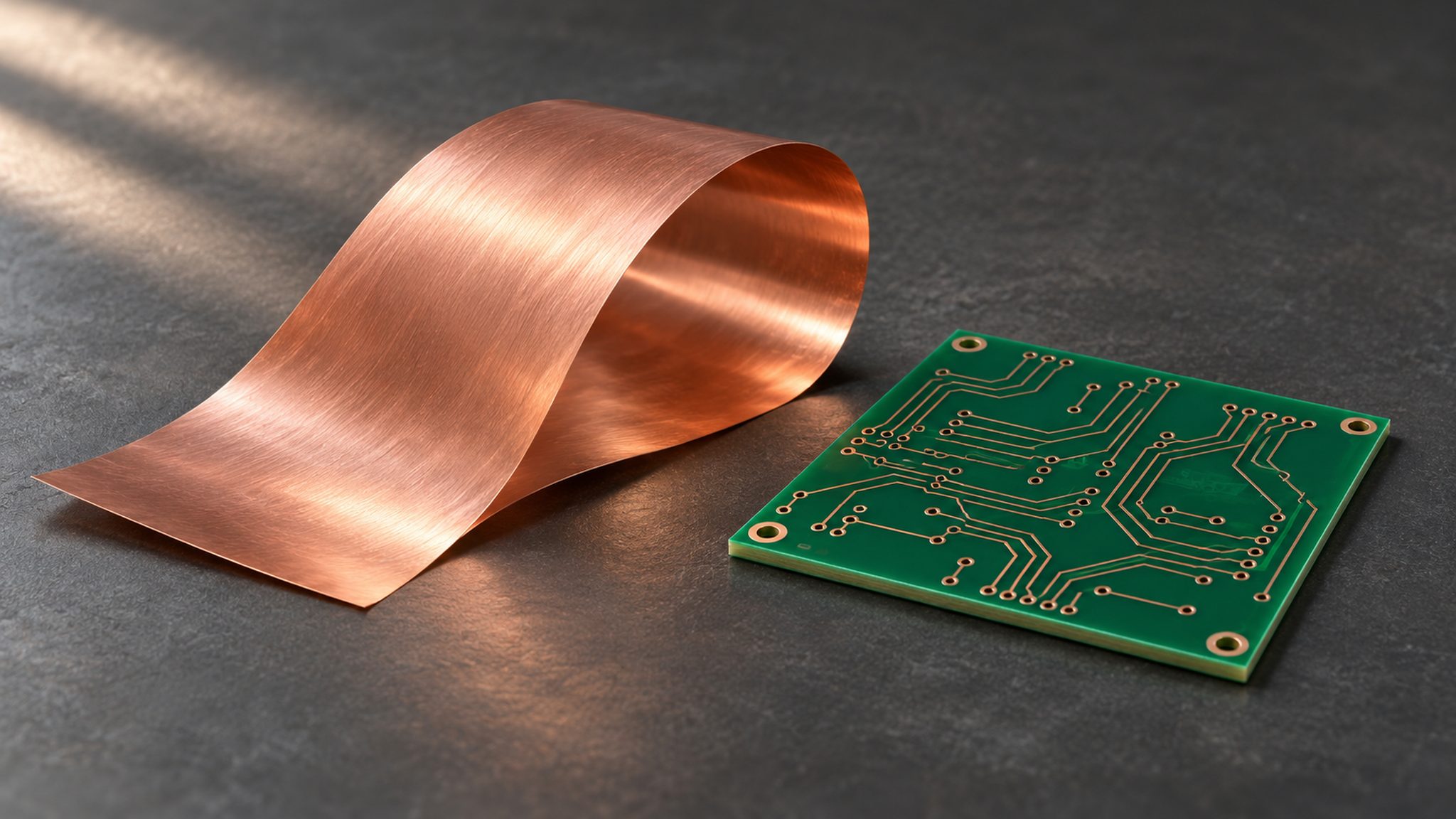
Follow a thin sheet of copper through a factory and the distinction between a material and a component becomes easier to see.
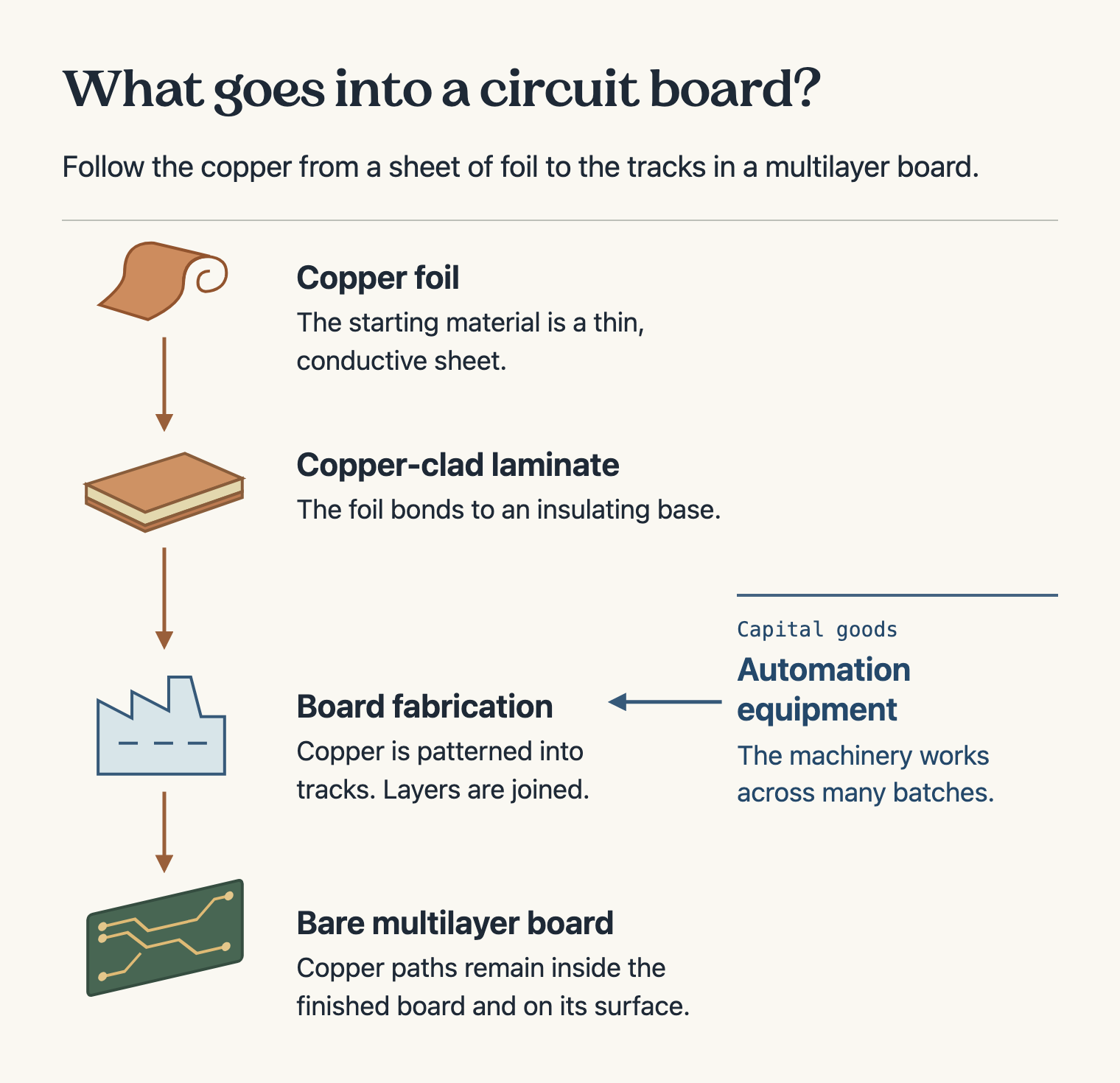
- Copper foil supplies the conducting metal. Bonding the foil to an insulating base produces copper-clad laminate, a board maker’s starting material that combines electrical conduction with physical support.
- A board maker forms conductive tracks by selectively removing copper. The copper that remains carries signals or distributes power between points specified by the circuit designer.
- In a multilayer board, insulating material keeps copper layers apart. Designers can route connections on different layers and join selected points through the thickness of the board.
- The ministry classified the bare board as a component. It already contains wiring, although an assembler still has to mount chips and other devices to provide the intended electronic functions.
- Consider a camera with a vision processing chip. The chip processes image data while the circuit board supports and connects it to the rest of the system.
Where Factory Equipment Fits
The same factory buys things that enter its product and equipment that stays on the production floor.
- A precision mould gives successive parts their shape. Its purchase adds productive capacity because the factory can use the same tool to make many units for delivery to customers.
- A heat sink, by contrast, travels with the equipment in which it is installed. It carries heat away from a working part and releases it across a larger surface.
- The approved power and control systems serve capital equipment. A controller fitted to a production machine can help operate the line through many batches of finished electronic goods.
- The ministry included factory automation and system integration under capital equipment. Connecting machines so that they work together can improve a factory’s capabilities even when its final product design stays the same.
- Classify a purchase by asking what the buyer does with it. Copper foil can be the foil maker’s finished product and the board supply chain’s purchased input at the same time.
What Project Approval Establishes
Look for a separate piece of evidence at each stage from a project decision to a sale.
- An approved application identifies a proposed manufacturing activity accepted under the scheme. A subsequent commissioning announcement would establish that the firm had brought facilities or equipment into service.
- For a domestic foil supplier, customer acceptance matters. A board maker needs foil that meets its specifications consistently before it can rely on that supplier across production batches.
- To assess domestic value addition, ask what processing takes place locally and which intermediate goods still come from abroad. Counting every rupee of a finished device’s price would include imported inputs.
- The ministry reported expected employment and projected output for this group of applications. Payroll and actual sales would answer the later questions of how many people work there and what buyers purchased.
Way Forward
Track the Supplier Through to Its Customer
- Record commissioning and first commercial supply separately for each product.
- Check whether manufacturers receive repeat orders for inputs that meet buyers’ specifications.
- Measure local processing at each stage to avoid counting the same purchased input twice.
Conclusion
- A multilayer board brings several manufacturing capabilities into view. The copper supplier provides a material, the board maker builds connections into it, and the assembler fits electronic devices onto the board.
- The industrial policy question is which capabilities buyers can actually obtain in India. Follow approved projects through commissioning, supply and repeat purchases to judge how the domestic production chain changes.
UPSC Practice Questions
Prelims MCQ 1
With reference to the recent ECMS approvals, consider the following statements:
- Copper foil was classified as a supply chain product.
- Precision moulds and tooling were approved under capital goods.
- The ministry classified heat sinks as factory automation equipment.
How many of the above statements are correct?
(a) Only one (b) Only two (c) All three (d) None
Answer: (b) Only two
Explanation:
The first two statements match the ministry’s categories. Heat sinks were included among bare components.
Prelims MCQ 2
Which observation gives the strongest evidence that a new domestic foil supplier can meet sustained demand?
(a) A projection of employment (b) The submission of a project application (c) Repeat purchases by a laminate manufacturer (d) The announcement of a factory location
Answer: (c) Repeat purchases by a laminate manufacturer
Explanation:
Repeat purchases show a customer has used the material and continues to order it. The other observations describe earlier stages.
UPSC Mains Questions
- Using copper foil and printed circuit boards as examples, explain how developing intermediate goods industries can increase domestic value addition.
- Which indicators would you use to assess whether approvals for electronics components and capital goods have improved industrial capability?
Source: PIB, Ministry of Electronics and Information Technology.
Frequently Asked Questions
Why is copper foil useful in a printed circuit board?
Copper conducts electricity and can be patterned into tracks. Foil bonded to an insulating base provides material from which the board maker can form those connections.
What distinguishes a component from a capital good in these approvals?
A component such as a heat sink becomes part of the product sold to its user. A capital good such as a precision mould stays with the manufacturer for repeated production.
Did the approved ECMS projects start commercial production on 6 November?
The ministry announced project approvals and gave projections for output and jobs. Establishing commercial production for a particular project requires subsequent evidence of operations at that facility.
How was the Semicon 2.0 announcement different?
The ministry opened applications for selected parts of the semiconductor programme. In a separate decision, it announced approvals already granted to applicants under the Electronics Component Manufacturing Scheme.
Tell Google you want more of this.
Add Anantam IAS as a preferred sourceOne tap, and this site shows up more often in your own Top Stories, AI Overviews and AI Mode. Remove it any time.