Why in News?
Tokamaks have gained attention as global research programmes explore nuclear fusion as a potential source of abundant, low-carbon energy. The International Thermonuclear Experimental Reactor (ITER), the world’s largest international fusion research project, uses the tokamak design.
| UPSC Relevance: GS-3 Science and Technology: Nuclear Technology Prelims: Tokamak, Nuclear Fusion Mains: Nuclear fusion: Potential, technological challenges, India’s progress in fusion research |
What is Nuclear Fusion?
- Nuclear fusion is a process in which two light atomic nuclei combine to form a heavier nucleus, releasing enormous amounts of energy.
- The most extensively studied fusion reaction involves two hydrogen isotopes, deuterium and tritium, which combine to produce helium, a neutron and energy.
2H + 3H ———> 4He + n + 17.6MeV
- Fusion powers the Sun and other stars through nuclear reactions.
Why is Fusion difficult to achieve on Earth?
- Positively charged nuclei repel each other due to electrostatic forces (Coulomb repulsion).
- Extremely high temperatures, typically around 100-150 million°C for deuterium-tritium fusion, are required to overcome this repulsion and enable nuclei to fuse at useful rates.
- At such temperatures, matter exists as plasma, a highly energetic state in which electrons separate from atomic nuclei.
- No conventional material can directly contain such hot plasma without being damaged or cooling it.
This creates the central challenge of fusion research: how to confine extremely hot plasma long enough for sufficient fusion reactions to occur.
What is a Tokamak?
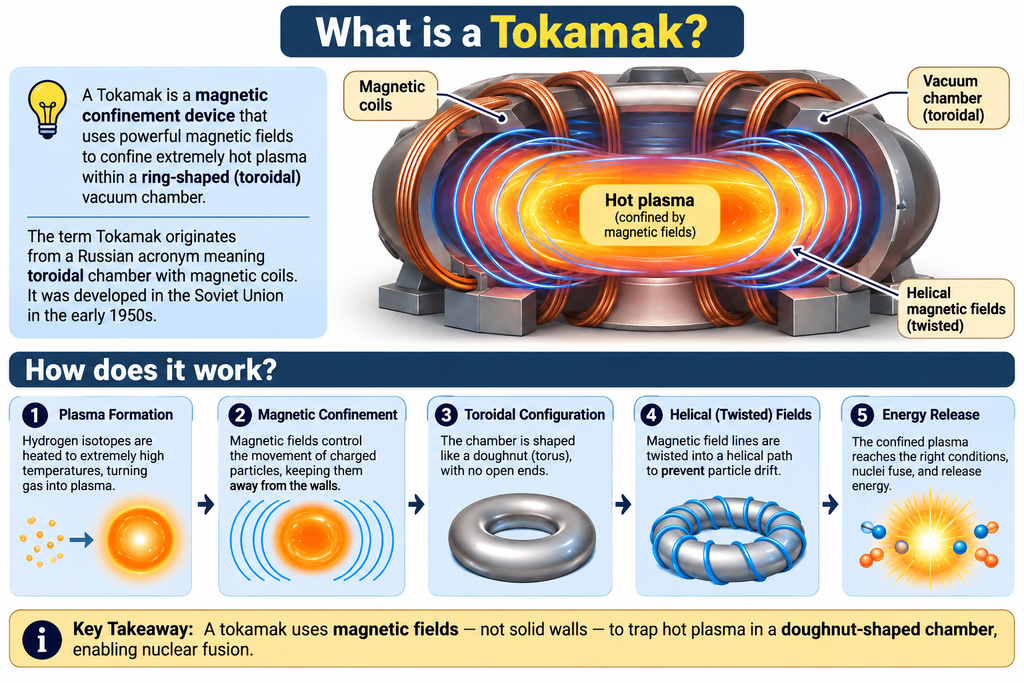
- A Tokamak is a magnetic confinement device that uses powerful magnetic fields to confine extremely hot plasma within a ring-shaped (toroidal) vacuum chamber.
- The term Tokamak originates from a Russian acronym meaning toroidal chamber with magnetic coils. It was developed in the Soviet Union during the early 1950s, primarily associated with physicists Igor Tamm and Andrei Sakharov.
How does it work?
- Plasma formation: Hydrogen isotopes are introduced into a vacuum chamber and heated to extremely high temperatures, converting the gas into plasma.
- Magnetic confinement: Since plasma consists of electrically charged particles, magnetic fields can control their movement and keep them away from the chamber walls.
- Toroidal configuration: The chamber is shaped like a doughnut (torus). This continuous geometry eliminates “open ends,” preventing the charged particles from escaping.
- Helical (twisted) Magnetic fields: Straight magnetic fields cause plasma particles to drift outwards. To stabilise them, the Tokamak twists the magnetic lines into a helical path.
- Energy release: The combined helical field confines the high-density plasma. Under suitable temperature, density and confinement-time conditions, nuclei collide and fuse, releasing energy.
Note: A tokamak does not physically contain plasma using solid walls. It uses magnetic fields to confine the charged particles without direct contact with the chamber.
How is Energy Generated and Converted into Electricity?
- Energy release: In deuterium-tritium fusion, approximately 17.6 MeV of energy is released per reaction.
- About 80% of the energy is carried by high-energy neutrons.
- The remaining 20% is carried by helium nuclei (alpha particles), which help maintain plasma temperature through further collisions.
- Heat generation: The high-energy neutrons escape the magnetic confinement and strike into the breeding blanket (typically containing lithium) lining the interior walls of the vacuum vessel, transferring their energy as heat.
- Electricity generation: In a future commercial fusion power plant, a coolant such as water or helium would carry this heat to a steam-generation system, which would drive turbines to produce electricity.
Why has Commercial Nuclear Fusion not yet become Possible?
Despite scientific progress, several challenges remain:
- Plasma instability: Extremely hot plasma can develop turbulence and instabilities, causing energy loss or sudden disruptions.
- Long-duration confinement: Maintaining stable plasma at the required temperature, density and confinement time for sustained operation remains difficult.
- Material limitations: High-energy neutrons can damage reactor walls and structural materials, reducing their operational life.
- Tritium availability: Tritium is scarce and radioactive. Commercial reactors will need efficient lithium-based breeding systems to generate sufficient fuel.
- Energy efficiency: Producing more fusion energy than the energy supplied to heat and confine plasma is not the same as generating net electricity. Magnets, cooling systems and other auxiliary equipment also consume substantial power.
- High costs: Advanced superconducting magnets, specialised materials, complex engineering and long experimental timelines make fusion research capital-intensive.
Major Global Developments in Fusion Research:
(i) International Thermonuclear Experimental Reactor (ITER)
- ITER is one of the world’s largest international scientific collaborations, located at Cadarache, France.
- It involves seven members: China, the European Union, India, Japan, South Korea, Russia and the United States, representing 35 countries.
- It aims to demonstrate the scientific and technological feasibility of magnetic-confinement fusion.
(ii) China’s EAST (Experimental Advanced Superconducting Tokamak)
- China’s EAST, popularly called the Artificial Sun, sustained high-confinement plasma operation for 1,066 seconds (approximately 17.8 minutes) in 2025 at temperatures of around 100 million °C.
- In 2026, researchers reported progress in overcoming the conventional empirical plasma-density limit, an important development for achieving higher-performance fusion conditions.
India’s Progress in Tokamak and Fusion Research
India has developed indigenous expertise in plasma physics and magnetic-confinement technologies through the Institute for Plasma Research (IPR), Gandhinagar, under the Department of Atomic Energy.
Major Indian initiatives:
- ADITYA / ADITYA-U: India’s first indigenously developed tokamak, ADITYA, began operations in 1989. It was subsequently upgraded to ADITYA-U to study advanced plasma configurations and control techniques.
- SST-1 (Steady-State Superconducting Tokamak-1): India’s first superconducting tokamak, designed to study long-duration plasma confinement using superconducting magnetic coils.
- PRAGYA: Bengaluru-based Pranos Fusion unveiled PRAGYA in 2026 as India’s first privately developed compact tokamak. It is an experimental testbed for plasma control and magnetic confinement, not a commercial fusion power reactor.
Alternatives to Tokamak-Based Fusion
Fusion research follows two broad approaches:
| Approach | How it works | Example |
| Magnetic confinement | Uses magnetic fields to confine hot plasma. | Tokamak, Stellarator |
| Inertial confinement | Uses powerful lasers or particle beams to compress a tiny fuel pellet, triggering fusion before it expands. | National Ignition Facility (NIF), USA |
Potential of Nuclear Fusion:
- Abundant fuel: Deuterium can be extracted from seawater, while tritium can potentially be bred using lithium.
- Low-carbon energy: Fusion does not produce direct carbon emissions during operation.
- Energy security: Successful commercialisation could diversify the global energy mix and reduce dependence on fossil fuels.
- Lower long-lived radioactive waste: Fusion generally produces less long-lived radioactive waste than conventional fission reactors, although neutron-activated reactor materials still require management.
- Operational safety: Fusion does not involve a self-sustaining chain reaction. If confinement conditions are disrupted, the reaction stops.
India’s participation in ITER, domestic tokamak research and emerging private-sector initiatives can help build the technological capabilities required for the future fusion-energy ecosystem.
Tell Google you want more of this.
Add Anantam IAS as a preferred sourceOne tap, and this site shows up more often in your own Top Stories, AI Overviews and AI Mode. Remove it any time.